Why You're Still Losing After Learning ICT
After 10+ years of trading, I have a pretty good idea which traders tend to struggle longest. It's not the beginners who don't know what a Fair Value Gap is. It's the traders who have watched every ICT video, built 12-condition checklists, and can narrate a chart like a textbook, but still can't pull the trigger on a clean setup without second-guessing themselves into a missed trade or a revenge entry.
The problem with ICT trading isn't a knowledge gap. For most traders reading this right now, it's the opposite.
Key Takeaway: Accumulating more ICT confluences past a certain threshold doesn't improve your win rate, it actively destroys your execution quality. In my experience, the traders who get funded tend to be the ones who deliberately simplified.
The Confluence Trap Nobody Talks About
Here's the myth that gets repeated in almost every ICT community, Discord, and YouTube comment section:
Myth: If your trades keep losing, you need more confluence. Add the HTF bias, confirm on the intermediate timeframe, wait for the MSS, look for the FVG inside the OB, check that it's in discount, confirm liquidity was taken, and then wait for a BOS on the entry timeframe. Then you can consider entering.
Reality: Every condition you add past three primary confluences introduces a new decision fork. And at each fork, your brain doesn't become more confident, it becomes more uncertain. You're not building a case for a trade anymore. You're building a case for not taking it.
What I Actually See: Traders with eight-confluence checklists miss their actual setups constantly. They catch the tail end of a move after everything confirms, then blame slippage or the spread. The trade wasn't late because of execution. It was late because the checklist required every piece of the puzzle to snap into place before granting permission to act.
This isn't a discipline problem. It's an architecture problem. You built a system that structurally prevents clean execution.
A Worked Example: What a Simplified Trade Looks Like
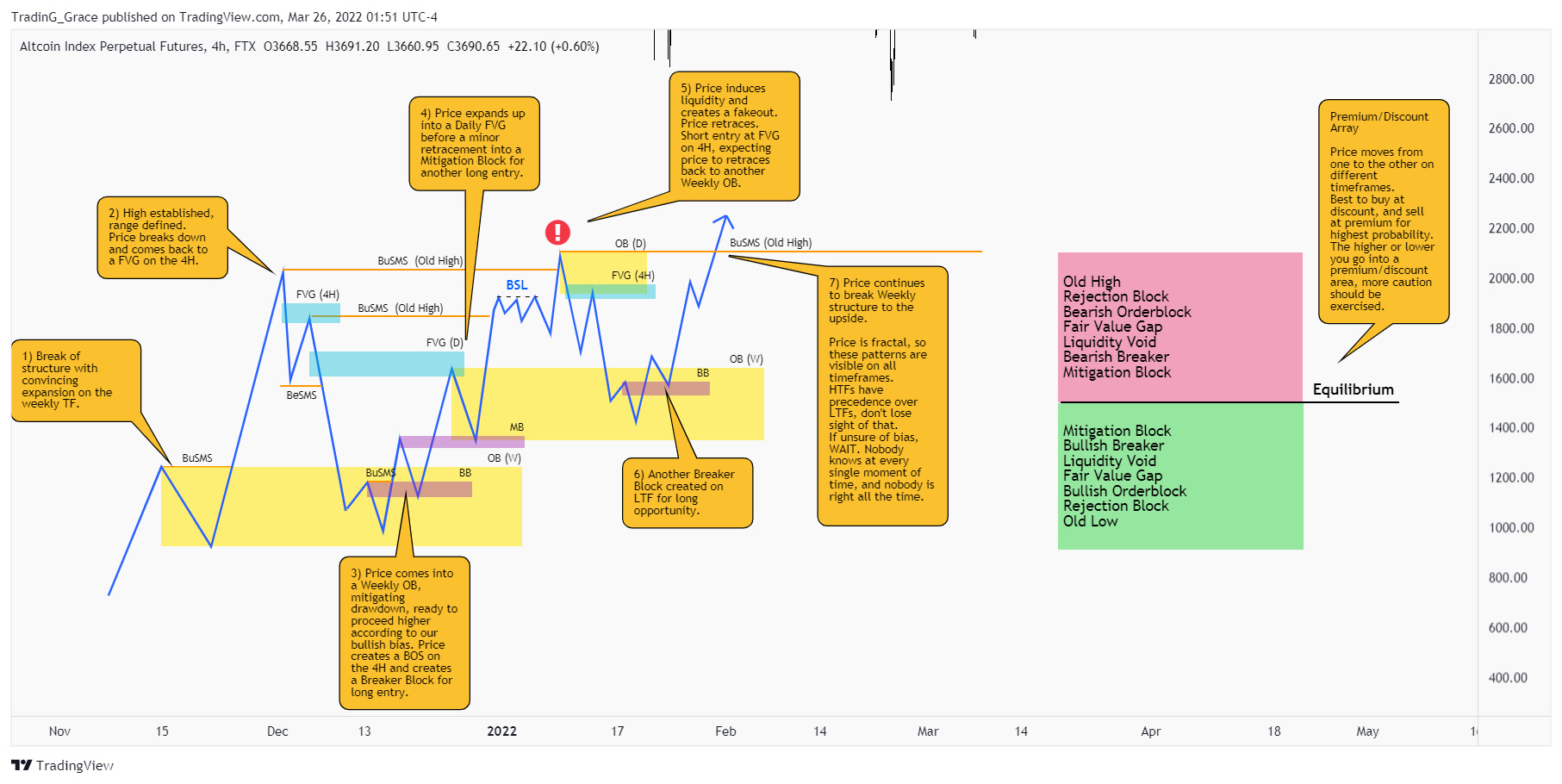
Here's the kind of setup I mean. Picture GBPUSD on the 15-minute chart heading into the London open. The prior Asian session has swept the previous day's low, a clean liquidity grab that's easy to identify. On the 1-hour, price is sitting in a discount array relative to the most recent swing range. That's confluence one: order flow pointing higher, liquidity taken to the downside.
As London opens with expansion, displacement candles push up through the Asian range and leave a 15-minute FVG. That's confluence two: a displacement FVG sitting in a discount condition relative to the move's origin.
Price retraces into the FVG shortly after the open. The entry is in the gap, with the stop below it, because a close back through the gap means the displacement has failed. The target is the Asia high, which lines up with a 1-hour order block acting as a draw. That's confluence three: a clear target with institutional logic.
Three confluences. That's it. No Fibonacci overlay on the FVG, no 5-minute BOS confirmation inside the gap, no checking whether Mercury is in retrograde. A sensible way to manage it is to take partials on the way to the target and move the stop to breakeven.
What you don't do is spend eight minutes asking whether the FVG is also inside an OB, whether the OB is inside a breaker, whether you should wait for a liquidity sweep of internal lows before entry, or whether the weekly is technically still in premium. All of that thinking can exist in your head. You choose not to use it.
That choice is the skill.
The Archetype I See Breaking Down Most Often
There's a very specific type of trader who ends up stuck in this loop. They've usually been studying ICT trading for somewhere between 12 and 24 months. They know the terminology cold, they can explain the difference between a mitigation block and a breaker block without hesitating. They post clean-looking annotated charts. Other traders in communities ask them questions.
But their live account looks like a disaster. Or they've blown two or three funded challenges at the final stages. And when you look at their trade review, the pattern is usually the same: they entered late because they waited for one more confirmation, or they didn't enter at all because the setup didn't have enough boxes ticked, and then they chased the move and got chopped.
Here's what's actually happening. When a trader with this much accumulated ICT knowledge looks at a chart, they don't see a setup, they see every possible valid interpretation simultaneously. That 15-minute candle? It's an FVG. But it's also inside a potential OB. But the OB might be a breaker if price trades through it. But is this MSS genuine or a fake-out before a deeper draw on liquidity below?
Every answer generates two more questions. The chart becomes an infinite recursion of valid ICT logic. And when everything is simultaneously valid, nothing is actionable.
I've written about this pattern from a slightly different angle in the context of Q2 2026 market structure shifts, and choppy conditions make overcomplicated frameworks even more expensive to hold onto.
The Three-Confluence Rule (And Why It Works)
I used to get this wrong. I believed a long pre-trade checklist meant fewer bad trades. What it actually meant was fewer trades, period, and then the urge to abandon the checklist entirely and trade impulsively just to feel like I was doing something.
Here's the framework I use now, and what I'd suggest testing:
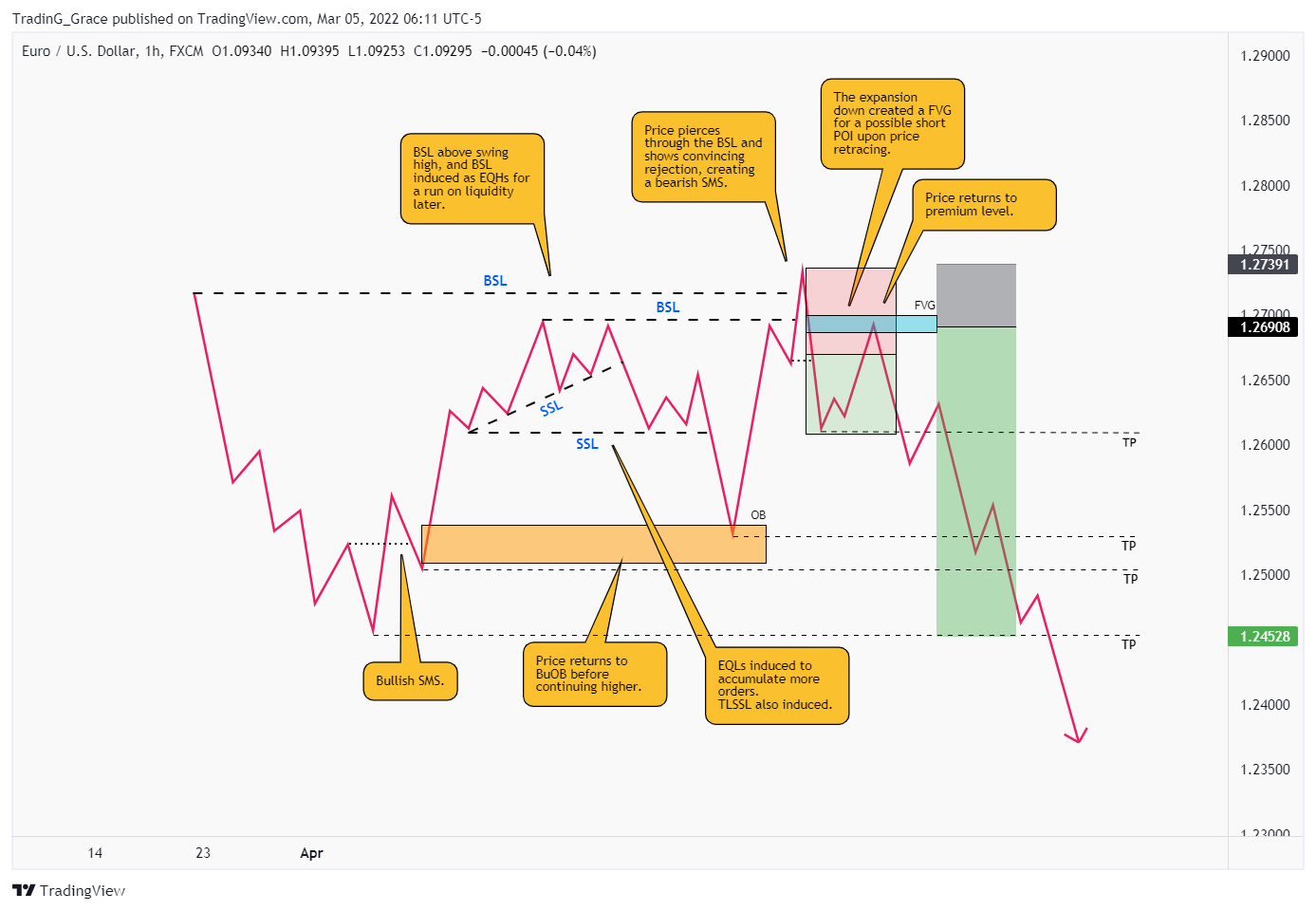
Step 1, Establish one HTF directional bias only. Not a bias AND a sub-bias AND a session bias. One answer: is price likely to go up or down from here based on the most recent significant liquidity event and structural move? One sentence, written down before you touch the lower timeframe.
Step 2, Identify one PD array at your entry timeframe. Not the best OB and the FVG inside it and the mitigation block above it. Pick the single most relevant array: an OB, FVG, or breaker. If you can't decide which is most relevant in under 30 seconds, the level isn't clean enough to trade.
Step 3, Confirm one trigger. An MSS on the entry timeframe, a displacement candle, or a clean rejection wick, your choice, but pick one and stick with it across all setups. No swapping triggers mid-session.
That's the full system. HTF bias + PD array + trigger. Three pieces. If all three align, execute. If they don't, you don't trade that setup. Not because you lacked information, but because the structure wasn't there.
For prop firm challenges specifically, this simplicity matters even more than in live accounts. The funded account environment punishes hesitation and revenge trading more severely than it punishes occasional wrong calls. If you want to understand why a lot of people fail challenges at the final stage, this article on funded account mistakes covers the behavioral patterns that kill accounts when traders are within reach of payout.
Also worth being honest about position sizing inside this framework. Three confluences give you enough conviction to size properly, not oversize, not undersize out of uncertainty. If you're not sure how to calibrate risk per trade to account size, the risk calculator on this site is a solid starting point before you run any new simplified setup live.
What Deliberate Unlearning Actually Looks Like
Saying "simplify your approach" is easy. Actually doing it requires specificity. Here's what I mean by deliberately unlearning a big chunk of what you know:
For one full week, remove every tool from your charts except horizontal levels and one indicator if you use one. No Fibonacci, no VWAP, no multi-timeframe overlay panels, no drawn OBs beyond the current session. Trade only clean FVGs that form after displacement, in the direction of your HTF bias, with a clearly defined stop below or above the gap.
You won't trade as many setups. That's the point. Scarcity of setups is the cure for over-analysis. When you only get two or three clean opportunities a session, you stop looking for reasons to override them, you execute them or you miss them, and both outcomes teach you something clean.
The FVG checklist I put together here is useful for trimming down your pre-trade process, but take what applies to your three-confluence framework and ignore the rest. It's a menu, not a mandate.
The Uncomfortable Truth About ICT Content
Most ICT content, including a lot of the freely available material, is incentivized to teach you more, not less. More concepts means more videos, more community engagement, more reasons to come back. Nobody gets views with a video titled "Here Are the Only Three Things You Actually Need."
But after ten-plus years of doing this, including passing an FTMO Challenge, the pattern I keep seeing is clear: complexity is a trap that feels like progress.
The traders who break through aren't the ones who finally understood the concept they were missing. They're the ones who finally stopped treating every new ICT concept as an upgrade and started treating their existing framework as something to defend against additions.
If you want to pressure-test your current approach and identify exactly where your confluence loop is stalling you, check out the coaching options here. The Lite and Pro tiers are designed specifically for traders who already know the material, the work isn't teaching concepts, it's cutting the ones that are costing you clean execution. Or if you want to have a conversation first about where you're at, a free discovery call is the lowest-friction starting point.
Stop adding. Start cutting. The trade you didn't take because you needed one more confirmation is already telling you everything you need to know.
Harvest Wright
ICT Trading Coach · 10+ Years Experience
Harvest specializes in ICT methodology and has helped traders pass prop firm challenges, develop consistent strategies, and build the psychology needed for long-term profitability.
Book a Free Discovery Call →Ready to Get Funded?
1-on-1 ICT coaching built around prop firm rules, from a trader who has passed an FTMO Challenge.
Book a Free Discovery CallFree ICT Funded-Trader Playbook
The setups, the pre-trade checklist, and the risk rules I use. Get it free.