
Why Knowing ICT Perfectly Still Keeps You Broke
Most ICT traders I come across aren't losing because they don't know enough. They're losing because they've spent eighteen months optimizing for the wrong skill entirely, and nobody has told them that yet.
Key Takeaway: The gap between knowing ICT and profiting from ICT is not a knowledge gap, it's a skill-type gap. Recognizing a setup in hindsight and responding to one in real time are two completely different cognitive skills that require completely different practice to build. More concepts won't fix this.
The Trader Who Can Pass Any ICT Quiz But Can't Pull the Trigger
Picture this archetype. Spent a year deep in ICT trading content. Can identify a breaker block from a mitigation block without blinking. Understands why a fair value gap forms at the displacement candle, can recite the difference between a premium and discount array, and has watched enough content to teach a beginner session about market structure shifts. Backtests look beautiful. Replay sessions feel clean.
Then the live market opens.
Something breaks. The hands freeze, or worse, they move too fast. The entry looks different when price is actually ticking. Suddenly there's a second-guessing loop: Is this OB still valid? Did that MSB really confirm? Maybe I should wait for the 15-minute close. Price moves without them, or they enter late, or they enter right but size up because they were 'certain,' and the trade stops out at the exact wick before the move.
It's a pattern I see a lot. And here's the brutal truth: adding more ICT concepts to that trader's toolkit is the exact wrong prescription.
If you've seen this pattern in your own trading, you're not broken. You've just been misdiagnosing the problem.
Myth / Reality / What I Actually See
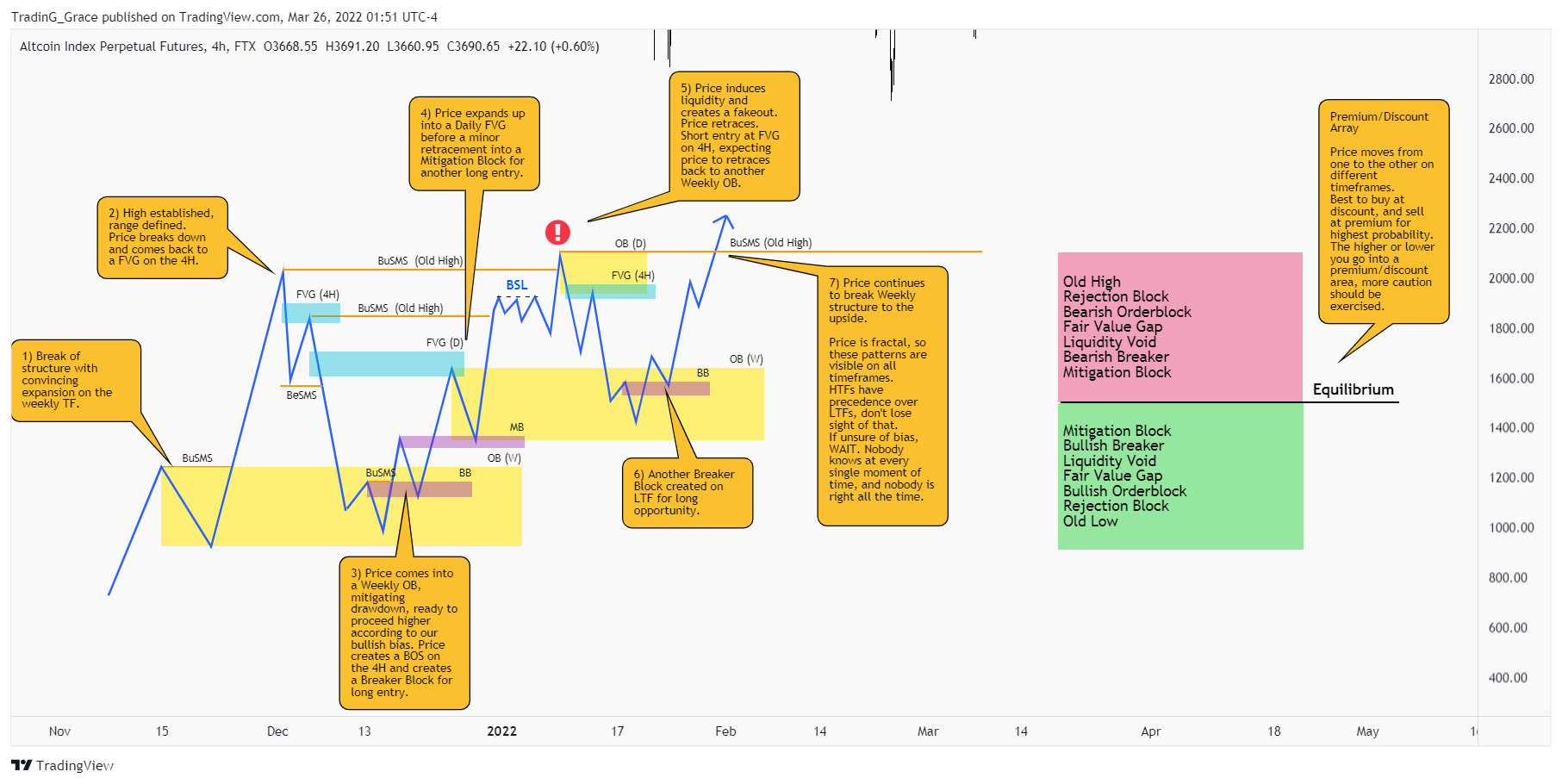
Myth: "I keep losing because I don't understand the concepts well enough yet. Once I figure out [PD arrays / AMD / Optimal Trade Entry / silver bullet], it'll click."
Reality: Conceptual understanding and executional competence are built in completely different parts of your brain, through completely different practice loops. One is declarative memory, facts you can recall. The other is procedural memory, patterns your nervous system executes under pressure without conscious thought. You can have the first in abundance and zero of the second.
What I Actually See: Traders who keep consuming content are unconsciously doing something very human, they're avoiding the discomfort of not knowing why they failed by replacing it with the comfort of learning something new. Every new ICT concept feels like forward progress. It isn't. Not if the foundation skill (execution under live conditions) hasn't been built yet.
I used to do this exact thing too. In my earlier years trading, I'd have a rough week and immediately go looking for the concept I must have missed, the confirmation I hadn't been using, the timeframe I hadn't been layering in. I was treating every losing trade as a knowledge failure when most of them were execution failures. Took me an embarrassingly long time to separate those two things clearly.
A Worked Example, and What It Teaches
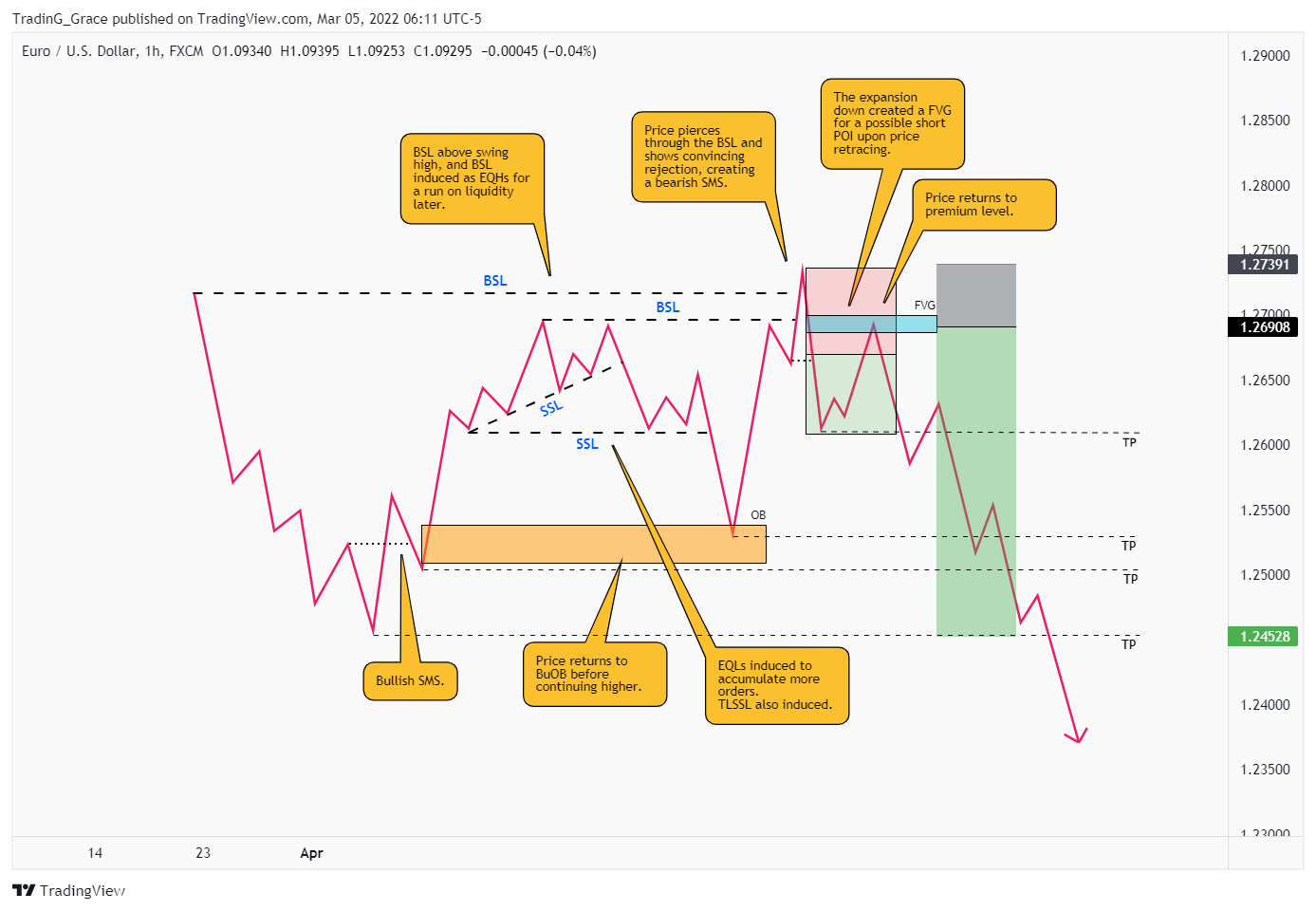
Here's the kind of setup I mean. Picture GBPUSD at the London open, on the 15-minute chart, after a clear liquidity sweep on the 4H. Price takes out equal highs from the prior Asian session and prints a sharp displacement candle back down, leaving a clean FVG.
Price retraces into that FVG during the London session. The entry is inside the gap. The stop goes above the FVG high and the OB origin, because if price climbs back through there the displacement has failed. The first target is the 4H SIBI below, where the next obvious draw on liquidity sits. Take some off at the first target and let the rest trail.
Here's what's worth noticing: nothing about that trade needs an advanced concept. The FVG is a FVG. The liquidity sweep is a sweep. The MSB confirms direction. The playbook is four steps.
Now here's the question I'd ask any struggling ICT trader reading this: could you identify that setup in replay? Almost certainly yes. Could you execute it in real time, sized correctly, entering without waiting for 'one more confirmation,' holding through a pullback without closing early? That's where the answer gets complicated for most people. And that gap is not closed by watching more ICT content.
The Recognition Trap (And Why It Feels Like Progress)
When you practice ICT trading in replay or backtesting, you are overwhelmingly practicing recognition. You're training your eye to find the thing after the fact, when there's no money on the line, no live spread moving, no emotional charge in the room.
Recognition is a pattern-matching skill. It feels exactly like competence because, in a replay session, it produces correct answers.
Execution is entirely different. It requires your nervous system to act under uncertainty, with incomplete information, when money is at stake and your ego is invested. That runs on procedural memory, and procedural memory is only built through live repetition under conditions that actually stress you.
Here's the uncomfortable part: most traders have a huge number of reps at recognition and almost none at actual live execution, especially at meaningful size. So when they sit down at a real chart, they've built one skill to an advanced level and left the other one at nearly zero.
This is why the trader who aces a replay session completely falls apart in live markets. The skill they trained doesn't transfer to the environment they're trading in.
For more on how market structure nuances in 2026 have been exposing this gap even harder, this breakdown on Q2 market structure shifts is worth reading.
The Exact Practice Regimen That Actually Fixes This
So what does execution practice actually look like? Here's the framework I use and would recommend:
Step 1, Reduce your model to 3 conditions, not 10. Write down the minimum criteria for a valid trade. For ICT trading, this might be: (1) liquidity swept on the higher timeframe, (2) displacement candle leaving an FVG or OB, (3) price retracing into that level during a kill zone. That's it. Three conditions. If all three are met, you execute. You do not wait for a fourth confirmation.
Step 2, Go live at minimal size immediately. Not demo. Not replay. Live markets, minimum position size, even if that's micro lots. The emotional charge of real money is not optional. It's the actual training stimulus. Without it, you're practicing recognition again. Use a risk calculator to set your micro-lot size so that even a full loss feels negligible, small enough that you won't hesitate, real enough that you care.
Step 3, Grade executions, not outcomes. After every trade, ask one question: Did I follow the 3 conditions exactly? If yes, that's a successful execution regardless of profit or loss. If no, that's a failed execution regardless of profit. This separates process from outcome and stops the brain from drawing false lessons from lucky wins or unlucky stops.
Step 4, Increase size only after 20 consecutive clean executions. Not 20 winning trades. Twenty trades where the entry was taken at the right time, with the right size, and the stop was set before entry. When that streak exists at micro size, step up one level. Repeat.
Step 5, Journal the moment of hesitation specifically. Not 'I hesitated.' Write: 'Price touched the FVG low at 8:34, I did not enter because I was waiting to see if the candle would close. Price moved 28 pips without me.' That specificity is what your brain can actually learn from. Vague journaling produces vague improvement.
For a companion checklist specifically around FVG entries that supports this process, the 9 pre-trade FVG confirmations checklist is a useful reference to pair with this framework.
Why More ICT Concepts Make This Worse, Not Better
Every new concept you add to your model increases the number of conditions your brain has to evaluate in real time before acting. More conditions mean more hesitation windows. More hesitation means either missing the entry entirely or entering late into a worse position.
A lot of traders who blow funded accounts have a model with too much sophistication for them to execute cleanly under pressure. The common funded account failure patterns often trace back to this, an overcomplicated entry checklist that creates paralysis at the exact moment decisiveness is required.
Elite execution in ICT trading looks boring from the outside. It's the same three-step model, executed cleanly, repeatedly, across different sessions and pairs. Not because that trader doesn't know the advanced concepts, but because they've learned that adding them doesn't improve results, it complicates execution.
Analysis paralysis is a well-known trap in trading. In my experience, more tools, more indicators and more confirmations, past a certain point, make performance worse. ICT trading isn't immune to this. If anything, the richness of the ICT model makes this trap especially easy to fall into.
The Honest Reckoning
If you've been studying ICT trading for more than six months and your live results don't reflect your replay performance, the answer is not another month of content consumption. The answer is a deliberate shift from recognition practice to execution practice, with a simplified model, real money at minimal size, and process-graded journaling.
Adding your fifteenth concept to a model you can't execute cleanly is like adding a spoiler to a car with a broken engine. The fundamentals have to work first.
If you want an honest assessment of where your specific execution is breaking down, not a generic checklist, but an actual look at your trade log, take a look at the coaching options here or book a free discovery call to start with a conversation about what your trading actually needs right now versus what you think it needs.
The gap is closable. But you have to stop filling it with more knowledge first.
Harvest Wright
ICT Trading Coach · 10+ Years Experience
Harvest specializes in ICT methodology and has helped traders pass prop firm challenges, develop consistent strategies, and build the psychology needed for long-term profitability.
Book a Free Discovery Call →Ready to Get Funded?
Our students pass prop firm challenges in under 60 days with personalized ICT coaching.
Book a Free Discovery CallFree ICT Funded-Trader Playbook
The setups, the pre-trade checklist, and the risk rules I use. Get it free.