
ICT Fair Value Gap Checklist: 9 Confirmations
ICT Fair Value Gap Trading Checklist: 9 Pre-Trade Confirmations That Separate Profitable FVG Entries From Losers
I'll be honest with you. When I first started trading ICT concepts, I treated every Fair Value Gap (FVG) like a guaranteed money printer.
Every three-candle imbalance looked like an opportunity. Every gap screamed "trade me now!" And plenty of them turned into losing trades.
That's when I learned the hard truth: not all Fair Value Gaps are created equal. The difference between profitable traders and those who burn through funded accounts isn't just spotting FVGs, it's knowing which ones to ignore.
After 10+ years in the markets and passing an FTMO Challenge, I've developed this ICT fair value gap trading checklist to keep me out of the weak setups. Today, I'm sharing all nine confirmations I use before risking a single dollar on any FVG setup.
Key Takeaway: Not every Fair Value Gap deserves a trade, use a structured pre-trade checklist of confirmations to filter high-probability FVG entries from random imbalances that will drain your account.
What Makes a Fair Value Gap Worth Trading?
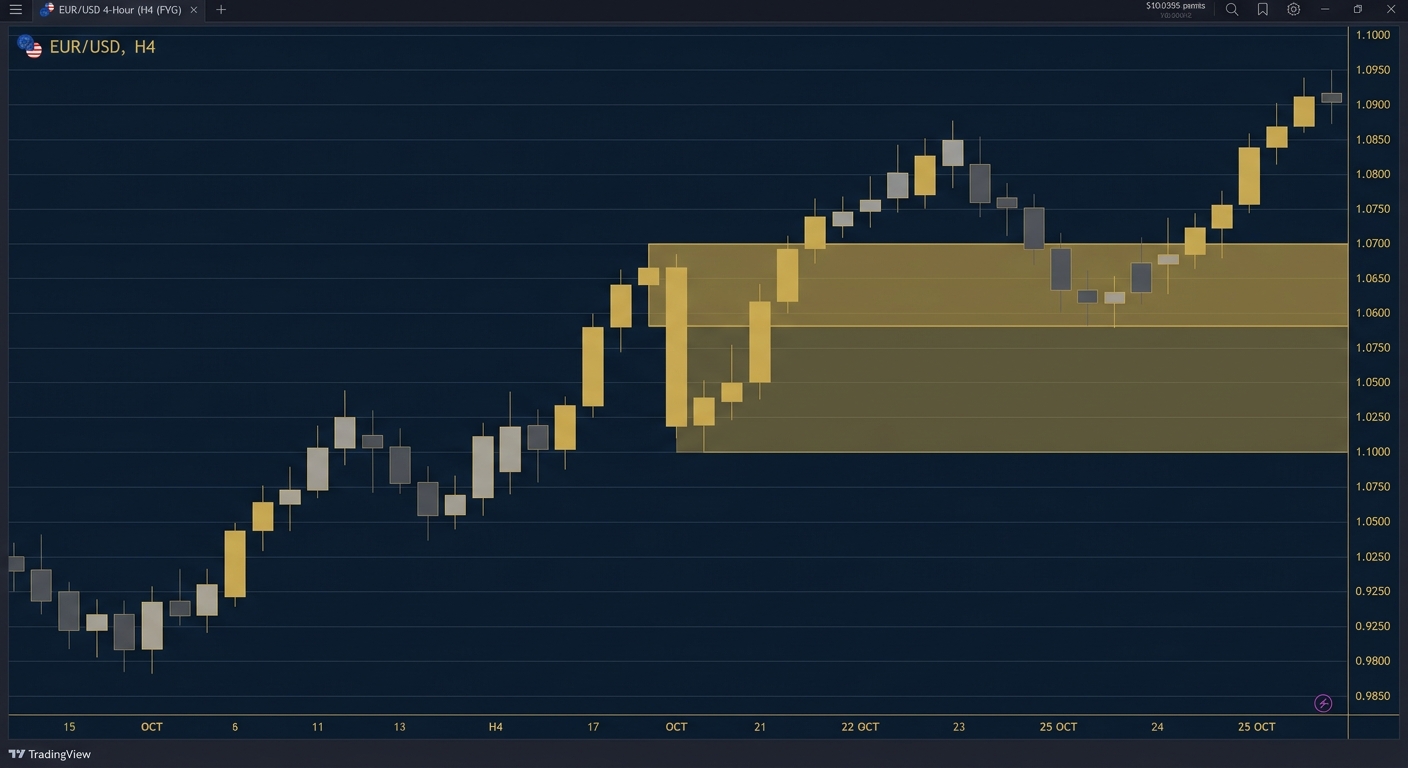
Before diving into the checklist, let's quickly define what we're working with. A Fair Value Gap occurs when there's an imbalance between buying and selling pressure, creating a "gap" in a three-candle sequence where the wick of the first candle doesn't overlap with the wick of the third.
But here's what most traders miss: FVGs aren't signals, they're simply areas of inefficiency. Price often comes back to them, but timing and context determine whether that move generates profit or pain.
In my experience, plenty of gaps get revisited without giving a tradeable reaction. That's where systematic validation comes in.
The 9-Point ICT Fair Value Gap Trading Checklist
✅ 1. Market Structure Alignment
What to check: Is the FVG aligned with the current market structure bias?
If you're looking at a bullish FVG but the daily structure shows clear bearish market structure with lower highs and lower lows, you're swimming against the current. I learned this lesson the hard way when I took a long position on a beautiful 15-minute FVG, only to watch higher timeframe selling pressure steamroll my position.
Action step: Confirm your FVG direction matches at least two higher timeframes before proceeding.
✅ 2. Premium/Discount Validation
What to check: Is price currently in premium or discount relative to the daily/weekly range?
Taking bullish FVG entries when price is already at 80% of the daily range rarely works. You're essentially buying at retail prices hoping for more retail buyers above you. Smart money operates differently. Understanding how to trade ICT premium/discount arrays in quiet, compressed markets can sharpen how you apply this confirmation in live market conditions.
Action step: Use a 50% retracement of the current daily/weekly range to determine if you're buying discount or selling premium.
✅ 3. Liquidity Proximity Check
What to check: Where is the nearest liquidity pool in relation to your FVG?
Every profitable trade needs a target, and in ICT methodology, those targets are liquidity pools, equal highs, equal lows, or obvious stop-loss clusters. If your FVG is pointing toward empty space with no clear liquidity target within reasonable distance, skip it. If you've ever wondered whether a move into your FVG is a genuine smart money entry or a trap, the distinction covered in ICT liquidity grab vs stop hunt: 8 questions every trader asks is essential reading.
Action step: Identify at least 1:2 risk-reward potential to a clear liquidity pool before considering the trade.
✅ 4. Killzone Timing Alignment
What to check: Are you trading during an active ICT killzone?
The London Open (2:00-5:00 AM EST) and New York Open (8:30-11:00 AM EST) killzones provide the algorithmic activity needed to drive FVG reactions. Trading FVGs during dead hours often results in choppy, unpredictable price action.
Action step: Prioritize FVG entries that align with major killzone openings, especially when combined with high-impact news events.
✅ 5. Order Block Confirmation
What to check: Is there a supporting order block (OB) near your FVG?
Order blocks represent areas where institutional orders were placed. When an FVG forms near a respected order block, it often signals that smart money is still interested in that price level. This confluence significantly increases the probability of a successful reaction.
Action step: Look for FVGs that form within 10-20 pips of previously respected order blocks on your trading timeframe.
✅ 6. Volume Profile Analysis
What to check: What does volume tell you about this price level?
High-volume nodes often act as magnets for price, while low-volume areas (Volume Profile gaps) can accelerate price movement through your FVG. Understanding volume context helps predict whether your FVG will get a quick reaction or a slow grind.
Action step: Use TradingView's Volume Profile tool to identify if your FVG sits in a high-volume area (likely bounce) or low-volume area (likely continuation).
✅ 7. Multi-Timeframe FVG Stack
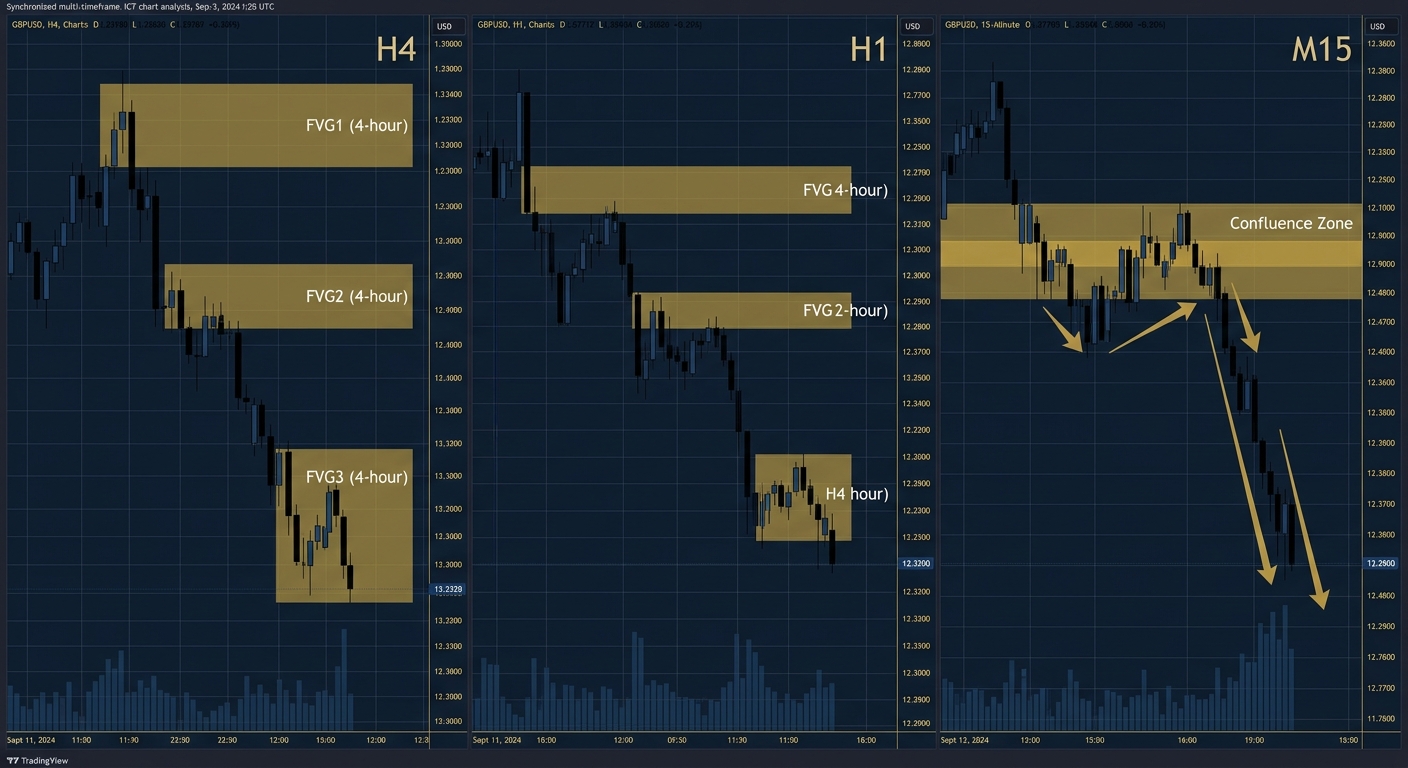
What to check: Are there FVGs on multiple timeframes pointing in the same direction?
When I see a 4-hour FVG aligned with a 1-hour FVG and a 15-minute FVG all pointing in the same direction, that's when I get excited. Multiple timeframe confirmation means you're trading with the bigger order flow instead of against it.
Action step: Scan at least three timeframes (your trading TF and two higher) for FVG alignment before entering.
✅ 8. News Event Proximity
What to check: Are there high-impact news events within 4 hours of your planned entry?
I've seen perfect FVG setups get obliterated by unexpected NFP or CPI releases. While some traders thrive on news-driven volatility, FVG strategies work best in algorithmic market conditions, not during fundamental volatility spikes.
Action step: Check Forex Factory's economic calendar and avoid FVG entries 2 hours before and after red-folder news events.
✅ 9. Risk Management Alignment
What to check: Does this FVG fit within your daily/weekly risk parameters?
This might seem obvious, but it's where most traders fail. A perfect FVG setup means nothing if taking the trade violates your risk management rules or pushes you over your daily loss limit.
Action step: Calculate your position size before analyzing the setup. If the required stop loss exceeds your risk tolerance, walk away regardless of how "perfect" the setup looks.
A Worked Example
Picture a bullish FVG on the EURUSD 15-minute chart during the London session. Here's how the checklist would run:
Market Structure: ✅ Daily showing bullish structure
Premium/Discount: ✅ Price in the lower part of the daily range (discount)
Liquidity: ✅ Equal highs sitting above as a clear target
Killzone: ✅ London Open active
Order Block: ✅ Respected OB just below the FVG
Volume: ✅ Low volume area suggesting continuation
Multi-TF: ❌ 4-hour showing a bearish FVG above, between entry and target
News: ✅ No high-impact events for several hours
Risk: ✅ Stop below the order block, target at the equal highs, better than 1:2
The multi-timeframe conflict is the problem. That bearish 4-hour FVG sits right in the path to the target and could reject price exactly where you need continuation. That's a skip.
This is the kind of trade that can look like a winner for a while, move in your favor, then stall at the higher timeframe gap and come back through your entry. The checklist is there to catch that before you're in it.
Common FVG Trading Mistakes This Checklist Prevents
Trading every gap: Without systematic validation, you'll overtrade and kill your win rate.
Ignoring higher timeframes: 15-minute FVGs mean nothing if the 4-hour structure is against you.
Poor timing: FVGs during inactive market hours rarely provide clean reactions.
No clear targets: Trading toward empty space is gambling, not trading.
How I Use This Checklist in Live Markets
I keep this checklist as a saved template in my trading journal. When I spot a potential FVG, I literally go through each point and mark it as confirmed (✅) or failed (❌). I need at least 7 out of 9 confirmations to consider a trade, and certain confirmations (market structure, liquidity, risk management) are non-negotiable.
The biggest benefit is that it keeps me out of trades that look perfect on the surface but have hidden flaws.
What Separates Consistently Profitable Traders
One trait I keep coming back to, in my own trading and in my coaching plans, is being better at saying "no" to trades than saying "yes."
The market will always provide new opportunities. Your job isn't to catch every move, it's to catch the highest-probability moves that align with your systematic approach.
This ICT fair value gap trading checklist gives you the framework to make those distinctions consistently. But remember, no checklist replaces proper education, practice, and emotional discipline.
Your Next Steps
Start implementing this checklist on your next 20 FVG setups. Track your results in a trading journal, noting which confirmations had the biggest impact on your success rate.
If you're struggling with ICT concepts or want personalized guidance on implementing systematic trading approaches, I'd love to help. You can book a free discovery call to discuss which of my coaching programs might accelerate your progress.
Remember, trading is a skill that develops over time. Be patient with yourself, stay systematic, and trust the process. The market rewards consistency, not hero trades.
For more insights on navigating current market conditions with ICT strategies, check out my breakdown of NFP week liquidity and ICT entry opportunities.
The difference between profitable traders and everyone else isn't talent, it's process. This checklist is your process for Fair Value Gap trading. Use it religiously, and watch your results improve.
Harvest Wright
ICT Trading Coach · 10+ Years Experience
Harvest specializes in ICT methodology and has helped traders pass prop firm challenges, develop consistent strategies, and build the psychology needed for long-term profitability.
Book a Free Discovery Call →Take Your Trading to the Next Level
Get personalized 1-on-1 ICT coaching with Harvest Wright. Free discovery call, no commitment.
Book a Free Discovery CallFree ICT Funded-Trader Playbook
The setups, the pre-trade checklist, and the risk rules I use. Get it free.