
ICT Premium/Discount Arrays in Quiet Markets
Every market goes through stretches where volatility compresses and ranges get tight. Traders often call the quiet part of the year the summer doldrums, but it can happen any time. If you're an ICT trader, these phases change how premium and discount arrays play out.
In 10+ years of trading, with ICT concepts for a good part of that, I've learned that compressed markets separate the prepared from the panicked. If you can read premium and discount in tight conditions, you can keep trading well. If you can't, you tend to bleed through fakeouts.
Let me show you how I adapt an ICT premium discount trading strategy when volatility compresses.
Key Takeaway: When volatility compresses, premium and discount zones get smaller and fakeouts get more common, so have your draw-on-liquidity targets mapped and your entry criteria tightened before you take a trade.
What Changes When Volatility Compresses?
In a compressed market, price still moves between premium and discount, just over shorter distances and with more fakeouts.
That tends to create an environment where:
- Premium and discount zones are smaller, so your levels need to be more precise
- False breakouts become more common, so chasing breaks gets punished
- Killzone timing matters more, since the quiet hours offer very little
The key idea? Price action gets tighter and less explosive. Big range expansion days are rarer, so you work with smaller, more methodical moves between premium and discount.
Understanding ICT Premium and Discount Arrays in Compressed Markets
For those new to ICT concepts, let me quickly explain what we're working with. Premium refers to areas where price is expensive relative to recent structure, typically above equilibrium or key reference points. Discount represents areas where price is cheap, usually below equilibrium.
In normal market conditions, these zones are relatively easy to spot. When volatility compresses, they become more nuanced.
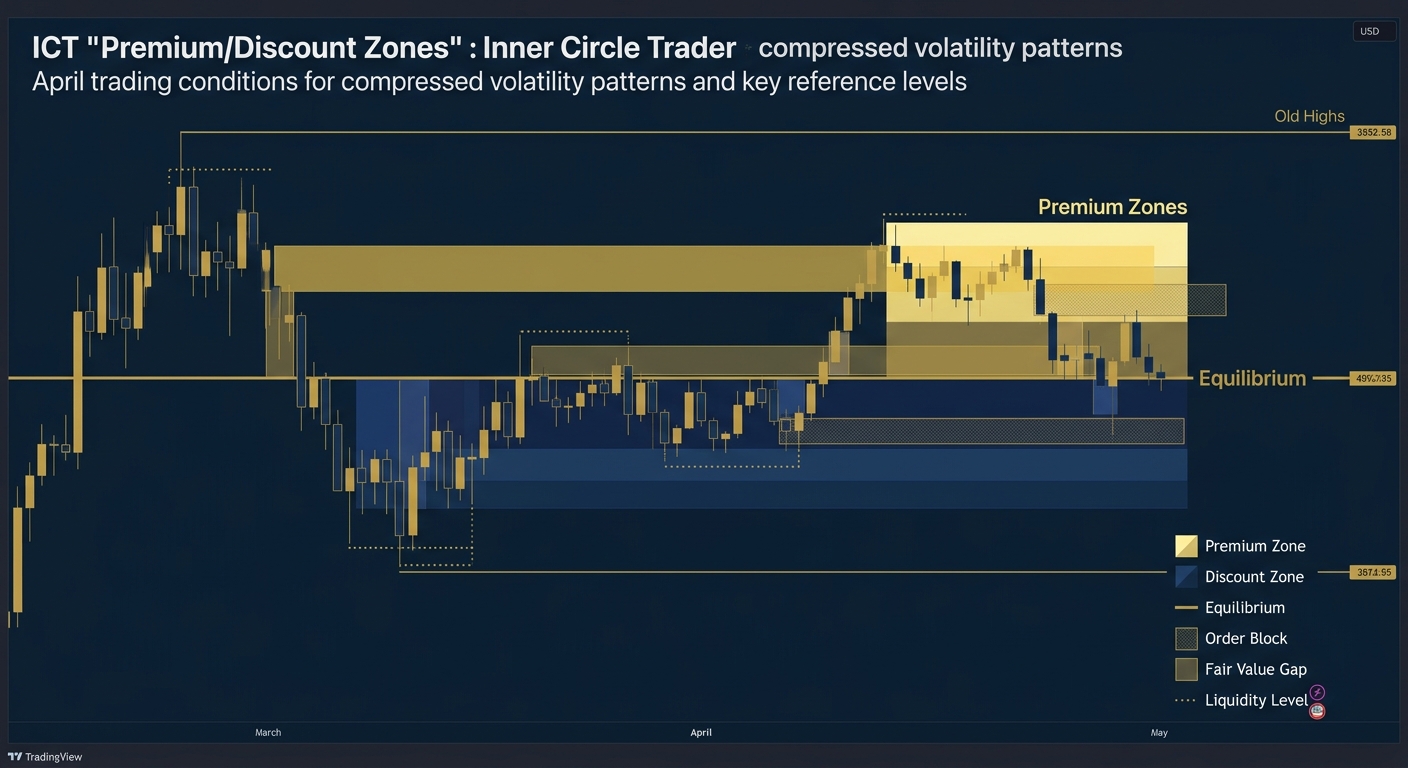
Here's what changes during compressed volatility:
Premium Zones Become Micro-Environments
Instead of broad premium areas, you're working with much smaller zones inside a tight range. Order blocks (areas where large institutional orders were placed) inside those premium zones are where I focus.
Fair Value Gaps (FVGs), the three-candle imbalances where the wicks of the first and third candle don't overlap, tend to get revisited quickly when price is going nowhere fast. If you want a deeper breakdown of exactly when to act on these setups, the ICT Fair Value Gap checklist of 9 pre-trade confirmations is worth reviewing before you start mapping your zones.
Discount Arrays Require Tighter Risk Management
The traditional "buy the dip" mentality needs refinement. Liquidity pools (areas where stop losses cluster, often below/above key levels) get targeted more efficiently, meaning your entries need to be more precise.
Your stop still needs to sit beyond the structure that invalidates the idea. If the range is too small to fit a sensible stop and a worthwhile target, that's a sign to skip the trade.
The Killzone Strategy for Premium/Discount Trading
Here's where the rubber meets the road. During compressed volatility, not all killzones (optimal trading time periods based on institutional activity) are created equal.
London Killzone (2:00-5:00 AM EST): The Setup Phase
In a compressed market, I treat London mainly as a market structure session. I use it to:
- Identify the day's premium and discount boundaries
- Mark key liquidity levels (previous day's highs/lows, Asian session ranges)
- Note any overnight FVGs that need filling
Pro tip: Don't chase London moves in these conditions. Instead, focus on mapping the battlefield for New York.
New York Killzone (8:30-11:00 AM EST): The Execution Phase
The New York open, with its data releases and added volume, is usually where a quiet market finds enough movement to trade premium/discount arrays.
Here's my systematic approach:
- Wait for price to reach identified premium or discount
- Look for confluence with order blocks or FVGs
- Confirm with liquidity grab (quick move beyond a key level to trigger stops)
- Enter on the return to premium/discount with tight risk
Here's what this looks like:
A Worked Example (EURUSD): Picture price opening in discount relative to the previous day's range. During London, it slowly works higher, filling a couple of small FVGs along the way. At the New York open, price spikes a few pips above the Asian high (the liquidity grab), then snaps back below it.
The plan: Short on the retrace back into the Asian high area, which is now premium of the day's range. The stop goes just above the spike high, because if price takes that out, the grab failed. The target is the discount side of the range, where the sell-side liquidity rests, at roughly twice the risk.
That's the kind of tight, defined setup a compressed market can still offer.
Common Mistakes That Kill Your Premium/Discount Strategy
I see the same errors repeatedly, especially from traders trying to adapt to compressed volatility conditions. These mistakes become even more costly when you're working with tighter ranges.
Mistake #1: Using the same position sizes as high-volatility periods
Size from your stop distance and a fixed percentage risk. If the setup needs a smaller stop, the position size changes, and your dollar risk stays the same.
Mistake #2: Ignoring the power of multiple timeframe confluence
During compressed volatility, the alignment between 15-minute, 5-minute, and 1-minute premium/discount levels becomes crucial. If they're not aligned, skip the trade.
Mistake #3: Fighting the change in conditions
Trying to force the same aggressive approach that worked in a trending, volatile market will drain your account. As I discuss in my article about fatal mistakes that kill funded account challenges, adapting to market conditions is non-negotiable.
How to Identify High-Probability Premium/Discount Setups in Tight Ranges
When ranges are tight, every setup needs to count. Here's my framework for identifying the highest-probability premium/discount trades:
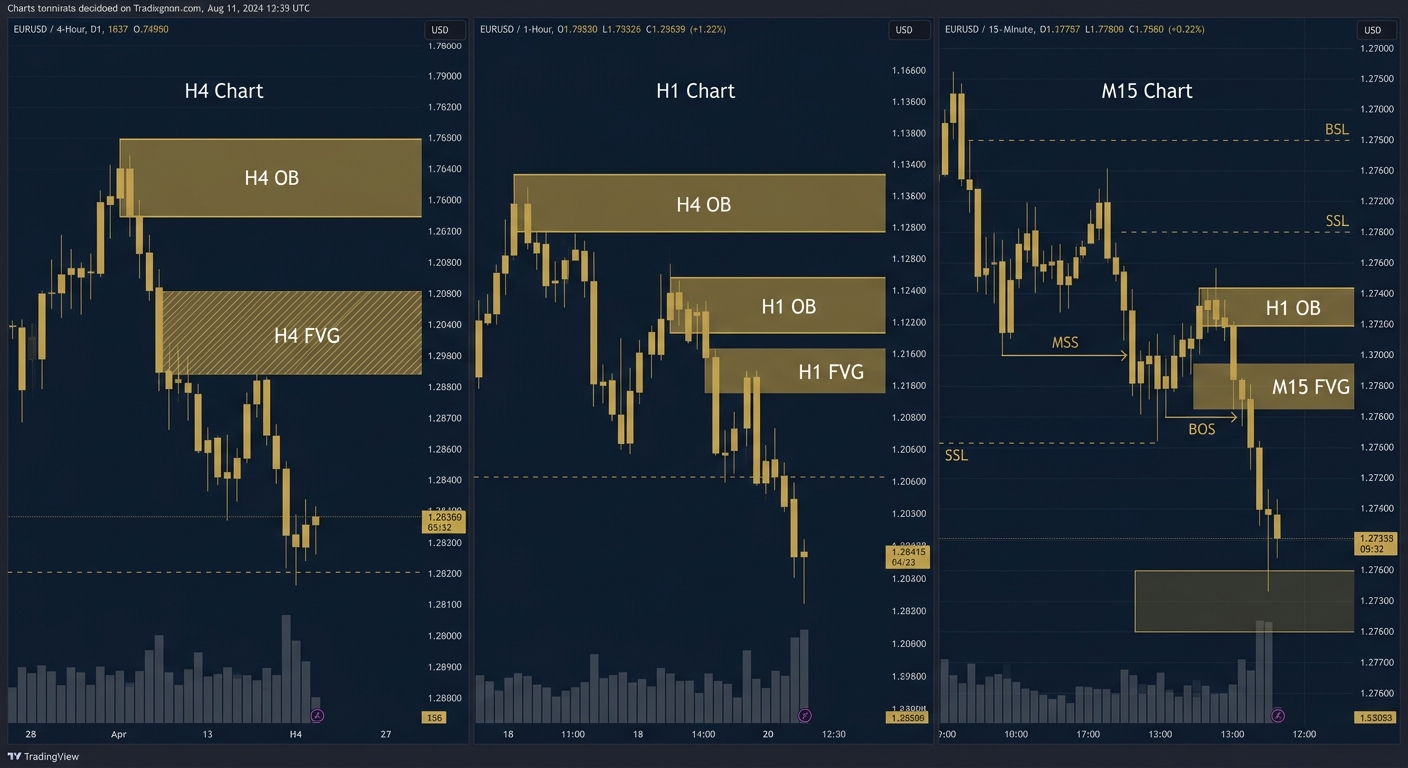
The Three-Layer Confirmation System
Layer 1: Structural Premium/Discount
- Where is price relative to the daily/4-hour equilibrium?
- Are we in premium or discount on the higher timeframe structure?
Layer 2: Tactical Premium/Discount
- What's the 15-minute and 5-minute market structure telling us?
- Are there clear order blocks or FVGs providing confluence?
Layer 3: Execution Premium/Discount
- Can I identify precise entry/exit levels on the 1-minute chart?
- Is there a clear liquidity grab setup developing?
All three layers need to align before I pull the trigger. This might seem overly cautious, but being this selective is what keeps you out of the chop when volatility compresses. Understanding whether a move is a genuine liquidity grab or just a stop hunt is a critical part of reading that third layer correctly.
Preparing for Quieter Stretches
Quiet periods, like the summer doldrums many traders talk about, can compress ranges even further. Some of your usual patterns may stop working as cleanly.
That makes quiet stretches a good time for:
- Protecting your account instead of forcing trades
- Refining your precision with tighter setups
- Developing patience for the quality setups that show up less often
Adapting your ICT premium discount trading strategy to the conditions in front of you is what keeps you in the game until volatility comes back.
What This Means for Your Trading Plan
Weekly Targets Need Adjustment
Expect smaller weekly moves when ranges are tight. Set your expectations from the ranges the market is actually printing, not from a busy month.
Risk Management Becomes Everything
One bad trade can wipe out a week's worth of gains when ranges are compressed. Dropping your risk per trade a little while conditions are tight is a reasonable option, and being more selective with entries helps too.
Skill Development Accelerates
The precision required during compressed volatility will make you a better trader. Think of it as trading boot camp: if you can work premium/discount arrays in tight conditions, you'll be well prepared when normal volatility returns.
Your Next Steps for Mastering Compressed Markets
If you're serious about mastering premium/discount arrays in compressed markets, you have options:
- Start with our educational content: Browse through our comprehensive trading insights to build your foundation
- Get structured guidance: Our coaching plans give you 1-on-1 sessions to work through your own charts
- Take the personalized approach: Book a free discovery call to discuss your specific challenges with compressed volatility trading
Remember, premium and discount arrays don't disappear during compressed volatility, they just require a more refined eye to spot and the precision to execute. The profits are still there for those who know where to look.
Harvest Wright
ICT Trading Coach · 10+ Years Experience
Harvest specializes in ICT methodology and has helped traders pass prop firm challenges, develop consistent strategies, and build the psychology needed for long-term profitability.
Book a Free Discovery Call →Take Your Trading to the Next Level
Get personalized 1-on-1 ICT coaching with Harvest Wright. Free discovery call, no commitment.
Book a Free Discovery CallFree ICT Funded-Trader Playbook
The setups, the pre-trade checklist, and the risk rules I use. Get it free.