
The Sunday Bias Trap: Why I Stopped Setting Weekly Bias
Picture a week where your ICT weekly bias calls for a bullish GBPUSD run. You do everything right on Sunday: weekly chart, monthly range, previous week's high and low, PD arrays lining up. Textbook. By Wednesday, price has already swept the buy-side, reversed hard through a daily FVG you flagged as 'resistance to be respected later,' and is in full bearish displacement. You sit there watching it happen, not trading it, because it doesn't match your bias.
That isn't a loss of money. It's a loss of opportunity. And it comes from a classic mistake I made for years and now see everywhere in ICT trading circles: treating the Sunday analysis as a forecast to defend instead of a hypothesis to test.
Key Takeaway: The problem with setting an ICT weekly bias isn't the analysis, it's the psychological ownership that develops around it. Renaming it a 'hypothesis' isn't semantics; it's the cognitive shift that lets you stay objective when price disagrees with you mid-week.
The Word 'Bias' Is the Problem
This is something I've never seen addressed in any YouTube ICT summary, and I've watched a lot of them. Everyone teaches how to set the weekly bias correctly, draw your HTF range, identify the opposing liquidity pools, look for the PD array that price is likely to seek. The mechanical checklist is everywhere.
What nobody talks about is what happens to your brain once you've committed to that bias.
The word 'bias' implies a directional conviction. And once your brain assigns conviction to a position, even a theoretical one, it triggers loss aversion in reverse. It's not that you fear losing money. You fear being wrong. For a lot of traders, that fear is even stronger. It's basically confirmation bias: once we label something as our 'view,' contradicting information gets filtered instead of processed.
In trading, that filtering is catastrophic. Because the market doesn't care what you wrote in your Sunday journal.
I used to get this wrong for years. I'd set a bullish weekly bias, see bearish price action Monday or Tuesday, and rationalise it as 'inducement' or 'the stop hunt before the real move.' Sometimes that was correct. A lot of the time, I was just protecting the analysis I'd spent 45 minutes building on Sunday night.
A Worked Example
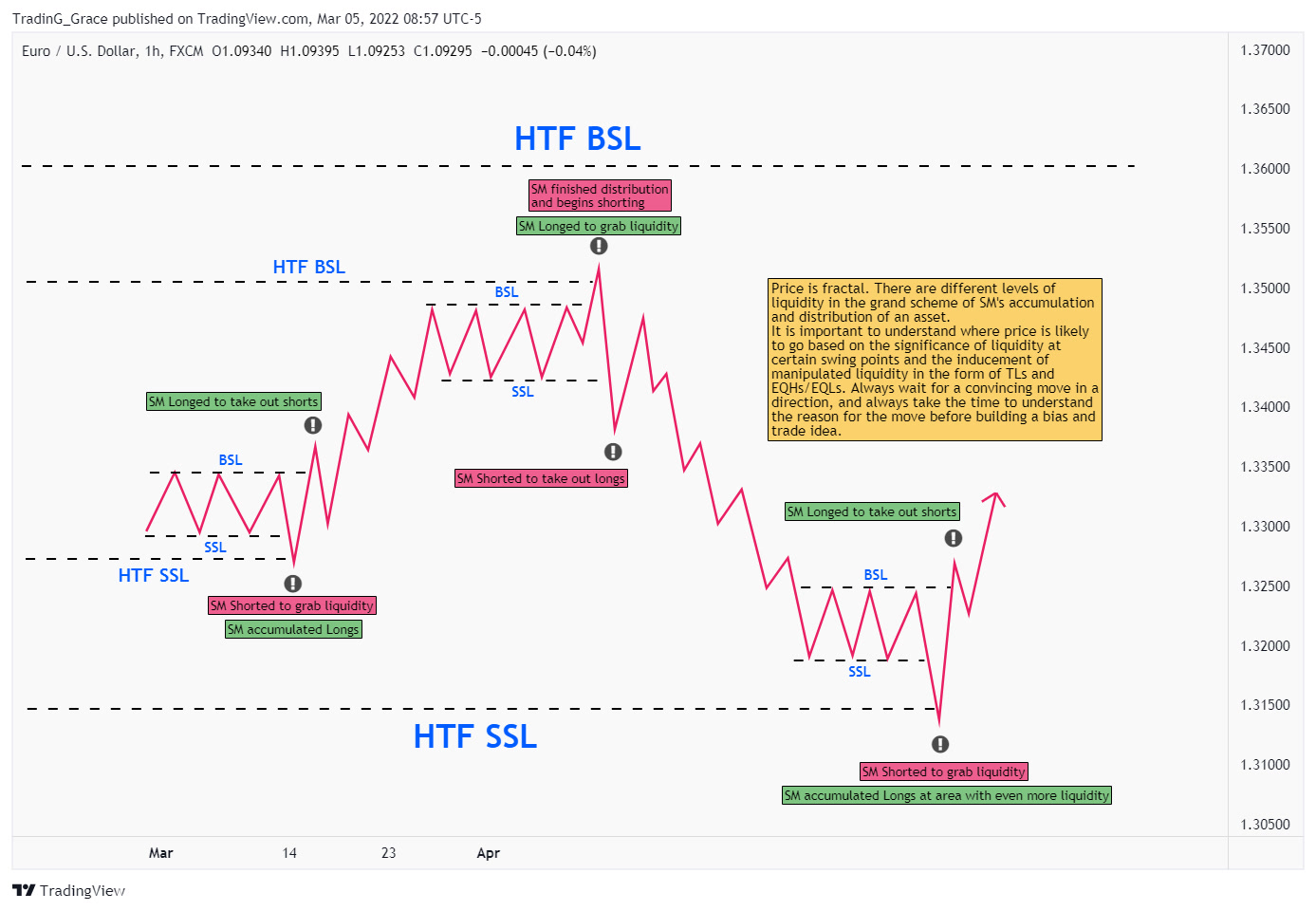
Here's the kind of week I mean. Picture EURUSD with a bearish Sunday read: the previous week closed as a down-close candle, there's a clean daily FVG above current price that should act as resistance, and buy-side liquidity rests just above that. The weekly bias: price sweeps that buy-side, rejects the FVG, and heads south toward the weekly low.
Monday opens flat. In Tuesday's London session, price displaces to the upside, clears that buy-side level, and instead of rejecting, it consolidates above it. On the 15-minute chart, that consolidation is building a textbook bullish OB after a clean retracement into a micro FVG.
A trader locked into the bearish bias reads that consolidation as 'accumulation before the sweep fails.' They look for shorts, with the idea that price will close back below the swept level and confirm the bearish narrative.
If the 15-minute OB holds and price keeps running higher, they get stopped out, and the long setup was sitting right there the whole time. The FVG, the displacement, the OB were all visible. The long would have had its stop below the OB and its target at the next buy-side liquidity above. But every piece of price action was being processed through the lens of a bearish bias set four days earlier.
That's the Sunday bias trap in its purest form.
The Archetype I See Constantly
There's a specific pattern that shows up in ICT communities all the time. A trader posts their Sunday weekly bias, detailed, articulate, shows real understanding of HTF structure. Gets good engagement. Then by Wednesday, price has completely invalidated the setup, and instead of adapting, they either sit on their hands waiting for price to 'come back to the narrative' or force a marginal entry just to stay consistent with what they posted publicly.
The public posting compounds the problem. Now it's not just about being right internally, there's an audience. The ICT weekly bias has become a content commitment, not a trading tool.
But even without the public element, the psychology is identical. You've spent real mental energy on Sunday. You've gone through a process. That investment creates ownership. And ownership creates the kind of selective attention that misses clean setups simply because they're pointing the wrong direction.
This is different from having no read at all. I'm not arguing for trading without HTF context, that's reckless. What I'm arguing is that the framing around how you hold that context matters enormously.
From 'Setting a Bias' to 'Holding a Hypothesis'
Here's the practical shift, and it's deceptively simple:
On Sunday, instead of writing "My bias this week is bullish on GBPUSD," I write: "My current hypothesis is that GBPUSD is more likely to seek the buy-side at [level] before seeking the sell-side at [level], given that price remains above [invalidation structure] on the daily chart."
That final clause is everything. It builds the invalidation condition directly into the hypothesis at the moment of formation, before you've developed any emotional attachment to the direction.
The framework I now use looks like this:
Step 1, Define the competing narratives. On Sunday, I write out both the bullish and bearish case equally. Not just the one I believe. Both. This forces honest engagement with the opposing scenario and starts to loosen the grip of whichever direction feels more compelling.
Step 2, Set structural invalidation levels, not price invalidation. Don't say "if price hits X, I'm wrong." Say "if price closes above/below this structure on the 4H, the hypothesis is suspended." Structure-based invalidation is harder to rationalise away than price levels.
Step 3, Review the hypothesis at each session open, not just at trade entry. Monday London open: does the hypothesis still hold? If not, what's the updated read? This replaces the 'defending the bias' reflex with an active reassessment habit.
Step 4, Give the counter-scenario equal right to play out. This is where most people fail. If your HTF hypothesis is bearish but the 4H is printing a clean bullish CHoCH, the correct response isn't to look for the short, it's to ask whether the counter-scenario is developing and whether there's a valid long with its own HTF justification.
The language shift from 'bias' to 'hypothesis' isn't just self-talk. It changes how you process contradicting information. A bias being wrong feels like a personal failure. A hypothesis being suspended by new data feels like science working correctly.
This is related to a broader issue I've written about in why Q2 2026 market structure shifts are breaking traditional ICT setups, the market doesn't reward rigid frameworks. It rewards adaptive ones.
What 10 Years Teaches You That One Year Doesn't
A trader with one year of ICT experience is still in the phase of proving the model works. So every time their weekly bias is right, it feels validating. Every time it's wrong, it feels threatening. That emotional cycle makes 'locking in' a bias feel like commitment to a process.
After a decade, you stop needing the model to validate itself. You already know it works. What you're optimising for now is when to apply it and when to suspend it. That's a fundamentally different problem.
The best ICT setups usually share one characteristic: they don't care what your Sunday analysis said. They present themselves on their own terms, at their own time. Your job is to be receptive to them regardless of which direction you've been leaning.
If you're forcing entries to match your weekly bias, you're not trading the market, you're trading your Sunday evening.
For traders serious about funded account performance, this psychological rigidity is one of the fastest ways to blow a challenge. The mid-week bias defence is something I covered from a different angle in 7 fatal mistakes that kill your funded account challenge success, it's worth reading alongside this if the funded path is your goal.
Holding the Map Loosely
The Sunday review is still valuable. Look at the weekly, the daily, understand where the liquidity rests, understand the broader PD array landscape. That map matters. But you have to hold the map loosely enough that when the terrain changes mid-week, you update the map, not the terrain.
On TradingView, I keep my Sunday analysis in a separate idea draft that I label 'W[week number], Working Hypothesis.' The word 'working' is deliberate. It signals to my own brain that this is a live document, not a verdict.
Small change. Real difference.
If the psychology of trading, not just the mechanics, is where you want to dig deeper, the coaching plans I run cover exactly this: how the ICT framework breaks down not at the chart level but at the decision-making level, and how to rebuild it in a way that's actually consistent. The Full Mentorship over four months is specifically structured to address these compounding psychological patterns, not just pattern recognition.
But start with Sunday. Change one word. 'Bias' to 'hypothesis.' See what it does to how you read Tuesday's price action.
That's the whole shift. And it took me years to figure it out the hard way.
Harvest Wright
ICT Trading Coach · 10+ Years Experience
Harvest specializes in ICT methodology and has helped traders pass prop firm challenges, develop consistent strategies, and build the psychology needed for long-term profitability.
Book a Free Discovery Call →Master Your Trading Psychology
Psychology is a huge part of trading. Our coaching includes dedicated psychology sessions.
See Coaching PlansFree ICT Funded-Trader Playbook
The setups, the pre-trade checklist, and the risk rules I use. Get it free.