
The Silence After a Loss: ICT Trader's Recovery Protocol
There's a specific kind of quiet that follows a bad trade. Not peaceful quiet. The kind where you're staring at a chart you just got stopped out on, watching price do exactly what you thought it would, after you exited. That silence is where your trading career either gets stronger or starts quietly unraveling. And almost nobody talks about what you're supposed to do in it.
The conversation around ICT trading mindset is dominated by surface-level advice. "Control your emotions." "Don't revenge trade." "Step away from the screen." Technically correct. Practically useless without structure. Because what happens in the 48 hours after a losing trade isn't random, it follows a near-identical neurological pattern in almost every trader I've observed, including myself at my worst, and if you don't have a deliberate protocol for navigating it, you'll default to one of two destructive paths without even realizing it.
Key Takeaway: Recovery from a losing trade isn't about motivation or emotional control, it's about executing a structured 48-hour protocol that interrupts your brain's default loss-response pattern before it hardens into a habit. Most ICT traders skip this entirely and wonder why the same psychological mistakes keep recurring.
The Trade That Made Me Build This
Let me give you the specific setup so this isn't abstract.
It was a Tuesday London session in late Q1 2026. GBPUSD, 15-minute chart. Price had swept the Asian range lows just before the London open, classic liquidity raid into what I'd marked as a 4H bullish order block sitting at 1.2634. Displacement candle confirmed. I entered long at 1.2641, stop at 1.2618, 23 pips, risking 0.75% of the account. The setup was clean. Confluence was there: HTF bias was bullish, we were in discount on the daily range, and there was a 4H FVG sitting directly above at 1.2710 as a reasonable first target.
Price pushed up six pips, stalled, then rolled over and took my stop out at 1.2618. Full 0.75% loss.
Here's the part that stings: forty minutes later, price reversed from almost exactly my entry area and ran 58 pips to the upside, blowing through both of my targets.
The setup wasn't wrong. The entry timing was slightly early, I didn't wait for a lower-timeframe CHoCH to confirm the reversal, which is a confirmation layer I sometimes skip when I'm feeling impatient. That impatience cost me the trade. And in the silence that followed, I felt the familiar pull toward two very bad options: either dismiss the loss as "bad luck" and jump back in hunting the next setup, or obsess over what went wrong until I second-guessed every entry for the next week.
Neither option is recovery. Both are avoidance.
Why the 48-Hour Window Matters More Than the Trade Itself
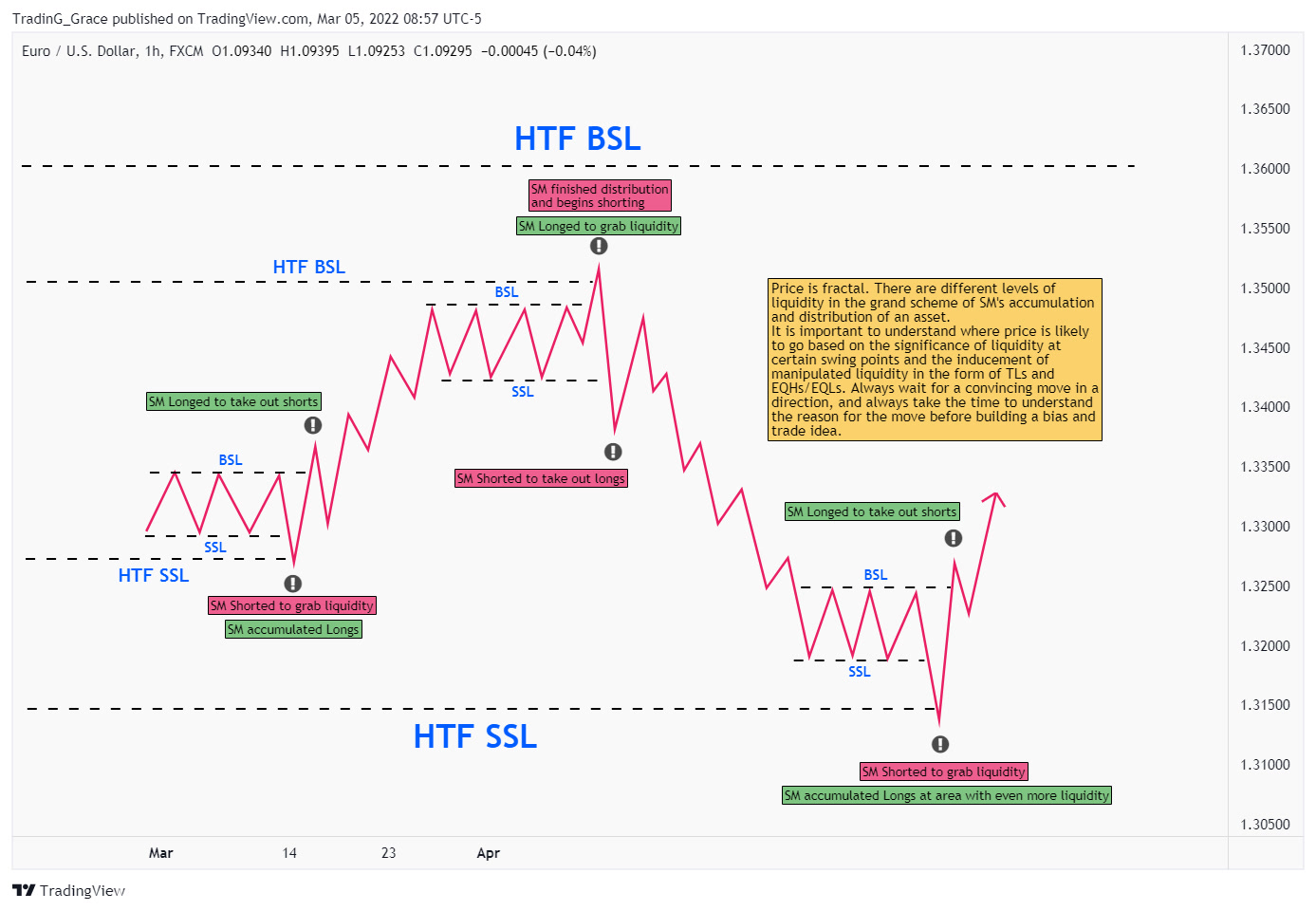
Here's the neurological reality that most trading psychology content skips over: your brain processes a financial loss through the same pathways as physical pain. This isn't metaphorical, it's documented in behavioral finance research. What matters for traders is what comes after the initial pain response.
In the roughly 48 hours post-loss, your brain is in an elevated threat-detection state. Pattern recognition goes hypersensitive. You see setups everywhere. You're also more likely to override your own rules because the pain of inaction feels greater than the risk of a bad trade. This is the window where revenge trading happens, where traders start "adjusting" their stop losses mid-trade, and where ICT traders specifically start abandoning the confirmation layers that define their edge.
The traders who bounce back within one session aren't more disciplined than you. They have a structured interruption protocol that prevents the threat-response state from dictating their next move.
I've seen a very specific pattern repeat across the trading community: the trader who takes a loss on an order block entry, immediately re-enters a slightly different OB on the same pair within the hour because "this one's stronger," and compounds the loss. They're not stupid. They're operating from an activated loss-response state with no circuit breaker in place. By the time they've taken three losses in the same session, they've convinced themselves the strategy doesn't work, when the strategy was never the problem.
The 48-Hour Protocol (Not What You Think)
This protocol is built around one counterintuitive principle: the primary activity is structured inactivity. Most coaches don't teach this because it's not motivating content. It doesn't feel like progress. But it's the difference between a bad trade that stays isolated and a bad trade that metastasizes into a bad week.
Hours 0, 4: The Documentation Window
Before you do anything else, before you close TradingView, before you re-examine the chart, write the trade journal entry while the memory is fresh. Not an emotional post-mortem. A factual one.
For the GBPUSD trade above, my entry looked like this:
- Pair: GBPUSD
- Session: London open, Tuesday
- Setup: Liquidity raid into 4H OB at 1.2634, displacement confirmed
- Entry: 1.2641 | Stop: 1.2618 | Risk: 0.75%
- What I did vs. what the model requires: I skipped the 5-minute CHoCH confirmation. Model requires it. I didn't get it before entering.
- Outcome: -0.75%. Price later validated the setup without me.
- Verdict: Execution deviation. Not a setup failure.
That last line is critical. Categorizing losses as either "execution deviation" or "setup failure" prevents your brain from generalizing the loss into "my strategy doesn't work." Most ICT traders who spiral after losses are collapsing these two categories into one, and it's destroying their confidence in valid setups. You can find a broader breakdown of how these categorization errors affect funded account performance in the piece on 7 fatal mistakes that kill your funded account challenge success.
Hours 4, 24: The Detachment Window
Close the charts. Not because you're too emotional to trade, but because there's nothing productive left to extract from them today. This is where most ICT traders fail the protocol, because the framework we work in rewards deep chart study. Spending four hours reviewing price delivery on a losing day feels like it should help. It doesn't. What it actually does is reinforce the threat-response state by keeping your nervous system engaged with the stimuli that triggered it.
The detachment window is non-negotiable in my own routine. No live charts, no re-running the setup mentally, no watching other traders' YouTube recaps of the same pair. The journaling is done. That's enough for today.
Hours 24, 48: The Session Replay Protocol
This is where the actual learning happens, and it has to be done in a specific way to be useful. Twenty-four hours later, come back to the chart with fresh eyes and run a structured replay.
Here's the exact sequence I use:
- Mark the HTF bias as it was at the time of trade entry, not what you know now.
- Replay price delivery from 2 hours before your entry, forward.
- At the point of your entry, pause. Ask specifically: Were all model confirmations present? Not "was the setup good", but "did I follow the model?"
- Continue replay through the outcome.
- Add one annotation to the journal entry: What is the single mechanical rule I deviated from?
One rule. Not a list. Not a philosophical reflection. One rule. Because vague self-analysis produces vague improvement.
For the GBPUSD trade: Rule, require 5-minute CHoCH before OB entries during London open. No exceptions.
If you want a sharper understanding of how confirmation layers work specifically in FVG-based setups, the ICT fair value gap trading checklist breaks down nine pre-trade confirmations that directly apply to this kind of post-loss review.
The Mindset Myth Nobody's Challenging
Here's the contrarian take: motivation is almost completely irrelevant to recovery. The trading psychology industry runs on the idea that if you can just feel better about the loss, reframe it, find the lesson, stay positive, you'll trade better next session. That's backwards.
Feelings follow behavior, not the other way around. When you execute the documentation window with precision, when you close the charts on schedule, when you run the session replay correctly 24 hours later, the confidence comes back on its own. Not because you worked on your mindset, but because your behavior demonstrated to yourself that you have a process. That process is the evidence your nervous system needs to move out of threat-detection mode.
I used to spend hours after losses re-reading trading psychology books, watching motivational content, trying to manufacture the "right" headspace before the next session. It never worked. The protocol above replaced all of it, and my post-loss recovery time dropped from sometimes weeks of shaky execution to one solid session, consistently. The results speak for themselves over time when this becomes a habit rather than an emergency measure.
For anyone working through a more extreme version of this, a significant drawdown rather than a single loss, the framework I documented in my $47k prop firm loss rebuild applies the same structural principles at larger scale.
The One Thing That Changes Everything
Stop treating post-loss recovery as an emotional challenge. It's a mechanical one. You're not trying to feel better, you're trying to interrupt a neurological pattern before it produces a behavioral habit.
The 48-hour protocol isn't glamorous. Journaling one trade entry and closing your charts is not the kind of content that gets shared. Doing nothing for 20 hours is not an inspiring story. But it's what separates traders who have isolated bad trades from traders who have recurring bad weeks, and the difference compounds dramatically over a year of trading.
If you want to work on building this kind of structured approach to both execution and recovery, the coaching plans at R2F run from Lite support at $150/week through to a full four-month mentorship. The focus is always on process, not performance, because performance is downstream of everything else.
For now: next time you take a loss, before you do anything else, open your journal and categorize it. Execution deviation or setup failure. That one step is the beginning of a different kind of silence, the useful kind.
Harvest Wright
ICT Trading Coach · 10+ Years Experience
Harvest specializes in ICT methodology and has helped traders pass prop firm challenges, develop consistent strategies, and build the psychology needed for long-term profitability.
Book a Free Discovery Call →Ready to Get Funded?
Our students pass prop firm challenges in under 60 days with personalized ICT coaching.
Book a Free Discovery CallFree ICT Funded-Trader Playbook
The setups, the pre-trade checklist, and the risk rules I use. Get it free.