
The Quiet Mind: Trading ICT With Zero Emotion
There's a version of trading psychology content that gets recycled endlessly, breathe before you enter, journal your emotions, don't trade angry. And I'm not saying that stuff is worthless. But after 10+ years in this, I've come to believe it's solving the wrong problem. The real goal isn't to manage your emotions when they show up. It's to build an ICT trading mindset and a pre-trade structure so specific that emotion never gets a seat at the table in the first place.
Key Takeaway: Emotional interference in ICT trading isn't a willpower problem, it's a structural one. When your model has hard, non-negotiable criteria for entry, invalidation, and timing, there's simply no moment where fear or greed can insert themselves into the decision.
Why "Emotional Control" Is the Wrong Goal
Every book, course, and YouTube video on trading psychology frames the problem the same way: emotions appear, and your job is to control them. Breathe through the fear. Resist the greed. Sit on your hands.
But here's what nobody says out loud, if you're white-knuckling your way through a trade, wrestling with whether to exit early or hold for the target, your model wasn't specific enough to begin with. That internal debate isn't a psychology problem. It's a criteria problem.
ICT's concept of "waiting for the model" is talked about constantly in the community, but almost always as a technical instruction. Wait for displacement. Wait for the mitigation. Wait for the killzone. What most traders miss is that "waiting for the model" is also the psychological architecture. When your model defines exactly what has to be true before you enter, not approximately true, not mostly true, there's no ambiguity left. And ambiguity is where emotion lives.
Want to go deeper on how Q2 2026 market conditions are affecting ICT setups specifically? I broke that down in detail here: why Q2 2026 market structure shifts are breaking traditional ICT setups and how to adapt.
The Archetype I Keep Seeing
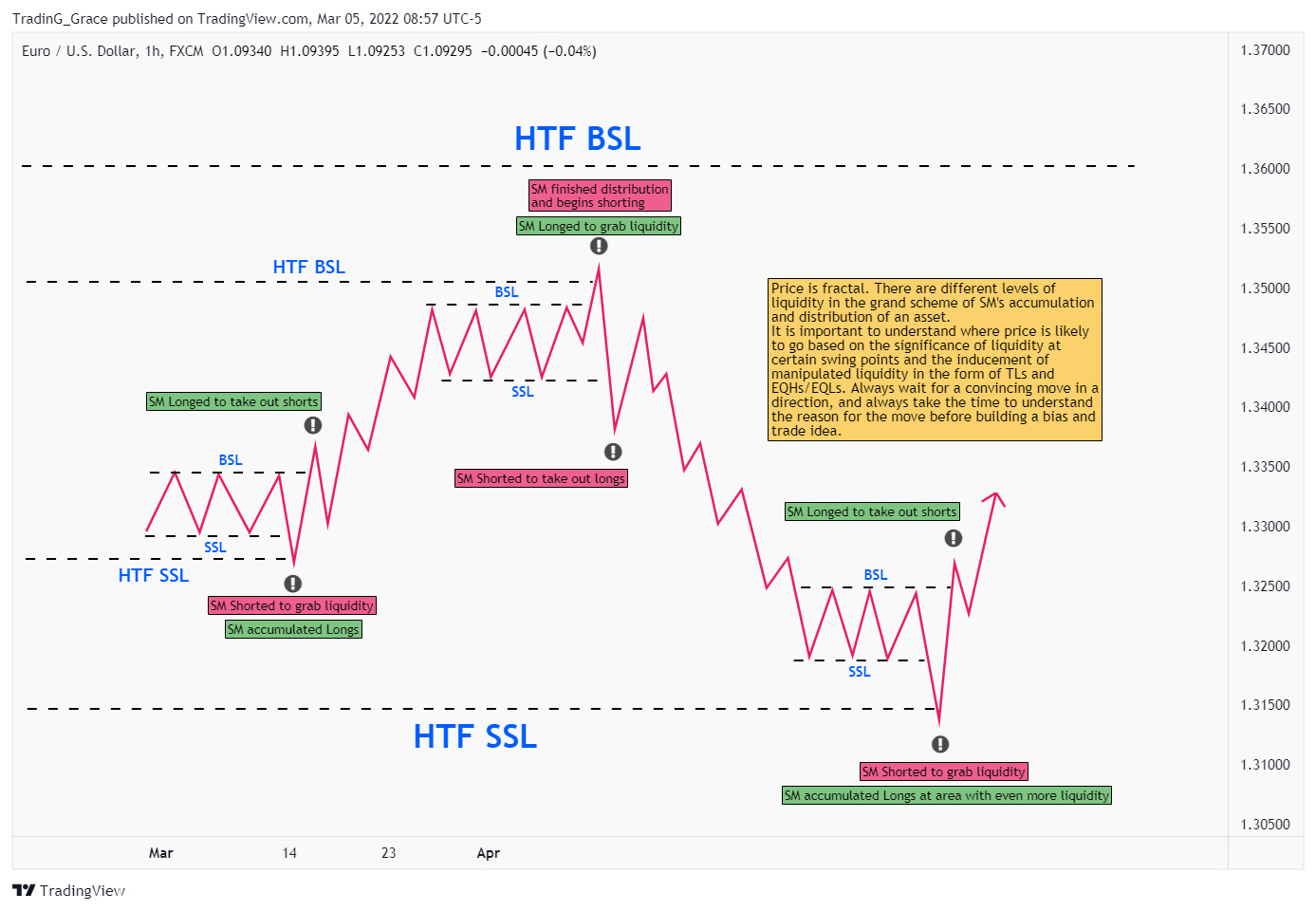
There's a trader pattern I've noticed repeated constantly across forums, Discord servers, and trade review threads. This trader has studied ICT extensively, they understand order blocks, FVGs, liquidity grabs, killzones. They can identify setups on a clean chart in hindsight with impressive accuracy.
But when they're live, they adjust. They enter slightly early because "it's close enough." They widen stops after the price taps their level and starts moving against them. They exit at 1R because the candle body looks concerning, even though their target was 3R.
None of that is emotional weakness. It's the predictable result of a model with soft edges. When "close enough" is allowed once, your brain files that as a rule. And then emotion, which is just your brain's pattern-matching system operating under uncertainty, fills every gap where a hard rule should be.
The fix isn't discipline. The fix is specificity.
A Worked Example: GBPUSD in the London Session
Let me show you what this looks like in practice rather than in theory.
Picture GBPUSD on the 15-minute chart during London. The 4H shows clear bearish market structure: a break of structure to the downside formed overnight, leaving a displacement leg and an unfilled Fair Value Gap.
A model for the short might require: (1) price trading in premium on the HTF range, (2) a mitigation of the FVG or entry into the OB inside the London killzone, (3) a 1-minute confirmation candle closing below the FVG low after mitigation, and (4) a structural reason to the left confirming the premium zone, such as equal highs printed the day before.
Now say price sweeps those equal highs during the killzone, drops back inside the range aggressively, and retraces into the FVG. The 1-minute prints a displacement candle closing below the gap. Every box is ticked.
The short goes in at the FVG. The stop sits above the high of the liquidity sweep, because if price takes that high again the sweep was not a reversal and the idea is wrong. The target is the sell-side liquidity below, the nearest clean low. If a bullish FVG forms on the 5-minute near the target, that's a reasonable signal to take the rest off.
Here's the part that matters for this conversation: in a trade like that, there's very little to feel anxious about, because every decision was made before the entry. Entry criteria, met or not met. Stop level, fixed at trade open. Target, defined by structure, not by how you feel about the candles.
There's nothing to feel because there's nothing to decide.
How to Build the Structure (Step by Step)
This is the framework I use, and it's designed to eliminate decision-making during the trade, not manage it.
Step 1: Define your entry criteria as a checklist, not a vibe. Write out every condition that must be true before you enter. Not "FVG looks clean", instead, "FVG formed after a minimum 3-candle displacement on the 15M, price is in a premium array on the 4H, and entry is within the London or New York killzone window." Each item is binary: yes or no. If any box is unchecked, you don't enter. Full stop.
Step 2: Set your invalidation level before you look at your entry. Before you even think about where to enter, identify the level that proves the trade idea wrong. For ICT models, this is almost always the buy-side or sell-side liquidity that, if swept, would invalidate the directional bias. Your stop goes above or below that level, not at a "comfortable" distance, not at a round number.
For position sizing against that stop, I use a risk calculator to remove that calculation from the emotional moment entirely. You punch in the numbers before the trade, and the lot size is just math.
Step 3: Define your take profit before entry using structure, not targets. Your take profit isn't "I want 3R." It's "the nearest pool of liquidity below/above current price, confirmed by equal highs/lows or a previous day's high/low." When structure defines the target, you're not making a judgment call mid-trade about whether to hold or fold.
Step 4: Build a killzone-only rule into your routine. This single rule cuts out a lot of emotionally-charged entries. If you're not in the London (2 to 5am EST) or New York (7 to 10am EST) killzone, the trade doesn't exist. Doesn't matter how perfect the setup looks at 2pm EST, it's not your window. A specific rule like this doesn't require willpower to follow. It just requires a clock.
Step 5: Do your pre-session analysis before the session opens. This is where the ICT trading mindset actually gets built. Every morning before London, I've already identified: the HTF bias, the relevant premium/discount arrays, the liquidity pools on both sides, and the key levels I'm interested in. By the time the session opens, I'm not analyzing, I'm just watching to see if my pre-drawn scenario plays out.
This separation of analysis from execution is everything. Analysis is where your intellect works. Execution is where your checklist works. Never mix the two in real time.
For a detailed look at how FVG entries specifically should be confirmed before you pull the trigger, this checklist is worth reading: ICT fair value gap trading checklist, 9 pre-trade confirmations that separate profitable FVG entries from losers.
The Counterintuitive Truth About Patience
I used to think patience was a character trait. Either you had it or you didn't. Sitting on your hands while price danced around felt like a test of willpower, and some days I failed it spectacularly.
What I understand now is that patience isn't a feeling, it's a consequence of preparation. When you've done your analysis, when you know exactly what you're waiting for, and when you have nothing to do until the criteria are met, waiting doesn't feel like restraint. It just feels like waiting. Like standing in a queue, not like suppressing an urge.
ICT's phrase "let price come to you" is often quoted but rarely explained mechanically. What it actually means is: identify the discount array where institutional interest is likely to be present, draw the specific level or zone, and simply wait for price to arrive there. You're not watching every candle with white knuckles. You've set a price alert. You go do something else. The alert fires, you check your checklist, and you either enter or you don't.
That's not emotional control. That's structural irrelevance of emotion.
For context on how this plays out in volatile conditions, which Q2 2026 has delivered in spades, this breakdown of April volatility setups is directly relevant: 5 ICT trading setups that thrive during April's Fed meeting uncertainty.
One Thing Worth Being Honest About
None of this works if your model is vague. I spent years thinking I had a model when I really had a collection of concepts. I knew what an order block was. I knew what a FVG was. I could identify liquidity on a chart. But I didn't have rules, I had preferences. And preferences flex under pressure.
The process of actually building a model, writing out every entry condition in binary terms, back-testing it against historical data on TradingView until you can articulate exactly what the setup looks like in six different market conditions, and then forward-testing it for at least 30 trades before going live, that process is where most traders never actually go. It's unglamorous. It feels like paperwork compared to watching live price action.
But it's the only reason I can sit down at the chart at 7am, watch London run a liquidity sweep, and feel nothing except mild interest in whether my criteria get met.
The Quiet Mind Isn't Empty, It's Occupied
Here's the reframe: a quiet trading mind isn't one that has suppressed all emotional reactions through years of meditation and journaling. It's one that is fully occupied by a specific, mechanical process, with no gaps left for doubt to fill.
The ICT trading mindset, done properly, is a structural achievement. You build a model with hard edges. You do your analysis before the session. You define every decision in advance. And then you show up and operate the checklist.
Fear can't find a foothold when there's no open question to attach to. Greed can't inflate your target when the target was defined by structure before the trade started. The emotions don't need to be wrestled with, they just have nowhere to go.
If you're at the stage where you're still building that model, or you want a framework with real accountability built around it, take a look at the coaching plans we offer, from the Lite option at $150/week through to the Full Mentorship program. Or if you want to see whether the approach fits before committing to anything, book a free discovery call and we can talk through where you actually are.
The quiet mind isn't something you achieve. It's something you build.
Harvest Wright
ICT Trading Coach · 10+ Years Experience
Harvest specializes in ICT methodology and has helped traders pass prop firm challenges, develop consistent strategies, and build the psychology needed for long-term profitability.
Book a Free Discovery Call →Ready to Get Funded?
1-on-1 ICT coaching built around prop firm rules, from a trader who has passed an FTMO Challenge.
Book a Free Discovery CallFree ICT Funded-Trader Playbook
The setups, the pre-trade checklist, and the risk rules I use. Get it free.