
Why You Revenge Trade After Winning, Not Losing
Every piece of trading psychology content you've ever read tells you the same story: you blow up after a losing streak. You take a bad trade, it stings, you overtrade to get it back, and the account bleeds out. That's the canonical revenge trading narrative, and it's only half the picture.
After 10+ years of trading, a lot of it inside ICT-based frameworks, the pattern I keep seeing doesn't follow that script. The most dangerous session of any trader's week isn't the one after their worst day. It's the one after their best day. This is what I call winner's tilt, and understanding it might be the most important trading psychology shift you ever make.
Key Takeaway: The dopamine spike from a perfect ICT setup doesn't dissipate after you bank profit, it creates an invisible psychological pressure to re-enter the market immediately, at lower-quality setups, with inflated size. The session following your best trade is often your highest-risk session.
Myth, Reality, and What I Actually See After a Perfect Setup
Myth: Revenge trading is an emotion that triggers after pain. You lose, you feel bad, you trade impulsively to recover. Classic loss-aversion psychology.
Reality: The way I think about it, a big win doesn't just feel good, it creates a debt. Your brain registers the reward, recalibrates its baseline expectation upward, and then demands another hit. The discomfort you feel after a big win isn't satisfaction. It's the beginning of withdrawal. And withdrawal makes you do stupid things.
What I Actually See: Traders who have just executed a technically flawless ICT setup, clean displacement, confirmed FVG, proper premium/discount entry, a big R multiple, will often give back a real chunk of that gain within the next few sessions. Not because they're undisciplined in general. Because the quality of their previous execution temporarily disables their patience filter. They've proven to themselves that they "see the market." And that feeling of clarity is the most dangerous state a trader can be in.
A Worked Example
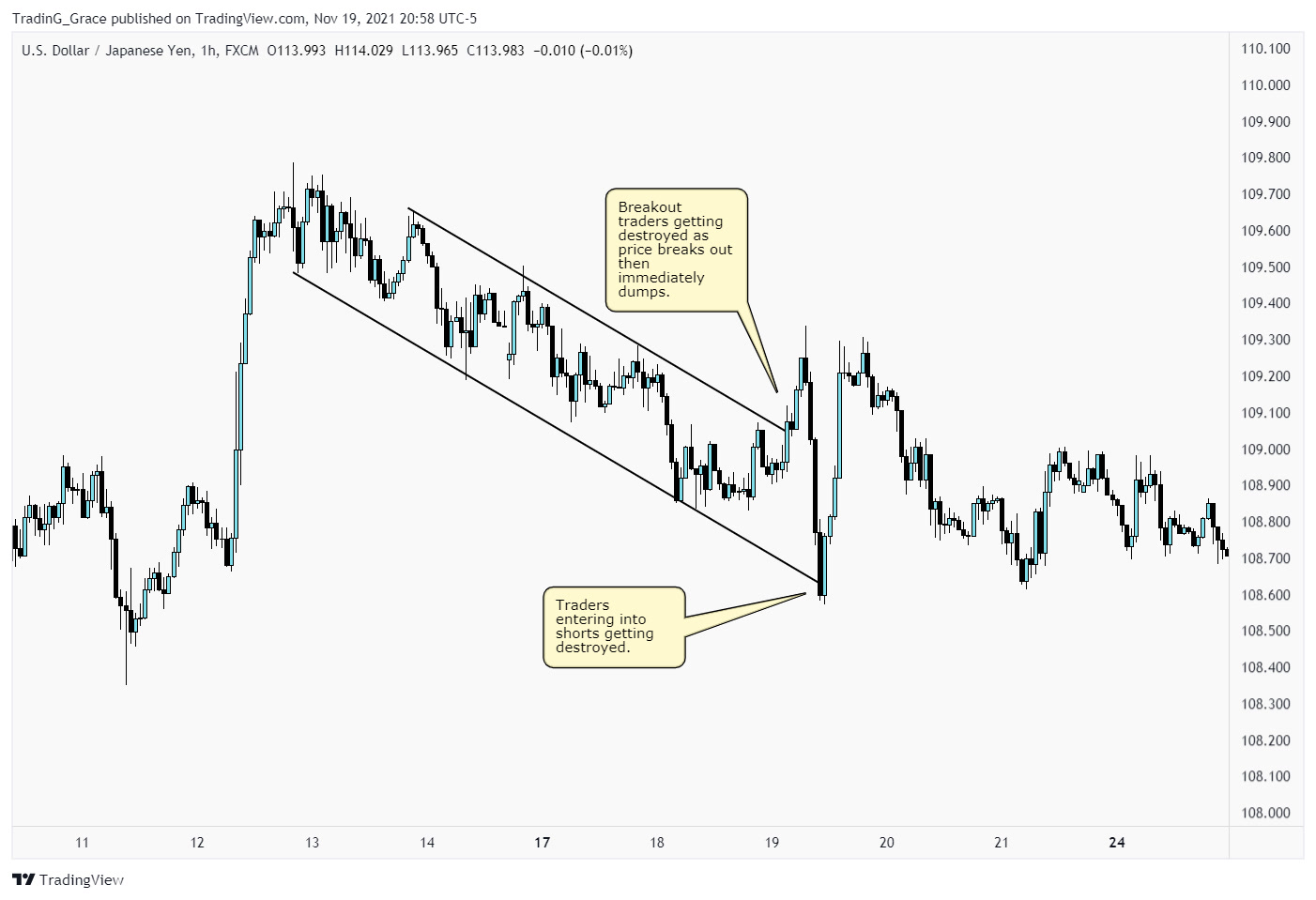
Here's the kind of session I mean.
Picture GBPUSD on the 15-minute at the London open. A clean displacement candle drives down through the Asian range lows, sweeping the sell-side liquidity that built up since the previous day's close. Price then retraces into a well-defined FVG left by that move. The short goes in inside the gap, with the stop just above the gap and the swing that created it, because if price trades back through there the displacement has failed. The target is the next obvious liquidity below, something like the previous week's low sitting near a daily demand zone.
Say it works. Price runs to the target, partials come off along the way, and the rest closes when price starts stalling. One clean trade, done early in the session.
That's the moment to close the platform. This is where a lot of traders don't.
Instead, over the next hour or so, they take a few more positions, none with the same structure as the first. One is a so-so setup in a range that goes nowhere. The others are noise. Part of the morning's gain goes back to the market. Those trades weren't from the model. They came from something else entirely.
That "something else" is winner's tilt.
The Neurological Overconfidence Loop, Why ICT Traders Are Especially Vulnerable
Here's the part that most trading psychology content completely misses, especially content aimed at ICT or smart money traders.
When you trade a generic strategy, a moving average crossover, a simple breakout, there's limited cognitive involvement. But when you execute a proper ICT setup, you've done real analytical work. You've read displacement, identified institutional order flow, confirmed with higher-timeframe bias, waited for premium/discount alignment. When that trade works, the reward feels proportional to the effort. Your brain doesn't just register "profitable trade." It registers "I decoded the market correctly."
That's a fundamentally different dopamine trigger. It's not just money, it's intellectual validation. And intellectual validation is significantly more addictive than monetary gain alone.
So when the position closes in profit, your brain isn't in cool-down mode. It's in pattern-recognition overdrive. You start seeing setups everywhere. FVGs that aren't quite right start looking "close enough." Order blocks that formed in premium start looking like "good enough" discount. The threshold for what constitutes a valid entry collapses, not because you've forgotten your rules, but because you feel like you're operating at peak clarity.
You're not. You're high.
This is why I'd argue ICT traders are more vulnerable to winner's tilt than traders using simpler strategies. The more sophisticated your framework, the more your brain can rationalize a bad trade as a good one. You have the vocabulary to justify almost anything. A bad entry becomes "early accumulation." A stop hunt on a mediocre setup becomes "liquidity engineering." The toolset is so rich that it can be weaponized against your own discipline.
For more on how this kind of rationalization destroys funded accounts specifically, the breakdown in 7 fatal mistakes that kill your funded account challenge success is worth reading in full, some of those mistakes trace directly back to winner's tilt, even if they're not labeled as such.
The Trader Archetype I See Blow Up the Most
There's a specific profile I've observed repeatedly across trading communities, forums, and Discord servers: the trader who has genuinely cracked their model. They're not a beginner. They've got real edge. Their journal shows a solid win rate on A+ setups, good R:R, and they understand ICT concepts at a level most YouTube traders never reach.
But look at their monthly equity curve and you'll see a pattern: spikes followed by cliff edges. A great Monday or Tuesday, then a Thursday or Friday that erases most of it. When you dig into those ugly days, the entries aren't from their model. They're from a distorted version of it, the same concepts, applied at the wrong time, with the wrong confirmation, at inflated size.
This trader isn't revenge trading after losses. They're revenge trading after wins, except it doesn't feel like revenge at the time. It feels like momentum. It feels like "striking while the iron is hot." It feels like confidence, which is what makes it invisible until it's already cost them.
The cruel irony is that this is the trader who's closest to being genuinely funded and profitable. They have the edge. They're just detonating it on the session after their best performance.
The Post-Win Protocol: A Practical Framework
Here's the framework I'd use.
Step 1: Define your "win threshold" before the session opens. If your target for the week is 2% growth, and you hit 1.8% in a single trade before noon on Tuesday, that trade is your session. Write it in your journal. Close the platform. This has to be a pre-commitment, not a in-the-moment decision, because in the moment, you will rationalize continuing.
Step 2: Implement a mandatory 24-hour no-trade window after any single trade that returns 2R or better. This feels painful. It also works. A night's sleep does a lot to reset your head. If you're back at the charts within two hours of a 3R win, you're not trading your model. You're chasing the feeling.
Step 3: Before every entry that follows a winning trade, run a stricter confirmation checklist, not a looser one. Most traders do the opposite. They loosen their criteria after a win because they feel invincible. Flip that deliberately. I use a simple internal rule: if I made money on the last trade, the next trade needs to clear a higher bar, not the same one. I'm looking for all the usual confirmations, HTF bias aligned, displacement confirmed, FVG in discount (for longs) or premium (for shorts), a clean liquidity target, plus I want a minimum of two independent confirmations I haven't used yet this week. If I can't find them, there's no trade.
For position sizing discipline as part of this, the risk calculator on this site helps you keep that mechanical anchor in place even when your psychology is pulling you toward oversizing.
Step 4: Journal the feeling, not just the trade. After every winning trade above 2R, write one sentence about how you feel in that moment. Not the trade details, those go in the trade log separately. Just the emotional state. "Felt invincible." "Wanted to immediately re-enter." "Felt like I could see every setup." Read those entries back at the start of your next session. They are a warning label.
Watch the Week After Your Best Week
Zoom out from individual sessions and the same idea applies at the weekly level.
Go back through your own journal and look at what happened the week after your best weeks. If you're like a lot of traders, you'll find those weeks were rougher than they should have been. It's worth checking honestly, because your own data will tell you more than any article.
The academic literature on this in behavioral finance calls it the "hot hand fallacy", the belief that recent success predicts continued success in a domain that's actually probabilistic. Traders who study smart money concepts understand that the market is engineered, but the psychological trap is believing you are also engineered to keep winning because you won yesterday.
If you want to go deeper on the market-structure side of managing volatile periods where this kind of psychological pressure compounds, why Q2 2026 market structure shifts are breaking traditional ICT setups covers the environmental factors that make winner's tilt even more destructive in ranging or choppy conditions, exactly the conditions where bad post-win entries get punished hardest.
What Changes When You Understand This
I used to get this wrong. Some of my rougher stretches confused me because they didn't follow the conventional trading psychology script. I hadn't just had a losing streak. I'd had a great week, felt good, and then given back a big part of it over the next few sessions.
I blamed the market. Market structure shifted. Spread widened. Bad luck.
It wasn't any of those things.
Once I mapped the actual sequence, winning trade, elevated confidence, lower confirmation threshold, inflated size, loss, the fix became structural rather than motivational. It stopped being about "being more disciplined" (which is advice that helps nobody) and became about building hard rules around the conditions that precede the predictable failure point.
Your worst trading sessions are upstream from your best ones. That's the real insight. And if you internalize it, it changes how you celebrate wins entirely. A 4R trade on a perfect FVG entry isn't a signal to press. It's a signal to stop.
If you're serious about rebuilding your trading psychology framework around how the market actually punishes behavior, rather than how most content says it does, take a look at the coaching plans here. The Lite tier at $150/week (one 1-on-1 session) or Pro at $250/week (two sessions) covers exactly this kind of structural accountability work. The Full Mentorship at $5,000 for four months goes deeper into the behavioral patterns that separate traders who compound gains from traders who perpetually cycle them back.
Or if you want to see whether any of this maps to your own equity curve before committing, book a free discovery call and we'll look at it together.
Your best trade of the month might already be in the past this week. The question is whether you're about to give it back.
Harvest Wright
ICT Trading Coach · 10+ Years Experience
Harvest specializes in ICT methodology and has helped traders pass prop firm challenges, develop consistent strategies, and build the psychology needed for long-term profitability.
Book a Free Discovery Call →Ready to Get Funded?
1-on-1 ICT coaching built around prop firm rules, from a trader who has passed an FTMO Challenge.
Book a Free Discovery CallFree ICT Funded-Trader Playbook
The setups, the pre-trade checklist, and the risk rules I use. Get it free.