
The Silence After a Loss: What ICT Doesn't Teach
Nobody talks about the silence.
Not the loss itself, traders talk about losses all the time. What nobody maps is the specific 4-6 hour window that follows a stop-out, a window where your ICT trading psychology is operating at maybe 60% capacity without you knowing it. You're still reading charts. You're still identifying order blocks and fair value gaps. You're running through your checklist. Everything looks normal. But you're making decisions in a physiological and emotional state that is measurably compromised, and the chart doesn't tell you that.
Key Takeaway: The most dangerous trades ICT practitioners take aren't the ones with bad setups, they're the ones taken in the 4-6 hours after a loss, when cortisol elevation and emotional suppression create a cognitive blind spot that makes objectively flawed setups look valid. Recognizing and sitting out this window entirely will do more for your account than any additional confirmation you add to your entry checklist.
What My Trade Log Actually Shows
I've kept a detailed trade journal for over a decade. Not just entries and exits, sessions, mood ratings, time since last loss, sleep, whether I ate before the session. Most traders track the first two. Almost nobody tracks the last four, and that gap is exactly where the damage hides.
When I went back through roughly three years of data, spanning both personal accounts and funded challenges, a pattern appeared that I couldn't unsee. Trades taken within six hours of a stopped-out position had a win rate approximately 22 percentage points lower than my baseline. Not slightly lower. Dramatically lower. And the average loss on those trades was larger, not smaller, because position sizing decisions made in that window trend toward overcompensation.
The trades themselves often looked fine on replay. Valid FVGs, displacement, proper market structure. The setup quality wasn't the problem. The filter was broken.
Here's a specific example. On a Tuesday in late Q1 2026, I was trading GBPUSD on the 15-minute chart during London open. I'd taken a long off a bullish order block at 1.2634, risking 0.75% of the account, targeting a 3R into the prior week's high. Clean setup, displacement, FVG fill, proper premium/discount positioning. The trade stopped out 14 pips below entry when London reversed hard into an NFP revision narrative I'd underweighted. Fine. That happens.
What wasn't fine was what happened at 11:40 AM London time, roughly 90 minutes later. I saw another long setup forming, again on GBPUSD, this time a 15-minute FVG sitting inside what I was calling a bullish breaker. I entered at 1.2651 with a 16-pip stop, risking 1.0%, already elevated from my standard 0.75%. The entry was in mid-range on the daily chart. There was no displacement on the 5-minute leading into the FVG. I had mentally labeled a consolidation candle as an order block because I wanted it to be one.
I didn't notice any of that at the time. I thought I was being disciplined by waiting 90 minutes before re-entering. That trade stopped out too. Back-to-back losses in the same session, and only on replay did I see how obviously the second one shouldn't have been taken.
That's the dead zone. Not the fog you feel during a loss, the fake clarity that follows it.
The Neuroscience Nobody Puts in Their YouTube Video
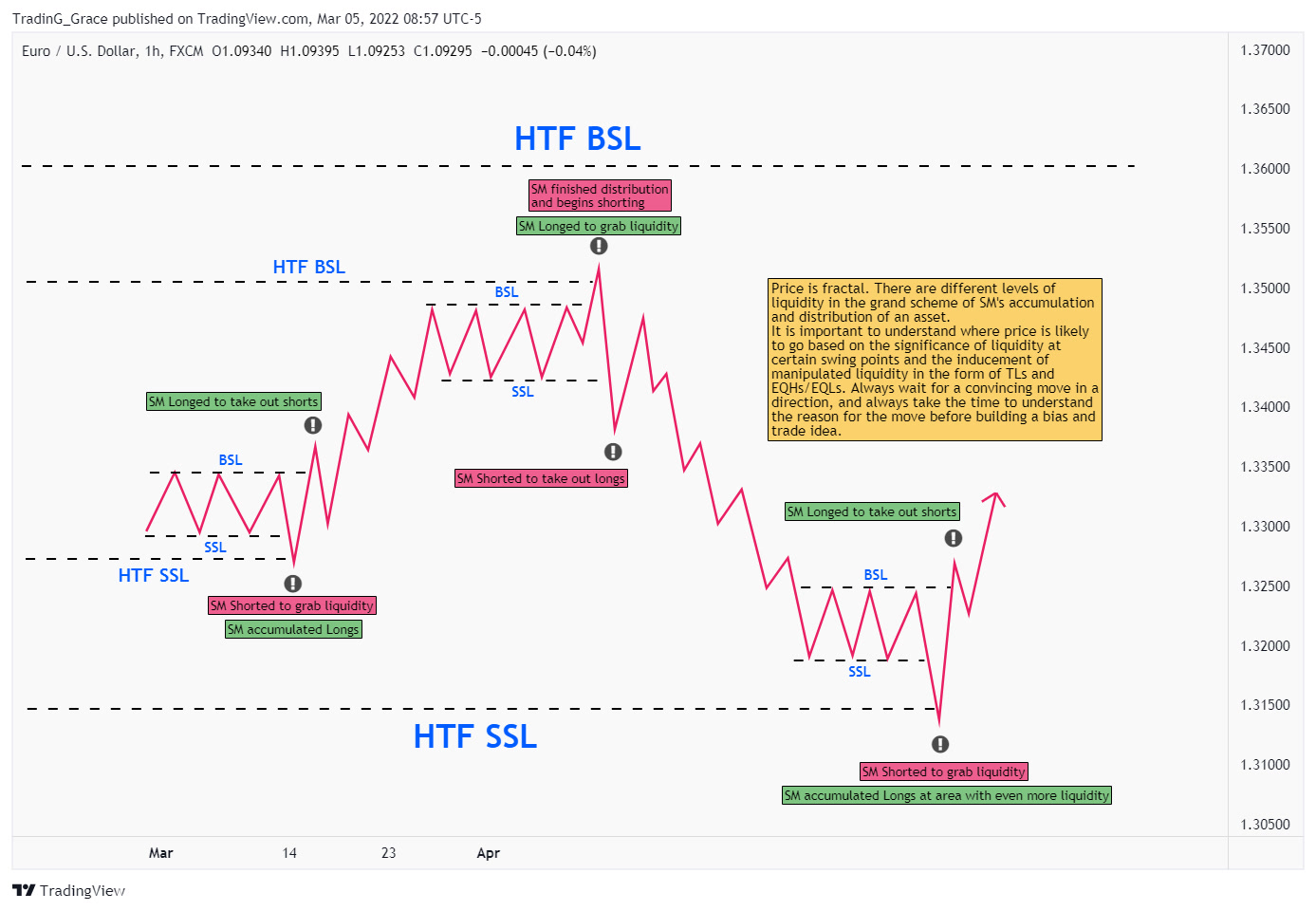
Here's what's happening under the hood. When you take a loss, your brain registers it as a threat event. Cortisol spikes. So does a compensatory dopamine drive, the brain wants to resolve the negative state, and in a trading context, that resolution pathway is "make the money back." This is well-documented in behavioral finance research; the pain of a loss activates regions associated with physical pain, and the drive to neutralize that pain is largely unconscious.
The problem isn't the emotional reaction in the immediate aftermath. Most traders actually handle that part okay, they step back, breathe, maybe close the platform. The problem is what happens when that acute phase passes and the trader returns to the charts feeling "settled."
Cortisol doesn't clear your system in 20 minutes. Depending on the intensity of the stress response and individual physiology, elevated cortisol can persist for 4-6 hours. During that window, research on cortisol and decision-making consistently shows impaired executive function, specifically, the prefrontal cortex (responsible for probabilistic thinking and impulse control) operates with reduced efficiency while the limbic system (emotional, reactive) exerts stronger influence on decisions.
In plain English: your pattern recognition is intact. You can still see a FVG. But your ability to accurately assess whether that FVG meets your full criteria, and whether the context actually supports the trade, is genuinely degraded. You're running the ICT checklist through a compromised filter and getting confident green lights on setups that should be yellow or red.
This isn't a willpower problem. It's biology. And treating it like a willpower problem, "just be more disciplined", is why generic trading psychology content fails traders who are already technically competent.
The Trader Who Trades Through It
There's a specific pattern I see repeatedly in trade logs people share in trading communities, and it almost always looks the same: a trader who has a solid methodology, a documented edge, reasonable results over time, but a handful of catastrophic sessions that account for a disproportionate share of their total drawdown. When you zoom into those sessions, there's almost always a first loss, followed by a second trade 1-3 hours later, followed by a third. The first loss was often legitimate. The second and third have subtle but clear deviations from the trader's own stated rules.
The common narrative is "tilt" or "revenge trading," and while those terms aren't wrong, they obscure the mechanism. The trader genuinely doesn't feel like they're revenge trading. They feel like they're making calm, analytical decisions. That felt clarity is exactly what makes the dead zone dangerous. Obvious emotional trading is easy to catch. Compromised-but-calm trading is nearly impossible to self-identify in real time.
This is also why blown prop firm accounts so often cluster around specific days rather than spreading evenly across weeks. One bad entry hits the daily drawdown limit. The trader resets, comes back tomorrow, but the emotional residue of that loss is still active. Tomorrow's trades look careful. They're not. I wrote more about this pattern in the context of funded account failures here, the mechanics overlap significantly.
The Dead Zone Protocol
This is what I actually do now, and it's not complicated. The complexity is in the commitment to follow it when your brain is telling you the coast is clear.
Step 1: Log the stop-out immediately. The moment a trade closes at a loss, I write one sentence in my journal: the time, the pair, and a single word describing my state. Not an analysis, just a timestamp and a gut check word. "Frustrated." "Neutral." "Annoyed." That timestamp is now the start of a 4-hour clock.
Step 2: The clock is non-negotiable. For four hours from that timestamp, I do not take a new position in the same pair or session. I can watch. I can mark up charts. I can write observations. I cannot execute. If that window overlaps with New York open or a high-impact news event, I sit it out. The setup doesn't matter. The opportunity cost of missing one valid trade is trivially small compared to the cost of the second or third bad trade that typically follows.
Step 3: Before re-entry after the window, run the context check, not just the setup check. Most ICT checklists are setup-focused: displacement present? FVG formed? Entry in discount? OB confluence? That's all valid. But after a loss window, I add three context questions before touching the keyboard: Is my position sizing exactly at my standard risk (not elevated)? Can I articulate in one sentence why this specific entry time and session make sense? Have I identified the nearest opposing liquidity pool and am I comfortable with the trade failing into it?
If I fumble on any of those three, if I can feel myself reaching for a justification rather than reading one clearly, I don't trade.
Step 4: Track the windows explicitly in your journal. This is the part most people skip because it's uncomfortable. At the end of each week, go back and tag every trade that was taken within 4 hours of a prior loss. Calculate that group's win rate separately from your baseline. Do this for eight weeks. The data will show you what it showed me, and seeing the number is more persuasive than any psychological framework.
For a clean look at how this kind of contextual filtering applies to specific entry types, the ICT FVG entry checklist I broke down here pairs well with this protocol, the checklist is the setup layer, and the dead zone protocol is the state layer that runs underneath it.
What ICT Actually Misses Here
I want to be precise about this, because it's not a criticism of the methodology itself, it's an observation about what the curriculum covers and what it doesn't.
ICT gives you one of the most rigorous frameworks available for reading price: understanding how institutional order flow leaves footprints in the form of order blocks, FVGs, liquidity voids, and displacement. That part is genuinely excellent, and over a decade of trading, I haven't found a more coherent model for understanding why price does what it does. If you're newer to those concepts, the crash course here covers the foundational layer before you layer on any of this.
But the methodology, like most technical frameworks, is delivered as if the operator is a neutral, consistent instrument. The implicit assumption is that if you understand the model and follow the rules, the results will follow. What it doesn't address, and what almost no ICT content on YouTube addresses, is that the operator is a biological system with state-dependent variability. The same eyes, looking at the same chart structure, with the same knowledge, will consistently generate different quality reads depending on hormonal state.
That's not a character flaw. That's physiology. And a trading protocol that doesn't account for it is incomplete by design.
The good news is the fix doesn't require therapy, meditation retreats, or a personality overhaul. It requires a clock and a rule. Four hours after a loss, you're off. No exceptions. The market will have other setups. It always does. What you won't get back as easily is the account capital or the funded challenge you burned through because a checklist-passing trade was taken by a brain that wasn't operating at full capacity.
If you want to work through how this kind of protocol fits into a broader system, position sizing, session filters, the whole structure, the coaching options here cover everything from weekly support to full mentorship builds. Or if you're just starting to map all of this out, book a free discovery call and we can figure out where the actual gaps are in your process.
The silence after a loss isn't just uncomfortable. It's telling you something. Start listening to it differently.
Harvest Wright
ICT Trading Coach · 10+ Years Experience
Harvest specializes in ICT methodology and has helped traders pass prop firm challenges, develop consistent strategies, and build the psychology needed for long-term profitability.
Book a Free Discovery Call →Ready to Get Funded?
Our students pass prop firm challenges in under 60 days with personalized ICT coaching.
Book a Free Discovery CallFree ICT Funded-Trader Playbook
The setups, the pre-trade checklist, and the risk rules I use. Get it free.