
The Revenge Trade Trap: Why Smart Traders Lose Double
There's a specific version of revenge trading that nobody talks about, the kind that feels completely justified while it's happening. Not the emotional, rage-clicking kind where you throw position sizing out the window. The calculated kind. The kind where you sit back, take a breath, re-analyze the chart, find another confluence stack, and re-enter. Still convinced you're right. Still methodical. Still losing.
That's the revenge trade trap. And it cost me a funded account.
Key Takeaway: Revenge trading in the ICT framework isn't triggered by raw emotion, it's triggered by a dangerous belief that the market owes you back after a high-conviction setup fails. The higher your confluence, the worse this gets. Breaking the loop requires understanding why your brain misreads invalidated bias as a statistical debt.
The Night I Blew a Funded Account and Thought I Was Being Disciplined
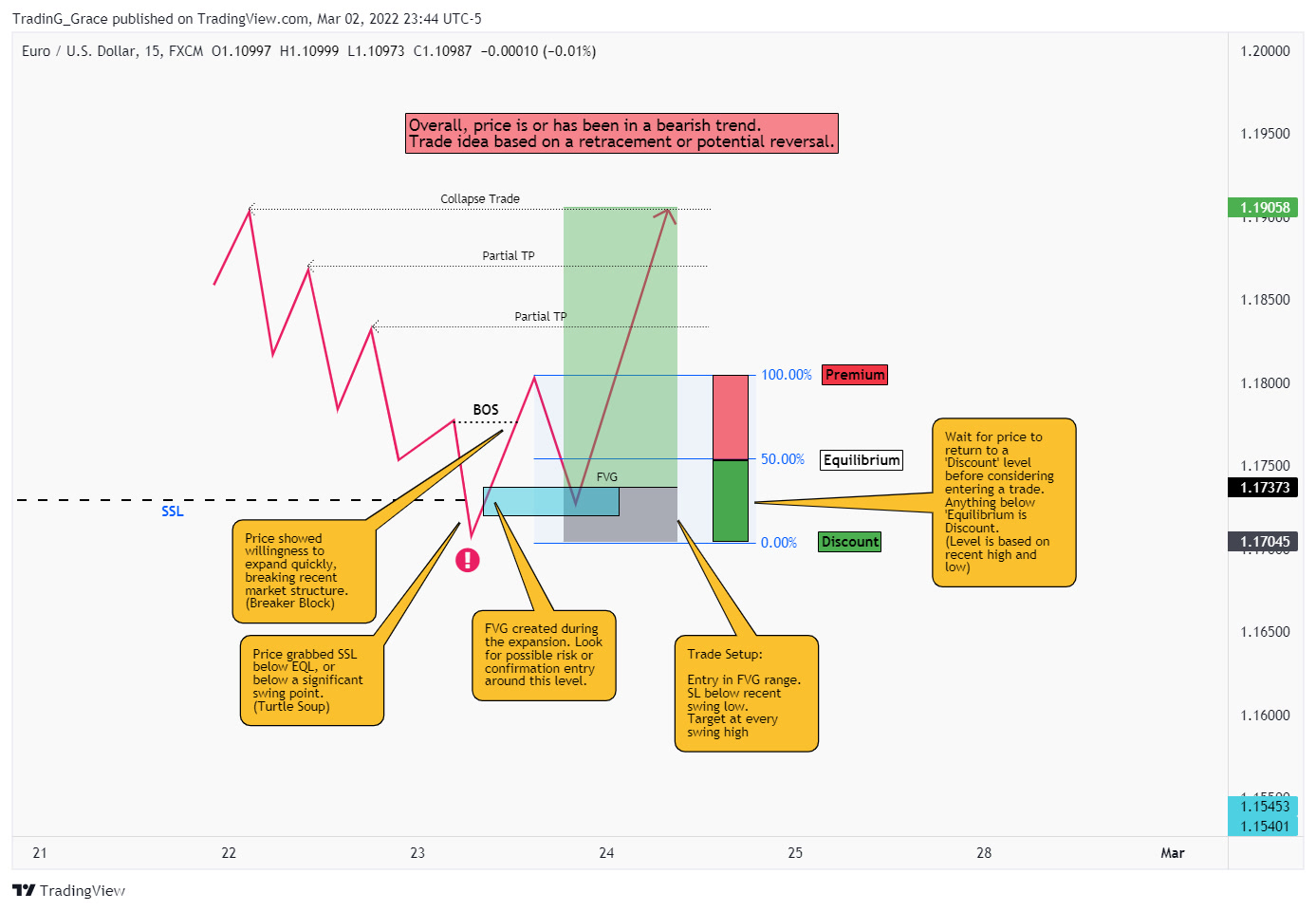
April 2022. GBPUSD, 15-minute chart, early London session. I had a textbook setup, displacement through Asian range highs, a clean Fair Value Gap formed at 1.3042 to 1.3051, higher timeframe bullish bias confirmed on the 4H with a fresh BOS through a significant swing high. I sized in at 1.3047, stop at 1.3028, targeting 1.3110. Risking 1% of a $100k funded account.
Stopped out at 1.3028 within forty minutes. Clean stop hunt below the FVG. I watched price sweep the liquidity, close back inside the gap, then immediately reclaim the level, the textbook inducement move. So I re-entered at 1.3049. New stop at 1.3021. Still bullish. Still within my daily drawdown limit.
Stopped out again.
Price reversed hard. By the time I finally stepped away, I'd taken three consecutive losses on what I had assessed as variations of the same setup, burning through 3.2% of the account in under two hours. The account had a 4% daily drawdown limit. I was done for the day, and nearly done with the account itself.
Here's what made it insidious: I genuinely believed I was being disciplined. I wasn't doubling lot sizes in a panic. I wasn't abandoning my framework. I was re-analyzing, re-confirming, re-entering. To anyone watching, it probably looked like process-driven trading. It was actually revenge trading dressed in ICT clothing.
The Real Trigger Isn't Anger, It's Statistical Injustice
Every article you've read about revenge trading says the same thing. You got emotional. You lost control. You need to step away and cool down. That advice isn't wrong exactly, but it misidentifies the root cause for a significant portion of traders, especially those who've put serious time into a high-conviction methodology like ICT.
When you've spent hundreds of hours learning to identify displacement, liquidity sweeps, FVGs, order blocks, premium and discount arrays, when you can look at a chart and build a genuinely sophisticated case for a directional move, your brain doesn't reach for emotion after a stop-out. It reaches for logic. Specifically, a flawed form of logic that sounds like this: "My analysis was correct. The execution was slightly off. The bias hasn't changed. Therefore, re-entering is the rational move."
Neuroscientists call the underlying mechanism the "gambler's fallacy", the mistaken belief that past outcomes influence future probabilities in independent events. But in trading, there's a more specific variant at play. Call it statistical justice syndrome: the belief that a well-reasoned trade that lost is somehow owed a correction by the market. That because your confluence was high, the universe has an outstanding debt to you.
It doesn't. Markets don't care how good your setup was. Price doesn't owe you a recovery because you identified a clean FVG in the right session window with HTF alignment. The stop-out was data. Your bias was invalidated. But high-confluence frameworks make this lesson nearly impossible to accept in real-time, because the same analytical rigor that made you confident in the first place now generates equally confident reasons to re-enter.
This is precisely why ICT traders are uniquely vulnerable to this trap. The framework is designed to build conviction. When a 9/10 setup fails, the trained response isn't "maybe I was wrong", it's "the entry timing was off" or "the stop was too tight" or "I should've waited for the re-entry after the sweep." And all of those rationalizations might even be technically true. That's what makes it so dangerous.
For more on how the ICT framework can be misapplied under pressure, this breakdown of common funded account mistakes covers several patterns that show up repeatedly in blown accounts.
The Archetype I See Over and Over Again
There's a specific trader who falls hardest into this trap. They're not a beginner, beginners make impulsive revenge trades that are obviously emotional. This trader has 12 to 24 months of ICT study behind them. They post detailed markups. They understand narrative. They can articulate liquidity theory with real confidence.
What they haven't developed yet is the ability to distinguish between a setup being valid and a bias being active. These are not the same thing. A setup can be technically valid, all the confluence boxes ticked, while the underlying directional bias has already been invalidated by how price actually moved. After a stop-out that sweeps into your FVG and then reverses hard through your entry, the bias is gone. Price told you something. But this trader doesn't hear that message, because they're too focused on whether their entry criteria were met.
They re-enter. Sometimes they're right. When they are, it reinforces the behavior. When they're wrong again, the cycle deepens, and now they're also dealing with a thinned account and mounting psychological pressure heading into the next session.
If this pattern sounds familiar in the context of ranging market conditions, where setups look clean but never follow through, this piece on why ICT order blocks keep failing in sideways volatility is worth reading alongside this one.
A Practical Framework for Breaking the Loop

I used to tell myself I'd "take a break" after a losing trade. That advice never worked for me, because it doesn't address the cognitive distortion. Here's the actual framework I've built after years of watching this pattern in my own trading:
Step 1: Classify the stop-out within 5 minutes of it happening.
Force yourself to answer one question immediately: Did price invalidate my bias, or just my entry? These require different responses. If the stop-out was a tight-stop inducement and price has since reclaimed the level and closed back inside the FVG, that may genuinely be an entry refinement issue, and re-entry has a case. But if price ran aggressively through your entry, closed through your order block, and broke the swing that defined your bullish/bearish narrative, your bias is dead. Write those words in your trading journal: BIAS INVALIDATED. Then close the chart.
Step 2: Apply the 30-minute hard rule, but make it mechanical, not emotional.
After a bias-invalidating stop-out, I have a literal timer rule. Thirty minutes minimum before I can look at that pair again. Not because I need to calm down emotionally (though that doesn't hurt), but because the bias contamination needs time to clear. My brain is actively looking for reasons to re-enter. That's not discipline, that's dopamine seeking. The timer creates a hard interrupt in the loop.
Step 3: On re-approach, require a new setup, not a re-entry justification.
This is the critical distinction. When the 30 minutes is up, I'm not looking for reasons the original trade was still valid. I'm approaching the chart as if I've never been in it. Is there a new structural reason to be bullish or bearish? Does the current price action tell a coherent narrative on its own merits? If I'm reaching, if I'm looking at the chart and mentally connecting dots to the trade I already lost, that's the revenge trading instinct talking. Close it and move on.
For position sizing specifically, I use a consistent formula to keep risk objective rather than emotionally adjusted after losses. The risk calculator here helps remove the discretionary element from that calculation when my judgment is most compromised.
Step 4: Track revenge trade attempts, not just revenge trades.
Most traders only journal completed trades. Start journaling the moments you almost re-entered and didn't. Over weeks, you'll see a pattern, which sessions, which pairs, which setup types trigger the impulse most strongly. That data is more valuable than almost anything else you can collect, because it shows you exactly where your statistical justice syndrome is most active.
The Counterintuitive Truth About High-Conviction Frameworks
Here's what a decade of doing this teaches you: the better you get at building a trade case, the more dangerous a single loss becomes, because your confidence in the framework scales faster than your humility about any individual trade.
ICT concepts are genuinely powerful tools. The FVG checklist, the liquidity grab identification, the premium/discount framework, these work, and they work often enough that high conviction is frequently rewarded. But that reward history is exactly what makes the brain misfire after a loss. It creates an expectation of statistical justice that the market has no obligation to fulfill. You can be right about the structure and still wrong about the trade.
The traders who navigate this best aren't the ones with the most discipline in the traditional sense. They're the ones who've genuinely internalized that each trade is independent, that a stopped-out setup doesn't create probability debt, it creates a clean slate. That reframe is harder to build than any technical skill, but it's what separates sustainable performance from the cycle of good streaks followed by single-session account damage.
According to research published through behavioral finance literature, loss aversion causes traders to take on disproportionate risk after losses, not less, as most people assume, specifically because the pain of a loss activates the same neural pathways as physical threat responses. The market doesn't trigger revenge trading. Your brain's threat response does. Understanding that distinction changes how you approach the fix. Investopedia's breakdown of trading psychology covers some of the foundational research if you want the academic backing.
What to Do Next
If you're in a funded account challenge right now and you've had a session where you took multiple losses on the same pair within a few hours, go back and classify each re-entry. Was it a genuine new setup with a fresh narrative, or was it a bias continuation dressed up in new confluence? Be honest. The answer will tell you more about where you are psychologically than any P&L number.
If you want a more structured environment for working through this in real-time, with someone who's lived through the exact account blow-up described above and rebuilt from it, the coaching plans here outline what working together actually looks like. The Full Mentorship runs $1,000 over four months. Pro is $200/week. Lite is $150/week. Or if you're still figuring out whether structured coaching is even the right move, book a free discovery call and we'll figure that out together before you commit to anything.
Revenge trading doesn't announce itself. It arrives wearing your own analytical voice. Learning to recognize it is one of the most valuable skills you'll ever build.
Harvest Wright
ICT Trading Coach · 10+ Years Experience
Harvest specializes in ICT methodology and has helped traders pass prop firm challenges, develop consistent strategies, and build the psychology needed for long-term profitability.
Book a Free Discovery Call →Ready to Get Funded?
Our students pass prop firm challenges in under 60 days with personalized ICT coaching.
Book a Free Discovery CallFree ICT Funded-Trader Playbook
The setups, the pre-trade checklist, and the risk rules I use. Get it free.