
How Revenge Trading Rewires Your Brain
Almost every trader has done it. The loss hits. The stop triggers. And before rational thought even has a chance to load, there's already a hand on the mouse, sizing up the next entry, bigger this time, angrier this time. Revenge trading doesn't feel like a mistake in the moment. It feels like justice.
Key Takeaway: Revenge trading is not a willpower failure, it's your brain's hardwired threat-neutralization response activating after a perceived attack. ICT traders are uniquely vulnerable because the system's precision creates a false expectation of control, making normal losing trades feel like betrayals rather than variance.
Why 'Just Follow Your Rules' Is Completely Wrong Advice
Every article on revenge trading gives you the same prescription: slow down, follow your plan, don't trade emotionally. It's the trading equivalent of telling someone in the middle of a panic attack to just calm down. Technically true. Completely useless.
Here's what nobody talks about: the moment you take a loss on a well-executed setup, your body can react to it as a threat, in a similar way to a social rejection or a scare. Stress goes up, careful planning gets harder, and your survival instincts take the wheel.
The revenge trade isn't greed. It's your threat-neutralization system trying to eliminate the source of danger. The market took something from you, so the brain's answer is to go back at it, harder, faster, bigger, to reassert control and extinguish the threat signal. Willpower doesn't fix this. You can't out-discipline a survival response. That's not how neurological loops work.
I used to get this completely wrong. Early in my career, every bad trading week was followed by a personal lecture to myself about discipline. More rules, tighter checklists, stricter pre-trade routines. And it helped, until it didn't. The next significant loss would come, and the same loop would activate. Because I was treating the symptom (the impulsive trade) instead of the mechanism (the threat response).
Why ICT Traders Are Disproportionately Vulnerable
Most trading frameworks are vague enough that losses feel like ambiguity. "The trend didn't continue" or "the setup didn't work out", these are fuzzy explanations that let the brain file the loss under acceptable variance.
ICT is different. And this is the nuance I almost never see discussed.
When you're operating with order blocks, fair value gaps, liquidity sweeps, premium/discount arrays, and killzone timing, you're working with a system that implies precision. The framework tells you where smart money is positioned, when they're likely to act, and at what price levels. When you execute that setup correctly, correct bias, correct PD array, correct entry model, and it still stops you out, something neurologically different happens.
It doesn't feel like variance. It feels like betrayal.
The brain had a model. The model was specific. The model was violated. And that violation registers as a more intense threat signal than a vague setup failure would. The higher your confidence in the precision of your framework, the harder the cognitive dissonance hits when the trade doesn't conform. Which is why I think ICT traders often feel normal losing trades more sharply than traders using looser methods.
This is compounded during volatile market conditions like the ones Q2 2026 has already delivered. When the broader structure is shifting and your setups are failing at a higher rate than usual, the brain starts interpreting each loss not just as a single threat but as evidence that control itself has been lost. That's when revenge trading spirals become most dangerous.
A Worked Example
Here's the kind of moment I mean.
Picture GBPUSD on the 15-minute during the London session. The higher timeframe bias is bearish: the daily is bearish, and the 4H has swept equal highs and displaced lower. During the London open killzone, price comes back up into a 4H bearish order block. There's an FVG inside the block, and the 15-minute showed a break of structure down before the retracement. Textbook.
The short goes in at the order block. The stop goes just above it, because if price closes above the OB the bearish idea is in trouble. The target is the Asia session low, the obvious sell-side liquidity below.
Then price pokes just above the stop, takes it out, and the expected move happens without you. A classic stop hunt above the OB. A full 1R loss on a correctly identified setup. (One lesson in there: a stop placed right at the obvious edge of the block is exactly where resting liquidity sits. Placing it above the swept equal highs instead is often the cleaner invalidation point.)
In that moment, the pull toward a revenge trade is visceral. The market took the stop, showed the read was directionally right, and left you on the sideline. Everything in you wants to re-enter immediately at double size and "take back" what was taken.
Recognizing that impulse as a threat response, rather than market insight, is what stops a normal loss from turning into a bad day. That re-entry, at the wrong price with inflated size, would come from the urge to neutralize the threat, with no valid setup behind it.
The Archetype I See Most Often
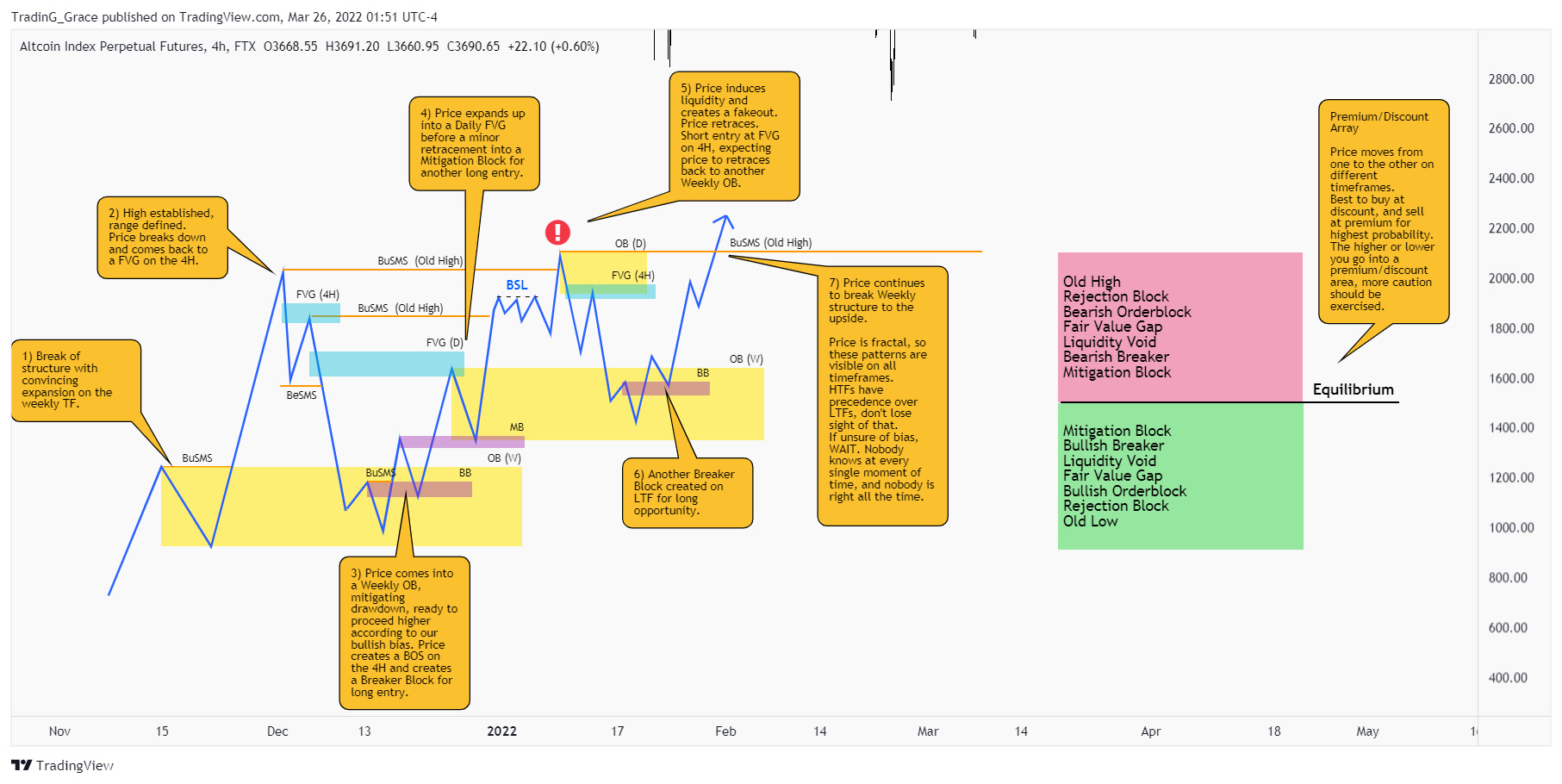
There's a specific trader pattern that I see constantly in the ICT community. They execute beautifully on their first trade of the session, correct bias, clean entry, proper risk. It loses. Maybe it's a stop hunt, maybe it's a failed setup, doesn't matter. The next trade they take is often:
- Larger size than their plan calls for
- Taken before the next legitimate killzone
- Entered on a lower timeframe than their primary model uses
What's happening there? The brain is trying to accelerate the threat neutralization. Bigger size = faster recovery = threat eliminated sooner. Skipping killzone timing = I need this resolved NOW. Dropping to a lower timeframe = finding any reason to enter, because the threat-response circuitry doesn't care about model quality, it cares about action.
This trader isn't undisciplined. They're biologically doing exactly what their nervous system is programmed to do. And the painful irony is that their ICT knowledge actually makes this worse, because they can always find some confluences on a lower timeframe to justify the entry their nervous system has already decided to make.
If this pattern is costing you accounts, this piece on 7 fatal mistakes that kill your funded account challenge success goes into the downstream consequences in detail.
Pattern Interruption: A Practical Framework That Actually Works
Since willpower doesn't fix a threat response, pattern interruption does. Here's the exact process I use and what the logic behind each step is:
Step 1, Name the state, not the trade. Immediately after a stop triggers, say out loud (or write): "My threat response is active." Not "that was a bad trade" or "the market hunted my stop." The specific language matters. Naming the state puts some distance between you and it, and gets you thinking in words again instead of just reacting.
Step 2, Mandatory 15-minute hard stop. Not optional. Close the platform if you need to. A stress response takes time to settle. Fifteen minutes of non-market activity, a walk, water, anything physical, gives it room to come down. Revenge trades tend to happen fast, right after the loss, so simply outlasting that first rush changes a lot.
Step 3, Return to the higher timeframe bias check. Before any re-entry, go back to the daily and 4H. Not to find a new trade, to confirm whether the original bias is still valid. This step forces the brain into analytical mode and interrupts the impulse loop. If the bias is intact, you wait for the next legitimate killzone setup. If the bias has changed, you have your answer anyway.
Step 4, Halve your risk on the next trade. This isn't punishment. It's strategic. Reducing position size lowers the emotional stakes of the next outcome, which keeps the threat response below activation threshold. Use the risk calculator to set this deliberately before you enter. A 0.5% trade after a 1% loss feels boring, and boring is exactly what you want your nervous system feeling.
Step 5, Post-session state log, not just trade log. At the end of the day, track your emotional state at entry, not just the technical parameters. You'll start seeing the pattern: certain loss types (stop hunts on confirmed setups, specifically) are your personal trigger. Once you know your trigger, you can recognize the threat response before it escalates rather than after.
For a deeper look at how liquidity mechanics interact with these stop hunt setups specifically, this breakdown of ICT liquidity grabs vs. stop hunts is worth reading alongside this framework.
The Uncomfortable Truth About Control
The deepest issue underneath all of this, and the one that takes years to genuinely internalize, is that ICT doesn't give you control over outcomes. It gives you a high-probability framework for identifying where institutional activity is likely to occur. Likely. Not certain.
A 70% win rate system still loses 30% of the time by design. That's not system failure. That's statistics. But the precision of the ICT model makes the brain treat every loss in that 30% as an anomaly that shouldn't have happened, which is exactly the cognitive framing that turns a normal losing trade into a perceived attack.
The traders I've seen last over time aren't the ones with the most discipline. They're the ones who've genuinely internalized that losses are outputs of the system, not violations of it. That reframe doesn't come from reading articles. It comes from repetition, pattern tracking, and, for most people, having someone in their corner who can hold that perspective when the threat response is screaming that it's wrong.
If you're at a point where the psychological side of trading is costing you as much as the technical side, look at the coaching plans to see what structured support looks like. The Lite plan at $150/week through to the Full Mentorship at $5,000 for 4 months, different levels of involvement depending on where you are.
Or if you want to start by understanding what's actually going wrong in your process, book a free discovery call and we can look at it directly.
The revenge trade isn't proof that you're weak. It's proof that your brain is working exactly as designed, in an environment it wasn't designed for. That's a very different problem. And a very different solution.
Published April 29, 2026, R2F Trading
Harvest Wright
ICT Trading Coach · 10+ Years Experience
Harvest specializes in ICT methodology and has helped traders pass prop firm challenges, develop consistent strategies, and build the psychology needed for long-term profitability.
Book a Free Discovery Call →Ready to Get Funded?
1-on-1 ICT coaching built around prop firm rules, from a trader who has passed an FTMO Challenge.
Book a Free Discovery CallFree ICT Funded-Trader Playbook
The setups, the pre-trade checklist, and the risk rules I use. Get it free.