
Why Order Blocks Fail in Ranging Markets (Fix)
There are stretches, often after a big news event like NFP, when the market goes sideways and traditional ICT order blocks start failing left and right.
If you've been getting whipsawed in a sideways market, you're not alone. When price grinds between higher timeframe levels, the standard order block approach needs serious adjustments.
Let me show you why this happens and how to fix it.
Key Takeaway: Order blocks lose their edge in ranging conditions because price is grinding between institutional levels instead of trending away from them, so filter your setups by requiring confluence with the range boundaries before trusting any OB reaction.
Why Traditional Order Blocks Fail in Ranging Markets
The Ranging Market Structure Problem
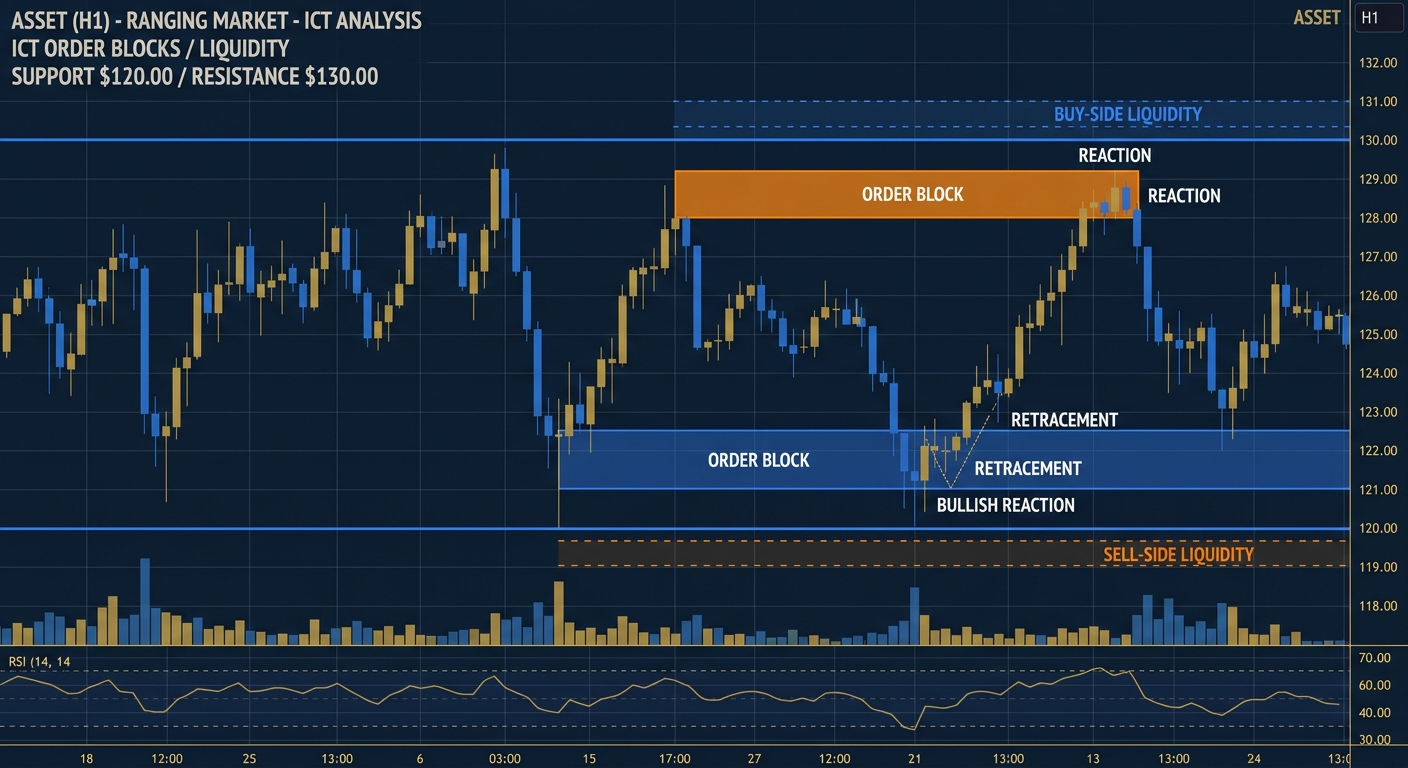
In a range, price respects the major higher timeframe levels but oscillates back and forth between them, sometimes for weeks.
When markets range like this, traditional order blocks behave differently. Instead of clean rejections and strong directional moves, you get:
- Partial fills that reverse before hitting targets
- Multiple taps of the same order block without invalidation
- False breakouts that quickly return to range
The biggest mistake I see traders make in ranging markets is expecting trending market behavior from consolidating price action.
The Liquidity Distribution Issue
In trending markets, liquidity pools are clearly defined, they sit at obvious highs and lows. But in ranging markets, liquidity gets distributed across multiple levels within the range.
This creates what I call "liquidity fragmentation." Instead of one clean sweep, institutions are taking liquidity in smaller chunks throughout the range. Your order blocks still work, but they work differently.
The 3-Step Fix for ICT Order Blocks in Ranging Markets
Step 1: Adjust Your Order Block Selection Criteria
In ranging markets, not all order blocks are created equal. I've developed specific criteria for identifying the ones that actually work:
High-Probability Range Order Blocks:
- Must be within 15-20 pips of range extremes
- Formed during London or New York killzones
- Show clear imbalance (Fair Value Gap) below/above
- Have at least 3 untested liquidity levels nearby
Avoid These Order Blocks:
- Mid-range order blocks (they're liquidity magnets)
- Blocks formed during Asian session low-volatility periods
- Any block that's been tested more than twice
Picture EUR/USD reacting to a mid-range order block, giving you a small bounce, then reversing straight through it. The real move comes from the range high, where the liquidity actually sits.
Step 2: Modify Your Entry and Exit Strategy
Entry Adjustments: Instead of entering immediately at order block boundaries, wait for confirmation:
- Market structure shift (break of previous high/low)
- Imbalance fill (Fair Value Gap getting filled)
- Displacement move of at least 15-20 pips
Exit Strategy for Ranges:
- Take profits at 50% of range width maximum
- Use trailing stops once you're 1:1 risk-reward
- Don't hold for massive runners, they rarely come in ranges
For example, if trading a range from 1.0800 to 1.0900 (100-pip range), take profits around 50 pips maximum. I used to hold for full range moves and watch profitable trades reverse back into the range.
Step 3: Time Your Entries with Killzone Analysis
Ranging markets are heavily dependent on session-based flows. Here's my killzone approach for ranging conditions:
London Open (3:00-5:00 AM EST):
- Best for range boundary reversals
- Focus on order blocks near range extremes
- Avoid mid-range setups completely
New York AM (8:30-10:30 AM EST):
- Prime time for breakout attempts
- If price breaks range during this window, it often sticks
- Order blocks outside the range become high-probability
Lunch Hour (11:30 AM-1:30 PM EST):
- Skip this completely in ranging markets
- Low volume creates false signals
- Save your risk capital for better opportunities
As I discussed in my breakdown of NFP week liquidity patterns, timing becomes even more critical when volatility is compressed.
A Worked Example: EUR/USD Range Trade
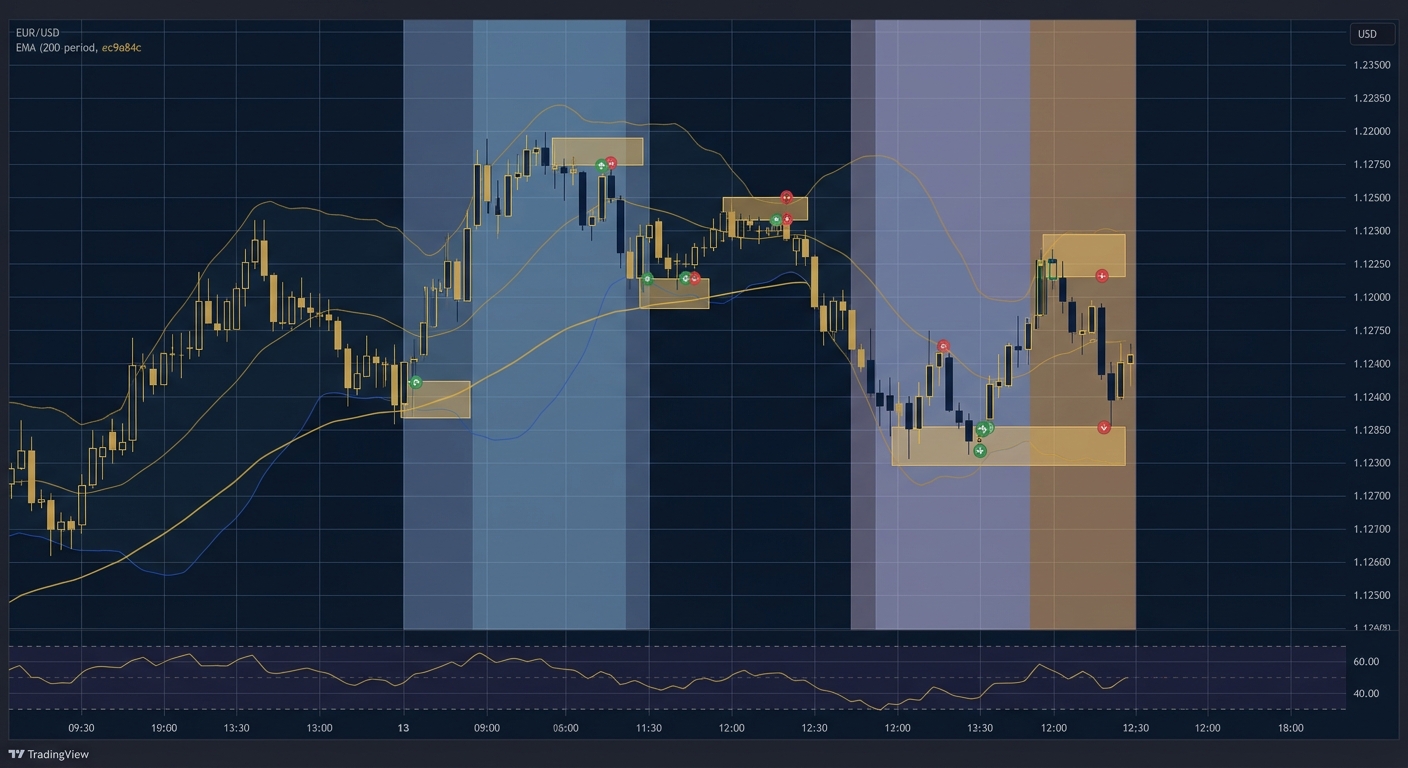
Here's what a ranging market setup looks like:
The Setup:
- A clearly defined range on EUR/USD
- A bearish order block just under the range high
- Buy-side liquidity resting just above the range high
- A small Fair Value Gap sitting inside the order block
The Plan:
- Wait for the London open displacement lower
- Enter short when price retraces into the FVG
- Stop a few pips above the range high, because a clean break above it means the range is over
- Target the range mid-point, roughly half the range width
Why It Works: The stop is tight to the range boundary, and the target is realistic for a range, so the risk-reward can still be good. The key is adjusting expectations and taking profits at the mid-point instead of waiting for a full range reversal.
How to Identify When Ranges Are About to Break
Here are the warning signs that your ranging market order block strategy needs to shift:
Bullish Breakout Signals:
- Multiple rejections at range lows with decreasing momentum
- Volume expansion on bounces from support
- Higher lows forming within the range
- Major resistance getting tested during high-impact news
Bearish Breakdown Signals:
- Weakening bounces from range highs
- Lower highs pattern developing
- Support tests happening during risk-off sessions
- Clear institutional order flow to the downside
When I see these patterns developing, I adjust my ICT premium/discount array strategy to prepare for the breakout move.
Common Mistakes That Will Blow Your Account
Mistake #1: Fighting the Range Trying to force trending market strategies on ranging price action. It's one of the most common ways traders bleed an account.
Mistake #2: Overleverage in Low Volatility Just because ranges seem "safer" doesn't mean you should increase position size. Whipsaws can be brutal.
Mistake #3: Ignoring Session Characteristics Trading Asian session order blocks in ranging conditions is usually a losing game. Stick to London and New York.
Mistake #4: Holding for Home Runs In ranges, singles and doubles win the game. Leave the home run swings for trending markets.
What This Means for Your Trading Plan
If you're struggling with order blocks in ranging conditions, you're not broken. Your strategy just needs adjusting to the market in front of you.
The traders who adapt their ICT concepts to current market conditions are the ones who stay consistently profitable. Those who rigidly stick to "trending market" approaches often find themselves on the wrong side of multiple whipsaws.
Frequently Asked Questions
How long do ranging market conditions typically last?
There's no fixed answer. A range can last days or weeks, and it usually ends when a new catalyst, like a central bank decision or major data, gives price a reason to expand. Watch the breakout signals above instead of counting days.
Should I avoid trading completely during ranging markets?
Absolutely not. Ranging markets can offer good trading opportunities when you adjust your approach, because the boundaries give you clear levels to trade from.
Can I use the same order block for multiple entries in a range?
Yes, but with caution. I typically allow 2-3 tests of a range boundary order block before considering it "worn out." After that, look for fresh levels.
Your Next Steps
If you're ready to master ICT order blocks in all market conditions, not just trending markets, you need structured guidance and real-time feedback.
The concepts I've shared today are just the beginning. There's a deeper level of understanding about institutional order flow, liquidity manipulation, and market structure that takes most traders years to develop on their own.
That's why I created my coaching plans to accelerate your learning curve. Whether you're just starting with our Lite Plan ($150/week) or ready for the Full Mentorship program ($5,000 for 4 months), we'll work together to build your ranging market skills systematically.
The key is getting personalized feedback on your order block selection and trade management during these tricky ranging conditions.
Ready to stop getting whipsawed by sideways markets? Book a free discovery call and let's discuss your specific challenges with ICT order blocks. I'll show you how to adapt your strategy to the market you're actually trading.
Remember: consistency comes from adapting to market conditions. Master ranging market order blocks now, and you'll be well prepared when trending conditions return.
Harvest Wright
ICT Trading Coach · 10+ Years Experience
Harvest specializes in ICT methodology and has helped traders pass prop firm challenges, develop consistent strategies, and build the psychology needed for long-term profitability.
Book a Free Discovery Call →Take Your Trading to the Next Level
Get personalized 1-on-1 ICT coaching with Harvest Wright. Free discovery call, no commitment.
Book a Free Discovery CallFree ICT Funded-Trader Playbook
The setups, the pre-trade checklist, and the risk rules I use. Get it free.