
NFP Week Liquidity: ICT Entry Opportunities
After 10+ years of trading through NFP releases, I've come to treat Non-Farm Payroll week as its own thing. The days before the release build up liquidity on both sides of the range, and if you map it with ICT concepts, the release day stops feeling like a coin flip.
Key Takeaway: NFP week tends to build liquidity on both sides of the range before the release. Map the fair value gaps and order blocks on the 15-minute to 1-hour timeframes during the pre-NFP sessions, then let the release sweep one side before you look for an entry.
Why NFP Week Needs Its Own Game Plan
NFP isn't just another data point. Positioning into the release changes how price behaves across the whole week. There are three things I watch for:
- Pre-NFP liquidity raids earlier in the week as price runs one side of the range
- A whipsaw initial reaction followed by the real move
- Overnight positioning that leaves order blocks and gaps outside the main sessions
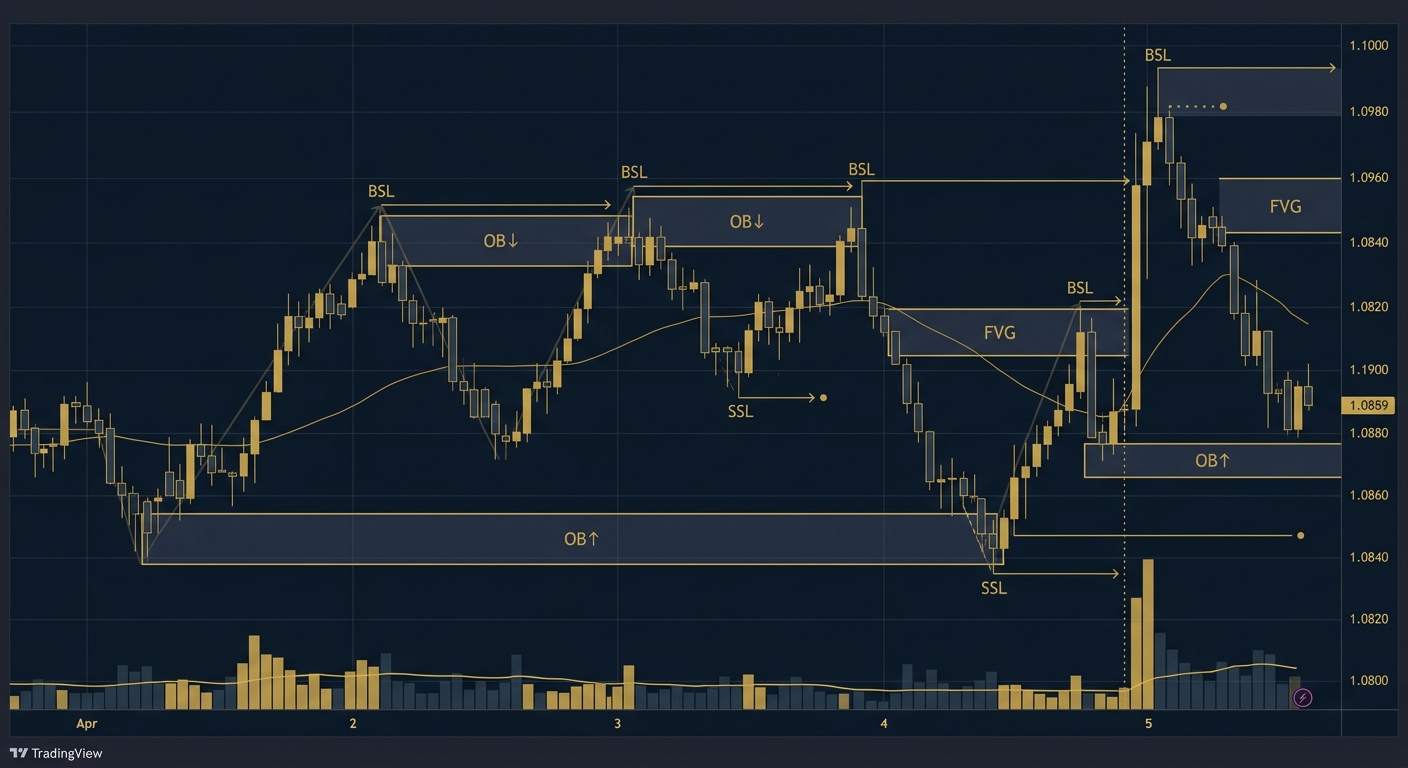
The ICT Framework for NFP Week Trading
Understanding Market Structure During High-Impact News
When I teach my coaching plans, I always emphasize that NFP week requires a completely different approach to reading market structure. The traditional ICT concepts still apply, but with critical modifications.
Order blocks during NFP week can form in less obvious places. Instead of only at the typical swing highs and lows, look at the overnight sessions too, roughly 2-4 AM EST, where quieter conditions can leave small consolidations that later act as order blocks.
Fair Value Gaps (FVGs) in the 24-48 hours before NFP are worth marking carefully. Price often goes quiet into the release, so gaps can sit open longer than usual and become reference points once the data drops. For a deeper breakdown of how to validate these setups, the ICT Fair Value Gap checklist of 9 pre-trade confirmations is an essential reference before NFP week.
The Pre-Release Killzone
On release day, the window between the London killzone and the 8:30 AM EST print matters. Roughly 6:30-8:30 AM EST, price often runs one side of the overnight range before the number comes out. That sweep is information, and it's what I build the plan around.
A Worked Example
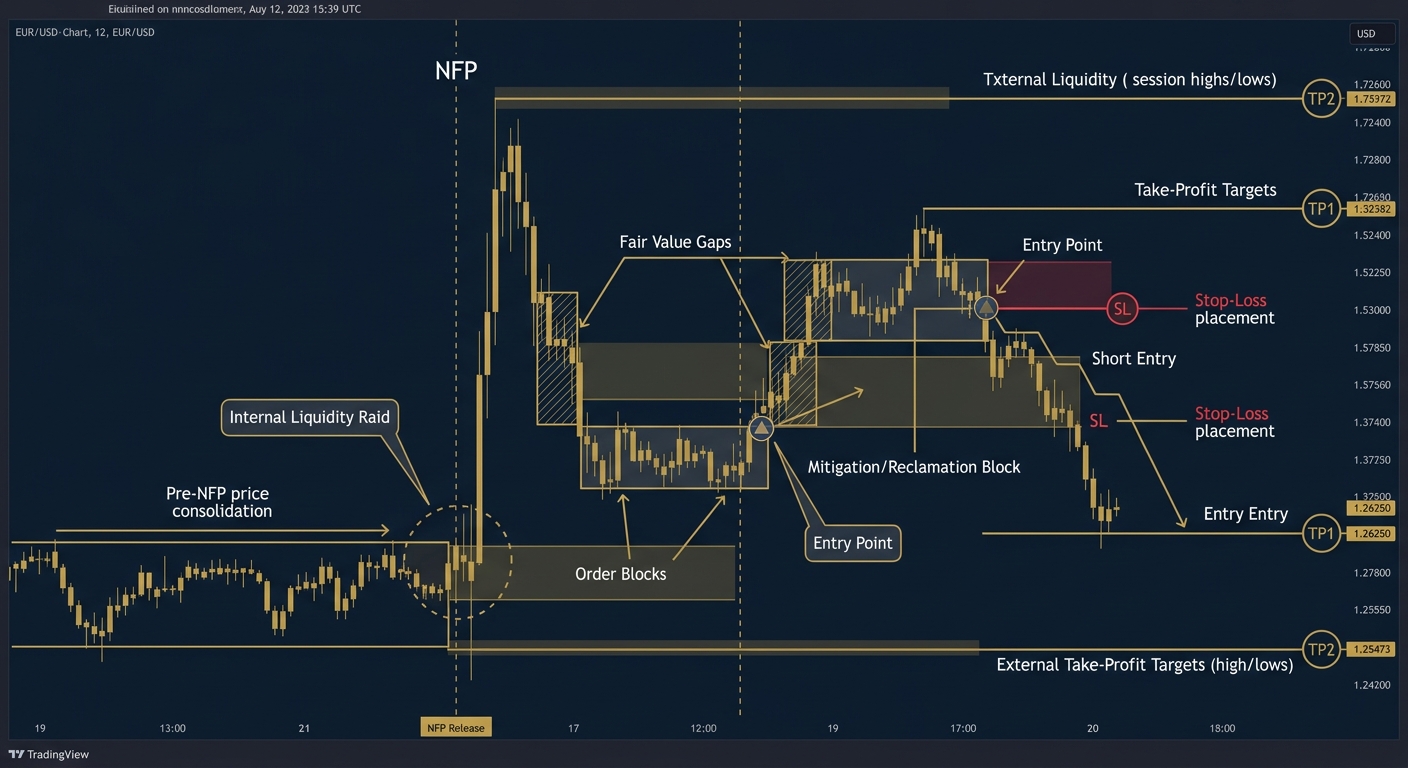
Here's the kind of setup I mean. Picture EUR/USD ranging for a few days into NFP. On the surface it looks like nothing is happening, but the liquidity map tells a story:
- An Asian session raid of a recent high midweek
- An unfilled FVG left from an earlier London open
- A small order block formed during an overnight session
The obvious liquidity everyone is watching sits above the previous week's high. Further below, there's a higher timeframe order block acting as the bigger draw on liquidity.
On Friday morning, price sweeps the recent high in the pre-release window and reverses. That's the trigger to look for a short: the entry comes on the retrace into the FVG, the stop goes above the sweep high (if price takes that out, the idea is wrong), and the first target is the sell-side liquidity at the bottom of the range, with the higher timeframe order block as the bigger target if the move extends.
Why This Setup Makes Sense
The logic has three parts:
- Liquidity built up on both sides during a quiet, ranging week
- One side got swept right before the release
- A clear draw on liquidity sat on the other side, so the target wasn't a guess
None of this guarantees a win. It just gives you a plan with a defined invalidation instead of a guess on the number.
The Three-Phase NFP Week Strategy
Phase 1: Pre-NFP Positioning (Tuesday-Thursday)
Tuesday Focus: Identify potential order blocks forming during overnight sessions. These often appear as small consolidations between 2-6 AM EST.
Wednesday Analysis: Look for liquidity raids of the early-week highs or lows. Note which side has been taken and which side is still resting.
Thursday Confirmation: Watch for FVG formations during London open. If they remain unfilled past 10 AM EST, they become high-probability entry zones post-NFP.
Phase 2: NFP Release Day (Friday)
6:30-8:30 AM EST: This pre-release window is your primary hunting ground. Look for price to sweep obvious liquidity levels then reverse.
8:30-9:00 AM EST: The release itself can whipsaw both ways. Spreads widen and the first spike often reverses, so I'd rather wait than trade the print.
9:00 AM-12:00 PM EST: Once the dust settles, look for displacement and a fresh FVG in the direction of the move. That's usually a cleaner entry than the initial spike.
Phase 3: Post-NFP Follow-Through (Following Monday)
Asian Session: Often provides the final liquidity sweep to complete the weekly range.
London Open: Confirmation of the bias for the new week.
Many traders ignore Monday after NFP, but it's worth watching how price treats the NFP day high and low.
Common Mistakes That Kill Your NFP Trades
These are the errors I see most often around NFP, and they line up closely with what I covered in my recent article about fatal mistakes that kill funded account success.
Mistake #1: Trading the obvious levels Everyone sees the previous week's high and low. Smart money knows this and uses those levels to trap retail traders.
Mistake #2: Ignoring overnight structure A lot of the week's structure gets built while most traders are asleep. If you're not analyzing overnight price action, you're missing part of the story.
Mistake #3: Using standard position sizing NFP can move price much further and faster than a normal session, with wider spreads and slippage. Your risk management must account for this.
Why Retail Traders Keep Getting Caught
Plenty of traders try to trade NFP by guessing the number or chasing the first spike. That puts their stops in obvious places, which is exactly the liquidity the sweep goes after. Understanding how these traps are set is something I explored in depth when looking at how smart money plays mind games on retail traders, the same psychological patterns that play out every NFP week.
How to Prepare for the Next NFP
NFP usually lands on the first Friday of the month. Here's your preparation checklist for the week:
This Weekend:
- Mark all monthly and weekly order blocks on major pairs
- Identify unfilled FVGs from last week
- Set alerts for overnight session activity
Monday-Wednesday:
- Watch for early liquidity raids of the weekly range
- Track overnight order block formations
- Note which side of the range still has liquidity resting
Thursday:
- Finalize your bias based on FVG behavior
- Set conservative position sizes
- Plan multiple scenarios for Friday's killzone
Frequently Asked Questions About ICT NFP Trading
Should Beginners Trade NFP Week?
Honestly? Not without proper preparation. NFP volatility can destroy accounts quickly if you don't understand liquidity concepts. If you're new to ICT methodology, consider paper trading this setup first or focusing on our trading insights to build your foundation.
What Pairs Work Best for This Strategy?
I like EUR/USD and GBP/USD for this, and USD/JPY is worth watching too, with DXY as a reference for the dollar side. The key is choosing pairs where you can clearly identify the institutional order flow.
How Much Risk Should I Take?
Never more than 1% per trade, and consider reducing to 0.5% during NFP week due to the increased volatility. Remember, one good setup can provide weeks of profits, so don't risk your account chasing every opportunity.
Taking Your NFP Trading to the Next Level
Understanding these liquidity patterns is just the beginning. The real skill comes from reading price action in real-time and adapting to changing market conditions. This is exactly why I developed my structured approach to mentoring traders through these complex setups.
If you're serious about mastering ICT concepts like these, consider booking a free discovery call to discuss how my mentorship programs can accelerate your progress. Whether you choose the Lite Plan for weekly guidance or the comprehensive Full Mentorship program, having an experienced trader guide you through these nuanced setups makes all the difference.
NFP comes around every month, so you get plenty of chances to practice this. Start with the chart work and paper trade it before you put real risk on it.
Start preparing now. Mark your charts, set your alerts, and remember: the best opportunities often hide in plain sight during the most volatile weeks of the year.
Harvest Wright
ICT Trading Coach · 10+ Years Experience
Harvest specializes in ICT methodology and has helped traders pass prop firm challenges, develop consistent strategies, and build the psychology needed for long-term profitability.
Book a Free Discovery Call →Take Your Trading to the Next Level
Get personalized 1-on-1 ICT coaching with Harvest Wright. Free discovery call, no commitment.
Book a Free Discovery CallFree ICT Funded-Trader Playbook
The setups, the pre-trade checklist, and the risk rules I use. Get it free.