
The Silent Trade That Reveals Your Real Risk Tolerance
There's a kind of trade that deserves more attention in your journal than it gets. It isn't a loss. It goes almost perfectly. And that's exactly why it should bother you.
Every conversation about trading psychology circles the same drain: how do you handle drawdowns, how do you recover from a bad week, how do you stop revenge trading after three consecutive losses. These are real problems. But after more than a decade of trading, a lot of it with smart money concepts, I think something just as account-limiting goes almost completely unaddressed: what happens to traders psychologically when the trade works too well.
Key Takeaway: Profit anxiety, the impulse to close winning trades early when they threaten your internal 'ceiling', quietly caps a lot of trading accounts. Recognizing it requires studying your winners as forensically as your losers.
A Worked Example: Closing at 2R When the Target Was 4R
Picture GBPUSD on the 15-minute chart at the London open.
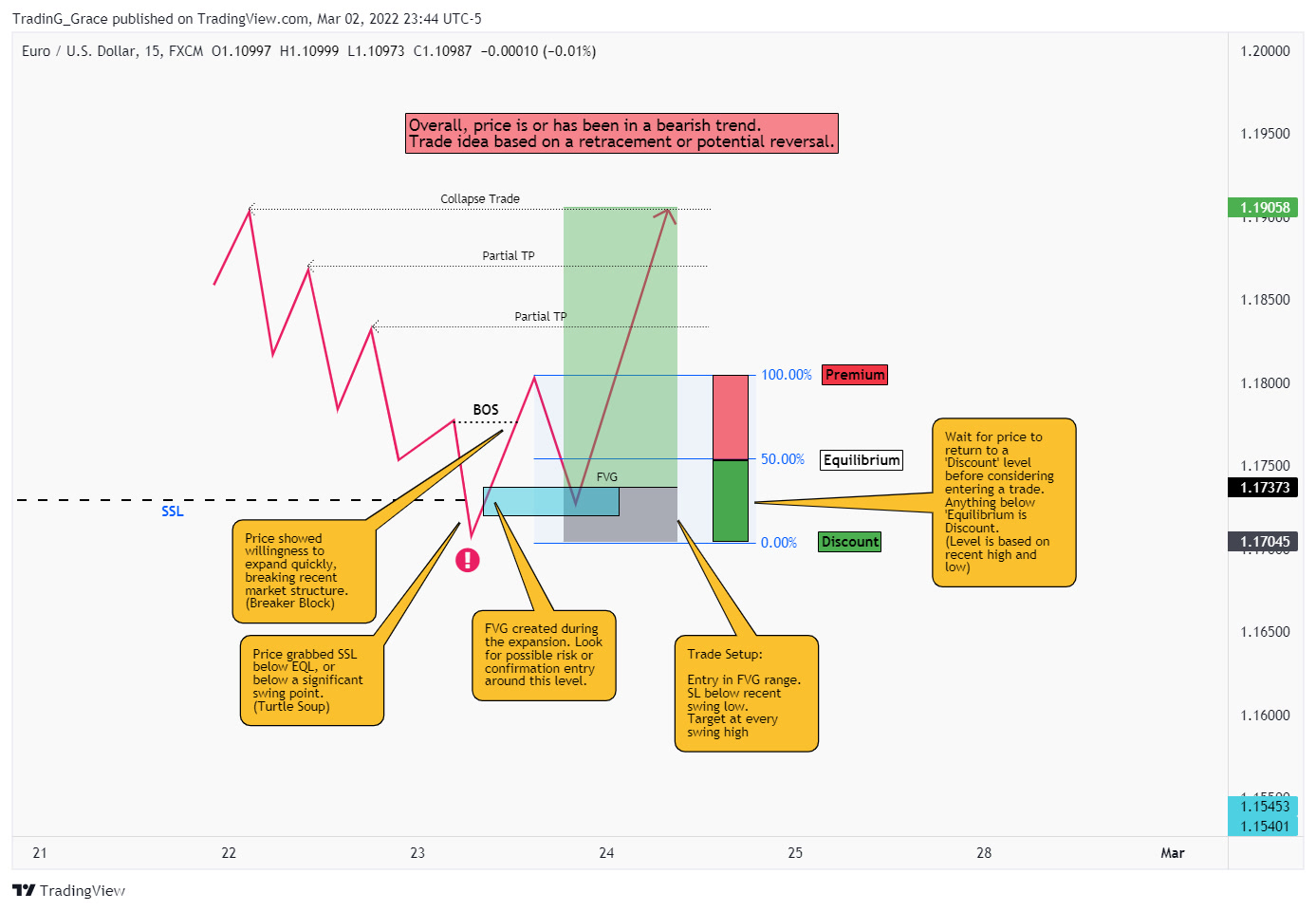
A clean three-candle displacement pushes through the Asian session highs and leaves a well-defined Fair Value Gap. The higher timeframe context is bullish: the daily chart shows price has swept equal lows from the prior week, and the draw on liquidity sits above at a clean double top. Textbook smart money concepts setup. Entry in the FVG, stop below the gap's origin because a move back through it means the displacement failed, target the buy stops resting above that double top, roughly 4R away.
Price moves immediately. No chop, no retest drama. A few hours later the trade is sitting at about 2R, with the draw still clearly above and nothing structural in the way.
The trader closes it.
There's no news, no structure break, no rule that says to exit there. They close it because a voice in their head says something this clean doesn't last. And in that moment, they listen to the voice instead of the chart.
That voice? That's profit anxiety. If price goes on to reach the draw, it cost them about 2R on a single trade, a loss most traders never even log as a mistake because, technically, they made money.
Why Your Winning Trades Are the Honest Mirror
Losses are emotionally loud. When you're in drawdown, you know it. The account balance screams at you. The emotional response is obvious and the feedback loop is fast. But winning trades, especially the ones that go in your favor immediately, create a different, quieter kind of psychological pressure.
Here's what actually happens, and most ICT content creators skip this entirely: as a trade moves into profit, your brain shifts from execution mode into protection mode. The goal quietly changes from "reach the draw on liquidity" to "don't give this back." At 1R profit, that shift is subtle. At 2R, it's loud. At 3R, for a lot of traders, it's overwhelming, and they exit regardless of what price is actually doing.
The cruel irony is that this is often when a smart money concepts setup is doing exactly what it should. A trade that's run to 2.5R in displacement, with no opposing order block overhead and the draw still clear, is not a trade you should fear. The market structure is confirming your read. But your nervous system is running a different calculation entirely, one based on your internal sense of how much you're "allowed" to make on a single trade.
That internal number? It's your real risk tolerance. Not the percentage you typed into your risk calculator. The psychological ceiling you'll unconsciously defend at all costs.
The Archetype I See Constantly
There's a specific type of trader I've observed repeatedly in trading communities and forums over the years. They post their entries, clean, well-reasoned, often using smart money concepts correctly. The order block was in discount. The FVG was respected. The draw was identified. And then the comments under their post say something like: "great entry, where'd you exit?" And they reply: "took profits at 1.8R, target was 4R but felt overextended."
Felt overextended. That phrase is everywhere. It's the linguistic fingerprint of profit anxiety.
What's actually happening is this: these traders have internalized a ceiling, usually somewhere between 1.5R and 2.5R, because that's historically where trades have turned against them on the occasions they held too long. One or two bad experiences with giving back profits becomes a subconscious rule, and that rule gets applied indiscriminately, even when the setup has nothing structurally in common with those past experiences.
The result is a win rate that looks fine (they close winners consistently) paired with a reward-to-risk ratio that's quietly bleeding the account over hundreds of trades. They're not losing. They're just never winning as much as they should be. The funded account challenge failure patterns this creates are subtle but devastating. Cut every winner short and the math gets tight fast: at a 50% win rate, a 1R average winner against a 1R average loser is breakeven before spread and fees, and a slow loser after them. That's the quiet math behind profit anxiety.
Draw on Liquidity as a Psychological Framework
One of the most useful reframes I've found, for myself and for understanding this pattern in general, is treating the draw on liquidity not just as a price target, but as a psychological anchor.
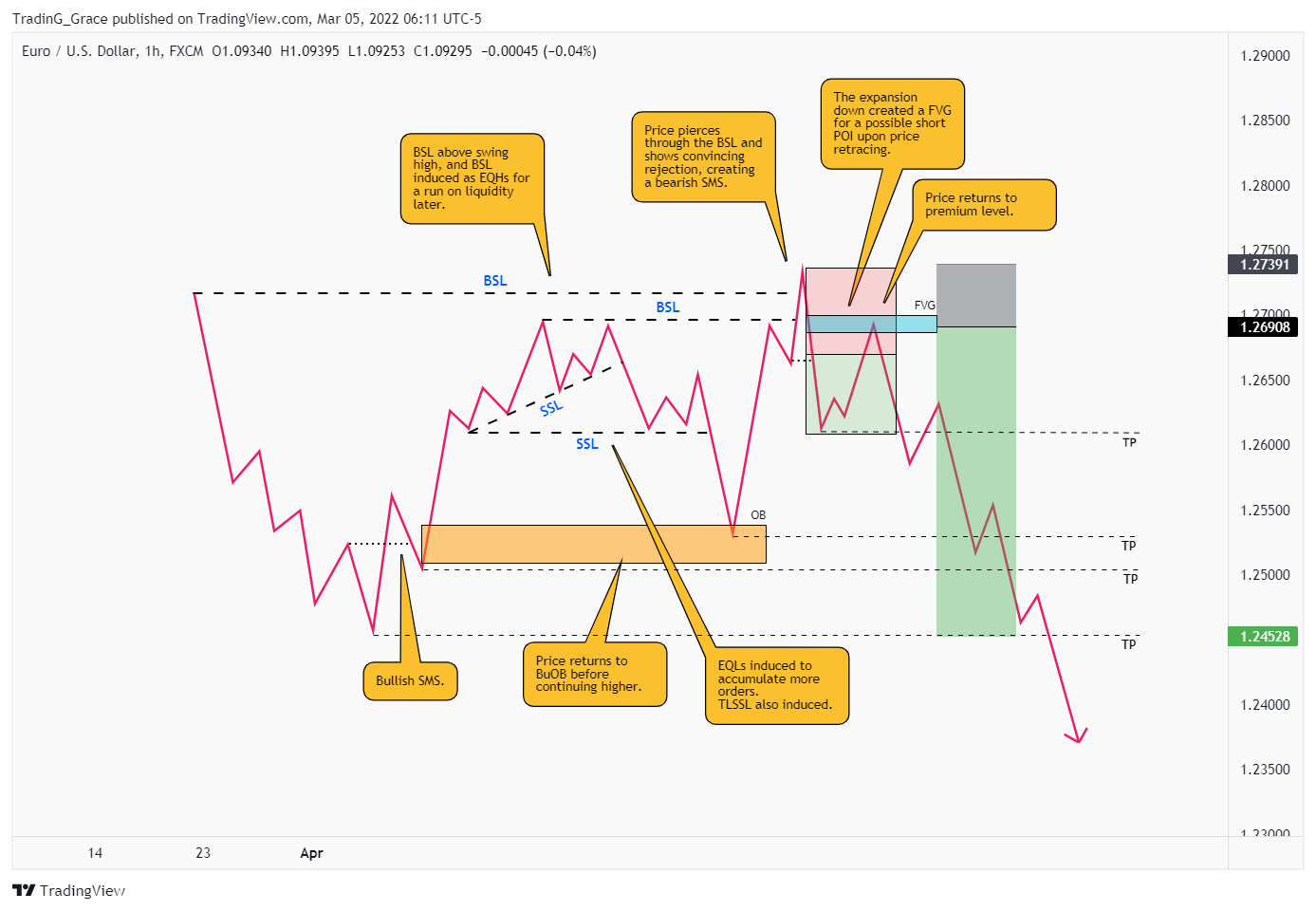
In smart money concepts, the draw on liquidity is the logical destination price is being engineered toward: old highs holding buy stops, equal lows packed with sell stops, a visible imbalance that needs to be filled. Price doesn't meander to these levels, it gets drawn to them because the orders sitting there need to be harvested. That's the mechanical reality.
But psychologically? The draw serves a different function. It gives you a reason to stay in the trade when your nervous system is screaming to exit.
When you're at 2R and the draw is still well above you, the question isn't "is this trade working?" It's already working. The question is: "has the reason I entered this trade changed?" If the FVG was respected, if no opposing OB has formed overhead, if structure hasn't shifted, the draw is still valid. The original thesis hasn't broken. Every exit before that draw is hit needs a structural reason, not an emotional one.
This sounds simple. It is genuinely hard to execute consistently. I used to get this wrong for years, treating discomfort at 2R as information, when it was really just noise from my own psychological ceiling.
A Practical Framework for Diagnosing Your Own Ceiling
Here's what I'd actually recommend doing, starting this week:
Step one, audit your last 20 winning trades. Not your losers. Your winners. For each one, record: what was the original draw on liquidity target? What R multiple did you close at? Was there a structural reason to close early, or was it purely discomfort?
Step two, calculate your "ceiling ratio." Take the average R you actually captured divided by the average R your setups theoretically offered. If your setups regularly offered 3-4R (measured to the draw) and you averaged 1.8R captured, your ceiling ratio is roughly 0.5. That gap can cost you more than your losing trades do.
Step three, identify the specific R level where your exits become emotionally driven. For a lot of traders, there's a clear inflection point. It might be 1.5R, might be 2R. Once you know it, you can treat it as a signal, not to exit, but to pause and look at the chart structurally before making any decision.
Step four, create a "hold checklist" that triggers at your ceiling. When a trade hits that level, run through three questions: Has structure broken? Has a new opposing OB formed between current price and the draw? Has the draw been reached or negated? If all three answers are no, your job is to stay in the trade. The checklist depersonalizes the decision at exactly the moment when emotions are loudest.
This isn't about forcing yourself to hold forever. Partial profits are legitimate and intelligent. The premium/discount array work I've written about previously covers exactly when to scale out within a move. The distinction is between scaling out because price is approaching a structural resistance level versus scaling out because you're uncomfortable with how well the trade is going. One is strategy. The other is self-sabotage wearing strategy's clothing.
The Uncomfortable Truth About Risk Tolerance
The percentage you risk per trade is not your risk tolerance. It's a setting on a calculator.
Your real risk tolerance is revealed in the moments where the market is agreeing with you, and you can't stand it. When smart money concepts are playing out exactly as anticipated, when the displacement ran clean, the FVG held, and price is pulling toward the draw with zero structural resistance, and you're still looking for reasons to exit, that's the moment. That's when you find out what you actually believe about your right to profit from this market.
For a lot of traders, especially those who've had their accounts blown in the past or who've spent time grinding through prop firm drawdown challenges, the ceiling is directly related to past pain. A trader who lost 20% of an account on a trade they held too long will often spend the next two years never holding a trade long enough. The overcorrection becomes permanent without intentional intervention.
That intervention starts with the audit. It starts with looking at your winners with the same forensic honesty you apply to your losses. Because the real story of what limits your trading isn't written in your worst trades. It's written in your best ones, the trades you closed too early, the draws you never let play out, the R you left on the table every week because some part of you decided that was more than you deserved to make.
Figuring out why that ceiling exists, and whether it's structurally justified or purely psychological, is some of the most important work a trader can do.
If you want to go deeper on this, the coaching frameworks at R2F Trading cover exactly this kind of psychological audit alongside technical development. Whether you're working through this solo or want structured accountability, the starting point is the same: look at your winners honestly.
Start with your last 20 winning trades. See where you closed them. See where the draw was. That gap tells you everything.
Harvest Wright
ICT Trading Coach · 10+ Years Experience
Harvest specializes in ICT methodology and has helped traders pass prop firm challenges, develop consistent strategies, and build the psychology needed for long-term profitability.
Book a Free Discovery Call →Ready to Get Funded?
Our students pass prop firm challenges in under 60 days with personalized ICT coaching.
Book a Free Discovery CallFree ICT Funded-Trader Playbook
The setups, the pre-trade checklist, and the risk rules I use. Get it free.