
The Confidence Trap: Why Good Trades Ruin You
Everyone in trading talks about losing streaks like they're the main villain. Revenge trading, tilt, blown accounts, that's the horror story we all rehearse. But after 10+ years working with smart money concepts and watching hundreds of funded trader journals, I've come to believe the opposite is true: a winning streak is more likely to end your trading career than a losing one. Not because wins are bad. Because of what wins do to your brain without you noticing.
Key Takeaway: A 5-trade win streak using ICT setups doesn't just boost your confidence, it systematically erodes the confirmation checklist, position sizing discipline, and patience that produced those wins in the first place. The danger isn't arrogance. It's that it feels exactly like mastery.
The Win Streak That Nearly Wrecked a Funded Account
Let me give you a specific example from a trade journal I reviewed, and then I'll connect it to the bigger pattern.
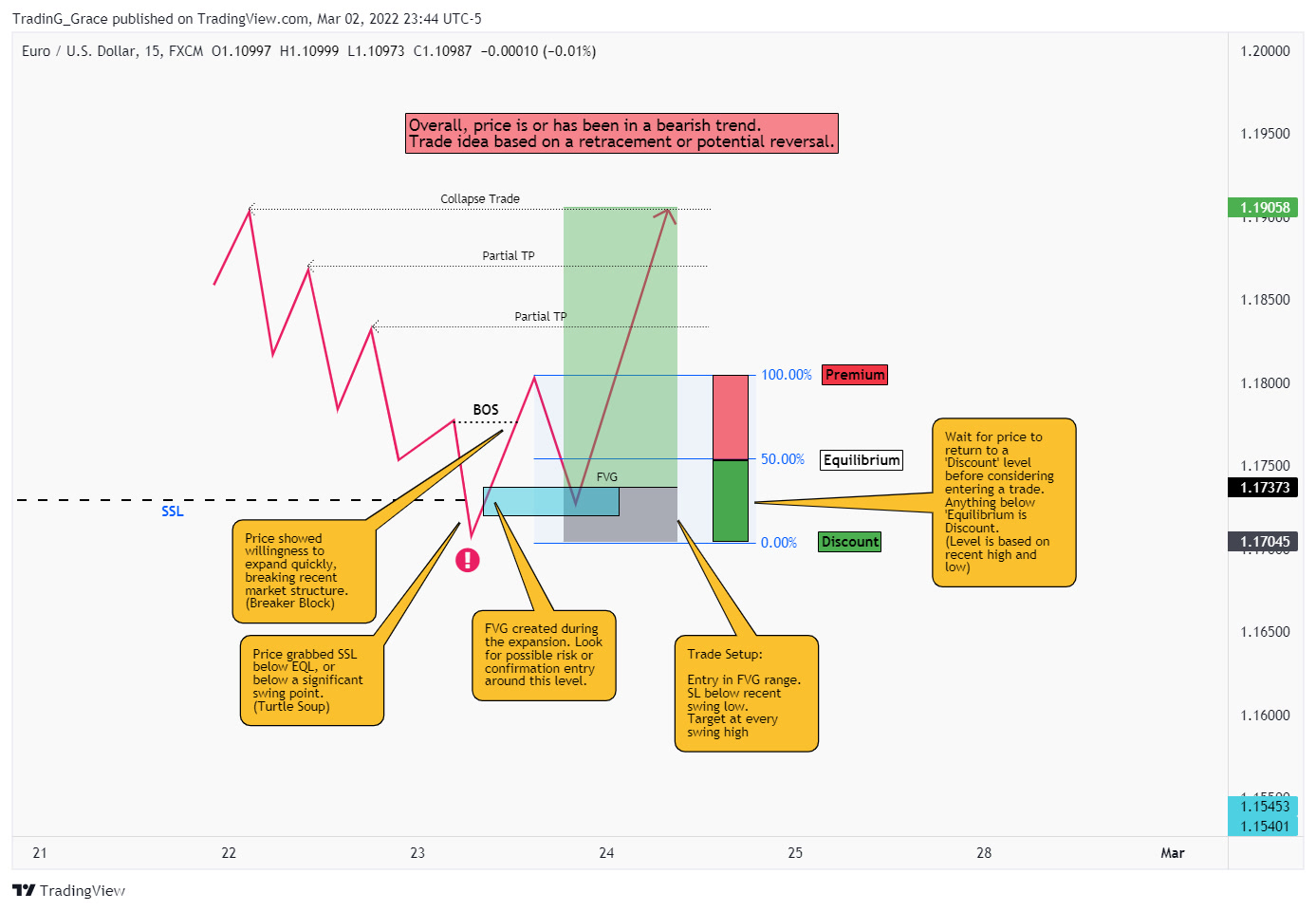
Late April 2026. GBPUSD, 15-minute chart. London killzone, roughly 8:15 AM GMT. Price had swept the Asian session low, printed a clean displacement candle, and left a well-defined Fair Value Gap between 1.2683 and 1.2697. The higher timeframe (4H) was bullish, sitting above a confirmed order block at 1.2640. The setup was textbook: liquidity taken, displacement confirmed, FVG in discount relative to the dealing range, New York open approaching.
Entry at 1.2686. Stop at 1.2669, 17 pips below the displacement low. Risk: 0.75% of account. Target: internal liquidity at 1.2748, which was the prior day's high. The trade hit 3.8R. Clean exit, clean journal entry, clean feelings.
That was trade number four in five sessions, all winners.
Here's where it gets dangerous. Trade five happened two days later. Same pair, same killzone window. But look at the journal entry: the FVG wasn't in discount, price was mid-range. The higher timeframe context was ambiguous (the 4H was ranging, not trending). There was no clear liquidity sweep before entry. And the position size had crept up to 1.5% of account, double the previous risk, without a formal decision to increase it.
That trade lost 1.5R. Not catastrophic in isolation. But the journal entry that followed said something more revealing than any drawdown number: *"I don't understand what happened. The setup looked the same as the others."
It didn't look the same. The confirmation checklist had been quietly abandoned, not all at once, but trade by trade, as each win made the process feel less necessary.
Myth, Reality, and What I Actually See
Myth: Confidence from winning trades reinforces good habits and builds the mental foundation for consistent execution.
Reality: Confidence from winning trades produces a specific cognitive shortcut, your brain starts pattern-matching the feeling of a good setup rather than the criteria of one. You stop reading the chart. You start reading your mood.
What I Actually See: The trader who overtrades killzones on a hot streak is almost never doing it consciously. They're not saying "I'll skip the FVG confirmation today." What they're saying is "this feels right", and that feeling is real, because the last four times it felt this way, they won. The market trained them to trust a feeling that was only valid when the actual structure was present. Remove the structure, keep the feeling, and you have a losing trade dressed up as intuition.
This is the confidence trap in its purest form: it feels like mastery because it once was mastery. That's what makes it so much harder to escape than a losing streak. After three losses, every trader I know tightens up, slows down, goes back to the checklist. After five wins? Nobody audits their process. Why would you audit something that's working?
I used to fall into this exact pattern. After a strong run in early 2022, six consecutive winning trades across EURUSD and Gold, I remember feeling like I'd unlocked something. I started entering on 5-minute FVGs without waiting for the 15-minute confirmation. I stopped marking out the full premium/discount range before entry. The losses that followed weren't random. They were predictable. I just couldn't see the degradation while I was inside the streak.
The Neurological Shortcut You Don't Know You're Taking
There's a well-documented behavioral finance concept called outcome bias, the tendency to judge the quality of a decision by its outcome rather than the quality of the process. In trading, this is catastrophic, and it accelerates during win streaks.
Here's what's actually happening neurologically: each winning trade releases dopamine. Dopamine doesn't just reward you, it tags the entire experience as "correct," including whatever shortcuts you took to get there. If you entered trade three without waiting for the full FVG mitigation, and it still won, your brain files "partial FVG entry" under "things that work." By trade five, skipping confirmations isn't negligence. It's learned behavior.
The cruel irony of trading with smart money concepts specifically is that the setups have enough structure to feel rigorous even when you're cutting corners. You still called it a FVG. You still identified the killzone. You still referenced the order block. The vocabulary of discipline is intact. The discipline itself is gone.
For a deeper look at how this pattern shows up in funded account challenges specifically, this breakdown of the 7 fatal mistakes that kill funded account challenge success covers the execution side of this in detail.
The 5-Trade Streak Audit: A Framework You Can Use Today
After seeing this pattern repeat across dozens of trading journals, I built a simple protocol specifically for managing win streaks. Not win streaks in theory, win streaks after ICT setups specifically.
Step 1: Flag the streak at trade three, not trade five. Set a rule in your journal: any time you record three consecutive winning trades, the fourth entry requires a written pre-trade checklist. Not mental. Written. The act of writing forces you to articulate what you see, and articulation is where shortcuts get exposed.
Step 2: Freeze your position size for the duration of the streak. This is non-negotiable. No increases. Not even partial increases. Use a risk calculator and lock the percentage at whatever you started the streak with. Position size creep during win streaks is one of the most consistent patterns across blown prop firm accounts, and it's almost always unconscious.
Step 3: Require higher timeframe confluence on trade four and five. During a streak, your minimum confirmations go up, not down. If your standard entry requires a 15-minute FVG with a 1H order block for context, trade four requires that plus a clear liquidity sweep on the 1H. You're paying a premium to stay in the game. That's not fear, that's position management.
Step 4: Journal the process, not the result. After each winning trade, write one sentence about what could have gone wrong. Not what did go wrong, what could have. This keeps the analytical brain engaged and prevents the "it worked, so it was right" feedback loop from taking hold. Something like: "Trade hit target at 3.4R. The 1H FVG wasn't fully mitigated before entry, if price had retraced slightly deeper, my stop could have been hit. Valid entry, but I was closer to the edge than the result suggests."
Step 5: Take a mandatory review after five consecutive wins. No new trades until you've gone back through all five and graded each one purely on process, using your entry checklist as the rubric. Score each setup 1-5. If the average score drops below 4 across the five trades, the streak wasn't mastery, it was variance favoring sloppy execution. That's a warning, not a celebration.
For more on how smart money concepts confirmations should stack across timeframes before you pull the trigger, the ICT Fair Value Gap trading checklist with 9 pre-trade confirmations is one of the most practical resources we've published.
The Archetype I Keep Seeing in 2026
There's a specific trader pattern I want to name, because recognizing it in yourself is half the fix.
This trader passed their prop firm evaluation, legitimately, with a solid process. They used smart money concepts correctly: waited for London displacement, confirmed FVGs in discount, respected the killzone windows. They were patient. Then the funded account started, the first few trades worked, and somewhere around week three, their trade frequency doubled. Not because the market offered more setups, it didn't. Because they started finding setups that confirmed what they already wanted to do.
This is the "earned recklessness" pattern. The logic sounds coherent: I proved I can do this. I have a funded account. I know what these setups look like. What they've actually done is replace the objective criteria of a setup with the subjective feeling of one. The result isn't obvious immediately, which makes it worse. They might win three more trades on pure market cooperation before the methodology collapse becomes visible in the P&L.
By the time they're asking why their smart money concepts setups stopped working, the setups stopped being what they think they are weeks earlier. If any of this sounds familiar from a Q2 2026 perspective, especially given the structural volatility we've seen this year, the breakdown on why market structure shifts are breaking traditional ICT setups is worth reading alongside this one.
The Harder Psychological Work
Every article about trading psychology circles back to losses. How to cope with them, how to recover, how to avoid making them worse. That content exists because losses are painful, and pain demands a solution.
Winning feels like the solution. That's exactly why no one audits it.
But the journals don't lie. The pattern is consistent across timeframes, account sizes, and experience levels: unchecked confidence after a winning streak is harder to escape than a losing streak precisely because it feels like the right mental state to be in. You're not suffering. You're not scared. You're not making obvious mistakes. You're just slowly removing the friction that was protecting you, one confirmation at a time, until the market finds the gap.
The fix isn't to be less confident. Confidence is useful. The fix is to make your process confidence-proof, to build it so that even when you feel certain, the checklist still runs, the position size still holds, and the pre-trade criteria still require evidence instead of feelings.
If you want to look at how this kind of process discipline plays out across different coaching plans, including what a real review of your trading journal looks like at the Pro and Full Mentorship level, that's all laid out there. And if you want to get a sense of what structured execution actually produces over time, the results page shows what that looks like in practice.
Otherwise: next time you string together four winning trades, don't celebrate. Audit. The streak didn't make you better. It made you feel better. There's a difference, and in this market, that difference costs real money.
, R2F Trading | More trading insights here
Harvest Wright
ICT Trading Coach · 10+ Years Experience
Harvest specializes in ICT methodology and has helped traders pass prop firm challenges, develop consistent strategies, and build the psychology needed for long-term profitability.
Book a Free Discovery Call →Ready to Get Funded?
Our students pass prop firm challenges in under 60 days with personalized ICT coaching.
Book a Free Discovery CallFree ICT Funded-Trader Playbook
The setups, the pre-trade checklist, and the risk rules I use. Get it free.