
The Silence Between Trades: Managing Boredom
There's a version of trading psychology content that goes something like this: fear will make you exit too early, greed will make you hold too long, so just be disciplined. Genuinely useful advice, if you're a fortune cookie. After ten-plus years of trading, I think one of the most underrated account killers is something else entirely: the quiet, creeping, almost imperceptible pull of a slow Tuesday afternoon when nothing is setting up and your cursor keeps drifting toward the entry button anyway.
Boredom. That's the one nobody wants to talk about.
Key Takeaway: Compulsive trade entry during low-volatility or drawdown periods is usually a behaviour pattern more than a strategy failure. Treat structured inactivity as an active, practiced discipline with a defined protocol, and it stops feeling like an absence of action.
Why Your Brain Treats 'No Trade' Like a Threat
Here's something most ICT YouTube content skips: waiting for a trade can feel a lot like waiting on a slot machine. The reward is uncertain and intermittent, and that's exactly the kind of situation that makes people compulsive. Consolidation and Asian session doldrums are full of it.
What this means practically: the longer you sit at your charts without a trade, the more your brain starts manufacturing reasons to enter one. That FVG on the 5-minute that you know doesn't have higher timeframe confluence suddenly looks tradeable. That order block you'd normally dismiss because it sits in premium starts looking 'close enough.' The setup hasn't improved. You're just getting impatient.
I used to get this wrong. Earlier in my trading, I'd sit through a dead London session, watch a clean setup miss my entry by two pips, and then chase it into a completely different structure because I felt like I'd earned a trade by waiting. That logic doesn't hold up for a second, but it felt completely rational at the time. That's the insidious part.
The traders I see making this mistake most consistently are the ones who've actually studied smart money concepts well enough to find something on the chart. They know what an FVG looks like. They know what an order block is. The problem isn't knowledge, it's selectivity. Having the vocabulary to identify every potential setup on a chart is not the same as having the judgment to know which ones to leave alone. That distinction takes time to develop, and a lot of people never develop it because they keep entering instead of observing.
What a Real 'Dead Session' Looks Like
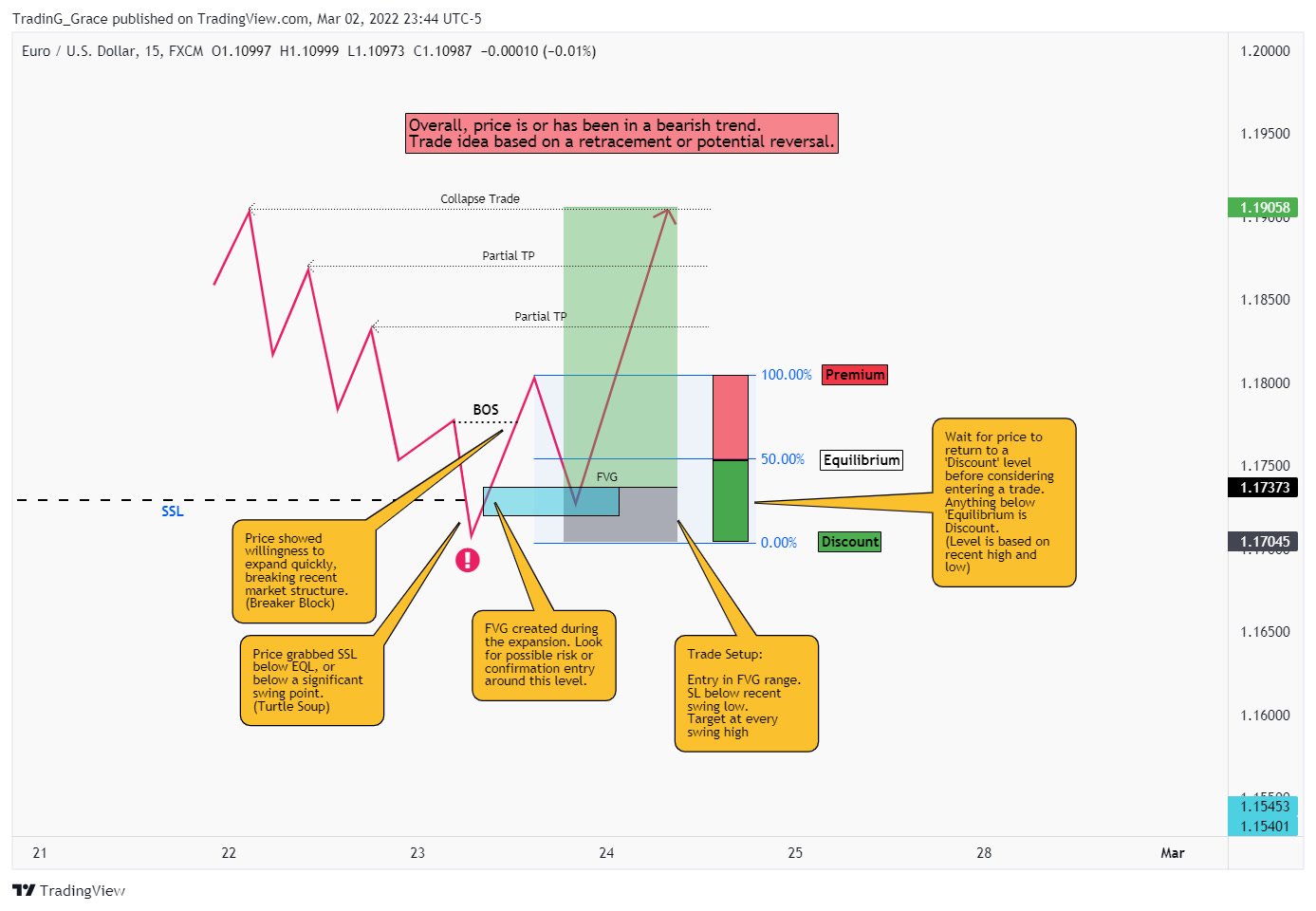
Here's a worked example. Picture GBPUSD in a tight compression the week after a big news event like NFP (the April NFP week liquidity patterns post covers that kind of week). On the 15-minute chart, price is sandwiched between a bearish FVG above and a pool of equal lows below. Clean range. Nothing to trade.
You mark it. You note the range. Then a 5-minute 'displacement' candle pushes up toward the upper FVG, stalling just short of it, and you feel the pull. The narrative is there if you squint: displacement into FVG, potential reversal, tight stop just above the FVG, target the equal lows. On paper, logical. In reality, price is inside a 15-minute consolidation range with no macro driver and no higher-timeframe POI confirmation. The 4-hour chart shows price sitting in a fair value gap that has already been partially filled, not a fresh origin.
The way to avoid that trade has little to do with heroic discipline. It comes from doing step one of the inactivity protocol below before the session starts, which would already have flagged the session as dead before that 5-minute candle even formed.
Ranges like this often chop around and sweep both sides before anything clean shows up. Trading inside one tends to mean a stop-out, a re-entry, another stop-out, on a setup that was never valid. The Q2 2026 market structure shifts post covers related conditions. Knowing when the market isn't talking to you is a legitimate edge.
The Inactivity Protocol (This Is the Actual Framework)
Patience isn't a virtue you either have or don't. It's a skill with a structure. Here's exactly what the protocol looks like, the same one I run on any session where my pre-market bias says 'low conviction.'
Step 1: Pre-session invalidation sweep (15 minutes before London or NY open) Before I touch a chart with intent to trade, I ask three questions: Does my daily bias have clean higher-timeframe confirmation (4H or daily structure break + POI confluence)? Is there a scheduled news event within 90 minutes that could negate any setup I take? Is the pair currently inside a consolidation range on the 1-hour or above? If two or more of these are 'no' or 'yes, problematic', the session is on observation mode only. I literally write 'OBS' in my trading journal before the session starts. That label creates a psychological contract with myself.
Step 2: Chart engagement without execution intent During an observation session, I still watch the charts, but I'm annotating, not hunting. Marking where sweeps occur, noting which order blocks get respected versus violated, tracking the actual delivery of price relative to my expectations. This is active work. It's not 'stepping away' from the screen. Understanding how ICT premium discount arrays behave during volatility squeezes requires screen time, just not trigger-pulling screen time. The data you gather during dead sessions is genuinely valuable for calibrating your models.
Step 3: The 20-minute rule for setup temptation When I feel the pull, and I still feel it, ten years in, I set a 20-minute timer and do not look at the entry button until it goes off. The setup usually won't be better in 20 minutes. The point is that the urge is strongest right when you first see a potential setup, and it fades with time. If the setup is still valid after 20 minutes and I haven't manufactured new reasons to justify a mediocre entry, it was probably real. If I've spent the 20 minutes building a case for why it's good, it's almost certainly not.
Step 4: End-of-session review before you do anything else Every observation session ends with a three-sentence journal entry: what price did, what I expected it to do, and what that difference tells me. That's it. No grades, no self-criticism, no 'I should have taken that.' Just data. Over months, these entries build a model of your own psychological patterns that's more accurate than any trading course.
This matters specifically for smart money concepts traders because the ICT model gives you so many things to look at. Order blocks, FVGs, breaker blocks, propulsion blocks, liquidity voids, the framework is comprehensive enough that a motivated mind can always find something. The protocol's job is to filter signal from the noise that your own cognition generates.
The Archetype Nobody Talks About
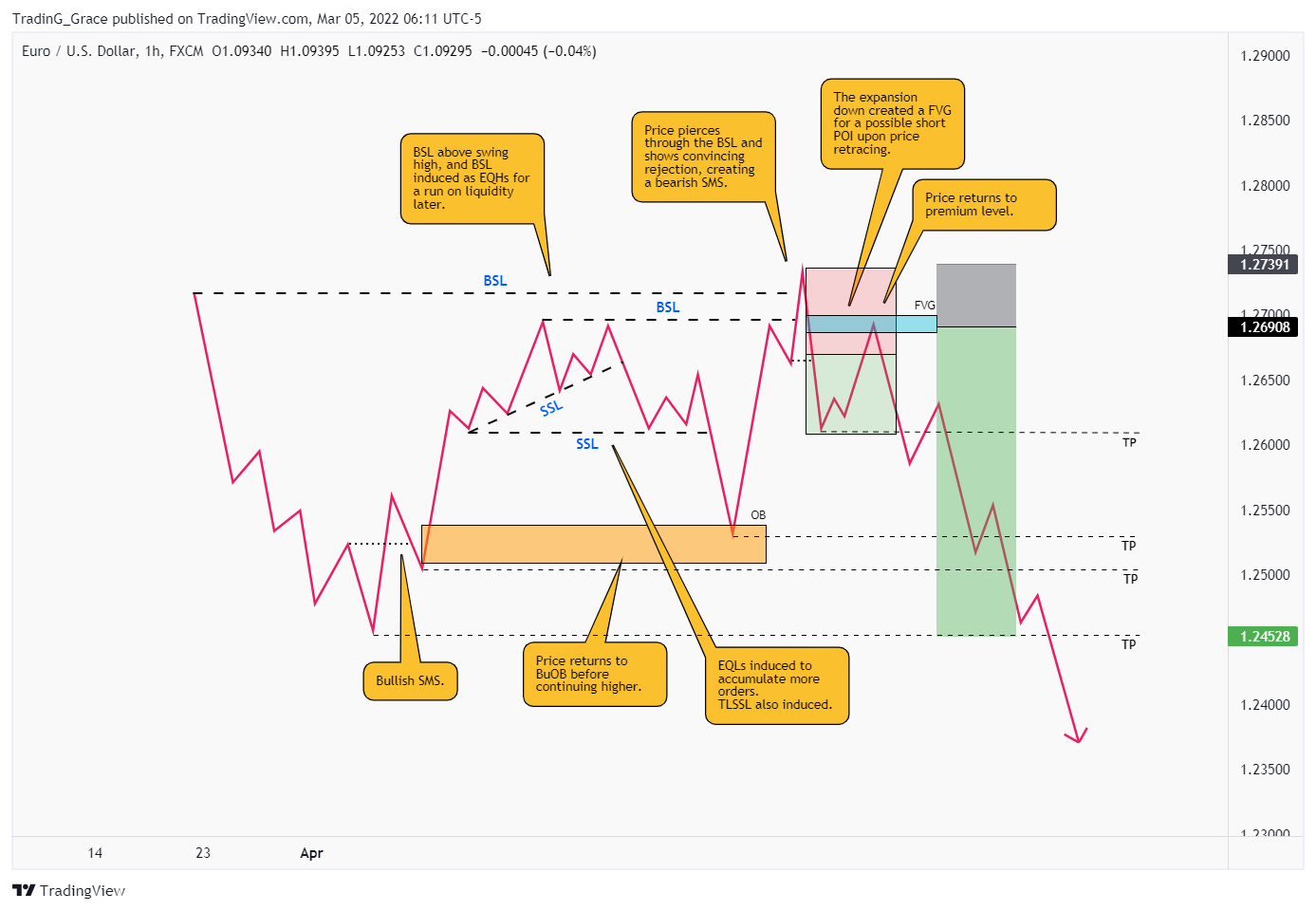
There's a particular trader pattern I've noticed across forums, Discord servers, and comment sections everywhere. Call them the Constant Confirmation Seeker. They post chart screenshots all day, every potential setup, every FVG they've marked, every order block they're 'watching.' They're technically competent. Their annotations are often correct. But they're posting ten setups a day across four pairs, which means they're seeing everything and filtering nothing.
When they get funded, the account often doesn't last long. They understand smart money concepts fine. The problem is that they've trained themselves to view market observation as equivalent to trade readiness, and they can't tolerate the cognitive dissonance of seeing a valid-looking structure and not trading it. Every dead session is torture. Every hour without a fill feels like opportunity cost.
The truth that takes years to absorb: missing a valid trade is a cost of doing business. Taking an invalid trade is self-sabotage. Those two things are not symmetrical, and the market will teach you that lesson expensively if you don't internalize it first. For more on the specific ways this pattern destroys funded accounts, the breakdown in 7 fatal mistakes that kill your funded account challenge success goes deeper than most want to admit.
Reframing What 'Working' Means
Here's the contrarian take I'll leave you with, because it's the thing that actually changed how I approached slow sessions: a day where you identified three valid setups, took none of them because the session was dead, and ended flat is a winning day. Not a neutral day. Not a 'wasted' day. A win.
Capital preservation during low-conviction periods is how funded accounts compound. Results that look impressive in hindsight are usually built on a foundation of sessions where nothing happened and the trader had the architecture in place to absorb that without self-destructing. That's not passive. That's not 'doing nothing.' That's executing a protocol under psychological pressure, which is exactly what trading is.
The silence between trades isn't dead air. It's where the edge actually lives.
If you want to work on building this kind of structured approach to the ICT model, not just the setups, but the decision architecture around when to stay out, the coaching plans break down how we approach this across different experience levels. Or if you're not sure where you currently sit in your development, book a free discovery call and we can map it out properly.
Harvest Wright
ICT Trading Coach · 10+ Years Experience
Harvest specializes in ICT methodology and has helped traders pass prop firm challenges, develop consistent strategies, and build the psychology needed for long-term profitability.
Book a Free Discovery Call →Ready to Get Funded?
1-on-1 ICT coaching built around prop firm rules, from a trader who has passed an FTMO Challenge.
Book a Free Discovery CallFree ICT Funded-Trader Playbook
The setups, the pre-trade checklist, and the risk rules I use. Get it free.