
The Quiet Confidence Trap in ICT Trading
There's a version of overconfidence that every trading psychology book misses, because it doesn't look like overconfidence at all. It's quiet. Measured. It feels like you've finally arrived. And in the world of smart money concepts, it's one of the things most likely to blow your funded account.
Key Takeaway: Quiet confidence in ICT trading isn't loud arrogance, it's the calm certainty that follows a winning streak with smart money concepts, masquerading as discipline and flow state. A 3-signal self-audit run before every trade sequence can catch it before the drawdown is already too deep to recover.
The Confidence Nobody Warns You About
Every trading psychology resource worth reading will tell you about the two killers: fear and overconfidence. Fear keeps you out of valid setups. Loud overconfidence has you doubling position size after a win, chasing price, taking trades that don't exist in the model. Both are recognizable. Both have obvious tells.
Quiet confidence is different. It doesn't announce itself. There's no elevated heart rate, no impulsive clicking, no revenge trade after a loss. It arrives slowly, usually after three or four clean wins, and it feels almost meditative. Like you've stopped fighting the market and started understanding it.
For ICT traders specifically, the context makes it worse. When you've correctly called a liquidity sweep on the 15-minute chart, watched price raid sell-side, flip structure, and then drive into a smart money concepts framework entry you identified hours in advance, that feeling is earned. You did the work. You read the tape correctly. The problem is that earned feeling doesn't stay calibrated. It expands. And after a few instances of being right, your brain stops asking the hard questions.
What It Actually Looks Like in Practice
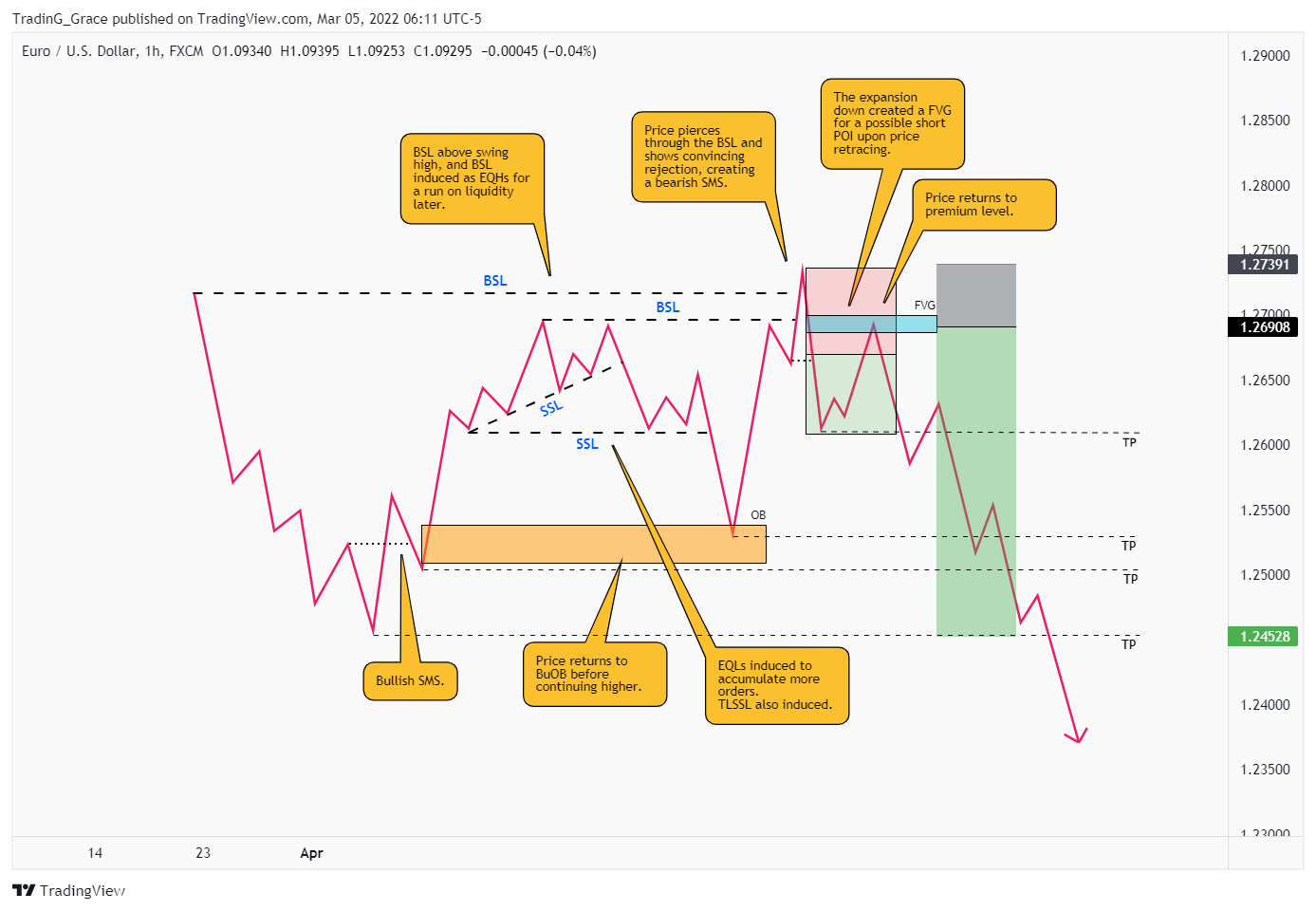
Here's a worked example of exactly this trap.
Picture GBPUSD on the 15-minute chart during the London session. The trader has had several clean winners in the past week, all within model, nothing forced. The week feels sharp.
London open comes in with a sweep lower into a bullish Order Block from the previous day, then displaces back up and leaves a Fair Value Gap. The draw on liquidity sits above the Asian high. Bias is bullish. Structure is right.
The entry is inside the FVG, with the stop below the displacement low, because if price takes that low out again the bullish idea is broken. The target is the liquidity above the Asian high. All of that is fine.
Here's where quiet confidence creeps in: the trader moves the stop to breakeven at 1R. There's no price action reason to trail that early. They just feel certain. The setup is too clean. They called the sweep, the FVG, the draw, all of it in their pre-session notes. They know this one is going to run.
Price comes back, tags breakeven, and then runs to the target without them. The trade itself wasn't the mistake. The state they were operating from was, because the stop moved on a feeling instead of a rule.
Myth, Reality, and What I Actually See
Myth: The danger zone in trading is when you're emotional, frustrated after losses, anxious before a big setup, or euphoric after a win.
Reality: Emotion is visible. You can feel frustration. You can notice euphoria. What you can't easily feel is the quiet recalibration that happens when your brain starts treating recent wins as evidence of permanent edge, rather than recent execution of a probabilistic model.
What I Actually See: The trader who loses a funded account after their best-ever week isn't the one who was celebrating. It's the one who was calm, confident, fully present, and completely stopped running the internal checks that got them to that winning week in the first place. They weren't being reckless. They just stopped being rigorous, and those two things feel identical from the inside when you're in a flow state.
This is the insidious part. Flow state and quiet confidence produce the same internal sensation. The difference is that flow state keeps you process-focused. Quiet confidence shifts you, almost invisibly, to outcome-focused, while still feeling like discipline.
Why ICT Traders Are Specifically Vulnerable
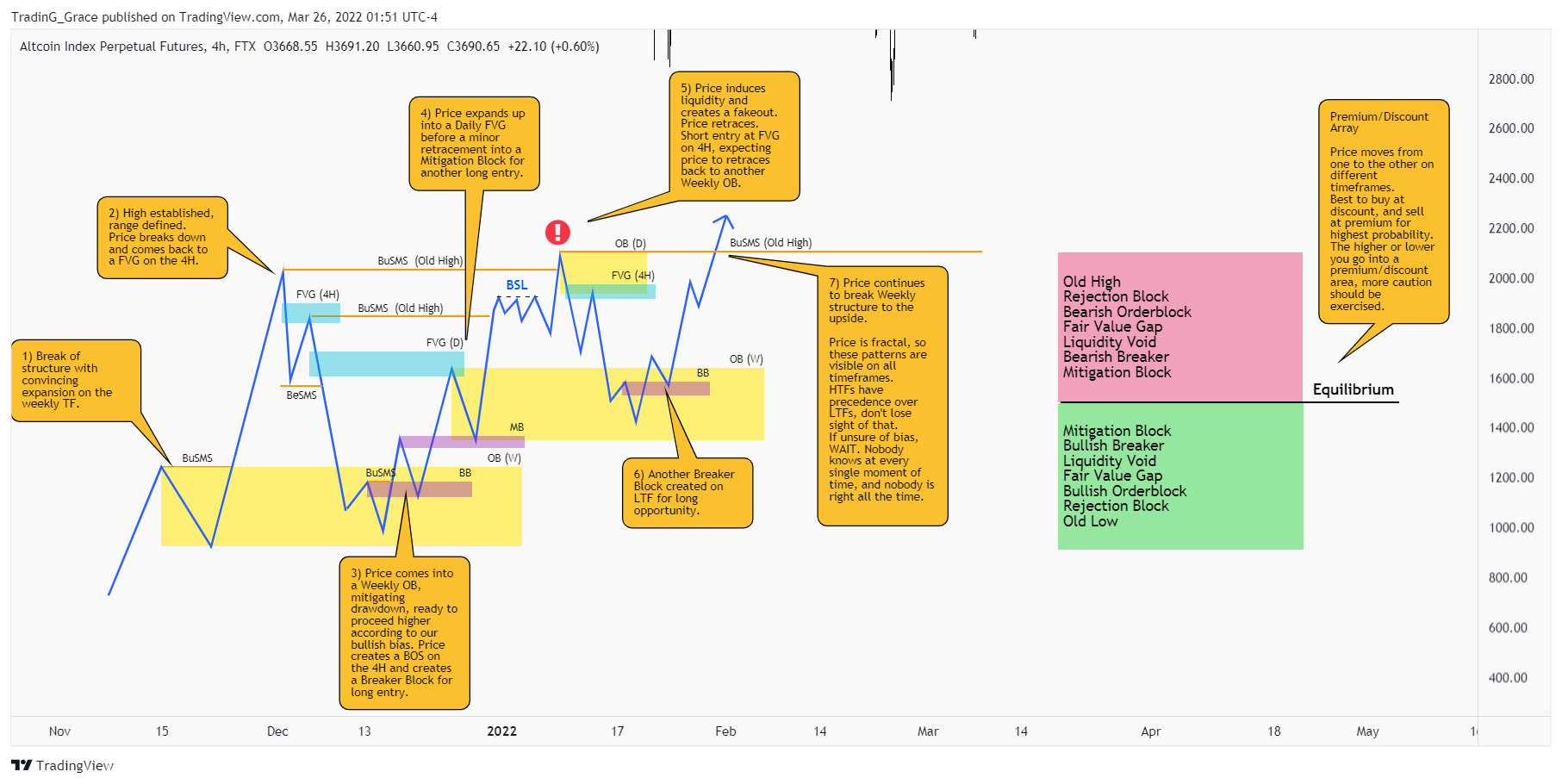
Most trading methodologies have a simple feedback loop: you either got the direction right or you didn't. Smart money concepts adds layers. You're reading order flow, liquidity pools, institutional footprints, displacement, premium and discount arrays, time-of-day models. When all of those pieces align and the trade wins, the internal reinforcement is enormous, because you weren't just right about direction, you were right about why.
That multi-layered rightness is cognitively powerful. And after you've correctly identified two or three order blocks that held, called a liquidity sweep before it happened, and watched price respect your discount array entries, your brain does something insidious: it stops treating each new setup as a fresh probability event. It starts treating your read of the market as reliable information rather than an educated hypothesis.
This is why you'll often see a pattern, after a successful run with smart money concepts setups, traders begin taking entries that are almost in the OB rather than at the OB. Taking trades on lower-quality FVGs because the higher-level read is correct. Sizing up slightly because the setup feels the same as the ones that worked. None of these feel like mistakes in the moment. Each one feels like calibrated confidence.
For more on how this plays out in actual funded account failures, the breakdown in 7 fatal mistakes that kill your funded account challenge success covers the downstream consequences well.
The 3-Signal Self-Audit (Run This Before Every Trade Sequence)
This isn't a checklist to slow you down. It's three specific questions designed to surface quiet confidence before it costs you. Run this before you execute the first trade of any session, especially after a winning streak.
Signal 1, The Justification Test Ask yourself: Am I building a case for this trade, or am I checking it? There's a subtle but critical difference. Building a case means you've already decided and you're finding evidence. Checking means you genuinely haven't decided and you're evaluating. Write out the bias in one sentence before looking at the chart. If the bias matches the chart immediately and perfectly, that's worth a pause, real markets are messy, and perfect alignment sometimes means you're seeing what you expect.
Signal 2, The Stop Placement Test Where is your stop, and why exactly there? Not "below the OB", exactly where, and what specifically invalidates the trade if price reaches it? If you struggle to answer this without referencing your recent wins ("it's working so I'm comfortable with a slightly wider stop"), you're operating from quiet confidence, not process. Use a structured risk calculator and input the numbers cold before you feel the setup. If the R:R doesn't justify the entry on paper, the recent winning streak isn't making it better.
Signal 3, The Boredom Test This one sounds strange. Ask yourself honestly: would you take this trade if the last five trades had been breakeven? If the answer is "probably not" or "I'd want more confirmation", that delta is quiet confidence in action. The trade's quality hasn't changed. What's changed is your internal state, and you're using recent wins as a substitute for edge.
Running these three signals takes about 90 seconds. They're not designed to talk you out of good trades. They're designed to separate what you know from what you feel certain about, which, after a winning streak with smart money concepts, are two very different things.
This kind of pre-session audit pairs well with the structural thinking in why Q2 2026 market structure shifts are breaking traditional ICT setups, because choppy, shifting markets are good at rewarding quiet confidence briefly, then punishing it hard.
The Archetype I See Most
There's a specific trader pattern that shows up repeatedly in trading communities and forums. This trader has put in genuine work on smart money concepts, usually 12 to 18 months of serious study, can articulate order blocks, FVGs, liquidity raids, and time-of-day models with real depth. They've passed a prop evaluation. They're not a beginner.
What kills them isn't ignorance. It's a very specific sequence: clean two-week run → informal loosening of rules ("I'll just take this one slightly early") → one or two trades that work anyway, which reinforces the loosening → sudden drawdown that feels inexplicable because "the read was right." The read was right. The process discipline was already gone.
The tragedy is that this trader often quits or resets believing they need more strategy knowledge, when the issue was never the strategy.
I Used to Get This Wrong Too
For a long time, I conflated confidence after winning trades with evidence that I'd elevated my trading. It took me a while to recognise that a winning streak doesn't make you better. It can make you less rigorous while you feel more capable. Those two things moving in opposite directions is the exact mechanism of quiet confidence.
The fix isn't finding new setups. It's rebuilding the habit of treating every trade as a cold probability event regardless of what the last ten did.
That reset, forcing process compliance to be independent of recent results, is the structural fix for quiet confidence. You don't need to doubt yourself forever or suppress your confidence. You need to separate emotional state from process execution, so that your rules run the same whether you're on a four-trade losing streak or a six-trade winning streak.
Where to Go From Here
If you're running smart money concepts and you've had a strong few weeks, take 15 minutes today and run the three-signal audit on your last five trades. Not to find mistakes, to calibrate where your process confidence ends and your state-based certainty begins.
If you're at a stage where you want a structured external check on this, someone to pressure-test your reads and call out the quiet confidence before it costs you, the coaching plans walk through exactly this kind of process accountability, from the Lite option at $150/week through to the Full Mentorship. Or if you want to start with a conversation first, book a free discovery call and we'll look at where your current edge is actually coming from.
Quiet confidence is almost always temporary. The drawdown it causes doesn't have to be.
Harvest Wright
ICT Trading Coach · 10+ Years Experience
Harvest specializes in ICT methodology and has helped traders pass prop firm challenges, develop consistent strategies, and build the psychology needed for long-term profitability.
Book a Free Discovery Call →Ready to Get Funded?
Our students pass prop firm challenges in under 60 days with personalized ICT coaching.
Book a Free Discovery CallFree ICT Funded-Trader Playbook
The setups, the pre-trade checklist, and the risk rules I use. Get it free.