The Boredom Problem: Why ICT Traders Self-Sabotage
Nobody wants to admit this one. We talk endlessly about fear, about greed, about FOMO and revenge trading, but in ten-plus years of trading, a lot of it with smart money concepts, I've seen a different emotion hollow out accounts that had no business losing money.
Boredom.
Key Takeaway: The discipline required to wait for genuine ICT killzone confluences creates a psychological vacuum that trained traders actively, and unconsciously, destroy with impulsive entries. The fix isn't willpower. It's a structured protocol that replaces dangerous idle screen time with purposeful work during the dead zones.
Here's what makes this so insidious: it hits the good traders hardest. The ones who've actually done the work. The ones who understand smart money concepts well enough to know they should only be trading London open displacement, or the New York AM session with a confirmed draw on liquidity. They've internalized the rules. And then they sit at their screens for three hours watching a ranging London session go absolutely nowhere, and something in them just... snaps.
I know this because I've lived it.
The Specific Moment It Happens (And Most People Miss This)
There's a window that I've started calling the dead zone, roughly 10:30 AM to 12:00 PM London time, which translates to about 5:30, 7:00 AM Eastern. London momentum has bled out. New York hasn't properly opened. The Asian range has been swept or it hasn't, but either way the market is coiling, ranges are compressing, and there's nothing to do.
Nothing except sit there and watch candles.
From what I've seen in my own trading and in journals shared publicly in trading communities and on TradingView, impulsive, low-quality entries tend to pile up in that pre-NY window. It's the quiet sessions that do the damage.
A second dead zone exists late London, around 2:30, 4:00 PM UK time. By this point, serious London traders have closed positions, the killzone is long done, and what's left is choppy, algo-driven noise with no real institutional participation. Yet this is exactly when you'll see traders who know better suddenly decide that the 15-minute chart has a "potential" order block that's "probably" going to hold.
Probably. That word is doing a lot of heavy lifting on a lot of losing trades.
What's Actually Happening in Your Brain
This isn't a discipline failure. Calling it that is lazy and it's why most trading psychology content misses the mark entirely.
What's happening feels more like physical restlessness that your brain interprets as urgency. Sitting still while a market moves, even randomly, triggers the same cognitive circuits that evolved to tell you: something is happening, you should act. The longer you watch without participating, the more that signal amplifies.
For ICT traders specifically, this is compounded by the conceptual framework itself. When you understand smart money concepts, when you can see sweep-and-reverse patterns, when you can identify institutional order flow, when every move on screen has a potential narrative, your pattern-recognition brain never fully rests. It's always building a case. And eventually it builds a case convincing enough that you enter.
That's not weakness. That's your brain doing exactly what you trained it to do. The problem is context: a ranging, dead-zone session offers fragments of patterns that look real but aren't actionable under a proper ICT framework. Your brain doesn't care about context. It just sees the fragment.
The Archetype I Keep Seeing
There's a trader type I've noticed repeatedly across forums and shared trade journals. Call them the Overqualified Destroyer.
They score well on ICT concept tests. Their markups are clean. They can identify a breaker block from a mitigation block without hesitating. When you ask them to review someone else's chart, they'll correctly diagnose exactly why a trade was low-probability.
But their own trading journal is a graveyard of 11:00 AM entries. Entries taken during ranging conditions with no clear draw on liquidity, no confirmed session displacement, no killzone confluence, just a vague sense that "the structure looks like it might be setting up."
Every single one of those entries has a common timestamp. Dead zone. And when you ask them why they took it, they can always construct a post-hoc ICT narrative that sounds almost reasonable. That's the danger. The framework is so rich with concepts that a motivated brain can almost always find something to justify an entry.
Qualification doesn't prevent this. If anything, deeper knowledge makes the rationalizations more convincing. This is what a year-one trader doesn't understand and what I didn't fully appreciate until well into year three: knowing more isn't the same as being more disciplined. Knowledge feeds the rationalizer as much as it feeds the analyst.
A Worked Example
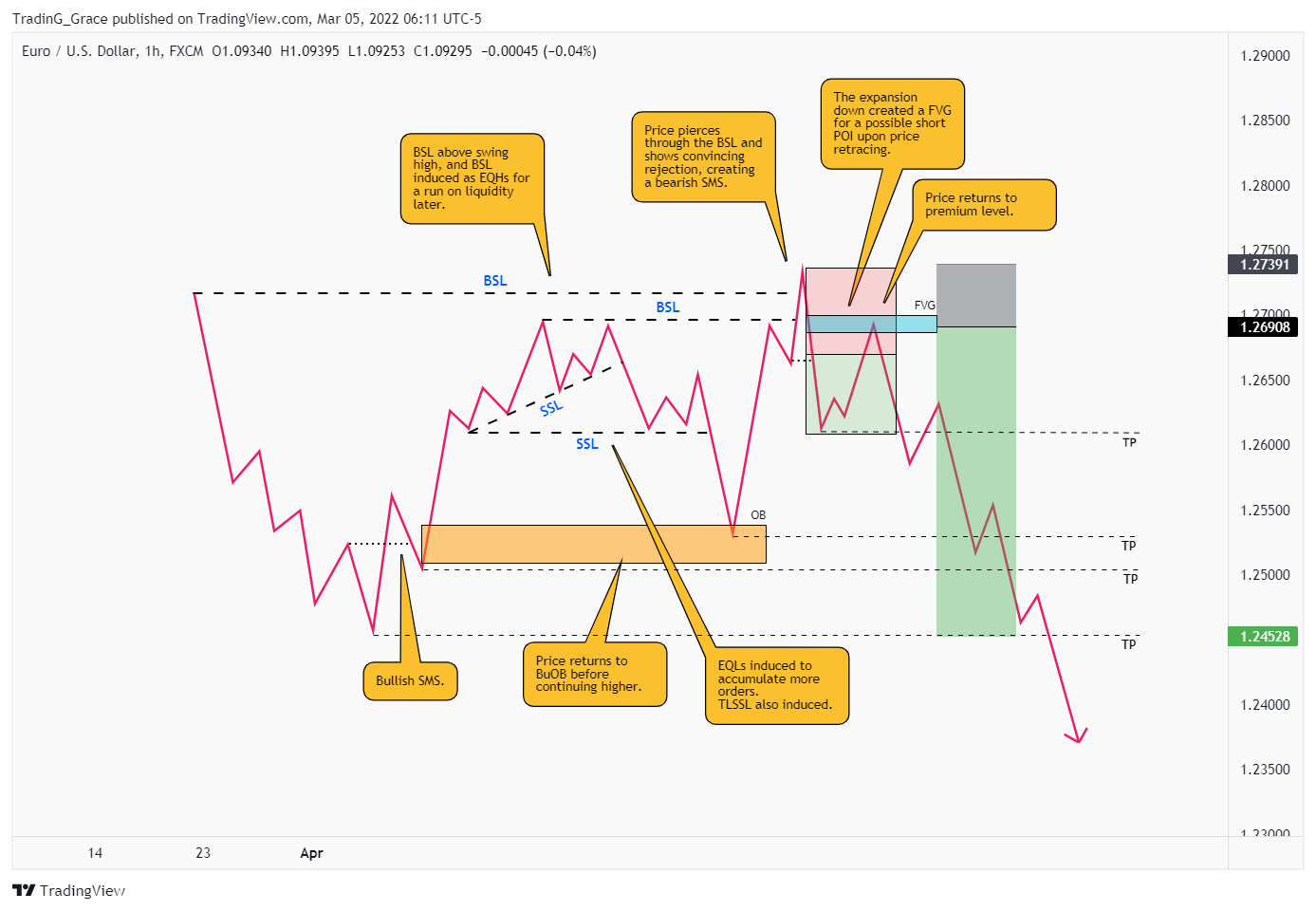
Picture GBPUSD on the 15-minute chart. The London open gives a clean long: price sweeps the Asian lows, displaces above the Asian highs, and pulls back into a bullish order block. Entry at the order block, stop below the swept low, target the buy-side liquidity above. By late morning London time, that trade is done and there's nothing to do.
The pair ranges for ninety minutes. Tight consolidation, absolutely nothing actionable. Then the trader takes a short from what they tell themselves is a bearish order block.
There's no draw on liquidity to the downside. There's no confirmed session high sweep. There's no reason for that trade except ninety minutes of staring at the screen and hands that need to do something.
If it stops out, it eats into the morning's gain. More importantly, it's a trade they would have talked anyone else out of in thirty seconds.
That's the boredom trade. You know exactly what it is when you see it on someone else's journal. You're blind to it on your own.
The Dead Time Protocol (What Actually Works)
Generic advice says: "step away from the screen." That's fine in theory and useless in practice for anyone who trades seriously. Stepping away feels like abandonment. What if this is the moment price does something?
Here's the protocol I use, built from my own mistakes and the patterns I see in the community. It has three hard rules:
Rule 1: Define your dead zones the night before, not in the moment. Before each trading day, write down your two killzone windows with start and end times. Everything outside those windows is dead time by default, not "possible setup time" or "watch and see" time. Dead. Predetermined. The decision is made before boredom has a chance to lobby for exceptions.
Rule 2: Replace screen time with replay work during dead zones. This is the non-negotiable core. When the dead zone starts, open TradingView's replay function on a different pair in a different market condition than you're currently watching. Run through 20, 30 candles, mark your levels, decide if you'd take a trade. This isn't busywork, it's training your pattern recognition in a context where it genuinely can't affect your live account.
The key mechanism: replay work satisfies the same neurological itch as live trading without the execution risk. Your brain is still hunting patterns, still making decisions, still engaged. But the stakes are removed. After two or three replay sessions, the live chart's urgency drops noticeably. The compulsion loses its grip.
Rule 3: Log the urge, not just the trade. Every time you want to enter during a dead zone but don't, write it down. Pair, time, what you thought you saw, why you didn't act. This does two things: it creates accountability (the urge now has to survive being articulated), and over time it builds a data set showing you exactly what your boredom trades look like before you take them. Pattern recognition, turned inward.
This framework won't eliminate the itch. Nothing will. But it gives the itch somewhere productive to go instead of straight into your position sizing screen. If you want to stress-test your current framework against a structured process, the risk calculator is a useful starting point for building habit anchors around position sizing rituals during live sessions.
Why This Matters More in Slow Markets
Ranging markets are brutal for boredom-driven entries. Extended ranging sessions, compressed volatility ahead of major macro events, and shifting market structure dynamics can create longer gaps between genuine ICT setups. The killzones still deliver, but when the dead zones between them get longer and noisier, the temptation is higher and the cost of giving in is steeper.
If you've noticed your win rate dropping despite your setups looking cleaner on paper, check your entry timestamps first. Sort your losses by time of day. I'd be surprised if you don't find a cluster in that 10:30 AM, 12:00 PM London window, or late in the London afternoon. The funded account mistakes that end prop challenges often have a boredom trade or two buried in the timestamp data.
Smart money concepts give you a genuinely powerful framework for reading markets. That power doesn't protect you from yourself during slow sessions, if anything, it gives your boredom more sophisticated tools to rationalize bad decisions. Knowing that is half the battle. The dead time protocol is the other half.
If you want to go deeper on the psychological side of ICT execution, not just the concepts but the mental infrastructure around applying them, take a look at the coaching plans we offer, from the Lite tier at $150/week up to Full Mentorship at $5,000 for four months. Or if you want to get a feel for whether the approach fits before committing, book a free discovery call and we can talk through where the gaps actually are in your trading.
Boredom isn't glamorous. It doesn't make for good YouTube content. But fixing it will do more for your equity curve than learning one more ICT concept ever will.
Harvest Wright
ICT Trading Coach · 10+ Years Experience
Harvest specializes in ICT methodology and has helped traders pass prop firm challenges, develop consistent strategies, and build the psychology needed for long-term profitability.
Book a Free Discovery Call →Ready to Get Funded?
Our students pass prop firm challenges in under 60 days with personalized ICT coaching.
Book a Free Discovery CallFree ICT Funded-Trader Playbook
The setups, the pre-trade checklist, and the risk rules I use. Get it free.