The Silence Between Trades That Breaks Traders
Nobody talks about the 6-hour stretch on a Tuesday where nothing happens.
You open the charts at London open. You've done your top-down analysis. You've marked your order blocks, your fair value gaps, your premium and discount zones. The setup is theoretically there. But price just... drifts. No displacement. No clean sweep of liquidity. No confirmation. Just candles grinding sideways through your markup like they didn't get the memo.
That's the moment that actually breaks traders. Not the loss. Not the drawdown. The silence.
Key Takeaway: The most dangerous period in ICT trading isn't during a live trade, it's the unstructured waiting time between valid setups. That void is where revenge trading, overtrading, and setup-forcing are born, and managing it requires specific mental rituals, not just willpower.
What Every Trading Psychology Video Gets Wrong
Scroll through any trading psychology content online and you'll find the same themes: managing emotions during a losing trade, how to handle a drawdown, what to do when you're in a winning position and want to move your take profit. All of it is focused on the trade itself, the moment where money is on the line and your heart rate is elevated.
But here's what a decade of ICT trading has made absolutely clear to me: by the time you're in a trade, the psychological damage has usually already happened. The impulsive entry, the forced setup, the over-leveraged position, those decisions were made in the hour before the trade, not during it.
The void between setups is where traders actually self-destruct.
And nobody is writing about it, because it's boring to describe. "I sat there for four hours and nothing happened" doesn't get clicks. But that experience, that particular kind of restless boredom that sits right next to anxiety, is one of the most common triggers for bad trades I've seen in this space.
What This Looks Like
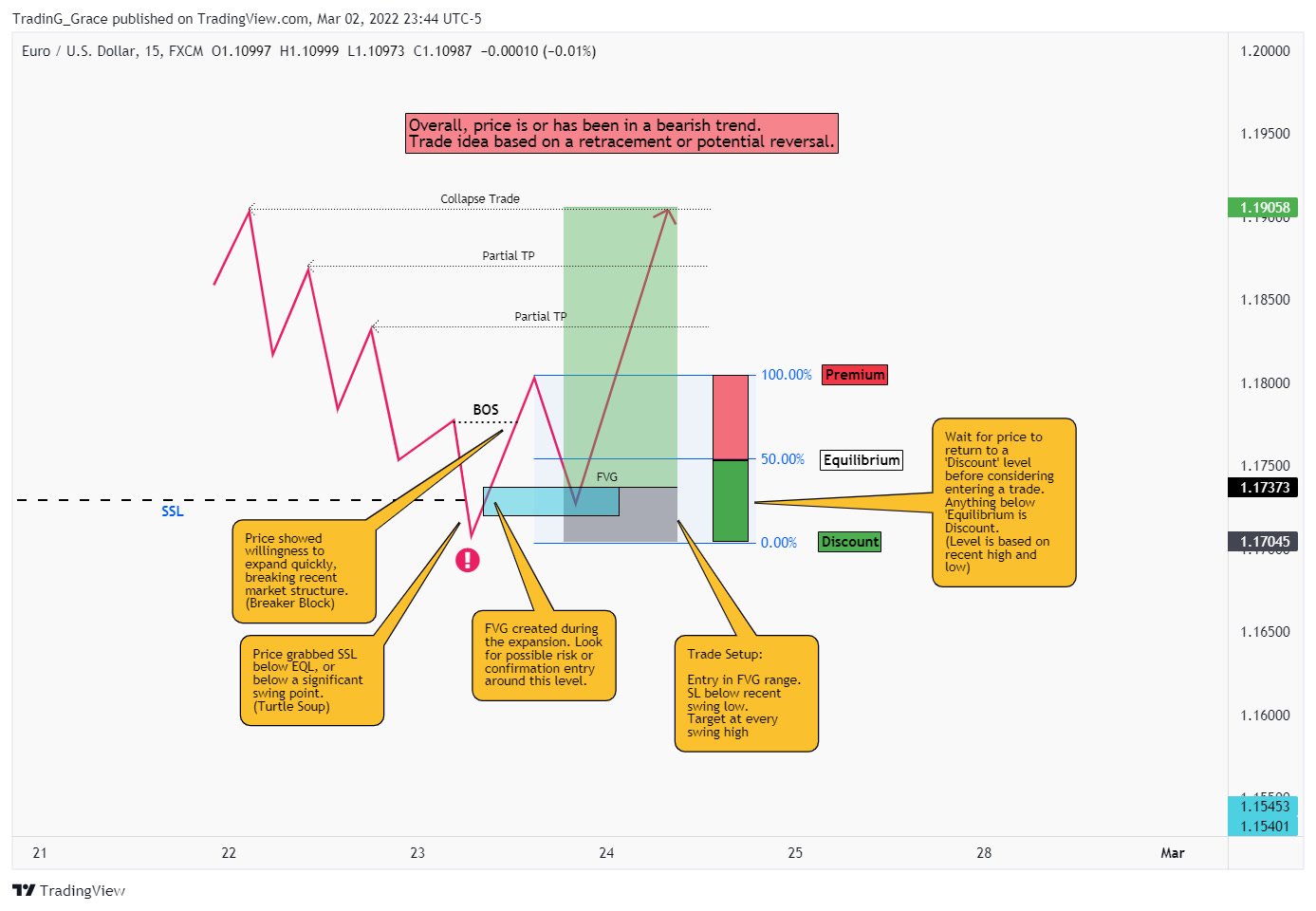
Here's the kind of day I mean.
Picture GBPUSD on the 15-minute at the London open. There's a clean order block above price, formed after a displacement move that swept a set of equal highs. Premium and discount are clearly defined, and the 4H bias points to a continuation short after a deep retracement into the weekly range.
You set alerts and walk away from the screen.
Price comes close to the OB, then turns without tapping it. Then it just sits there for hours. No displacement, no clean FVG, no liquidity sweep. Just noise.
A couple of hours in, you catch yourself highlighting a tiny imbalance on the 5-minute that you'd never touch on a clean day. The markup is getting more creative. The story about why this is a valid ICT entry is getting more elaborate.
That's the moment to recognise the pattern and close the charts.
Nothing changes structurally, so there's no trade that day. Maybe the next session price does tap the original OB and gives a clean displacement lower on the 15-minute. That's the entry: short from the order block, stop just above its high because a close through it kills the idea, target at the discount array and sell-side liquidity marked the day before. Or maybe it never comes back, and the plan simply doesn't trigger. Both are fine.
The setup was always the same. What changes the result is what you do during the silence.
The Archetype You'll Recognize Immediately
There's a specific kind of trader pattern that shows up constantly in forums and Discord servers, and it's almost always misdiagnosed.
This trader has solid ICT knowledge. They understand order blocks, FVGs, liquidity pools, the power of three. They can explain premium and discount in their sleep. Their backtesting results are actually decent. But their live account keeps bleeding slowly, not from big blowups, but from a steady drip of mediocre trades that don't meet the criteria they claim to follow.
When you look at their trade log, you see it immediately: the losing trades tend to bunch up in the quiet part of the New York morning on days with no high-impact news. The "dead zone" of the New York morning session before lunch. That's when the boredom peaks, the screen time is at its highest, and the patience is at its lowest.
They're not getting stopped out because their ICT analysis is wrong. They're getting stopped out because they're trading impatience dressed up as a setup. The orderblock they marked is real, it's just in premium when it should be in discount, or it's on a lower timeframe than their framework specifies, or there's no prior liquidity sweep to validate the move. They lowered the bar because the silence became unbearable.
This is the trader who needs a waiting protocol more than they need another hour of concept review. They already know the concepts. The problem is the gap between sessions.
If any of this sounds familiar, the piece I wrote on why your ICT order blocks keep failing in April's ranging markets goes deep on how ranging conditions specifically amplify this pattern.
Why the Silence Feels Like an Emergency
Here's the part most people don't examine: the brain doesn't distinguish between "dangerous inactivity" and "safe inactivity." To your nervous system, watching a market do nothing for three hours while your account sits there can register as a low-grade threat, like you're missing something, like you're falling behind, like you should be doing something.
Trading platforms are designed to exploit this. The charts are always moving. There's always a candle forming. The ticker never stops. So unlike, say, waiting for a bus where you can see there's no bus and your brain accepts it, you're staring at constant motion that looks like opportunity. The question your brain keeps asking is: "Is this the setup? What about this? Is this it?"
And eventually, starved for resolution, it answers yes, even when the honest answer is no.
In my experience, a lot of retail traders fill dead time with activity. The bigger players often aren't doing much during those windows, which is why they tend to be poor conditions for the kind of ICT setups that depend on institutional participation.
The Waiting Protocol, Exactly How I Handle It
After years of getting this wrong (and I did get it wrong, badly, for longer than I'd like to admit), I built a specific protocol for unstructured waiting time. Not a mindset tip. A literal procedure.
Step 1: Define the session window before it opens. Before London open, I write down: the one or two assets I'm watching, the specific price level where a setup could form, and the session cutoff, the time after which I'm done looking for that day. For London, that's usually 10:30 AM EST. For New York, 11:30 AM. No exceptions. If no valid setup appears by the cutoff, the session is closed. This turns the wait from open-ended to finite, which is psychologically enormous.
Step 2: Set price alerts and step away. Instead of watching candles form, I set alerts at the orderblock or FVG level I've identified. TradingView alerts are granular enough for this, you can set them to the pip. When the alert fires, I come back. When it doesn't, I'm not staring at 5-minute candles manufacturing reasons to enter.
Step 3: Do the post-session review during the dead time, not after. Instead of sitting on the charts during slow hours, I review yesterday's setups, specifically the ones I didn't take. Did price eventually reach my target? Was my level accurate? This keeps me engaged with ICT concepts without putting me at risk of forcing a trade. It's productive analysis time, not passive chart-watching.
Step 4: Track the urge, don't act on it. I keep a simple notes doc where I log every time I want to enter a trade that I ultimately talk myself out of. Not detailed, just the time, pair, and one sentence on why it didn't qualify. Looking at that log regularly is more revealing than almost any metric in my trading journal. It shows me exactly where the patience breaks down and what market conditions are most likely to trigger it.
This framework doesn't eliminate the discomfort of waiting. Nothing does. But it converts unstructured emptiness into a defined process, and that makes all the difference.
For context on how this kind of discipline plays out in high-stakes environments, the piece I wrote on 7 fatal mistakes that kill your funded account challenge success covers why a lot of prop firm failures trace back to session behavior rather than the strategy itself.
The Contrarian Take Nobody Wants to Hear
Here's something that took me an embarrassingly long time to accept: past a certain point, more screen time tends to make your ICT trading worse.
Every other skill in the world rewards practice time. Play more chess, get better at chess. Write more, get better at writing. But sitting in front of trading charts for 8 hours a day doesn't improve your ICT execution, it degrades it, because you're constantly exposed to the temptation to act on substandard setups. The extra hours don't generate better analysis. They generate more opportunities to override your own rules.
My best ICT trading sessions tend to be short. Alert fires, I engage, I assess, I execute or I don't, I close the charts. Done.
Some of my worst sessions were the ones where I had "all day to trade" with nothing specific to do.
If you're running a prop firm challenge right now, this is especially worth sitting with. I wrote about the broader psychological traps of funded trading in the truth about funded trading, what they don't tell you, and the between-session void is one of the most underappreciated challenge-killers in that entire environment.
What to Actually Do Next
If you recognize yourself in any of this, the elaborating markups, the creative setup narratives, the Tuesday afternoon trades that never show up in your journal highlights, start with one thing this week.
Before your next trading session, write down your session cutoff time. A hard stop. Not "I'll stop when nothing's happening", a specific time. Then commit to it for five consecutive trading days and review your trade log against it.
There's a good chance you'll find that your best trades occur in the first half of the session window, and the trades that hurt your statistics cluster in the back half, when you're waiting, restless, and willing to negotiate with yourself about what qualifies as a setup.
If you want a structured framework around this kind of session discipline, including position sizing, timeframe hierarchy, and how to build a waiting protocol specific to your schedule, the coaching plans break down exactly how that work gets done. Or if you're still building the ICT foundation underneath all of this, the crash course is the right starting point before adding psychological layers on top.
The silence between trades is going to be there regardless. The only question is whether you've built something to fill it, or whether the market gets to fill it for you.
Harvest Wright
ICT Trading Coach · 10+ Years Experience
Harvest specializes in ICT methodology and has helped traders pass prop firm challenges, develop consistent strategies, and build the psychology needed for long-term profitability.
Book a Free Discovery Call →Ready to Get Funded?
1-on-1 ICT coaching built around prop firm rules, from a trader who has passed an FTMO Challenge.
Book a Free Discovery CallFree ICT Funded-Trader Playbook
The setups, the pre-trade checklist, and the risk rules I use. Get it free.