
Why Discipline Breaks Down at Profit Targets
Everyone talks about discipline like it's a losing-trade problem. Hold your stop. Don't revenge trade. Don't widen your risk. But after 10+ years of doing this, I'm convinced that some of the worst discipline failures in trading psychology happen on winners.
Specifically, they happen in the last stretch right before your target prints.
Key Takeaway: The "almost there" moment in a winning trade works a lot like loss aversion: your brain treats an unrealized gain like something it already owns, making premature exits, target moves, and impulsive re-entries far more likely the closer price gets to your level. ICT traders are especially vulnerable because the precision of the methodology makes the near-miss feel like a certainty that got stolen.
The Myth That's Costing You More Than You Realize
Myth: Discipline breaks down when you're losing, blown stops, revenge trades, position sizing blowups.
Reality: Discipline breaks down most consequentially when you're up 2R and price is 8 pips from your target, because that's when your brain stops treating it like a trade and starts treating it like money you already earned.
What I Actually See: Traders who execute near-perfectly on entries, proper FVG confirmation, displacement on the higher timeframe, entry refined to the 15-minute, who then systematically destroy their R:R in the final stretch of the trade. The setup was elite. The execution on exit was chaos.
This isn't a discipline problem in the conventional sense. It's a psychology problem that trading content rarely addresses honestly. And ICT-based traders, specifically, have a unique vulnerability here that I'll explain in a moment.
What's Actually Happening in Your Brain Near a Target
Prospect theory, the behavioral economics framework developed by Kahneman and Tversky, tells us that humans feel losses more intensely than equivalent gains. Most trading educators stop there and say "that's why you hold losers too long." True. But the flip side is just as destructive and gets almost no airtime.
When a trade is in profit and approaching a target, your brain doesn't register it as unrealized gain. It registers it as gain that could be taken away. The closer price gets to your target, the more your nervous system treats that floating P&L as something you possess, and the more desperate it becomes to lock it in before it disappears.
This is the "almost there" trap. Emotionally, being 8 pips from a 40-pip target with price consolidating feels like losing 32 pips, not like being up 32 pips. Your risk aversion spikes exactly when you need to stay flat and let the setup deliver.
So you close early. Or you move the target to "lock in" more. Or you watch so intensely that when price wicks to within 2 pips of your TP before retracing, you immediately re-enter, without a setup, convinced the level will get hit.
That impulsive re-entry after a near-miss? That's where accounts go to die quietly. Not in a blaze of a blown stop. In a slow bleed of chasing your own target.
Why ICT Specifically Creates This Trap
Here's the nuanced take that most ICT YouTube content will never give you, because they're too focused on entry mechanics to discuss this honestly.
ICT's framework is precision-based by design. You're not just identifying a vague resistance zone, you're identifying the specific inefficiency, the exact premium array, the precise FVG mitigation level that price should return to. When you nail a premium/discount analysis correctly and enter in the 30-50% discount of a range after a displacement move, you have a legitimate reason to believe your target is not just probable but structural.
And that's the problem.
The more accurately your framework predicts a target, the harder your brain fights to protect the "near miss" when price approaches but doesn't quite reach it. Generic retail traders using horizontal support/resistance have lower conviction, which, counterintuitively, means less emotional volatility when price hovers near their target. ICT traders who've done the work, marked the 4H FVG correctly, refined entry on the 15-minute, and watched price move 2.8R toward the structural target? They feel owed that final 0.2R.
That feeling of being owed, that's where the behavioral disaster starts.
I used to fall into this. Picture marking a sellside liquidity pool at a specific low, watching price trade to within a few pips of it, then retrace. The brain immediately rationalizes a re-entry because "it's obviously going there." In you go, with no proper displacement sequence and no FVG to refine to, just conviction that the level has to print. Sometimes it works because the level does eventually get hit. When it doesn't, the loss is entirely self-inflicted, coming off what should have been a clean win.
A Worked Example
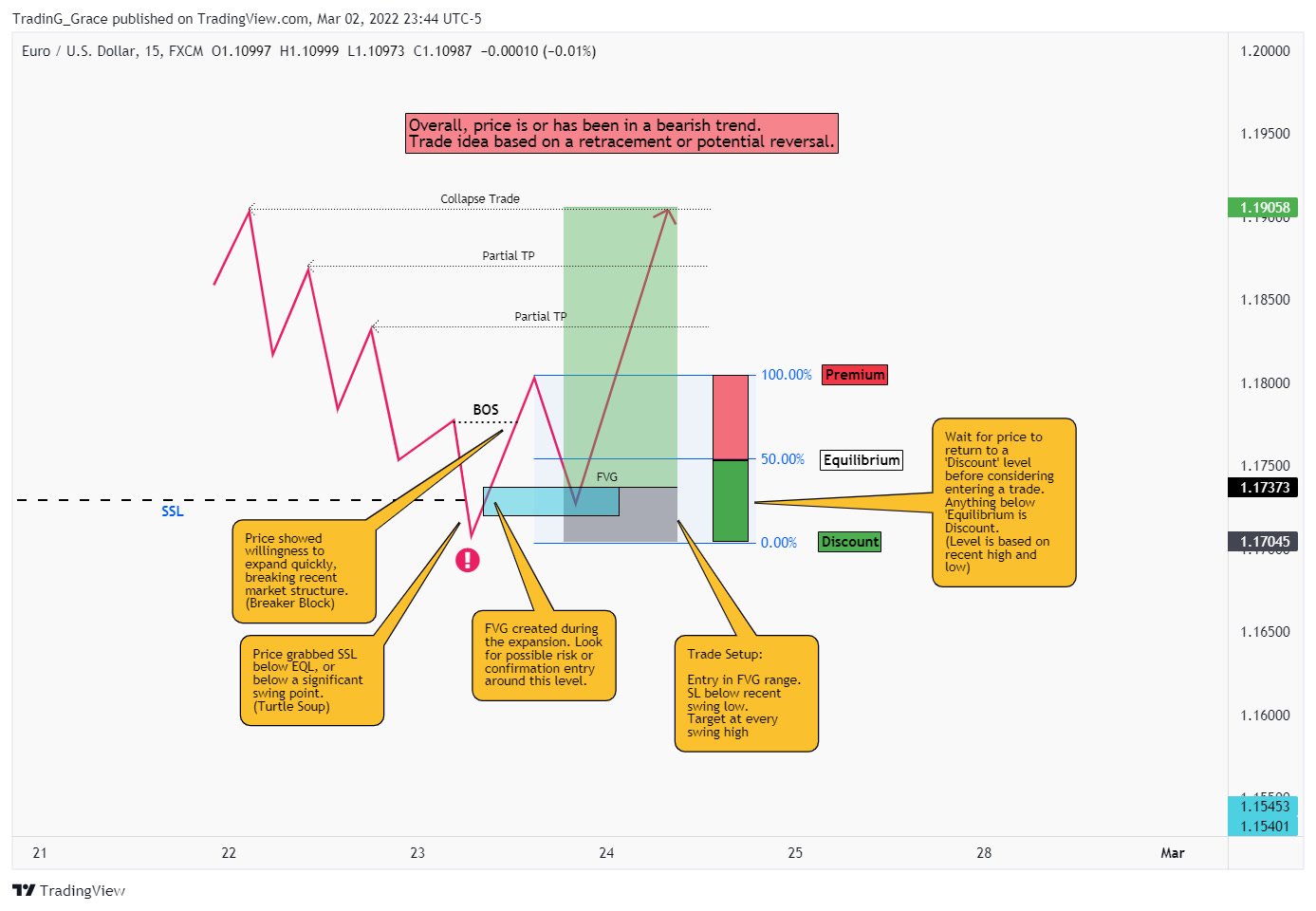
Let me make this concrete with an illustration. Picture a clean GBPUSD short on the 15-minute during the London session, maybe in a volatile week like the one described in this piece on April liquidity patterns.
Buyside liquidity above the Asian high gets taken. Price then displaces bearishly through an area of consolidation and leaves a 15-minute FVG. The 4H structure is bearish, and price is in premium on the 4H range. As textbook as it gets.
Entry goes in the middle of the FVG, refined on the 5-minute. The stop sits just above the FVG, because if price trades back through it the bearish move has failed. The target is the equal lows at the bottom of the 4H range, where the sellside liquidity sits.
Price drops cleanly, then churns sideways in a tight range sitting just above the target. No retracement back to any structural level. No mitigation. Just horizontal consolidation a short distance from the target.
Every fiber of the "almost there" trap is activating. The trader closes early and books a solid win. Then price trades through the original target a few minutes later.
Was closing early the wrong call? Not necessarily. The right call is the one defined before the trade: full target, or partials at predefined levels. Without a partial plan, closing early is an impulsive decision made under "almost there" pressure, not a planned execution. Proper position sizing (you can check yours with the R2F risk calculator) doesn't protect you from exit psychology.
The trade itself was fine. The exit process was compromised by proximity to the target.
The Archetype I See Constantly
There's a specific trader pattern that exemplifies this: the one whose backtesting results are excellent, but whose live winners are much smaller despite similar entry quality. When you review their trades, the entries are genuinely good. The problem is that trades that should be big winners keep getting closed well short of target, with a journal note that says something like "price was struggling near target" or "locked in gains before news."
This trader isn't lacking discipline on losses. He's systematically undermining every strong setup in the final phase of the trade. His entries show real edge. His exits are purely emotional, and always justified post-hoc with technical-sounding reasons that weren't part of the original trade plan.
The painful irony? His ICT analysis is good enough that the targets print more often than not. He's just never in them when they do.
A Practical Framework for Surviving Your Own Winning Trades
Here's how to structurally address this. Not motivational advice, a specific process.
Step 1: Write the exit plan before entry, with explicit contingencies. Before you click buy or sell, document: (a) full target, (b) partial percentage and level if you're taking partials, (c) the only condition under which you'll move the target. "Price struggling near target" is not a valid condition. "Price creates a 15-minute displacement back through a defined FVG" is.
Step 2: Set your TP as a hard order, then close the chart. This sounds extreme. It isn't. For any trade where you have a structural target (sellside/buyside liquidity, FVG mitigation, OB return), the target is defined. Set it. Walk away from the screen. The "almost there" trap cannot activate if you're not watching the tape. This is especially relevant near premium arrays, the exact point where ICT methodology trains you to watch most intensely.
Step 3: If you must watch, implement a 5-minute rule for any exit impulse. Every time you feel the urge to close a trade before target, set a 5-minute timer. Do not touch the trade until it expires. Write down your reason for wanting to close. A lot of the time, you'll recognize before the timer ends that the reason is "price is near my target and I'm scared it'll retrace", which is the trap, not a signal.
Step 4: Review exits as rigorously as entries. Most traders do detailed entry reviews. Almost nobody audits their exits with the same precision. Run a monthly report: for every trade that closed within 1R of target, did target eventually print? How often? This data will show you exactly how much the "almost there" trap is costing you in cold, hard R.
For a broader view of how discipline failures compound, especially in funded account contexts, this breakdown of the seven fatal mistakes that kill prop firm challenges covers the structural side of what poor exit management does to drawdown limits over time.
The Uncomfortable Truth About Precision
ICT methodology is among the most precise retail frameworks available. That precision is a genuine edge (the Q2 2026 market structure shifts post talks about structural targeting in current conditions). But precision cuts both ways in trading psychology.
When your framework is vague, near-misses don't sting as much. When your framework correctly identifies a specific pip level and price trades to within 3 pips before retracing, the cognitive dissonance is intense, and that's when the worst behavioral decisions happen.
Being good at ICT analysis doesn't protect you from this. If anything, it amplifies the trap. The better your reads, the more your brain treats each correctly-identified target as a certainty, and the more violently it reacts when that certainty is threatened by a slow, grinding approach to the level.
The solution isn't to care less about precision. It's to build a system that executes the final phase of your trade without you. Hard TP orders. Pre-written exit rules. A review process that holds you accountable to the plan you wrote when you were calm, not the decisions you make when you're watching price hover 5 pips from your target at 3:45 AM.
If you want to work through your specific exit patterns and build a personalized protocol around your setup types, the coaching plans at R2F are structured exactly for that kind of targeted work, from the Lite tier at $150/week up through the Full Mentorship at $5,000 for four months of dedicated development. Or if you're not sure where your trading psychology is actually leaking, book a free discovery call and we'll identify it together before you spend another month bleeding R on exits.
Your entries are probably better than you think. Your exits are almost certainly worse.
Harvest Wright
ICT Trading Coach · 10+ Years Experience
Harvest specializes in ICT methodology and has helped traders pass prop firm challenges, develop consistent strategies, and build the psychology needed for long-term profitability.
Book a Free Discovery Call →Ready to Get Funded?
1-on-1 ICT coaching built around prop firm rules, from a trader who has passed an FTMO Challenge.
Book a Free Discovery CallFree ICT Funded-Trader Playbook
The setups, the pre-trade checklist, and the risk rules I use. Get it free.