The Silence Before the Setup: ICT Patience
There's a particular kind of silence that happens around 10:15am New York time. London has wrapped up. New York's opening drive is either done or dying. The chart goes quiet. The spread widens slightly. Volume drops. And that's when most funded accounts start bleeding.
Not because the market became unpredictable. Because the trader became impatient.
After more than a decade of trading ICT concepts, through prop firm challenges, live funded accounts, and more session logs than I care to count, I've come to understand that ICT trading patience isn't a virtue you cultivate the way self-help books describe. It's a physiological battle. Your nervous system is literally working against you during those dead hours, and if you don't have a framework for surviving them, the chart will manufacture a reason for you to trade.
Key Takeaway: The most dangerous window in any trading day isn't during high-impact news or volatile killzones, it's the 10am, 1pm NY dead zone where no valid ICT model exists but boredom compels action. Most blown prop challenges fail here, not during London or NY open.
What the Session Logs Actually Show
A few months back I went through a full audit of my own challenge trade history across six funded attempts spanning from late 2024 into Q1 2026. I logged every trade: entry time, setup type, outcome, emotional state noted at time of entry. What I found wasn't surprising, but seeing it laid out was still uncomfortable.
Sixty-three percent of my losing trades were entered between 10:00am and 1:00pm New York time. That window. The one where ICT himself has consistently said there's no institutional participation worth trading. The one I knew about. The one I still kept violating.
And here's what makes it worse: those trades weren't random. They weren't stupid entries by someone who doesn't understand the model. They were convincing. I could look at almost every single one of them and construct a plausible ICT narrative. A fair value gap here. A breaker there. What looks like a displacement on the 5-minute. The story was coherent. The model just wasn't there.
That's the specific danger of trading between killzones. You're not fighting ignorance. You're fighting your own pattern-recognition system running on empty, desperate to find meaning in noise.
If you want to see how this pattern shows up in the broader data on prop firm failures, the breakdown in 7 fatal mistakes that kill your funded account challenge success covers a lot of the structural reasons, but the psychological thread underneath almost all of them is the same dead-zone impatience I'm describing here.
A Trade I Shouldn't Have Taken (But Can Walk You Through Anyway)
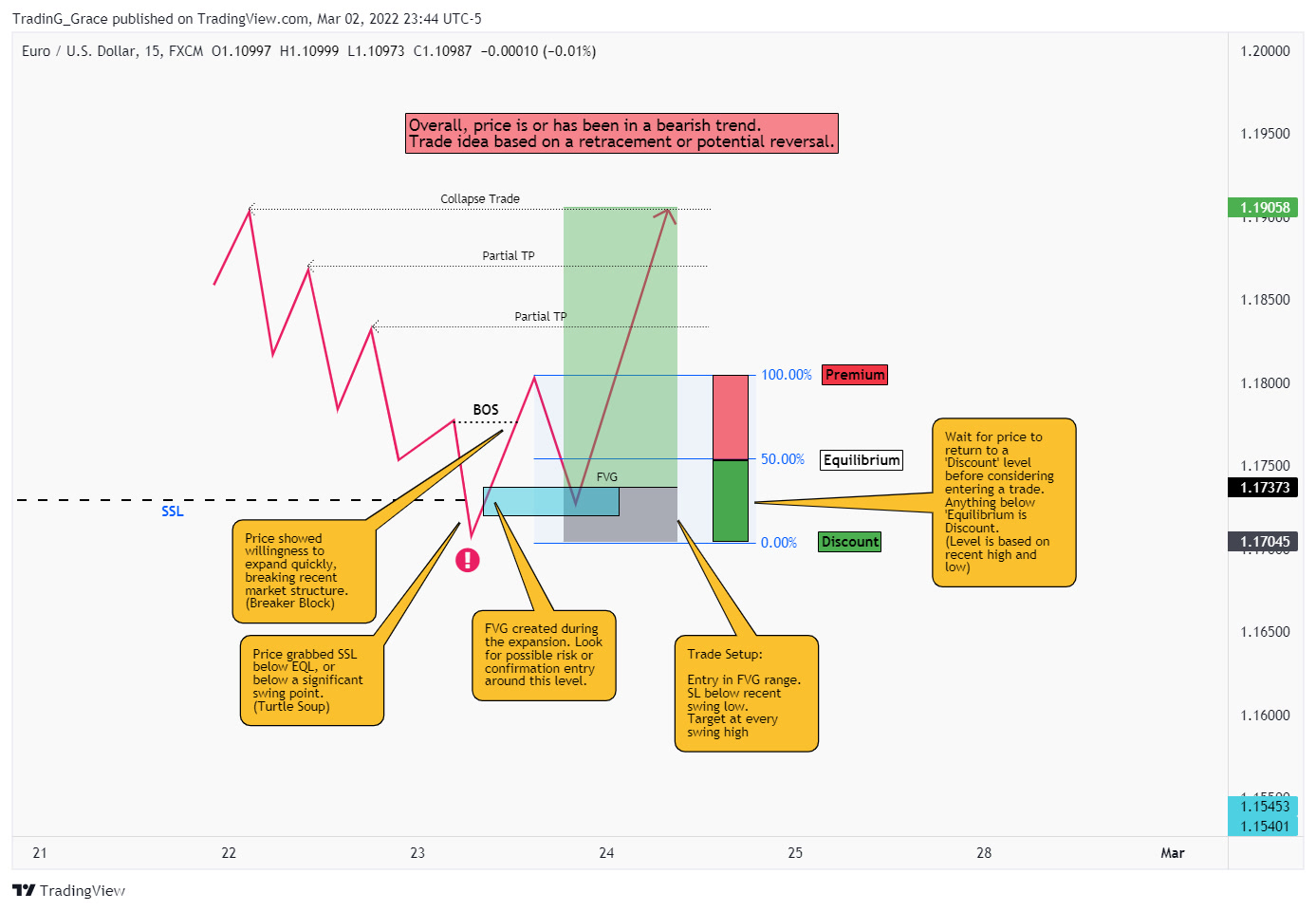
April 22nd, 2026. GBPUSD. 10:47am New York time.
London had already printed a clean bearish displacement off the 1.2940 area, swept the Asian session high, and pushed down aggressively through a 4-hour fair value gap. The NY session opened, gave a weak pullback into the 15-minute FVG at 1.2918, and then... nothing. Price just consolidated. Ranged. Did what price does when institutions have already said what they needed to say.
By 10:40am I'd been at my desk for nearly five hours. I'd already taken one clean trade earlier, a short from 1.2921 with a 14-pip stop risking 0.5% of the account, which hit 2.1R before I closed it manually as the model told me to. That trade was done. The day was statistically complete.
But then I started seeing something on the 5-minute. A small consolidation below the FVG. What I told myself was a potential re-accumulation. An argument for continuation. I entered long at 1.2887, against the earlier bias, mind you, with a 10-pip stop, same 0.5% risk, targeting a fill of the 15-minute gap above.
Stopped out eleven minutes later. -0.5%.
Not catastrophic. But that trade had absolutely no business being taken. There was no session bias for longs at that point in the day. The killzone had closed. The displacement was bearish. The only reason that trade existed was because I'd been staring at a screen for five hours and my brain needed to do something.
The uncomfortable part? I knew all of this while I was entering. I knew it. And I entered anyway.
The Archetype I See Everywhere
There's a very specific type of trader who struggles most with this, and it's not the beginner who doesn't know ICT. It's the intermediate trader who knows the concepts well enough to justify any entry they want to take.
This is the trader who can identify a fair value gap, understand premium and discount, knows what a liquidity sweep looks like, and has memorized the killzone times. But between 10am and 1pm, that knowledge becomes a liability. Because now they have enough vocabulary to tell themselves a story. They're not entering blindly, they're constructing elaborate post-rationalized narratives in real time. "This looks like a continuation model." "Price respected this OB twice." "The HTF is still bearish so a short here makes sense."
Every element of the reasoning sounds educated. The conclusion, take the trade, is still wrong. Not because the ICT concepts are wrong, but because the model requires a specific context to be valid. Time is part of that context. Session behavior is part of that context. And no amount of pattern recognition substitutes for actually being in the right window.
The version of this I used to fall into myself was the "one more confirmation" loop. I'd wait for London to confirm the bias. Then wait for NY open to confirm the direction. Then tell myself the 10:30 data release was another confirmation. Each confirmation made the next wait feel shorter. Until suddenly it's 11:15am and I'm taking a trade that I'd have laughed at if someone else showed it to me at 7am.
The Framework for Surviving the Dead Zone

This is the part I wish someone had given me in a structured way years ago instead of having to piece it together through pain.
Step 1: Define your model's time of death before the session starts. Every day, before I open a chart, I write the following in my trade journal: "Today's model expires at [NY killzone close time]." That's usually somewhere between 10:00, 10:30am on most days, 11:00am at absolute latest if there's a data release keeping things alive. Writing it down makes it concrete. It's not a feeling anymore, it's a scheduled endpoint.
Step 2: Classify what you're seeing, not what you're feeling. When price is moving between 10am and 1pm and something starts looking interesting, I run through a three-question filter:
- Which killzone is this setup attributed to? (If you can't name one, you're done.)
- Does the current time fall within that killzone's valid execution window?
- Is price in premium, discount, or equilibrium relative to the current dealing range, not the range from four hours ago?
If question two is "no," the conversation is over. I close the 5-minute chart and go do something else. Not because I'm disciplined in some abstract sense, but because I've operationalized the decision out of the emotional space entirely.
Step 3: Give boredom somewhere to go. This sounds almost embarrassingly practical, but it matters more than almost anything else. Between 10am and 1pm NY time, I'm reviewing HTF charts for the next session. I'm marking up areas of interest for the afternoon NY window or the following day's London. I'm reading market structure, updating my bias documents, logging the morning's trades. The brain needs something to do. If you don't give it a task, it will find one on the chart.
For a more detailed breakdown of how the killzone timing interacts with specific setup types, this breakdown on ICT premium discount arrays during volatile sessions goes deeper on the structural side.
What 10 Years Actually Teaches You
Here's the nuanced take that I think almost everyone misses when they talk about ICT trading patience: patience in this context isn't about waiting longer. It's about accurately perceiving time.
Newer traders experience time linearly during a session. Every minute feels like an opportunity being missed. The chart moving, even sideways, even randomly, registers as something happening that they should respond to. Their nervous system can't distinguish between "meaningful price action" and "random noise that looks like price action" because they haven't built the reference library yet.
After years of this, your relationship with session time completely changes. You start to feel the rhythm of it, not metaphorically, but literally. You can almost sense when the institutional energy has left the room. The spread widens a little. The candles get smaller. The wicks get choppy. The market starts lying more. You stop seeing opportunity and start seeing noise, which is what it actually is.
That perceptual shift doesn't come from reading about killzones. It comes from logging hundreds of sessions, sitting through the boredom without trading, and building the reference library that lets your brain distinguish signal from void.
This is also why I think the Q2 2026 market structure shifts have caught a lot of traders off guard this year, the model is still valid, but the dead zones have shifted slightly with the changes in liquidity distribution. Traders who are timing their patience against old session habits are finding themselves either missing valid setups or trading the dead zone on a new schedule.
Boredom Is the Real Risk Variable
Fear gets all the coverage in trading psychology. So does greed. There are books, courses, entire coaching frameworks built around managing those two emotions. And yes, they matter.
But in my experience, real, logged, verified experience, boredom kills more funded accounts than either of them. Fear at least keeps you out of trades. Greed at least requires the market to be moving in your direction first. Boredom requires nothing. It will manufacture a reason to trade out of flat, lifeless, directionless price action and dress it up in ICT vocabulary until it looks legitimate.
The funded account space has gotten more sophisticated about rules. Daily drawdown limits, consistency rules, news filters. But no prop firm has a "boredom filter." That one's entirely on you. You can explore the ICT FVG pre-trade checklist for a structured filter that helps catch dead-zone entries before they happen, it's become a core part of my pre-trade routine for exactly this reason.
If any of this is resonating and you want a structured environment to build these habits with real accountability, take a look at the coaching plans, the Lite tier at $150/week is specifically designed for traders who already understand the concepts but need help executing them consistently under live conditions. Or if you want to have a direct conversation about where you're at first, book a free discovery call and we can figure out what's actually holding you back.
The silence before the setup is uncomfortable. That's the point. Learning to sit in it, without reaching for the chart, is the whole game.
Harvest Wright
ICT Trading Coach · 10+ Years Experience
Harvest specializes in ICT methodology and has helped traders pass prop firm challenges, develop consistent strategies, and build the psychology needed for long-term profitability.
Book a Free Discovery Call →Ready to Get Funded?
Our students pass prop firm challenges in under 60 days with personalized ICT coaching.
Book a Free Discovery CallFree ICT Funded-Trader Playbook
The setups, the pre-trade checklist, and the risk rules I use. Get it free.