The Silence After a Loss Is Louder Than You Think
There's a version of losing a trade that everyone talks about. The rage. The revenge trade. The doubling up. The blown account with a timestamp you can point to and say, 'That's where it happened.' Trading psychology content is saturated with warnings about that moment, and fair enough, it's real and it's ugly.
But after ten years doing this, watching funded accounts fail in slow motion rather than explosions, I can tell you the version nobody talks about is far more dangerous. It doesn't look like a problem. That's the point.
Key Takeaway: The most destructive phase of trading psychology isn't the revenge trade that follows a loss, it's the 48, 72 hour window afterward where traders appear composed but unconsciously shrink size, skip valid setups, and over-filter entries. This silent sandbagging kills funded accounts more reliably than any emotional blowup, and almost no one is watching for it.
What 'Recovered' Actually Looks Like
Last April, late in Q1 2026, just before the volatility squeeze that made everyone's life complicated, I watched a clean setup form on GBPUSD during the London open. 15-minute chart. Price had swept the Asian session low, displaced sharply upward, and left a clear Fair Value Gap between 1.2614 and 1.2631. The order block that preceded the displacement was sitting right at the 50% equilibrium of the previous dealing range. Textbook premium-discount alignment. Confluence across HTF bias, session timing, and the FVG sitting in discount. Entry would've been 1.2618, stop at 1.2598, 20 pips, risking 0.5% of the account. Target: the buy-side liquidity resting above 1.2680, roughly 3.1R.
I didn't take it.
Not because the setup was bad. Not because I misread the structure. I didn't take it because three days earlier I'd been stopped out on a nearly identical GBPUSD entry that had looked just as clean, and while I'd journaled it, stepped away, done everything the psychology checklist says to do, some quiet part of my brain had filed GBPUSD 15m FVG entries under 'currently unreliable.' I wasn't angry. I wasn't emotional. I was composed. And I was wrong in a way that left absolutely no trace.
The trade ran to 3.1R without me.
That's the silence I'm talking about.
The Psychological Vacuum Nobody Names
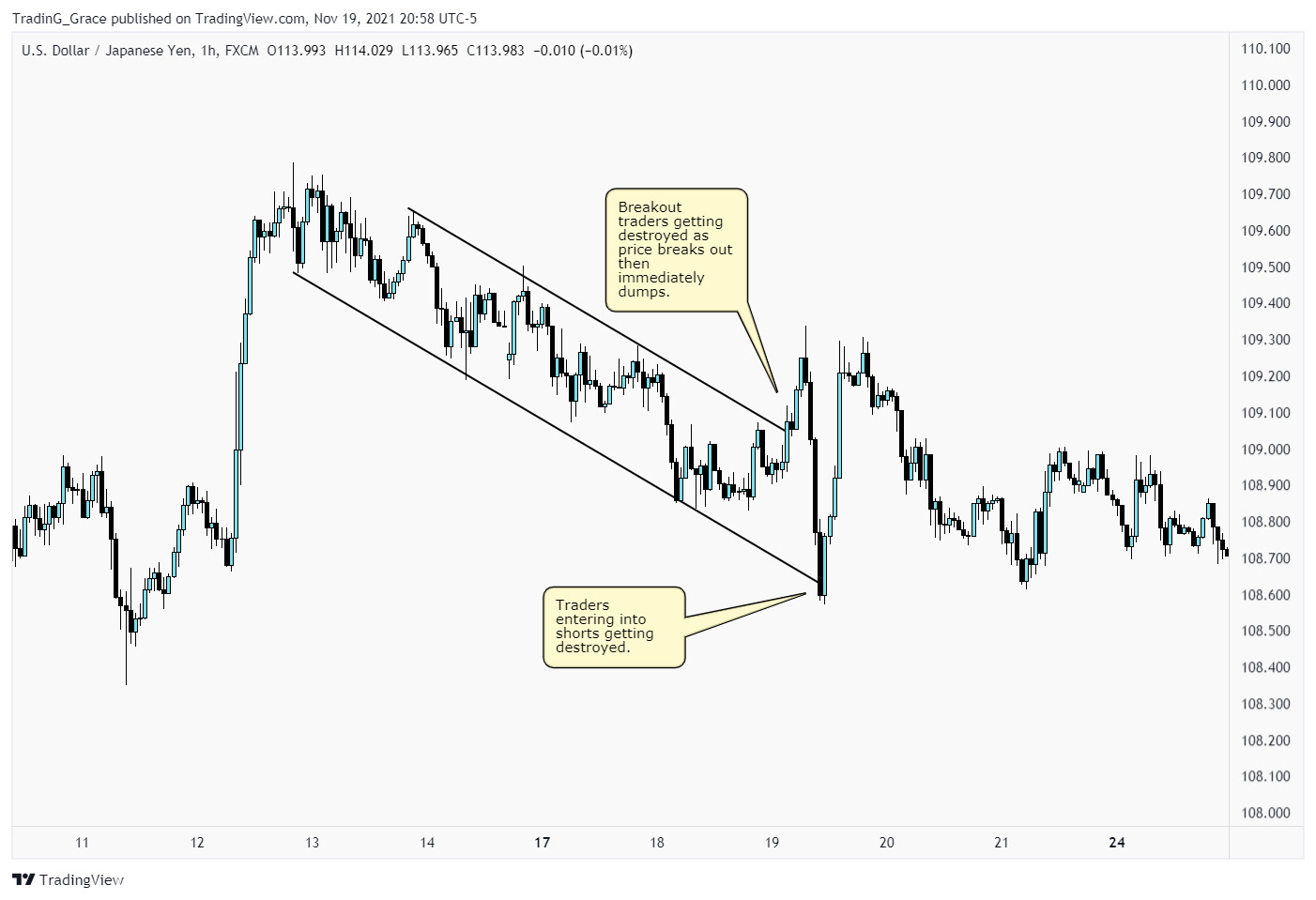
Here's what happens in the 48, 72 hours after a meaningful loss, and I mean meaningful relative to your psychology, not necessarily in dollar terms. A 1R loss on a funded challenge can hit harder than a 3R loss in a personal account depending on the context and pressure involved.
Your nervous system registers the loss as a threat signal. This is documented in behavioral finance research, the pain of losing is roughly twice as intense as the pleasure of an equivalent gain. Your brain doesn't just process this and move on. It encodes it. And the encoding doesn't happen consciously.
What follows is the dangerous part: you feel like you've recovered. You journal. You meditate. You sit down the next morning and open your charts with what feels like genuine calm. And then, without noticing, you start making tiny adjustments that feel like discipline but are actually fear in disguise.
You drop your risk from 0.5% to 0.25%, 'just for now, while I rebuild confidence.'
You see a valid FVG setup but notice one candle that's slightly ambiguous and decide to wait for 'more confirmation.' More confirmation that never cleanly arrives.
You start adding filters you've never used before. 'I'll only take this if the HTF also shows an NWOG lining up.' Reasonable-sounding. Made up on the spot.
None of this looks like a problem from the outside. From the outside, it looks like discipline. It looks like a trader who learned from a loss. And that external appearance, that false composure, is exactly what makes it so insidious. You're not getting flagged by your prop firm's risk team. You're not violating any rules. You're just quietly not being yourself, and your equity curve is going to reflect it two weeks later in a way that's very hard to explain.
If you're navigating a funded challenge right now and this resonates, it's worth reading through 7 fatal mistakes that kill your funded account challenge success, because this pattern, silent under-trading after a loss, is one of the ones that doesn't make most lists.
The Archetype I See Most Often
There's a specific trader profile where this destroys everything. They're disciplined. Actually disciplined, not just saying they are. They understand ICT concepts properly, they can identify displacement, they know the difference between a liquidity void and a Fair Value Gap, they can read dealing ranges. They pass their first prop firm challenge on solid mechanics.
Then they take a loss on their funded account, maybe two losses in a row, and something shifts. They don't revenge trade. They do the right things. And then they proceed to spend the next three weeks technically trading but practically ghost-trading, placing setups so filtered and undersized that even when they're right, it barely moves the needle. They fail the funded account not by blowing the drawdown limit, but by running out of time or simply never getting the account growing because every valid signal gets second-guessed into oblivion.
When they look back, they can't find the mistake. The journal shows 'disciplined entries, proper risk management.' But the equity curve tells a different story. What they're looking for is invisible in the journal because invisible decisions, the setups you didn't take, don't appear in a trade log.
This is what I wrote about in the context of rebuild psychology in my 47k prop firm loss piece. The mechanism of silent self-sabotage after drawdown is the same whether the numbers are large or small.
A Framework for Catching Yourself in False Composure
I used to get this wrong myself, badly. I thought the solution was more journaling, more reflection, more post-trade analysis. All useful, but they don't catch the right thing. Here's the framework I now use, and it's specifically designed to expose invisible decisions:
Step 1: The Setup Audit (24 hours after a loss) For the next 48 hours following any loss, I don't just journal what I traded. I screenshot every setup that formed during my session that met my pre-defined criteria on paper, FVG in discount, session alignment, HTF confluence. Every one. Whether I took it or not. At the end of each day I compare 'setups that qualified' against 'setups I actually entered.'
If my entry rate on valid setups drops below 70% in the 72 hours following a loss, I know I'm in the vacuum. Not a judgment, just a signal. Something is filtering that shouldn't be.
Step 2: The Parameter Freeze After a loss, I implement a 48-hour parameter freeze. Whatever my entry criteria were before the loss, those are the criteria for the next two days. No new filters. No additional confirmation requirements. If a setup meets the pre-loss checklist, it gets taken at pre-loss sizing. This sounds simple. It is genuinely hard to do when you're in the vacuum, because the extra filters feel so reasonable in the moment. That reasonableness is the tell.
For position sizing reference during this period, I use our risk calculator to remove any temptation to manually reduce size 'just a little.' If the number comes out at 0.5%, it goes in at 0.5%.
Step 3: The 72-Hour Review At the 72-hour mark post-loss, I run the setup audit numbers and ask one question: 'Did I trade the last three days like the loss didn't happen?' Not recklessly, I mean, did I apply the same criteria, the same sizing, the same decision framework? If yes, move on. If no, sit with why not before opening charts the next session.
The goal isn't to force yourself into trades. Valid skips are valid skips. The goal is to catch the difference between a disciplined skip ('this doesn't meet my criteria') and a fear-skip ('this meets my criteria but I found a reason to avoid it'). That distinction is everything.
For a more granular view of what 'meets criteria' actually means in practice, the ICT FVG trading checklist is the best place to anchor that definition before a loss happens, not after, when your brain will negotiate with the checklist.
The Contrarian Point Most Traders Won't Like
Conventional trading psychology wisdom says that after a loss, pulling back, reducing size, and being more selective are signs of growth. And sometimes they are. But here's the uncomfortable truth after a decade of watching this play out: in the context of ICT-based trading specifically, over-filtering is just as much a strategy failure as over-trading.
ICT setups have tight windows. The optimal trade entry on a 15-minute FVG during London open might exist for three candles. A session-based liquidity run has one real entry point before the move becomes extended. If you're operating with a brain that's quietly adding extra conditions after a loss, you're not being more disciplined, you're systematically missing the precision entries that make the methodology work, and then wondering why your results don't match the theory.
The Q2 2026 market structure shifts we've been navigating this year have already made timing harder. Layering unconscious fear-filtering on top of already-compressed entry windows is a combination that doesn't leave much room for the strategy to breathe.
The best traders I know aren't the ones who feel nothing after a loss. They're the ones who've built systems that catch their own silent distortions before those distortions compound. There's a meaningful difference, and it's not visible in the journal, it's visible in the results over time.
What to Actually Do With This
The silence after a loss is louder than you think because it sounds like peace. It sounds like composure. And your account will bleed quietly while you congratulate yourself on handling it well.
Start the setup audit after your next loss. Not the trade journal, the setup audit. Screenshot every qualified setup whether you took it or not. Run the numbers at 72 hours. Be honest about what you find.
If you want a structured framework for working through this kind of pattern with real accountability, not a course, actual feedback on how you're processing specific setups, take a look at the coaching plans to see what fits where you are right now. The Lite plan at $150/week works well if you're actively trading and just need a consistent outside perspective to catch the invisible patterns. The full mentorship goes deeper if this is something you've been cycling through for a while.
Either way: the next time you feel completely fine after a loss, treat that feeling as a prompt to look harder. The damage is usually already happening.
Harvest Wright
ICT Trading Coach · 10+ Years Experience
Harvest specializes in ICT methodology and has helped traders pass prop firm challenges, develop consistent strategies, and build the psychology needed for long-term profitability.
Book a Free Discovery Call →Ready to Get Funded?
Our students pass prop firm challenges in under 60 days with personalized ICT coaching.
Book a Free Discovery CallFree ICT Funded-Trader Playbook
The setups, the pre-trade checklist, and the risk rules I use. Get it free.