Patience Is Your Most Profitable ICT Skill
Picture this. GBPUSD, 15-minute chart, New York open. You've done everything right: marked the premium arrays the night before, identified the displacement move after London, watched price raid the buy-side liquidity above the Asian range. It's textbook ICT trading. The setup is clean. And you enter the moment price touches the order block.
You already know what happens next.
Price wicks through the zone, takes your stop, then reverses exactly where you expected it to go. The analysis was right and the trade is still a loss. If you've been trading a while, you've probably done this more than once. I certainly used to enter too early.
The useful question at that point is: why did I enter before I had permission to?
Key Takeaway: In ICT trading, the gap between price reaching a premium or discount array and your actual entry confirmation is where a lot of damage happens, usually from a predictable psychological pattern I call confirmation anxiety rather than from bad analysis. Training yourself to wait for the second confirmation, and knowing exactly what to do during that wait, is one of the most valuable habits you can build.
The Difference Between a Signal and Permission
A lot of ICT traders have the analysis down. Seriously, they can mark up a chart, identify a fair value gap, draw the order block, understand premium versus discount. The conceptual knowledge is solid. What's not solid is the distinction between seeing a signal and having permission to enter.
A signal in ICT trading is when price arrives at your area of interest. The order block. The FVG. The discount zone on a higher timeframe PD array. That's price telling you pay attention. That is not an entry.
Permission is what happens next, a mitigation candle that respects the zone, a lower timeframe market structure shift, a displacement move back in the direction of your bias. That's the second confirmation. And that's your entry.
Here's the contrarian take that most ICT content on YouTube completely glosses over: your first confirmation is just a filter, not a trigger. It eliminates the bad setups. The second confirmation is what actually defines your trade. Conflating the two doesn't just hurt your win rate, it fundamentally misaligns your risk-to-reward expectations, because you're entering at a price that hasn't yet proved anything except that it exists.
I've been trading for over a decade. In the early years, I thought patience meant waiting longer before I started looking at a chart. I was wrong. Patience in ICT trading is not about time. It's about information. You wait not because waiting is virtuous, but because the second confirmation contains data the first one doesn't.
What Confirmation Anxiety Actually Looks Like
Let me describe the few minutes after price reaches your zone, which can do as much damage as a bad setup.
Price has just arrived at your premium array. Your higher timeframe bias is bearish. You've got a clean order block sitting right where price is trading. This is the moment.
And then nothing happens. Price hovers. A candle opens and closes and doesn't do much. Another one forms. You start thinking, is it going to reject here? What if I miss the move? What if I enter a limit and it just blows through? Your eyes go from the chart to your order entry panel. Back to the chart. You start mentally calculating where the invalidation point is, not to set a proper stop, but to justify a tighter entry. You zoom into the 1-minute chart because the 5-minute "isn't showing enough." You find a candle that kind of looks like a rejection.
You enter.
That pattern, that specific sequence of anxiety, rationalization, and premature entry, is what I call confirmation anxiety. And it has nothing to do with market structure or liquidity or anything ICT. It's a stress response to uncertainty, dressed up as analysis.
The uncomfortable truth is that confirmation anxiety feels like alertness. It feels like you're being sharp and decisive. But you're actually just impatient, and impatience at a premium array is one of the most expensive habits in trading. I've written about some of the broader behavioral patterns that cost traders their funded accounts in 7 fatal mistakes that kill your funded account challenge success, and impatience is a thread that runs through a lot of them.
A Worked Example
The fix is a simple rule: I do not enter until I see a confirmed displacement on the entry timeframe away from the PD array. Not a wick. Not a doji. A displacement. A candle, or sequence of candles, that shows intent.
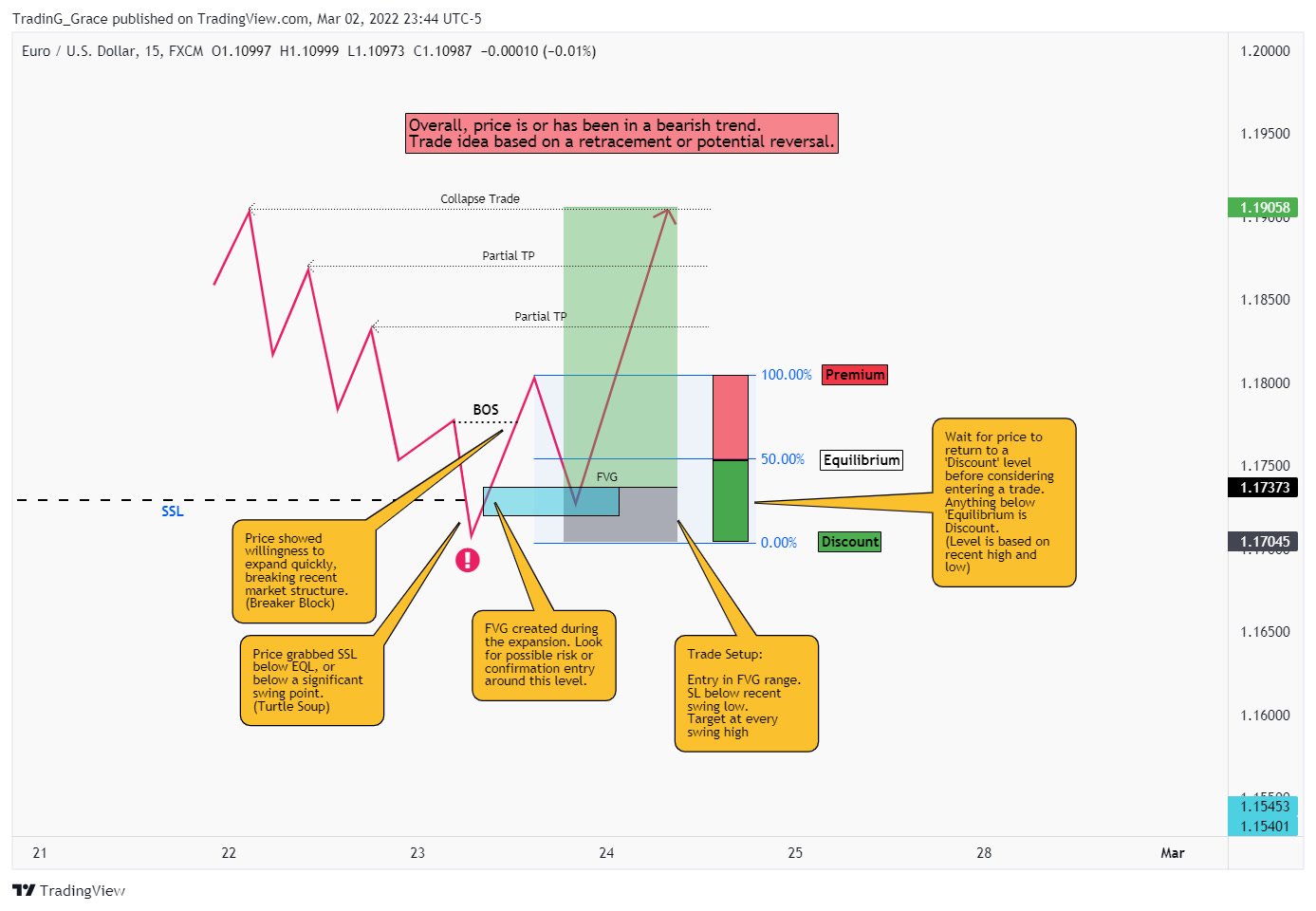
Here's what that looks like. Picture GBPUSD on the 15-minute chart with a clear bearish order block left behind by a strong London displacement to the downside. Bias is bearish. During the New York open, price rallies back into that zone, a textbook premium retracement.
Price arrives in the zone. You mark it, set an alert, and step back from the order panel.
For a few minutes, price just consolidates inside the upper part of the OB. The first-touch trader is already in. You aren't. Then a strong bearish displacement candle closes on the 5-minute chart, below the midpoint of the order block, engulfing the consolidation candles. That's the second confirmation. That's permission.
The short goes on after that candle. The stop sits above the order block high, because if price trades back above it the bearish idea is wrong. The target is a fair value gap or the sell-side liquidity below, the obvious place price is drawn to next.
Same setup as the early entry. Different entry behavior. And now you know the zone has actually held before you commit.
Here's Exactly What to Do During the Wait
This is the part nobody talks about. Everyone says "be patient", almost no one tells you what to actually do with your hands and your brain during the wait. So here's the protocol I use and teach in my coaching sessions:
Step 1, Mark it and mute it. The moment price enters your PD array, mark the exact zone boundaries on your chart. Then remove your hand from the mouse. Literally. I'm not being metaphorical. Put it in your lap. The physical separation from the order panel breaks the execution reflex.
Step 2, Identify your confirmation criteria before price gets there. Before the trade even sets up, write down, in your trade journal, on a sticky note, wherever, what your second confirmation looks like. For me, it's a displacement candle on the 5-minute chart closing beyond the array midpoint in my intended direction. Define this in advance so you're not inventing criteria under pressure.
Step 3, Watch the candle, not the price. During the wait, your eyes should be on candle behavior, not the price number ticking. One tells you what the market is doing. The other tells you what your anxiety is doing.
Step 4, If it doesn't confirm, it's not a trade. This is the hard one. Sometimes price touches the zone, wiggles around for a few minutes, and then just runs without giving you a clean displacement. That's a missed trade. Not a loss. Miss the trade. Protect the account. As I covered in how to trade ICT premium discount arrays during April's volatility squeeze, in ranging or compressed markets especially, a lot of zone touches are false tests, and the filter of second confirmation helps keep you out of them.
For position sizing during any entry, I run everything through my risk calculator so the math is never a variable in that waiting window. The size is already decided before I ever watch price approach the zone.
When the Analysis Is Right and the Account Isn't
A common pattern I see: a trader whose analysis is accurate. They can look back at their charts and show you plenty of trades where they correctly identified the PD array and the direction. But the account is still going down. The disconnect is usually entry timing: they enter on arrival instead of on confirmation.
The fix is to sit down and define second confirmation criteria for the specific pairs and timeframes you trade, then write it as a rule alongside a waiting protocol like the one above. Same zones. Better entry timing.
That's what patience actually does in ICT trading. It doesn't just keep you out of bad trades. It makes your good trades better.
The 10-Year Perspective
Here's what a one-year trader doesn't have yet: the lived experience of watching the same impatient mistake compound over hundreds of trades. When you're newer to ICT trading, every missed move feels catastrophic. Every zone that runs without you feels like a personal failure. So you enter earlier and earlier, tightening that gap between arrival and confirmation until it disappears entirely.
After ten years, you understand something different. The market will always give you another setup. The account that survives long enough to see that next setup is the account that wins. Every time I see a second confirmation candle form clearly, I'm reminded that the market is literally giving me evidence, hard visual evidence, that my bias was right. Why would I enter before receiving that evidence?
Patience in ICT trading isn't about white-knuckling through discomfort. It's about building a protocol that makes waiting the default behavior, so that entering without confirmation feels wrong, not entering with it. That's the behavioral shift. That's the trainable habit. And it starts in those few minutes when price sits in your zone and your anxiety tells you to do something.
Do nothing. Watch the candle. Wait for permission.
If you're working through funded account challenges or building a prop firm strategy around ICT concepts, the Q2 2026 market structure shifts article gives important context on how current conditions affect where and how second confirmations are forming right now.
And if you want to build this protocol with direct feedback on your actual trades, not generic advice, but someone watching your specific charts and your specific entry behavior, that's exactly what we do together. Book a free discovery call and we'll talk about whether the coaching structure that fits your current stage is Lite, Pro, or Full Mentorship.
The analysis was never your problem. It rarely is.
Harvest Wright
ICT Trading Coach · 10+ Years Experience
Harvest specializes in ICT methodology and has helped traders pass prop firm challenges, develop consistent strategies, and build the psychology needed for long-term profitability.
Book a Free Discovery Call →Ready to Get Funded?
1-on-1 ICT coaching built around prop firm rules, from a trader who has passed an FTMO Challenge.
Book a Free Discovery CallFree ICT Funded-Trader Playbook
The setups, the pre-trade checklist, and the risk rules I use. Get it free.