
Why Patience Feels Wrong in Profitable Trades
There's a specific kind of torture that comes with being right in a trade.
Not wrong, right. You read the setup correctly. You entered in discount. Price displaced beautifully. Your trade is in profit. And then... price starts pulling back, and every second it retraces, your brain is quietly screaming at you to close it.
This is one of the most talked-about problems in trading psychology, and almost every piece of content about it gives you the same answer: be more patient. Trust your analysis. Let your winners run.
After 10+ years of trading ICT concepts, through prop firm challenges, live funded accounts, and more retracements than I can count, I want to tell you something nobody says out loud:
The discomfort you feel holding a winner isn't a discipline problem. It's a neurological one. And if you trade ICT, your own market knowledge is making it significantly worse.
Key Takeaway: The pain of holding a winning trade through a retracement isn't impatience, it's your brain treating floating profit as already-owned money. ICT traders face an additional paradox: the more accurately you can read draw-on-liquidity, the more unbearable it becomes to watch a retracement you already predicted play out.
The Brain Doesn't Distinguish Between Unrealised and Realised Profit
Here's the neuroscience that the 'just be patient' crowd skips over.
Once your trade is in profit, even by a single pip, your brain has already partially claimed that money as yours. This is loss aversion in its purest form, documented extensively in behavioural economics research: losses feel approximately twice as painful as equivalent gains feel good. So when a 20-pip winner retraces 10 pips, your brain isn't processing 'I still have 10 pips profit.' It's processing 'I just lost 10 pips of something that was mine.'
That's not weakness. That's wiring.
And no amount of journaling, affirmations, or YouTube pep talks rewires that in any permanent way. What actually works is building a framework that removes the decision from your emotional brain entirely, but more on that in a moment.
Myth, Reality, and What I Actually See in the Wild
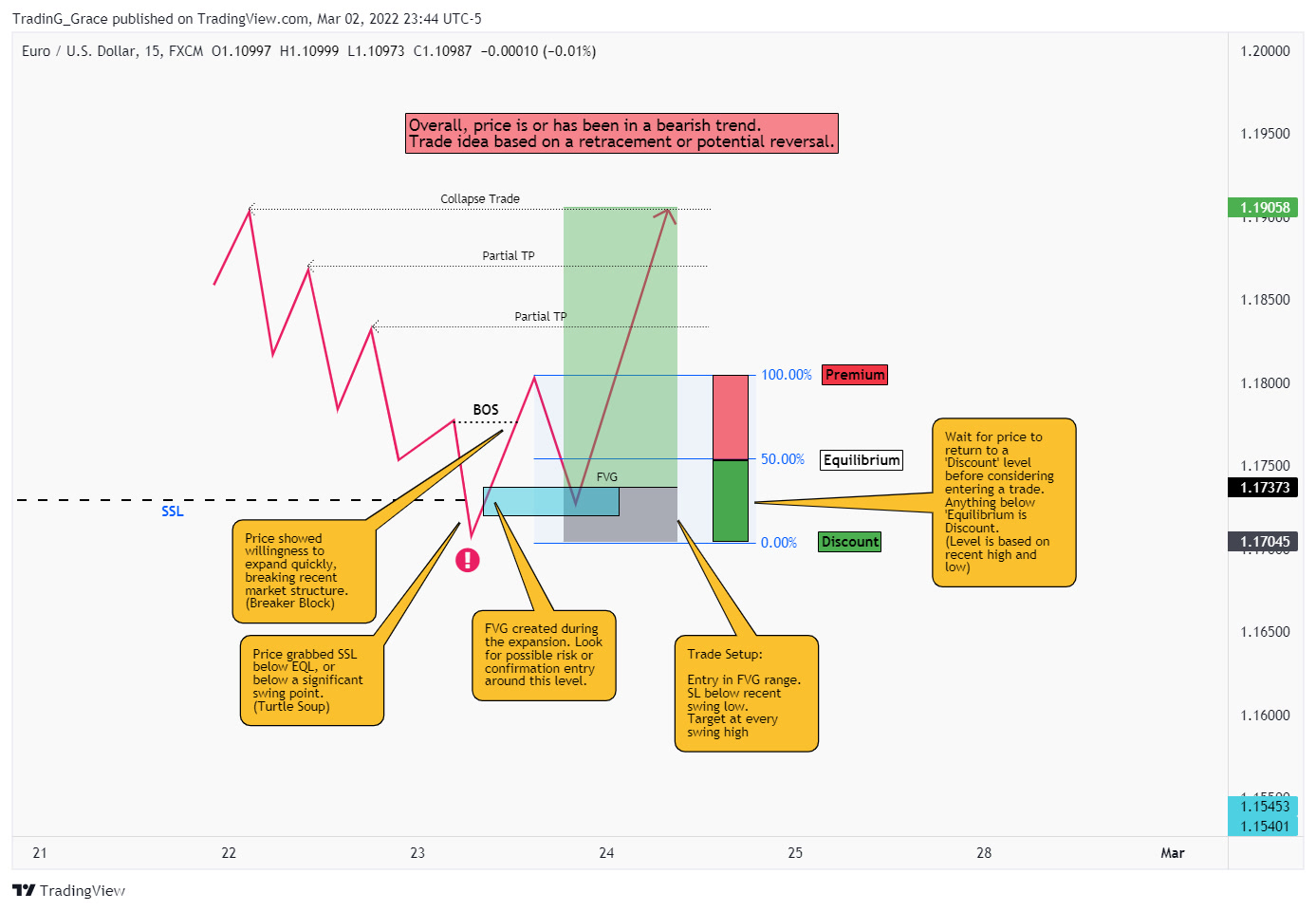
Myth: Holding a winning trade through a retracement is a patience problem, solved by more discipline.
Reality: The discomfort is proportional to how much of the move you've already captured. A trade at 1R feels different than a trade at 3R pulling back to 2R, even though the risk profile hasn't changed relative to your original stop.
What I Actually See: The trader pattern that plays out most often with ICT setups goes like this, someone enters a clean order block in discount on the 15-minute chart, gets a 2R move into a Fair Value Gap, and then exits the entire position the moment price touches that FVG. Why? Because they know FVGs get mitigated. They've studied this. Price touching the FVG feels like confirmation that the move is over, even when the draw on liquidity is still 4R above them.
The knowledge becomes the psychological liability.
The ICT Paradox Nobody in the Space Talks About
Here's the thing that separates ICT-based trading psychology from generic market psychology content, and I haven't seen anyone address this directly.
Most trading frameworks are vague about why price moves. You draw support and resistance, you wait for a bounce, you hold. The vagueness gives you psychological cover, you don't know exactly what's happening, so you can stay in the trade.
ICT removes that cover completely.
When you understand draw on liquidity, when you can identify the buyside or sellside pool that price is engineered to reach, you don't just have a target. You have a narrative. You know smart money needs price to raid those equal highs before reversing. You know the FVG on the 5-minute is going to get tapped before continuation. You can see the stop hunt forming before it forms.
And that visibility is extraordinary, until your trade is in profit and you're watching price retrace toward the exact level you knew it would tap.
Suddenly your analysis isn't an asset. It's a weapon pointed at your own position. Every pip of retracement comes with an internal monologue: Did I get this wrong? Is this the reversal? Should I have taken profit when I had the chance?
I used to get this completely wrong, by the way. I thought being able to see more of the chart meant I should manage trades more actively. What it actually took me years to understand is that more information requires more predetermined rules, not less, precisely because the temptation to act on that information in real time is overwhelming.
If you've fallen into this trap yourself, the piece I wrote on why Q2 2026 market structure shifts are breaking traditional ICT setups goes deeper into how our own framework can work against us in certain conditions.
A Real Trade That Illustrates This Exactly
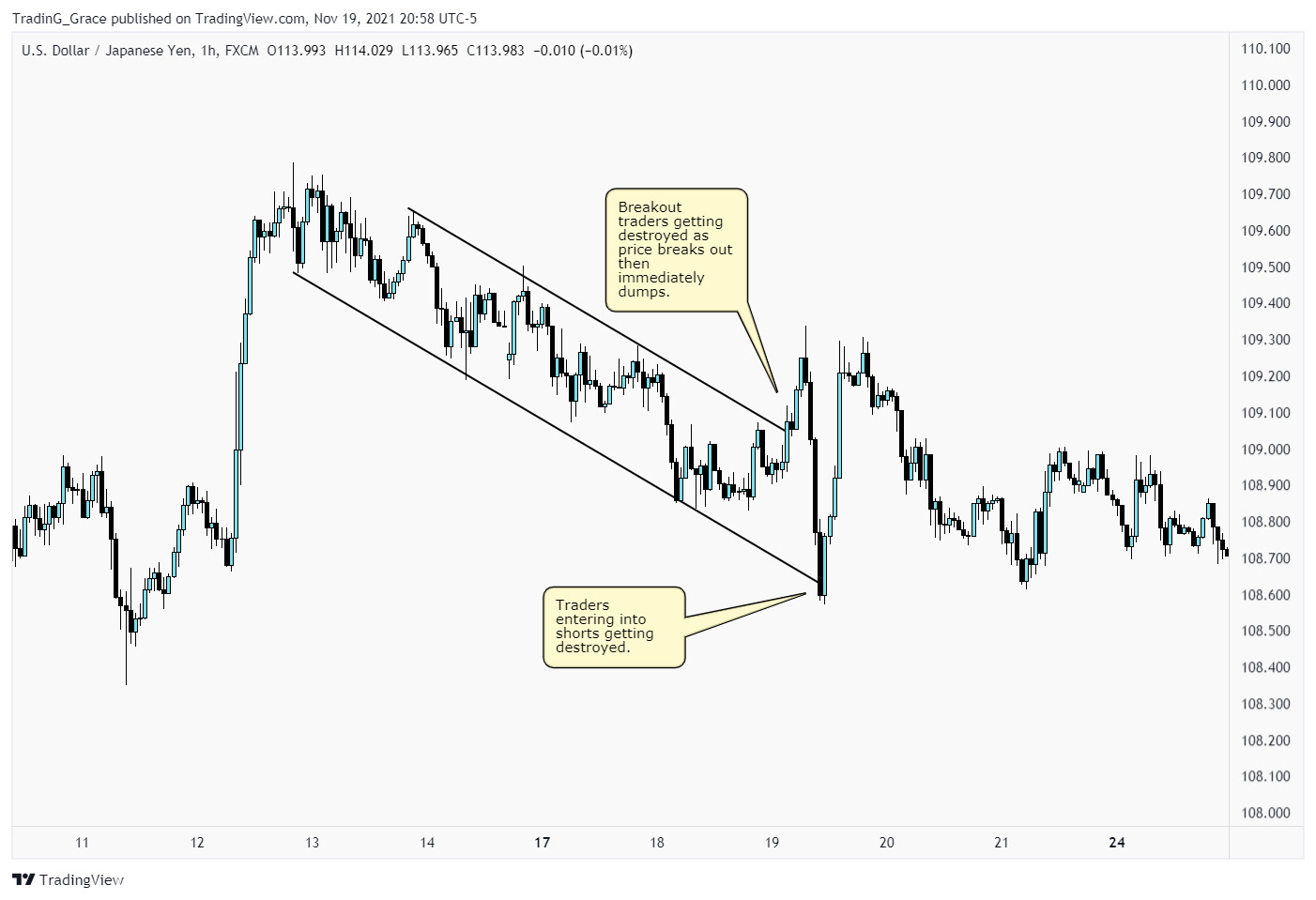
Let me give you a specific example because abstract psychology talk only gets you so far.
Early April 2026, GBPUSD, 15-minute chart. London open had just printed a clean displacement to the downside, a strong bearish FVG formed between 1.2634 and 1.2651 after a 30-pip impulse. I was looking for price to retrace into that FVG, grab the liquidity resting above the previous session's highs at 1.2668, and then continue the bearish expansion toward the 4-hour demand at 1.2541.
Entry: 1.2649, inside the FVG, on a 5-minute bearish shift in market structure. Stop: 1.2674, 25 pips, risking 0.75% of the account. Target: 1.2541, just above the 4H demand zone. That's 108 pips. A 4.3R trade.
Price dropped immediately. 40 pips in 90 minutes. Beautiful.
Then it retraced. Not to my stop. Not even close. But it tapped back to 1.2619, a 30-pip retrace, which happened to be sitting just above a minor 15-minute FVG I had marked.
Here's the psychology in real time: I was up 30 pips. I'd already mentally run the numbers, 0.75% risk, so I was up roughly 0.9% of my account in real money. My brain had claimed it. Then watching it give back 30 of those pips while sitting at my desk felt exactly like a loss, even though I was still 0 pips from my entry.
And the worst part? I could see exactly why price was retracing. That minor FVG needed to get mitigated. This was in the script. I had literally anticipated this at entry.
Knowing why something is happening doesn't make it easier to watch. That's the paradox.
I held. Price respected the minor FVG, continuation resumed, and the trade closed at 1.2548 for a 4.04R return.
But I want to be honest, that 30-pip retrace took about 45 minutes of real psychological effort to sit through, despite being completely expected.
The Framework I Actually Use to Hold Trades
Generic advice says 'have a trade plan.' That's not a framework, it's a platitude. Here's what actually works, specifically for ICT-style setups:
Step 1: Define your invalidation, not your profit target, as the active decision. Before entering, write down the single price level that, if reached, means your narrative is wrong. For ICT traders, this is usually a break and close beyond the origin candle of the displacement, or a reclaim of the OB you're trading from. That level is the only price you monitor after entry. Everything else is noise.
Step 2: Map the retracements before they happen. During your analysis, not during the trade, identify every FVG, every minor OB, every liquidity pool that price is likely to tap on its way to your target. Write them down. When price touches those levels, you're not surprised. You check your list, confirm price hasn't reached your invalidation, and that's the end of the decision-making process.
Step 3: Close the chart after confirming entry. This sounds extreme. For short-term setups on the 5 or 15-minute, it's genuinely the most effective tool I've found. Set your stop in the platform. Set a price alert at your target. Walk away. The trade either works or it doesn't. Your presence on the chart does not improve the probability, it only degrades your execution.
Step 4: Partial only at pre-planned levels, never at emotional ones. If you're going to take partials, and sometimes structurally it makes sense to, decide the levels before entry. '1R partial at the first FVG, let the remainder run to the draw' is a rule. 'I feel like I should take some off here' is not.
For position sizing on these setups, I use a risk calculator before every trade so the percentage risk is fixed and pre-decided, one less variable for my brain to negotiate with mid-trade.
The Trader Type Most Likely to Struggle With This
The trader I see lose the most to premature exits isn't the one who lacks knowledge. It's usually the opposite: someone who has studied ICT seriously for 12-18 months, understands the concepts well, and because of that understanding, micromanages every retracement into a crisis.
They enter a valid setup. Price moves in their favour. A minor FVG gets tapped on the way. And instead of referencing their pre-trade map, they open the 1-minute chart, zoom in, see a bearish structure shift, and talk themselves into an exit that gives them 0.8R instead of 3R.
The knowledge isn't the problem. The missing piece is a rule set rigid enough that the knowledge can't override it mid-trade.
If you've found yourself consistently leaving money on the table this way, and it's costing you funded account performance, the breakdown of 7 fatal mistakes that kill your funded account challenge success addresses this pattern directly in the context of prop firm rules.
Also worth reading: my breakdown of ICT liquidity grabs vs stop hunts, because understanding the difference structurally is what allows you to stay in a trade when price reaches a level that looks like it's hunting your stop but actually isn't.
What Actually Changes After Years of Doing This
Here's what I can tell you from genuine experience rather than borrowed wisdom: the discomfort of holding a winner never fully disappears. What changes is your relationship to it.
After enough repetitions of watching a predicted retracement play out exactly as mapped and then continuing to your target, your nervous system starts to build a competing reference point. The discomfort is still there, but it sits next to a memory bank of times you felt this exact feeling, stayed in, and were right.
That's not confidence from a motivational poster. It's pattern recognition built through documented trade history. Which is why a detailed trade journal isn't optional, it's the only long-term answer to the neurological problem.
If you want to work through this in a structured way, the coaching plans here at R2F break down into Lite, Pro, and Full Mentorship options depending on how much support and accountability you're looking for. Or if you want to get a feel for the approach first, book a free discovery call and we'll figure out where the gaps actually are.
The market will always feel like it's trying to take back what's yours. The goal isn't to stop feeling that. The goal is to have built a system so specific that the feeling becomes irrelevant to what you actually do.
Harvest Wright
ICT Trading Coach · 10+ Years Experience
Harvest specializes in ICT methodology and has helped traders pass prop firm challenges, develop consistent strategies, and build the psychology needed for long-term profitability.
Book a Free Discovery Call →Ready to Get Funded?
Our students pass prop firm challenges in under 60 days with personalized ICT coaching.
Book a Free Discovery CallFree ICT Funded-Trader Playbook
The setups, the pre-trade checklist, and the risk rules I use. Get it free.