
The Truth About Funded Trading: What They Don't Tell You
After 10+ years in the markets, passing an FTMO Challenge myself and now coaching traders, I've seen how this industry works. What I'm about to share might make some prop firms uncomfortable, but you deserve to know the truth.
The funded trading industry has exploded in recent years, promising traders the chance to manage substantial capital without risking their own money. While the opportunity is real, there's a darker side that most firms conveniently leave out of their marketing materials.
Key Takeaway: Funded trading programs can offer genuine opportunity, but before signing up, scrutinize the fine print around payout structures, drawdown rules, and reset fees, because the business model often profits more from failed evaluations than from funding successful traders.
The Marketing vs. Reality Gap
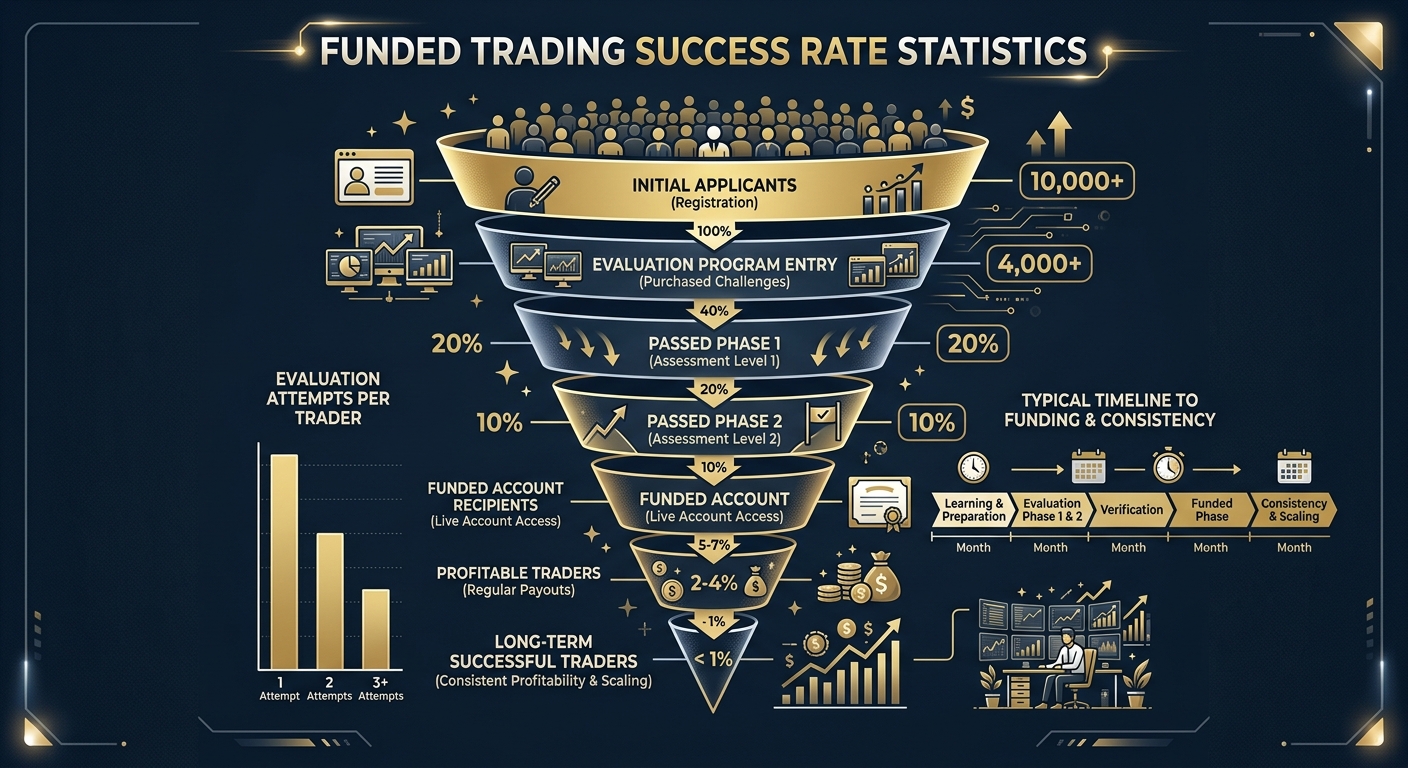
Prop firms love to showcase their success stories, traders making six figures, luxury lifestyle posts, and impressive profit screenshots. What they don't show you is the large share of traders who never make it past the evaluation phase.
Here's the reality as I see it:
- Most traders don't pass their first evaluation attempt
- Plenty of those who do pass lose the funded account later
- Many traders buy several evaluations before succeeding (if they ever do)
These aren't failures of character or intelligence. They're the result of unrealistic expectations and insufficient preparation for what funded trading actually demands.
The Hidden Psychological Warfare
Funded trading isn't just about having good setups or understanding Smart Money Concepts (SMC), though these are crucial. It's psychological warfare at the highest level.
Pressure Amplification
When you're trading evaluation capital, every trade carries the weight of your dreams. That Premium/Discount setup you'd normally execute with confidence suddenly feels like a life-or-death decision.
This pressure creates what I call "evaluation syndrome", traders abandon their proven strategies and start overtrading or second-guessing every Order Block and Fair Value Gap (FVG). The 7 fatal mistakes that kill your funded account almost always trace back to this psychological breakdown rather than any technical failure.
The Time Trap
Most evaluations come with time limits, typically 30 days for the first phase. This artificial deadline forces traders into a scarcity mindset, leading to:
- Taking suboptimal setups just to hit profit targets
- Ignoring proper Risk Management protocols
- Trading outside their optimal Market Structure conditions
A common pattern is capable traders failing evaluations simply because they felt pressured to trade when the market wasn't offering their A+ setups.
What They Don't Tell You About Risk Management
Prop firms love to talk about their "generous" risk parameters, like a 5% daily loss limit and a 10% maximum loss. What they don't explain is how these rules interact with real market conditions.
The Drawdown Reality
That 5% daily loss limit sounds reasonable until you're in a legitimate Breaker Block setup that gaps against you overnight. You can be right about direction and still get eliminated because normal volatility tagged a hard limit first.
The rules are designed to protect the firm's capital. Your trading performance comes second. Understanding this is crucial.
Hidden Costs Add Up
Most traders focus on the evaluation fee but ignore the ongoing costs:
- Monthly platform fees
- Data feed subscriptions
- Profit splits that aren't as favorable as advertised
- Reset fees when (not if) you need to restart
Add those up over several attempts and the total can get surprisingly large before you see a single payout.
The ICT Advantage in Funded Trading
Inner Circle Trader (ICT) concepts aren't just another trading methodology, they're specifically suited for the funded trading environment. Here's why:
Precision Over Frequency
ICT teaches you to wait for Optimal Trade Entry (OTE) conditions rather than forcing trades. This patience is exactly what evaluation environments demand.
Key ICT concepts for funded trading success:
- Market Maker Models help you understand when NOT to trade
- Liquidity concepts keep you out of traps that end a lot of evaluation attempts
- Algorithmic thinking removes emotional decision-making under pressure
Understanding True Market Structure
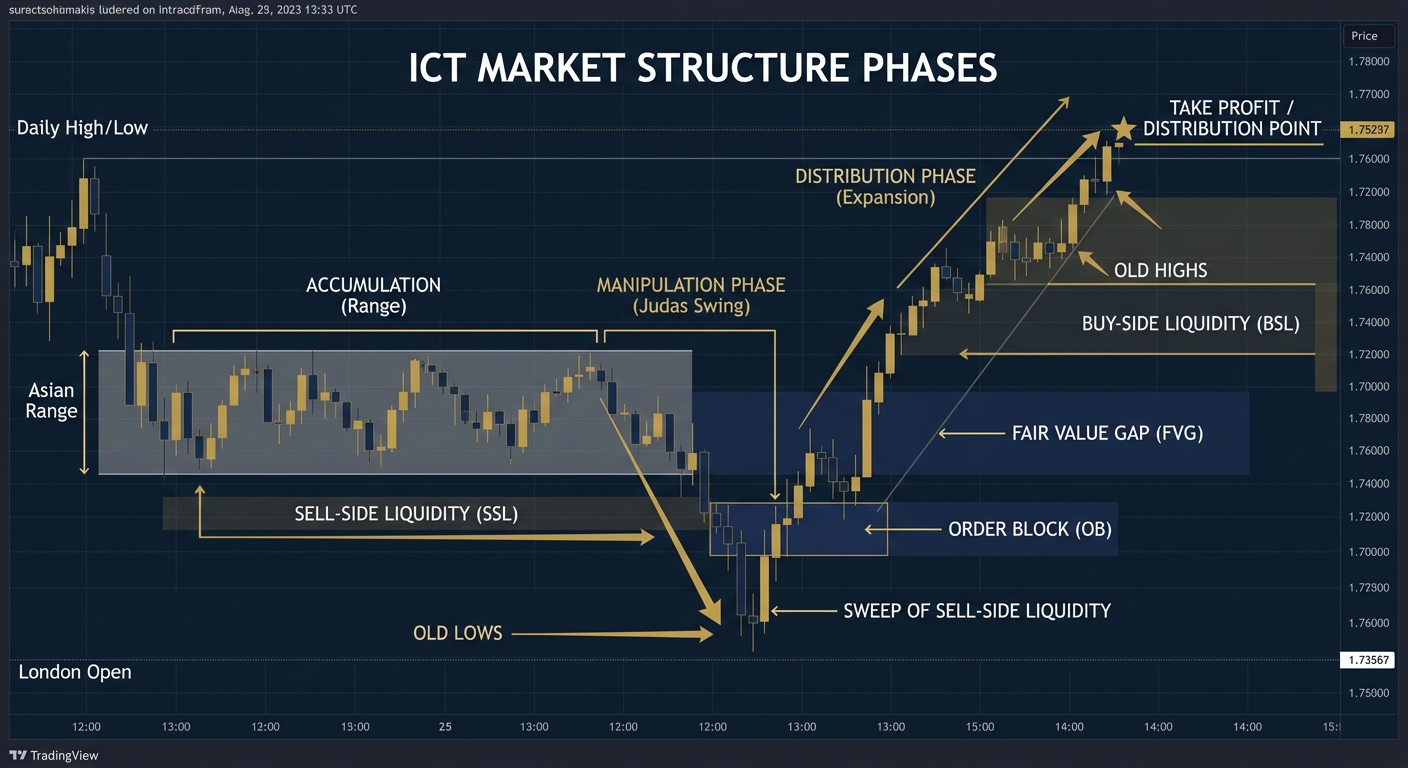
While other traders are getting chopped up in consolidation, ICT practitioners recognize Accumulation and Manipulation phases. This keeps you out of the random, low-probability trades that kill funded accounts. If you want to go deeper on how ICT Smart Money Concepts compare to traditional price action trading and which gets you funded faster, it's worth understanding the structural differences before committing to an approach.
The Three Phases of Funded Trading Success
Phase 1: Skill Development (3-12 months)
Before you spend a dollar on evaluations, you need to be consistently profitable on a demo account for at least 3 months. This isn't optional, it's the foundation everything else builds on.
Focus areas:
- Master Market Structure identification
- Develop your Risk Management framework
- Build psychological resilience through consistent practice
Phase 2: Evaluation Mastery (1-6 attempts)
Your first evaluation shouldn't be a learning experience, it should be the demonstration of existing skills. Most traders approach this backwards and pay the price.
Successful evaluation strategy:
- Trade smaller position sizes than your normal risk tolerance
- Focus on 1-2 Currency Pairs you know intimately
- Target the minimum profit requirement, not maximum potential
Phase 3: Scaling and Consistency
Once funded, your job changes completely. You're no longer trying to prove yourself, you're building a sustainable income stream.
The approach I'd take is to scale slowly and put account preservation ahead of aggressive profits. At this stage, risk management is often the difference between a short-lived funded account and a long-term career.
My Honest Assessment: Is Funded Trading Worth It?
Having passed an FTMO Challenge myself and coaching traders now, here's my unfiltered opinion:
Funded trading CAN be worth it if:
- You're already consistently profitable
- You have 6-12 months of living expenses saved
- You understand this is a business investment, not a get-rich-quick scheme
- You're prepared for multiple attempts and ongoing costs
Avoid funded trading if:
- You're still learning basic concepts
- You need this income immediately
- You haven't mastered your trading psychology
- You're looking for validation rather than capital
The Road Forward
The funded trading industry isn't going anywhere, but your approach needs to be realistic and strategic. Success requires more than good PD Arrays and perfect Fair Value Gap entries.
If you're serious about pursuing funded trading, invest in proper education first. Understanding Smart Money Concepts and developing a systematic approach isn't just helpful, it's essential for long-term success.
The traders succeeding in this space aren't the ones chasing every evaluation offer or jumping between firms. They're the ones who've done the work, understand the game being played, and approach it as the business it is.
Take Action Today
Ready to build the skills and mindset needed for funded trading success? The journey starts with proper education and structured development.
Our comprehensive coaching plans are designed specifically for traders serious about mastering ICT concepts and building sustainable funded trading careers. Don't gamble your future on trial and error.
If you're not sure where you stand or what your next steps should be, book a free discovery call with me. We'll assess your current situation and create a realistic roadmap for your funded trading goals.
For more insights on developing your ICT trading foundation, explore our trading insights section where I break down the concepts that separate successful funded traders from the rest.
The funded trading opportunity is real, but only for those who approach it with the right knowledge, skills, and mindset. Make sure you're prepared before you pay the price of learning these lessons the expensive way.
Harvest Wright
ICT Trading Coach · 10+ Years Experience
Harvest specializes in ICT methodology and has helped traders pass prop firm challenges, develop consistent strategies, and build the psychology needed for long-term profitability.
Book a Free Discovery Call →Ready to Get Funded?
Our students pass prop firm challenges in under 60 days with personalized ICT coaching.
Book a Free Discovery CallFree ICT Funded-Trader Playbook
The setups, the pre-trade checklist, and the risk rules I use. Get it free.