The Quiet Session Trap: Why You Trade Better Alone
Most trading psychology content is pointing at the wrong enemy. Fear, greed, revenge trading, these get blamed constantly, and yes, they matter. But after more than a decade of trading, I've become convinced a big performance killer is something far more mundane. It's the Discord notification at 6:45 AM. It's the tweet that plants a bias before price has shown you anything. It's the group chat where three people agree that Cable is bearish today, and now so do you, without a single smart money concept on your chart telling you that.
Key Takeaway: External bias from social media and trading communities hijacks your read of valid ICT setups before price even moves, not by corrupting your concept knowledge, but by anchoring your expectations to the wrong draw on liquidity. In my view, deliberately going dark before key sessions is one of the simplest ways to protect your read.
The Pattern I Kept Seeing
For a long time, I assumed underperformance on otherwise valid setups came down to execution, entering too early, stop placement errors, that kind of thing. Then I started noticing something specific. Traders who had solid concept knowledge, who could mark up a chart correctly in hindsight, were consistently forcing entries at the wrong draw on liquidity when they came into the session already loaded with someone else's opinion.
Here's what that looks like in practice. Let's say it's a Tuesday morning. Price on GBPUSD has been respecting a weekly bearish order block sitting above the current price, a clean institutional footprint, textbook smart money concepts. The daily draw is clearly on the buy side liquidity resting above equal highs from last Thursday. London open displacement should, in theory, sweep those highs and then look for a short entry on the return.
But the group chat said it's bearish. Three people posted analysis overnight. The bias is embedded. So instead of waiting for that buy side liquidity sweep and the subsequent shift in structure, the trader sees the first signs of bearish momentum during the 7:00 AM manipulation phase and enters short, right into what was always going to be the upside run. The concept wasn't wrong. The setup wasn't wrong. The chart was screaming the correct read. But an anchored expectation from external bias caused them to force a short into a move that was designed to take stops before the real direction emerged.
This isn't a discipline problem in the traditional sense. It's a perception problem.
Why Group Bias Rewires Your Perception
Anchoring bias is a well-known idea in psychology: the first piece of information you receive tends to have an outsized influence on your later judgments. What doesn't get talked about in trading communities is how insidiously this applies to chart reading. When you read someone else's bias before your session, you're not just getting an opinion. You're setting an anchor that your brain will now try to confirm at every subsequent data point.
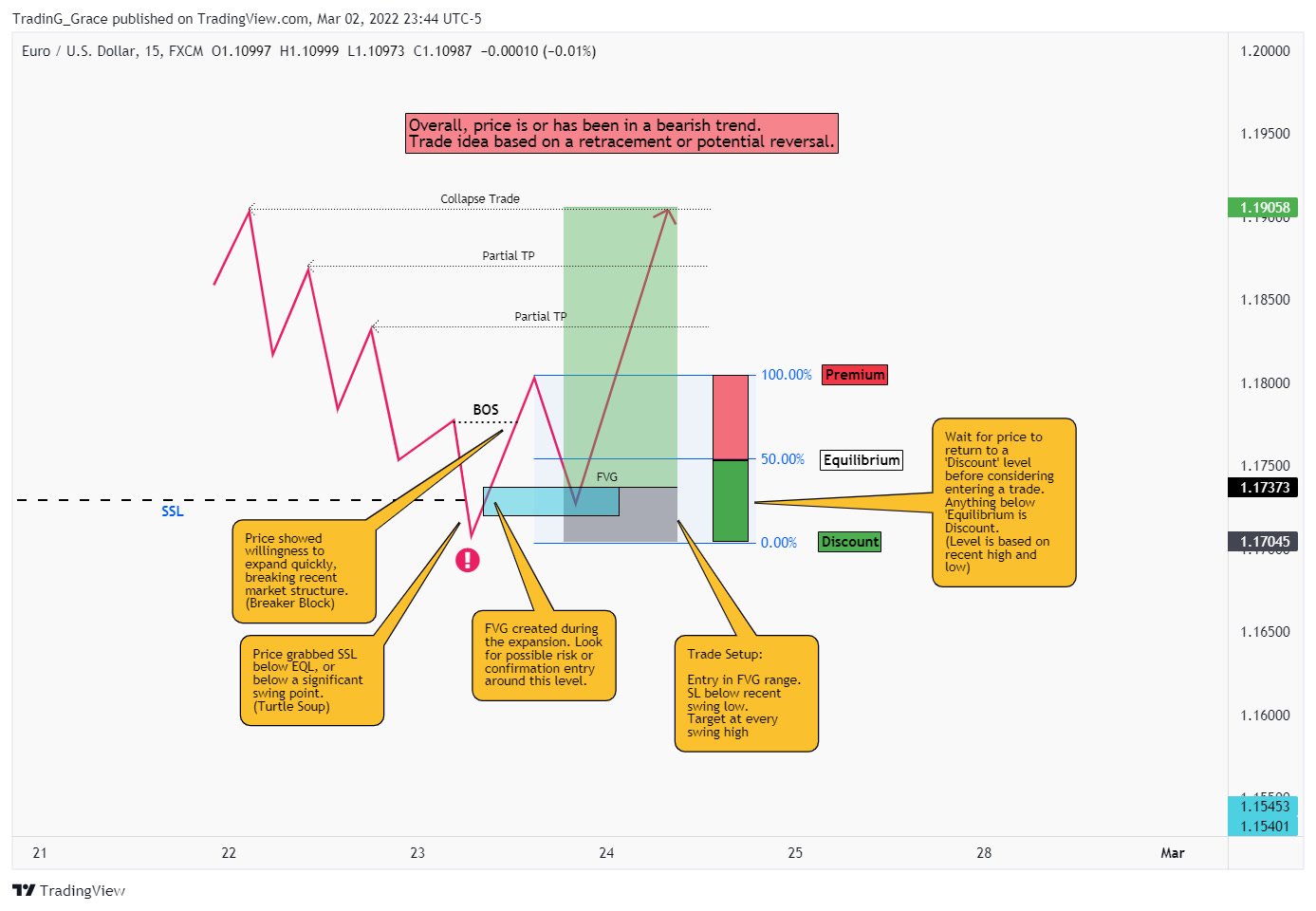
You'll see the bearish FVG and ignore the fact that it's sitting in a premium array where shorts are low probability. You'll dismiss the buy side liquidity resting above as already taken, even when it clearly hasn't been swept. Your eyes are on the chart, but your interpretation is being filtered through someone else's conclusion. This is sometimes called "confirmation bias," but that framing misses the mechanism. You're not just seeking confirmation. You're actively reframing what you see to fit a pre-loaded narrative.
Price doesn't care what the Discord said. Smart money concepts are, at their core, about reading the actual footprint of institutional order flow, and that footprint only reveals itself clearly when your mind hasn't been contaminated before the session begins.
The Real Entry Failure No One Talks About
Here's the contrarian take that I don't hear enough of: in my experience, a lot of ICT entry failures come from correct concept application on the wrong draw.
A trader who understands order blocks, fair value gaps, and liquidity can still lose consistently if they're repeatedly anchored to the wrong target. And the wrong target often comes from an external opinion that was absorbed before price told them anything. This is why you'll see traders who can backtest profitably but can't execute live, the backtesting happens in isolation, without social noise. The live session doesn't.
I've seen this pattern show up most acutely during London open, which is arguably the most important session for ICT-based traders. That 7:00 to 9:00 AM window is where manipulation is designed to mislead the majority. If you've already been misled by a group chat before price even opens, you're entering London open with a double layer of confusion. And you're going to get punished for it.
If you want to understand how April's volatility conditions are amplifying this problem right now, this breakdown of April 2026 market structure shifts is worth reading before your next session.
A Worked Example
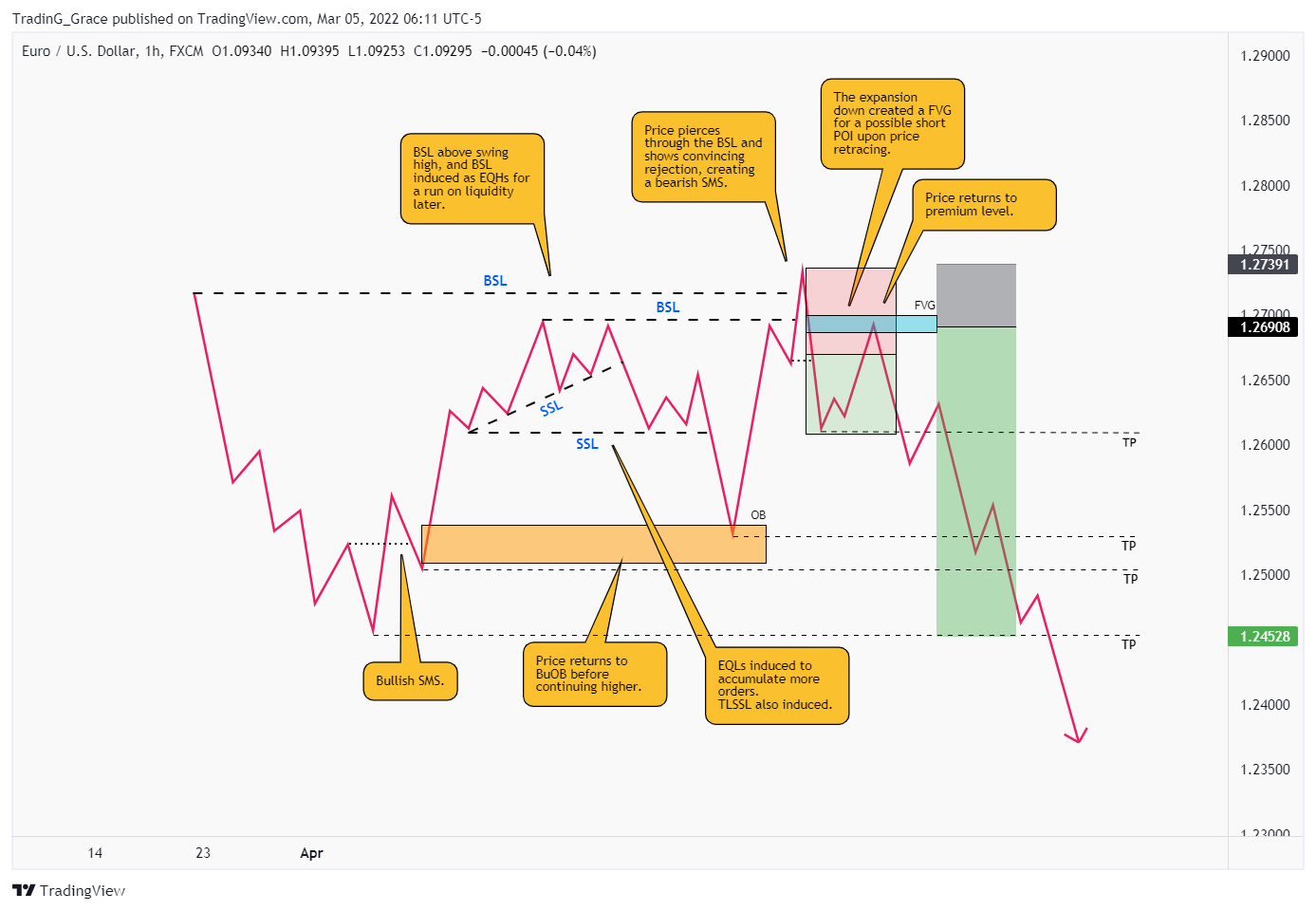
Here's what this looks like on a chart. Picture GBPUSD, marked up the night before. The daily draw is on buy side liquidity: a cluster of equal highs that has sat untapped for several sessions. The 4H shows a bullish breaker below price. The London open plan is simple: wait for price to sweep the sell side below the recent lows during early manipulation, then look for a bullish MSS on the 5-minute and enter on the return to the FVG.
Price opens, sweeps the lows, prints a clean displacement candle back up, and leaves a 5-minute FVG. The long goes on as price returns into the FVG. The stop sits below the manipulation low, because if price takes that low out again the bullish idea is wrong. The target is just under the equal highs, where the buy side liquidity rests.
Now add one thing. The night before, there's a popular thread saying Cable is set for continuation lower. Read it, and it sits in your head. Come into London with that bias and the early sweep of the lows looks like the start of the sell-off, so you short right into the manipulation instead of waiting for the real move.
The concept knowledge doesn't protect you from anchoring. Going dark does. That's why I close everything social the night before a planned session: no Discord, no Twitter, no YouTube analysis. Just my own chart, my own markup, my own read.
The Archetype That Keeps Losing on Valid Setups
There's a specific type of trader I keep seeing in trading communities. They post their markups. The analysis is solid. They understand premium and discount. They can identify the draw on liquidity. But their entry timing is consistently early, and their direction is consistently off, particularly on London open days.
When you dig into their routine, the pattern is often the same. They're in three or four group chats. They're checking Twitter before the session. They're watching someone else's analysis video while they're supposed to be reviewing their own levels. By the time the London candles start printing, they're already committed to a directional bias that has nothing to do with what the chart is actually showing.
These traders don't need more concept education. They need a routine that protects their perception before the session starts. The concept knowledge is fine. The input pipeline is poisoned.
If you recognize yourself in that pattern, this piece on fatal mistakes that kill funded account challenges goes into some of the downstream consequences in more detail.
The Dark Session Protocol
Here's the practical framework I use.
The night before a planned session: Mark your own charts. Identify the daily draw on liquidity, buy side or sell side, which pool matters most? Mark your key arrays: order blocks, FVGs, breakers. Write one sentence about what you need to see to confirm directional intent. Then close everything. No analysis content after 10 PM.
Morning of the session (before open): Open your chart and your chart only. Review your own levels. Ask yourself: has anything invalidated my draw on liquidity since last night? If not, your plan stands. Do not open Discord. Do not check Twitter. Do not watch a morning analysis video. Your levels are already there. Someone else's opinion adds nothing except noise.
During the session: For London open specifically, assume the first thirty minutes is manipulation. Price is designed to take liquidity from the side that the majority is positioned on. If the majority told you it's bearish last night via social media, price will likely sweep sell side first to get those longs to exit, and then reverse. Wait for the sweep. Wait for the MSS. Enter in the FVG on return. Use a proper position size, this risk calculator is worth bookmarking if you're not already sizing systematically.
Post-session: Only after you're flat can you re-engage social media. Review what happened. Compare it to your pre-session markup. Document whether your read was clean or contaminated.
This isn't a dramatic overhaul. It's a 12-hour window of deliberate isolation around your trading session. The point is to protect yourself from the wrong information at the wrong time, so you can execute smart money concepts cleanly.
Going Quiet Is a Skill
I used to think discipline meant sitting in front of a noisy stream of information and filtering out the bad parts. Years of experience and a lot of losing trades taught me that's not discipline, that's just ego. Real discipline is building an environment where the filters don't need to be that strong, because the noise isn't in the room.
In my view, a lot of traders who fail funded challenges repeatedly aren't failing because they don't understand smart money concepts. They're failing because they're executing those concepts through a fog of borrowed opinions. And the fix isn't more education. It's fewer inputs before the bell.
If this resonated and you're at the point where you want a structured approach to building this kind of session routine into a complete ICT trading system, take a look at the coaching plans available here. The Lite plan at $150/week, Pro at $250/week, and Full Mentorship at $5,000 over four months are each built around this principle, that good trading comes from clarity, not volume of information.
Or if you're not sure where you fit yet, book a free discovery call and we'll figure it out from there. No pitch, just an honest conversation about where your edge is actually breaking down.
Harvest Wright
ICT Trading Coach · 10+ Years Experience
Harvest specializes in ICT methodology and has helped traders pass prop firm challenges, develop consistent strategies, and build the psychology needed for long-term profitability.
Book a Free Discovery Call →Ready to Get Funded?
1-on-1 ICT coaching built around prop firm rules, from a trader who has passed an FTMO Challenge.
Book a Free Discovery CallFree ICT Funded-Trader Playbook
The setups, the pre-trade checklist, and the risk rules I use. Get it free.