
The Confidence Trap Killing ICT Traders
Here's something that took me years to articulate clearly: the most dangerous trader isn't the beginner who doesn't know what an order block is. It's the trader who just figured it out, and now sees them everywhere. That specific window, somewhere between three and eight months into serious ICT study, is where more accounts go to zero than at any other stage. And virtually nobody in the ICT trading psychology space is talking about it honestly.
Key Takeaway: The post-education confidence spike, the phase where ICT concepts finally 'click' and setup recognition improves dramatically, increases blow-up risk before it reduces it. Recognising order blocks and FVGs accurately is not the same as trading them profitably, and the gap between those two skills is where accounts die.
Why 'Trade With Confidence' Is Backwards Advice for ICT Traders
Most trading psychology content treats confidence as a linear good. More confidence equals better execution equals better results. The advice is everywhere: back yourself, trust your analysis, stop second-guessing. For certain methodologies, maybe that framework holds. For ICT traders specifically, it's a trap.
The ICT framework is conceptually dense. You're learning about market structure, liquidity pools, premium and discount arrays, displacement candles, fair value gaps, order blocks, breakers, mitigation blocks, and each of these concepts has genuine explanatory power. When they start connecting in your mind, something almost intoxicating happens. Setups begin appearing with what feels like pattern recognition clarity. You watch a 15-minute chart and you see the story the market is telling. You feel like you finally understand what's really going on.
That feeling is real. The problem is what it does to your behaviour.
Myth: Improved setup recognition means improved trading performance.
Reality: Improved setup recognition improves your entry rationale, but it does almost nothing to your execution discipline in the short term, and it actively inflates your position sizing confidence in a way that's measurably dangerous.
What I Actually See: Traders at this stage start sizing up. Not dramatically, they don't go from 0.5% to 5% overnight. They go from 0.5% to 1.5%, then justify it because this one is textbook. The setup recognition is accurate enough that this works several times. Which is precisely what makes the blow-up catastrophic when it doesn't.
The Specific Trade That Taught Me This the Hard Way
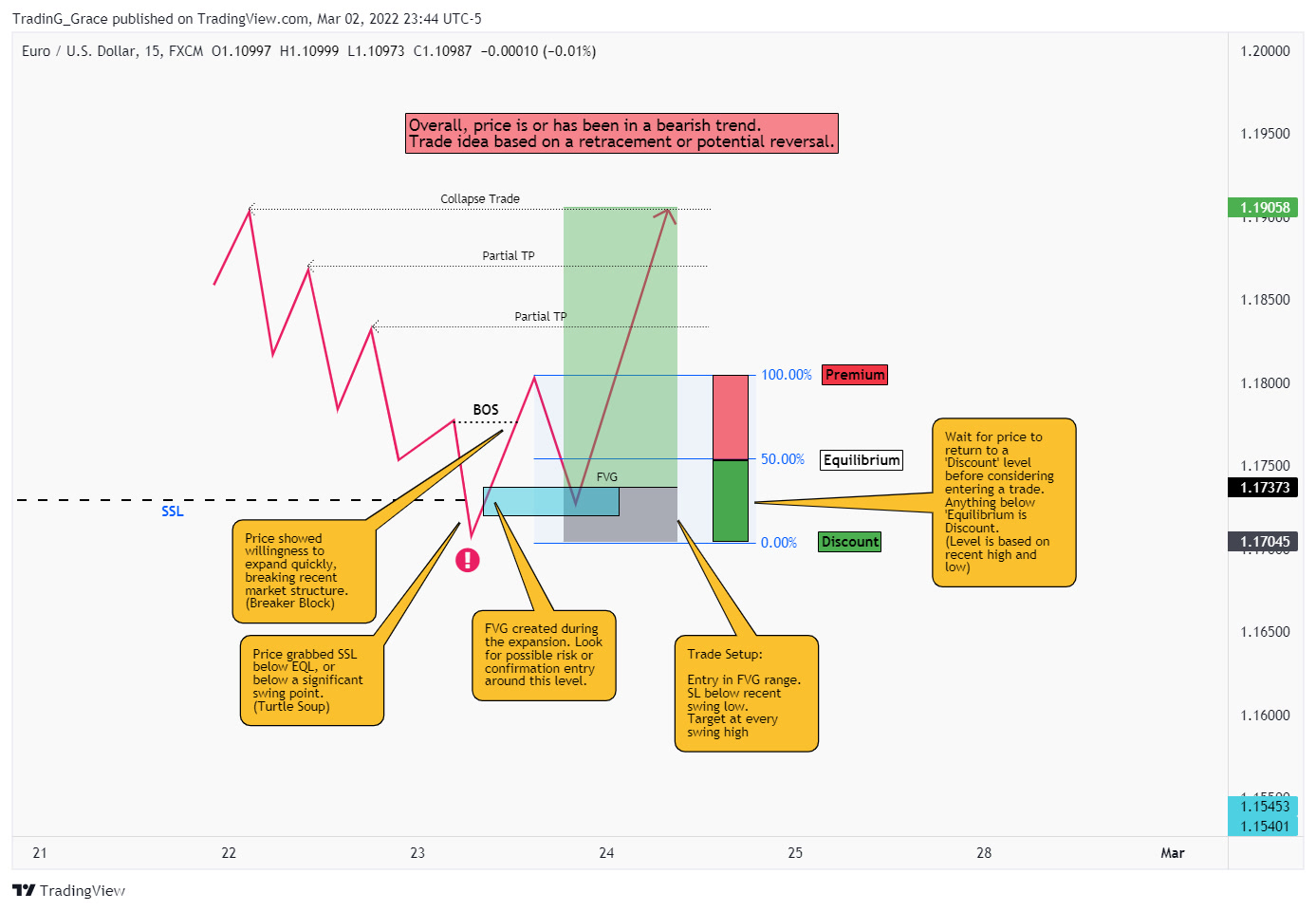
I used to get this wrong too. Not in the beginner phase, in exactly the phase I'm describing.
April 2026, GBPUSD on the 15-minute chart. London open had just printed a clean displacement to the upside, sweeping sell-side liquidity that had been sitting below the Asian range low. The displacement left a fair value gap between 1.2634 and 1.2658. Textbook. IPDA logic pointed to a draw on liquidity at the 1.2740 area, an untested weekly high sitting with obvious buy-side liquidity above it. I entered at 1.2641 on the FVG retracement, stop at 1.2618, risking 1.8% of the account, higher than my normal 0.75% rule, because honestly, I knew this one was good.
The setup was accurate. Every confirmation was there. And the trade ran, it hit 1.2R before a CPI revision headline hit the wire and price reversed hard through my entry, through my stop, through the FVG entirely, down to 1.2590.
The setup recognition was right. The position sizing decision was made by someone who felt more certain than the probabilities actually warranted. And 1.8% doesn't sound catastrophic until you add the next three trades I took in that same mental state, all sized above my rule, and the total drawdown from that week.
You can read more about how I rebuilt after a similar (worse) pattern in my account of a $47k prop firm loss and what came after.
The Archetype That Keeps Appearing
There's a specific trader pattern I keep noticing in forums, Discord servers, and trading communities. Call this person the Fluent But Fragile trader.
They can talk ICT concepts fluently. Ask them about displacement and they'll explain it with precision. Watch them mark up a chart and they'll identify FVGs, order blocks, and liquidity pools with reasonable accuracy. They post analysis that gets engagement because it looks sharp.
But their account equity curves look like a staircase going down, small consistent losses punctuated by occasional large ones. When you dig into their trade history, a pattern emerges: position size creeps up on the setups they're most confident about. Not because they're reckless in general, but because their confidence correlates to their sizing in a way their actual edge doesn't support yet.
The setups they're most confident about tend to be the most recognisable setups, the textbook ones, the ones that appear in YouTube breakdowns and TradingView published ideas. And here's the brutal irony: the most recognisable setups are the most heavily targeted. Retail traders piling into obvious order blocks and obvious FVGs are providing liquidity to the very institutions those concepts describe. I've written more about how this dynamic plays out specifically in Q2 in this breakdown of Q2 2026 market structure shifts.
The Fluent But Fragile trader's problem isn't knowledge. It's that knowledge produced confidence before it produced calibration.
What Calibration Actually Looks Like (A Practical Framework)
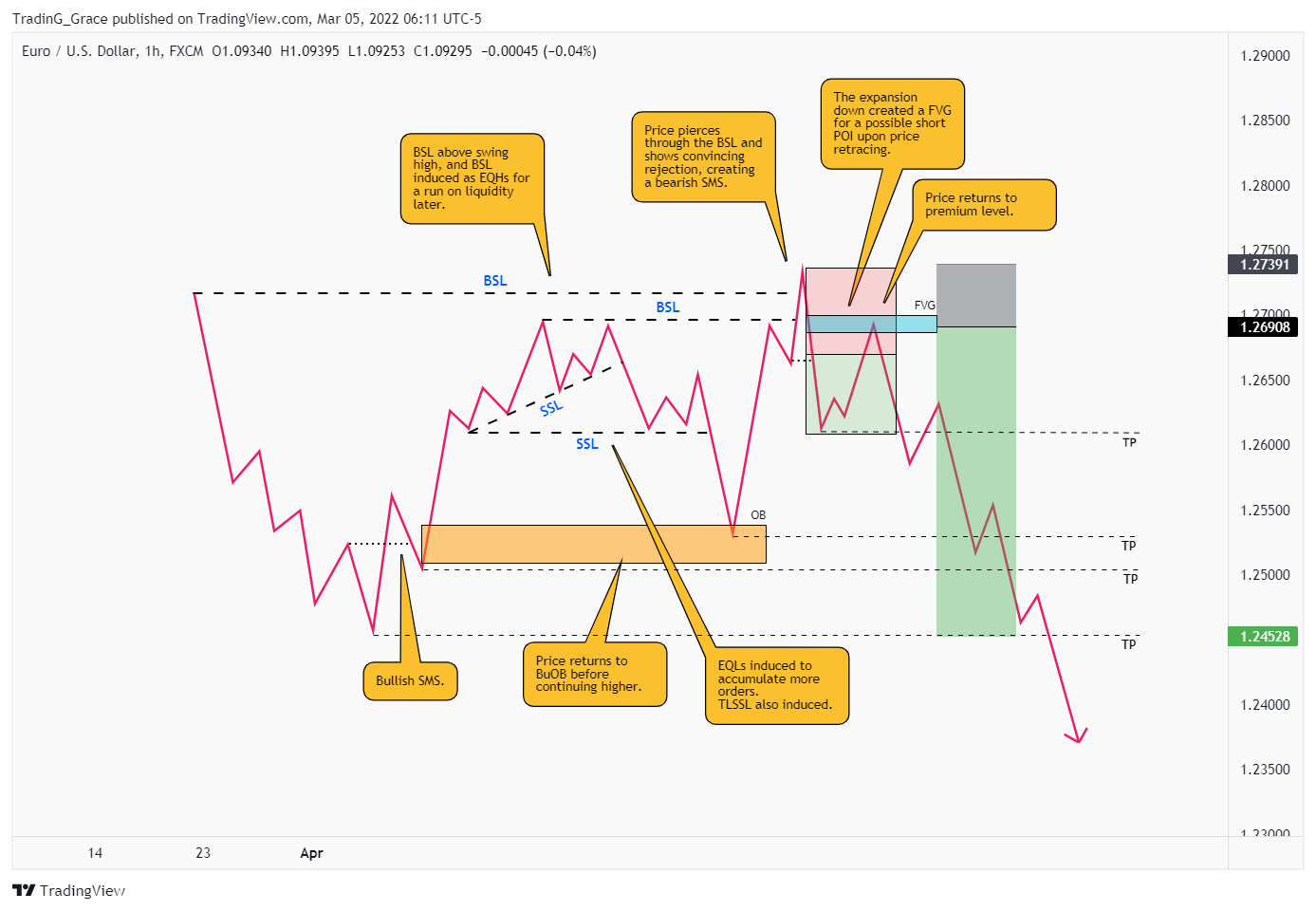
Here's the framework I use, and the one I'd suggest anyone in this danger zone builds into their process immediately.
Step 1: Separate Setup Recognition Score from Execution Score. After every trade, score two things independently on a 1-5 scale. First, how valid was the setup according to ICT criteria (structure, premium/discount, session timing, confluence)? Second, how clean was the execution (entry timing, stop placement, sizing adherence, exit management)? Most traders only score the first. The second is where the real data lives.
Step 2: Size inversely to confidence spikes. This sounds counterintuitive, but track it for 30 trades and you'll see the pattern. When you feel especially certain about a trade, when you're thinking 'this is textbook', that's a specific cognitive state, not a statistical signal. Cap your size at 0.5% on any trade where you feel above-average certainty. Use the risk calculator to make this mechanical, not emotional. You're not doing this forever. You're doing it until your win rate on 'high confidence' setups proves, with sample size, that confidence is actually predictive.
Step 3: Run a 'Confidence Audit' every 20 trades. Group your trades by the confidence level you logged at entry (you need to log this in real time, not retrospectively). Calculate win rate, average R, and maximum adverse excursion separately for high, medium, and low confidence trades. Most traders find, at the 3-8 month post-education stage, that their high-confidence trades have worse metrics than their medium-confidence ones. That data will do more for your psychology than any mindset content.
Step 4: Treat every FVG and OB entry as a hypothesis, not a prediction. Language matters internally. When you shift from 'price is going to react here' to 'I have a hypothesis that price may react here, and I'm risking 0.75% to test it,' your entire relationship to the outcome changes. A failed hypothesis is information. A failed prediction is a personal failure, and personal failures trigger revenge trading. Check the ICT fair value gap trading checklist for the specific pre-trade confirmations that should be part of every FVG hypothesis.
Step 5: Keep position sizing rules in a physical location. Not a note in your trading journal app. A physical card, a sticky note on your monitor, something that requires a physical action to acknowledge. This sounds trivial. It works because the confidence trap operates in the System 1, automatic-thinking part of your brain. Physical friction forces System 2 engagement before you touch the size input. Investopedia's research on trading psychology consistently points to this kind of environmental design as more effective than willpower-based discipline.
The Skill Curve Nobody Draws Honestly
Every trading education provider shows you a smooth curve: study → understand → apply → profit. What they don't draw is the confidence spike that peaks before profitability improves, and the trough that follows it.
For ICT traders specifically, this curve is steeper than most methodologies because the conceptual framework is so rich. You get fluent in the language of smart money concepts before you're calibrated in the application. And the language fluency produces confidence that the application doesn't yet deserve.
This isn't a failure state. Every serious trader who has gone deep into ICT concepts has passed through this zone. The ones who come out the other side with accounts intact are almost never the ones with the best setup recognition. They're the ones who recognised the danger zone as a danger zone, who actively dampened their confidence-to-sizing correlation precisely when their analysis was improving.
If you're in the phase where ICT is 'clicking,' that's genuinely exciting. Protect it. The 7 fatal mistakes that kill funded account challenges are overwhelmingly made by traders in exactly this window, good enough to get into a challenge, overconfident enough to blow it.
The Actual Next Step
Run the confidence audit I described above on your last 20 trades. Before you read another ICT breakdown, before you watch another video, before you tweak another entry criteria, do that audit. If your high-confidence trades are underperforming your medium-confidence ones, you've confirmed you're in the danger zone. That single data point is worth more than months of additional concept study.
If you want a structured framework for moving through this phase without destroying your account in the process, the coaching plans are built specifically around this problem, not just ICT concepts, but the psychological calibration that turns concept knowledge into actual edge. Or if you want to get a feel for the approach first, book a free discovery call and we can talk through where you actually are in the curve.
The confidence trap isn't a character flaw. It's a predictable phase. The traders who recognise it are the ones who survive it.
Harvest Wright
ICT Trading Coach · 10+ Years Experience
Harvest specializes in ICT methodology and has helped traders pass prop firm challenges, develop consistent strategies, and build the psychology needed for long-term profitability.
Book a Free Discovery Call →Ready to Get Funded?
Our students pass prop firm challenges in under 60 days with personalized ICT coaching.
Book a Free Discovery CallFree ICT Funded-Trader Playbook
The setups, the pre-trade checklist, and the risk rules I use. Get it free.