
When Trading Patience Turns Into Paralysis
Every trading book, every YouTube channel, every mentor you've ever encountered has told you the same thing: your biggest enemy is greed. Control your greed, and you'll be profitable. It's repeated so often it sounds like physics. But after 10+ years of trading, I'll tell you what quietly hurts a lot of accounts, without drama, without a single blown trade: weaponised patience.
Key Takeaway: Misapplied patience, waiting for a setup to be perfect rather than valid, is a disguised form of fear that ICT traders are uniquely vulnerable to, because the framework itself gives you endless reasons to wait for one more confirmation. The fix isn't to stop being patient. It's to know exactly when patience has crossed the line into paralysis.
The Myth the Industry Won't Challenge
Myth: Patience is a virtue. The disciplined trader waits for the perfect setup.
Reality: There is no perfect setup inside smart money concepts, or any framework. There are valid setups and invalid setups. The moment you start chasing perfect, you've left trading and entered a different psychological game entirely.
What I Actually See: Traders who can articulate ICT theory at an almost academic level, displacement, fair value gaps, order blocks, liquidity sweeps, PD arrays, IPDA logic, but who cannot pull the trigger on a live trade to save their lives. They've consumed thousands of hours of content. They can explain why price moves the way it does. But when the moment comes, they freeze, and then they rationalise the freeze as discipline.
That rationalisation is the most dangerous thing in trading. It lets you feel like you're doing the right thing while your account sits completely stagnant, or worse, while you're building a pressure cooker that eventually explodes into a revenge trade.
A Worked Example
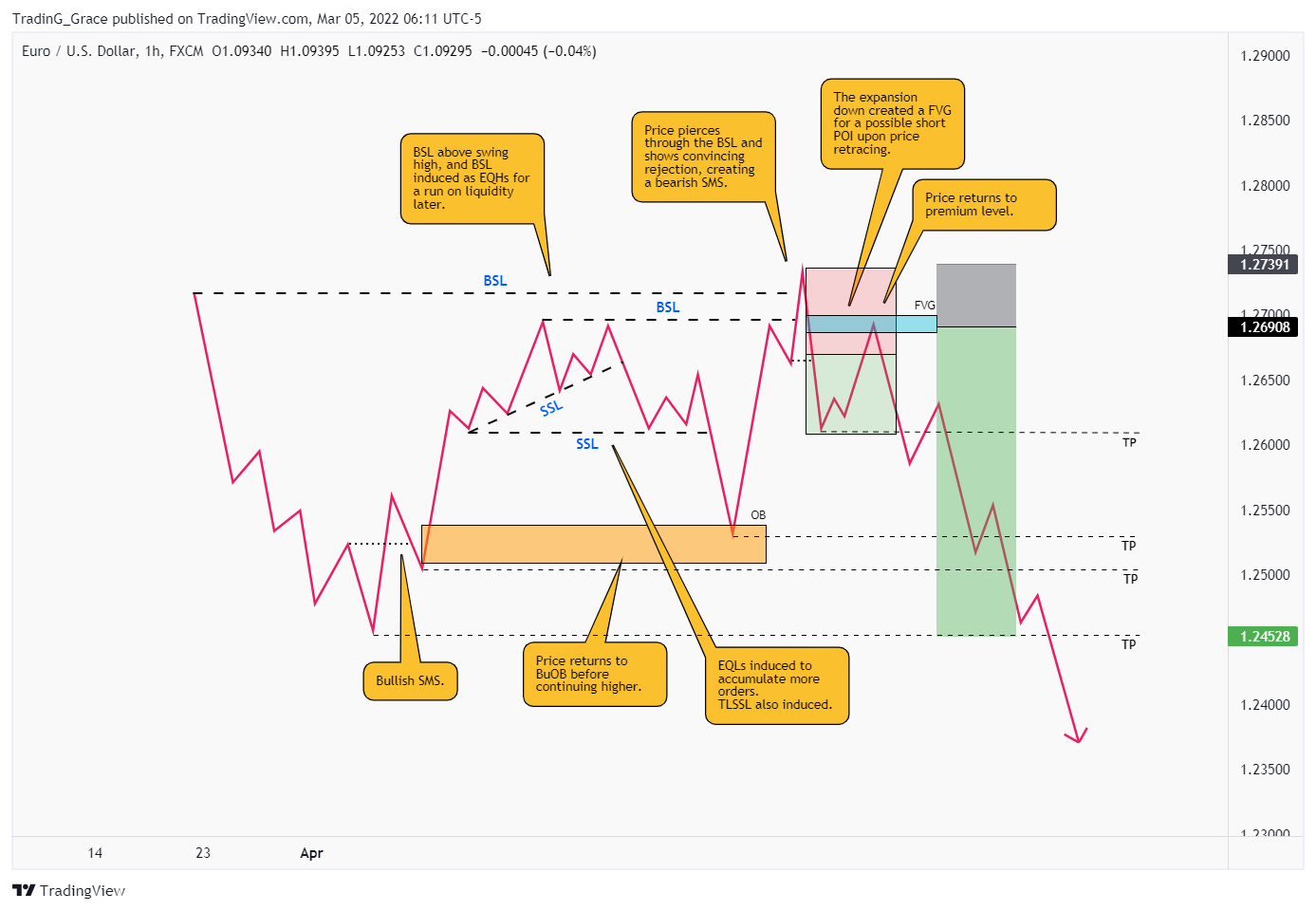
Let me walk you through something concrete. This is an illustration, not a trade log. Picture GBPUSD on the 15-minute chart. The London session opens and a clean displacement candle breaks above the Asian range high, sweeping the liquidity that sat there overnight. That displacement leaves a textbook fair value gap.
The higher timeframe bias? Bullish. The daily took out a significant sell-side pool the previous week, and the 4H structure has shifted bullish. HTF narrative is clean.
Price comes back into that FVG, to about the 50% level of the gap. Entry there. The stop goes below the low of the displacement candle, because if price trades back under it the bullish move has failed. The target is the next significant buy-side liquidity above. A good chunk of R on the table.
Now here's the thing. This is exactly the type of setup that gets skipped by traders who could tell you, in great detail, exactly why it was a valid entry. Why did they skip it? Because the 1-minute chart showed a minor bearish candle closing into the FVG. Because they weren't sure if they should wait for the 5-minute to confirm entry with a shift in market structure. Because maybe the gap wasn't quite a textbook FVG, the wicks overlapped slightly. Because the news calendar showed a minor UK data release later that morning and maybe they should wait.
Every one of those hesitations is a thought. None of them are reasons. None of them change where the setup is wrong, and none of them change the target.
The ICT Trap Nobody Talks About
Here's the specific problem with smart money concepts as a framework, and I say this as someone who has traded it for years: it is phenomenally rich in confirmation criteria. That richness is its greatest strength and its most dangerous feature.
You've got timeframe alignment to check. You've got the premium/discount matrix. You've got the dealing range. You've got killzone timing. You've got the HTF narrative, the intermediate structure, the intraday structure. You've got turtle soup setups, you've got SIBI/BISI considerations, you've got the weekly profile. Each layer of the model gives you a reason to look one more time, check one more thing, wait for one more confirmation.
At some point, waiting is the bias. And the market doesn't care.
I used to get this wrong in my early years with this methodology. I'd build a checklist so thorough that by the time I'd ticked every box, the trade had already moved in my direction and I was sitting there staring at an entry I never took. The checklist wasn't protecting me. It was protecting my ego from the discomfort of being wrong.
For a deeper look at how this shows up specifically in funded account environments, I'd recommend reading 7 fatal mistakes that kill your funded account challenge success, the psychology section hits this exact pattern.
The Trader Archetype I Keep Seeing in 2026
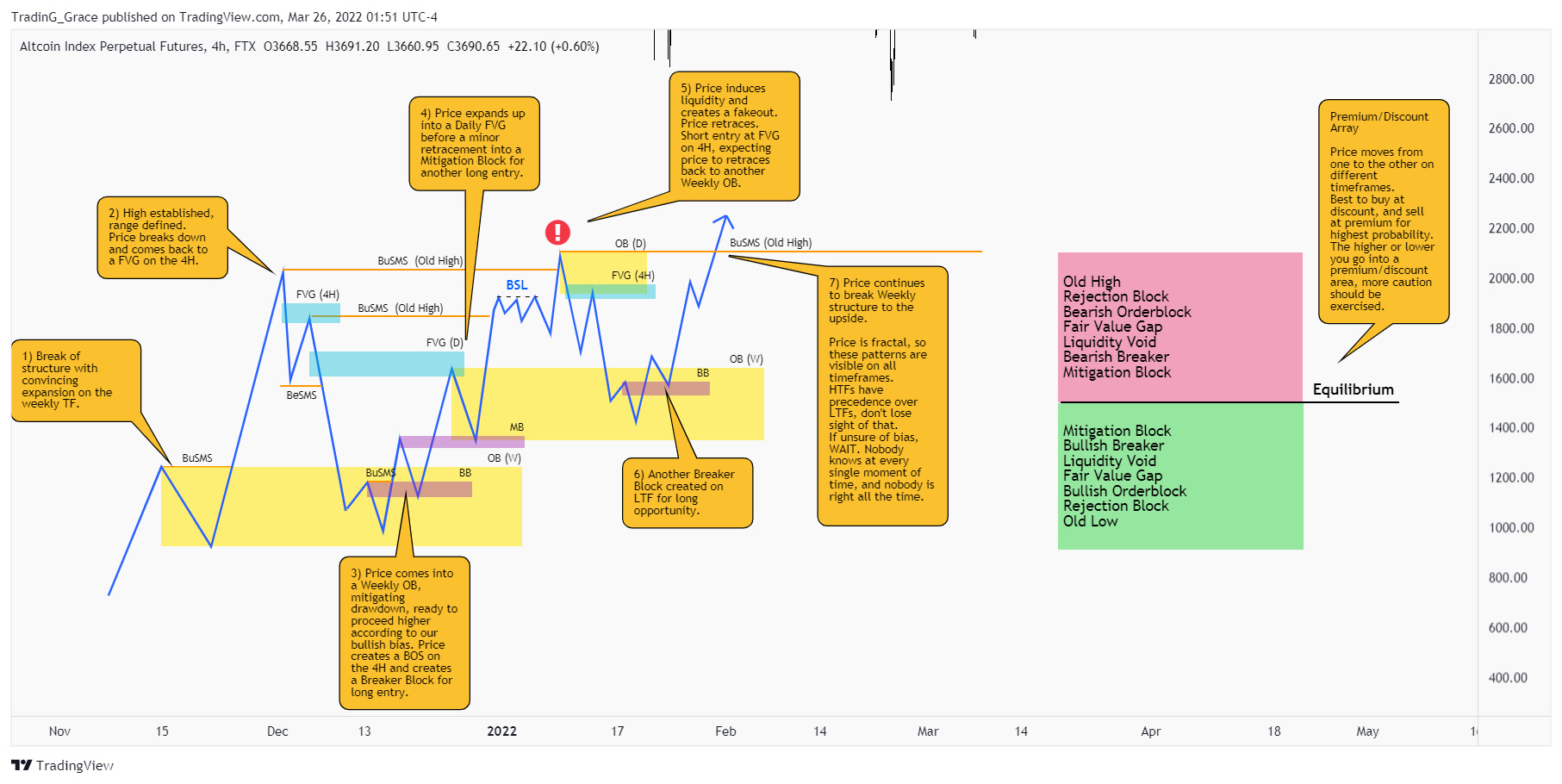
There's a specific type of trader who's emerged from the explosion of ICT content over the last few years. Highly educated on the model. Spends hours a day studying charts, reviewing YouTube content, annotating setups in their trading journal. Can identify an order block at 30 paces. Knows the difference between a breaker block and a mitigation block. Posts their analysis on social media with impressive precision.
And they are consistently unprofitable.
Not because their analysis is wrong. It's usually quite good. They're unprofitable because the moment their analysis is challenged by even a single contradicting signal, a wick that goes slightly the wrong way, a candle that closes a bit off, they either don't enter at all or they exit a valid trade prematurely.
This trader confuses preparation with trading. They've built an identity around being the person who waits for the perfect setup, and that identity is protecting them from the vulnerability of actually being wrong in a live trade. Preparation ends at analysis. Trading begins at execution under uncertainty.
See also: why Q2 2026 market structure shifts are breaking traditional ICT setups and how to adapt, because changing conditions are unforgiving to traders waiting for textbook-perfect setups.
The Frustration Spiral That Follows
Here's what makes misapplied patience so dangerous compared to greed: greed tends to blow accounts in one or two dramatic events. You can point to it. You can learn from it. Weaponised patience is slower, messier, and harder to diagnose.
The pattern looks like this:
- Miss a valid setup because you waited for more confirmation.
- Watch it run 3R without you.
- Feel a specific kind of frustration that's different from a loss, it's the frustration of being right and missing it.
- Spend the next two hours watching for another setup obsessively.
- Enter a setup that's half-valid because you need to catch the next move.
- That trade stops you out because it wasn't a genuine setup.
- Now you're frustrated and down, so the patience you were praised for ten minutes ago has actually led directly to an impulsive loss.
Greed gets you in too early or too big. Paralysis gets you in too late, and then the frustration of missing the good trade gets you into a bad one. The outcome is often identical. The cause gets blamed on greed when it should be blamed on the misapplied patience that preceded it.
A Practical Framework: Valid vs. Perfect
Here's exactly how I approach this distinction, and how I'd suggest building it into your process.
Step 1, Define your non-negotiables in advance, not in the moment. Before the session opens, write down the three things that must be true for you to enter a trade. Not five, not seven. Three. For a bullish FVG entry in London, mine are: (1) HTF structure is bullish, (2) price has taken a recent sell-side liquidity pool, (3) there is a clean FVG from displacement in a discount of the dealing range. That's it. If those three are present, the trade is valid.
Step 2, Separate entry criteria from risk management. A lot of the extra confirmations traders wait for, the 1-minute MSS, the specific candle close, should be informing where exactly you place your stop, not whether you enter. Use the risk calculator to pre-define your position size so that when the valid setup appears, sizing isn't a decision you're making in real time.
Step 3, Give yourself a commitment window. If your setup is valid at 8:45 AM in London killzone, you have until 9:30 AM to enter it. After that, the window closes regardless. This forces the question: "Is this a genuine reason to wait, or am I stalling?" Stalling has a deadline. Genuine reasons don't expire, they disqualify.
Step 4, Log your missed trades alongside your taken trades. Most traders only journal what they enter. Forcing yourself to write down why you didn't take a valid setup is uncomfortable, and that discomfort is precisely the point. If you can't articulate a specific disqualifying reason, you were paralysed, not disciplined. There's a huge difference.
For a structured checklist of what actually constitutes a valid FVG entry versus a marginal one, this piece is worth your time: ICT fair value gap trading checklist, 9 pre-trade confirmations that separate profitable FVG entries from losers.
What 10 Years Actually Teaches You
Young traders think experience makes you more confident. It doesn't, not exactly. What it actually does is make you more comfortable with uncertainty. The market is always uncertain. Smart money concepts gives you a high-probability framework for navigating that uncertainty, not for eliminating it.
In my experience, the traders who last with this methodology aren't the ones who wait longest. They're the ones who've accepted that a valid setup, executed with disciplined risk management and checked against a defined set of criteria, is the best they can do. The rest is outcome. And outcomes are not fully within your control.
You can read what past clients say on the results page, but the short version is this: profitable trading is not about finding certainty. It's about taking valid risk, repeatedly, without letting either greed or paralysis corrupt the process.
The market doesn't reward the most patient trader. It rewards the trader who is patient about criteria and decisive about execution.
If you want to work through what valid criteria looks like inside a complete smart money concepts framework, including how to structure your sessions, define your non-negotiables, and build the mental habits that make execution feel natural rather than terrifying, take a look at the coaching plans available here. The Lite plan at $150/week is built exactly for traders who have the theory and need the execution structure. Or if you want to talk through where you are first, book a free discovery call and we'll figure out the right fit.
Stop waiting for perfect. Start executing valid. That's the actual discipline.
Published 22 April 2026 | R2F Trading | Trading Psychology
Harvest Wright
ICT Trading Coach · 10+ Years Experience
Harvest specializes in ICT methodology and has helped traders pass prop firm challenges, develop consistent strategies, and build the psychology needed for long-term profitability.
Book a Free Discovery Call →Ready to Get Funded?
1-on-1 ICT coaching built around prop firm rules, from a trader who has passed an FTMO Challenge.
Book a Free Discovery CallFree ICT Funded-Trader Playbook
The setups, the pre-trade checklist, and the risk rules I use. Get it free.