
The Quiet Mind Protocol for High-Stakes Trades
Every piece of trading psychology content out there eventually lands on the same instruction: control your emotions. Breathe through it. Stay disciplined. Don't revenge trade. And look, none of that is wrong, exactly. But after 10+ years of trading, and seeing how often traders lose on setups they swear looked clean, I think that advice misses a big part of the problem. The emotional damage from a loss doesn't announce itself loudly. It doesn't arrive as rage or panic. It arrives as a subtle, invisible bias fog that makes your next analysis feel calm and methodical, while it's actually contaminated.
This is what I call the Quiet Mind Protocol. And the trading psychology problem it solves isn't about your emotions in general. It's about what those emotions do to your eye on the chart.
Key Takeaway: Post-loss distortion doesn't just make you feel anxious, it can change which price levels your attention gravitates toward when identifying ICT concepts like order blocks and FVGs. A specific 3-phase mental reset performed after a loss and before re-entry is what separates clean analysis from contaminated analysis, even when you think you're calm.
The Problem Isn't Revenge Trading, It's Invisible Bias
Here's the thing most trading psychology conversations get fundamentally wrong: they're designed to stop obvious emotional mistakes. Don't over-leverage after a loss. Don't chase the market. Don't move your stop. Those are real problems, but experienced traders, especially those six to twelve months into serious ICT study, have largely suppressed those behaviors. They know not to revenge trade. So they sit back down, take a breath, and look at the chart again with what feels like a fresh perspective.
Except it isn't fresh. Not even close.
What I've noticed is that emotional residue from a stopped-out trade creates a directional gravity on the chart. If you just took a loss on a short, your eye will subtly discount bullish order blocks on re-analysis. You're not doing it consciously. You genuinely believe you're reading price neutrally. But the brain, still processing the sting of that loss, performs a kind of motivated reasoning on the chart itself, searching for confirmation that the original bias was correct, or alternately overcorrecting to avoid another hit in the same direction.
The result? You misread the order block. You identify a valid-looking FVG but place it half a candle body too low because that level confirms a story you're still emotionally committed to. Your entry is off by a few pips. Your stop is in the wrong place relative to actual structure. And the trade loses, not because the ICT concept failed, but because you were identifying a slightly different version of it than what price actually left behind.
This is the invisible funded account killer. And it has nothing to do with not knowing ICT well enough. You can check out our breakdown of the 7 fatal mistakes that kill your funded account challenge success, and while technical gaps feature heavily, the psychological contamination problem runs underneath a lot of that list.
A Worked Example
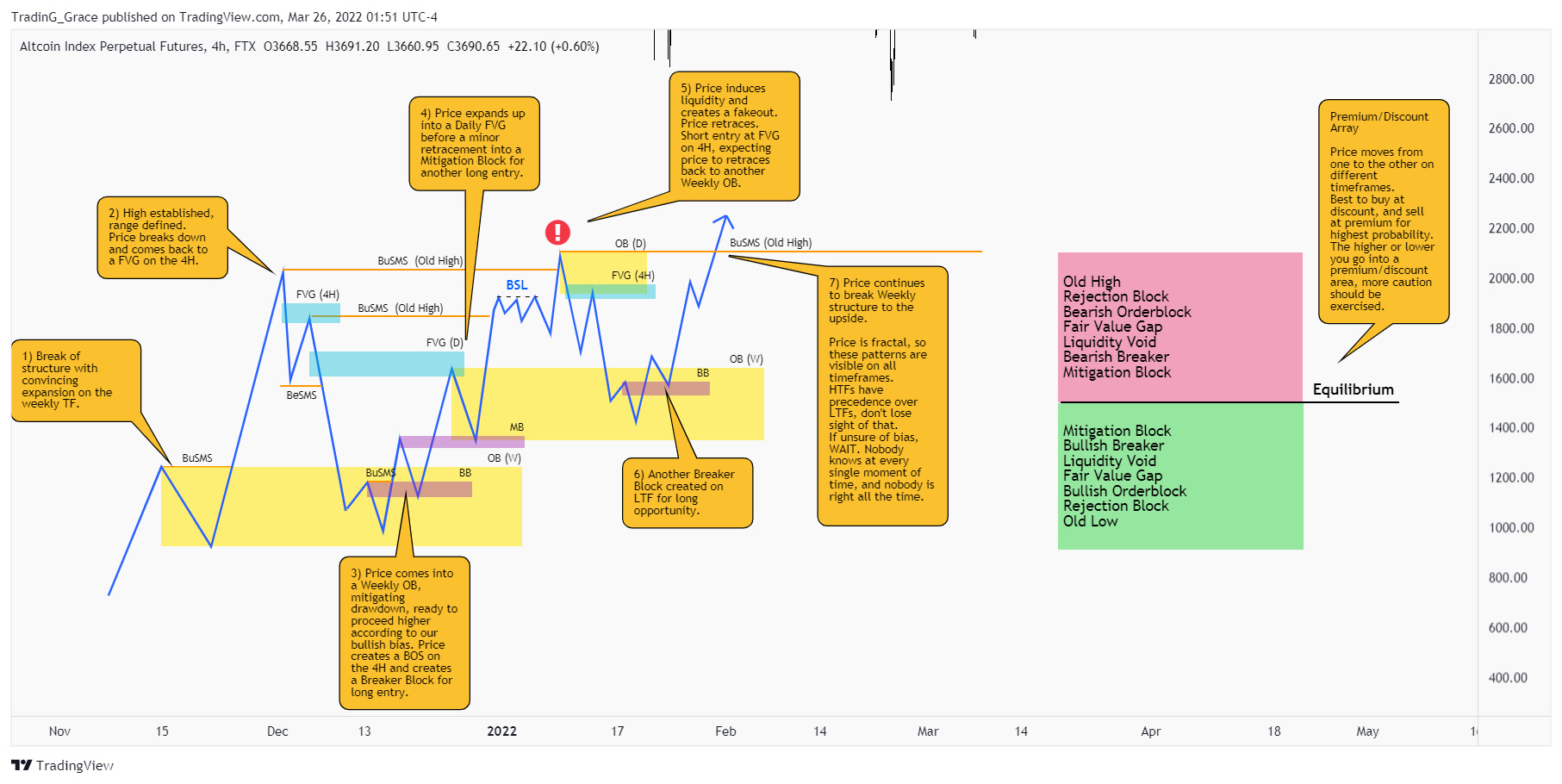
Here's what this can look like, because it deserves to be concrete.
Picture GBPUSD on the 15-minute chart in the London session. After the killzone displacement through the prior day's low, there's a clean bearish order block above price. The 4H structure is bearish. The daily swept buy-side liquidity a couple of sessions earlier. Confluence is high. The short goes on at the order block with the stop just above it, because if price trades back above the order block the bearish idea is wrong.
Price pushes up, nearly tags the stop, then drops sharply. Looks like it's going to work. Then an unscheduled GBP headline spikes it through the stop. Out. Clean, but still a loss.
Now the interesting part. A little later, a new setup forms: another bearish displacement candle, another potential mitigation point. When the trader goes to mark it, their first box lands on the wrong candle, a few candles too early, at a level that makes the short case look stronger. The correct OB is the last up candle immediately before the displacement.
That difference means an entry in the wrong place and a stop that sits inside the real order block instead of above it, so the setup is set up to fail. The emotional residue from the first trade is still live, and it's changing what they see, not just how they feel. The only way to catch it is to get in the habit of asking why you're drawing a box where you're drawing it.
The Quiet Mind Protocol: 3 Phases, 12 Minutes
This is the actual framework. Not vague mindfulness advice, a specific timed sequence.
Phase 1: The Debrief (3 Minutes, Away From the Chart)
Close the chart immediately after the loss. Not to avoid the pain, to stop adding new price data to a brain that's still processing the old trade. Set a three-minute timer. During this window, do one thing only: narrate the trade out loud or in writing as if describing it to someone who has never seen the chart.
"Price swept the low, displaced up into the OB, I entered short at X, stop was above Y, price ran up before reversing, stopped me out."
Just the facts. No interpretation. This verbal narration interrupts the brain's tendency to construct a narrative that protects your ego. You're not analyzing what went wrong yet. You're just separating the event from the emotion by externalizing it.
Phase 2: The Body Reset (5 Minutes, Physical)
This sounds simple because it is, but the mechanism matters. Walk away from the screen for five minutes. Don't scroll your phone, it keeps you wound up. Move instead: walk around the room, do 20 slow push-ups, drink water while standing. The goal is a real change in physical state.
In my experience, a short physical break after a stressful outcome does more than any amount of telling yourself to calm down. Your brain isn't separate from your body. The body carries the loss too.
Phase 3: The Clean Slate Analysis (4 Minutes, Structured Re-Entry to the Chart)
When you come back to the chart, do this in order, and don't skip steps:
- Zoom out to the Daily first. Not the timeframe you trade on. Start at daily, identify the current draw on liquidity. Write it down or say it aloud: "Price is targeting X."
- Drop to 4H. Mark the most recent swing structure, higher highs, lower highs, or ranging. One sentence: "4H structure is bearish/bullish/neutral."
- Drop to your execution timeframe. Now, and only now, look for the concept. OB, FVG, breaker. Mark it without looking at where the previous trade entry was. If you find yourself glancing at your last entry price, that's a signal. Cover it.
- Ask one question before entry: "If I hadn't just taken a loss, would I still take this setup?" If the honest answer is yes, take it. If you feel any pull toward proving something, wait for the next one.
The whole return-to-chart phase should take about four minutes. If you're spending 15 minutes re-analyzing and convincing yourself, that's not due diligence, that's negotiation with emotional bias.
The Archetype That Gets Destroyed by This
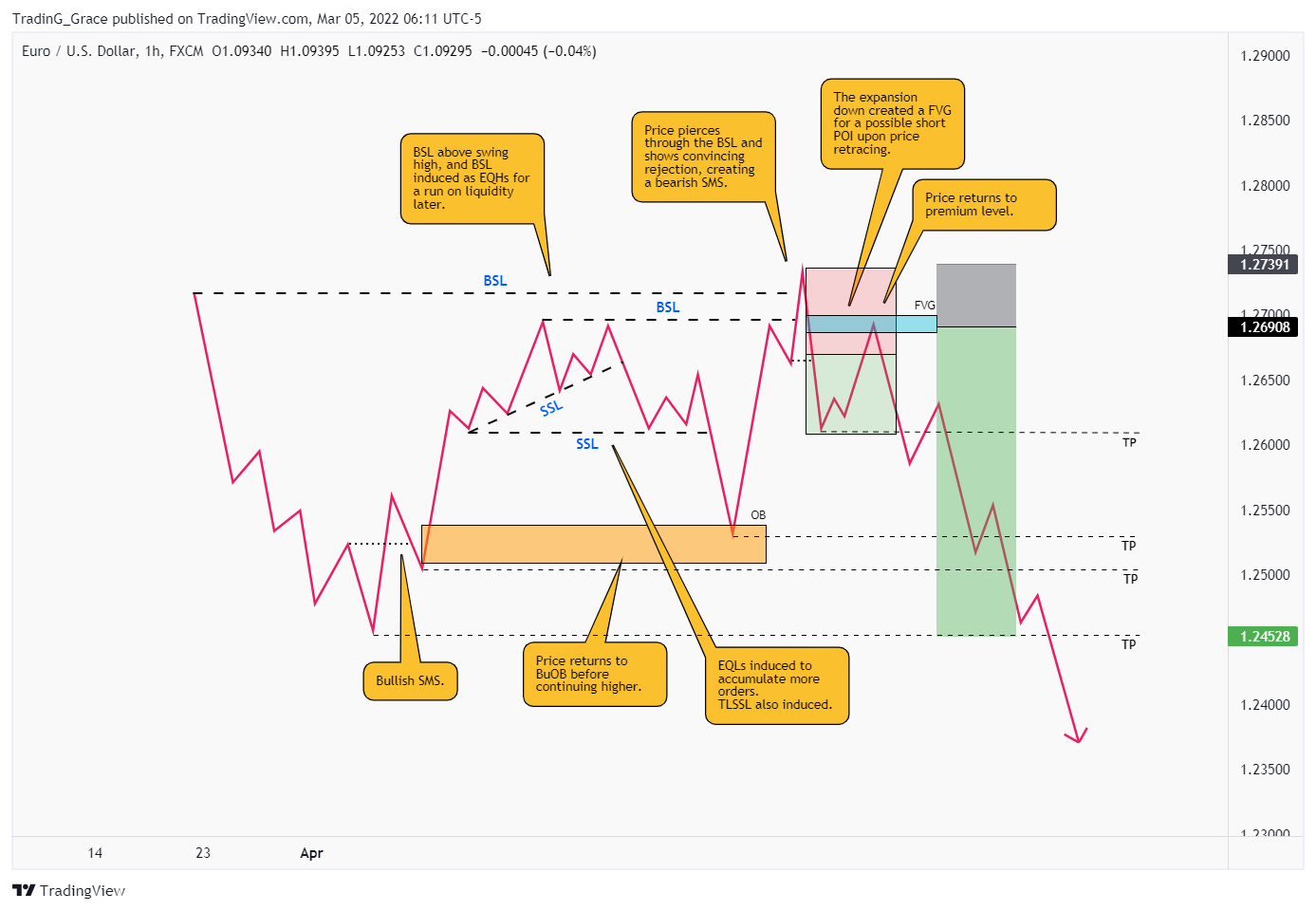
There's a specific trader pattern I see repeatedly in the prop firm world: technically skilled, knows ICT concepts well enough to explain them to others, gets through evaluation phases, then gets into trouble on a funded account, often on the second trade after the first drawdown day rather than on the first loss.
They handle the initial loss fine. They step away, collect themselves. Then they come back, find a setup, and it's almost right. The OB they identify is real, it's just not the highest-probability one. The FVG they're using for entry exists, but it's the older, already-mitigated one rather than the fresh displacement gap from the most recent leg. These aren't beginners' errors. They're precision errors. One or two candles off. A few pips in the wrong direction on the entry.
And the funded account dies on accumulated precision errors, not on reckless trading. That's the brutal truth about what contaminated analysis actually looks like in practice. If you want to understand why prop firm failures cluster the way they do, our piece on the truth about funded trading what they don't tell you goes deeper on the structural side of this.
What 10 Years of This Actually Teaches You
I used to think calm felt like calm. That if I wasn't visibly emotional, my analysis was clean. That was wrong. The quiet that follows a loss can be deceptive, it's not always neutral ground. Sometimes it's suppression wearing a rational mask.
My contrarian view is that experienced traders can be more vulnerable to invisible bias than beginners. Beginners make obvious emotional errors. Experienced traders make subtle ones, because they've learned to look calm while still operating with contaminated priors. Their confidence in their own composure is itself the blind spot.
The market doesn't care how composed you look. It only responds to where your orders are. And if emotional residue shifted your order block identification by a few candles, your calm demeanor isn't protection, it's camouflage for a flawed entry.
For traders looking at how these psychological layers interact with specific April 2026 market conditions, our breakdown of why Q2 2026 market structure shifts are breaking traditional ICT setups is worth reading alongside this.
Start Here
Run the Quiet Mind Protocol on your next loss, not the one five trades from now, the very next one. Time yourself through each phase. Write down what you identified on the chart before the protocol, and again after. Compare them. If your analysis is identical, great, you were already clean. But if the OB shifted, if the FVG looks different, if the entry changes even slightly, you've just made the invisible visible.
That's the whole point. Not to manufacture calm, but to verify it.
If you want a more structured environment to build this into your daily practice, take a look at the coaching plans available, from Lite sessions at $150/week through to Full Mentorship over four months. Or if you're not sure where you sit yet, a free discovery call is the right starting point. No obligation, just an honest conversation about where your trading actually is.
The protocol is free. What costs you is not using it.
Harvest Wright
ICT Trading Coach · 10+ Years Experience
Harvest specializes in ICT methodology and has helped traders pass prop firm challenges, develop consistent strategies, and build the psychology needed for long-term profitability.
Book a Free Discovery Call →Ready to Get Funded?
1-on-1 ICT coaching built around prop firm rules, from a trader who has passed an FTMO Challenge.
Book a Free Discovery CallFree ICT Funded-Trader Playbook
The setups, the pre-trade checklist, and the risk rules I use. Get it free.