
The Revenge Trade Trap: How I Finally Broke It
There's a moment, and if you've been trading long enough, you know exactly the one I mean, where a losing trade stops being a losing trade. It stops being a data point, a probability miss, a normal part of the distribution. Something shifts, and suddenly it becomes personal. The market took something from you, and some part of your brain has decided it's owed back. That's revenge trading, and that precise cognitive switch is where accounts go to die.
Key Takeaway: Revenge trading isn't a willpower problem, it's a cognitive reframe problem. The moment your brain reclassifies a loss as a 'debt the market owes you', you've already entered dangerous territory. A pre-built interruption protocol, not a screen break, is what actually stops it.
I've read the standard advice. Everyone says the same thing: walk away from the screen, take a break, go for a run, come back with a clear head. And look, I'm not saying that's wrong. But after ten years of trading, much of it ICT-based, I think it misdiagnoses the problem. You don't revenge trade because you're sitting at the desk. You revenge trade because of what happened inside your head three minutes after the loss closed red.
The Debt Reframe: Where It Actually Starts
Here's what nobody talks about precisely enough. There are two very different internal experiences of a losing trade, and they look identical from the outside.
The first: you take a loss, you feel the sting of it, you log it, you move on. The trade didn't work. That happens. Your edge has a win rate, and this was on the losing side of the distribution. Fine.
The second: you take a loss, and somewhere in the next sixty seconds, your brain performs a quiet little narrative surgery. The trade didn't just not work, it was wrong. The market cheated. The stop hunt was unfair. The setup was perfect, which means the outcome was undeserved. And if the outcome was undeserved, then there's a kind of cosmic imbalance in play, a debt.
That debt reframe is the actual ignition point. Everything else, the oversized position, the skipped confirmation, the 4am entry on a pair you know nothing about, all of that is downstream of the reframe. The screen break doesn't undo it. You can walk away for twenty minutes, come back, and if you never caught the reframe and dismantled it, you're still operating on the belief that the market owes you money. You're just doing it with slightly lower cortisol.
And here's what makes this especially dangerous for ICT traders specifically: our methodology gives us sophisticated-sounding justifications for bad entries. You can dress up a revenge trade in an order block narrative, a fair value gap story, a premium-discount rationale. I've done it. The setup looks real on the chart because you're good enough to find something structural at almost any level if you're motivated to look. The knowledge becomes a weapon against you.
What This Looks Like
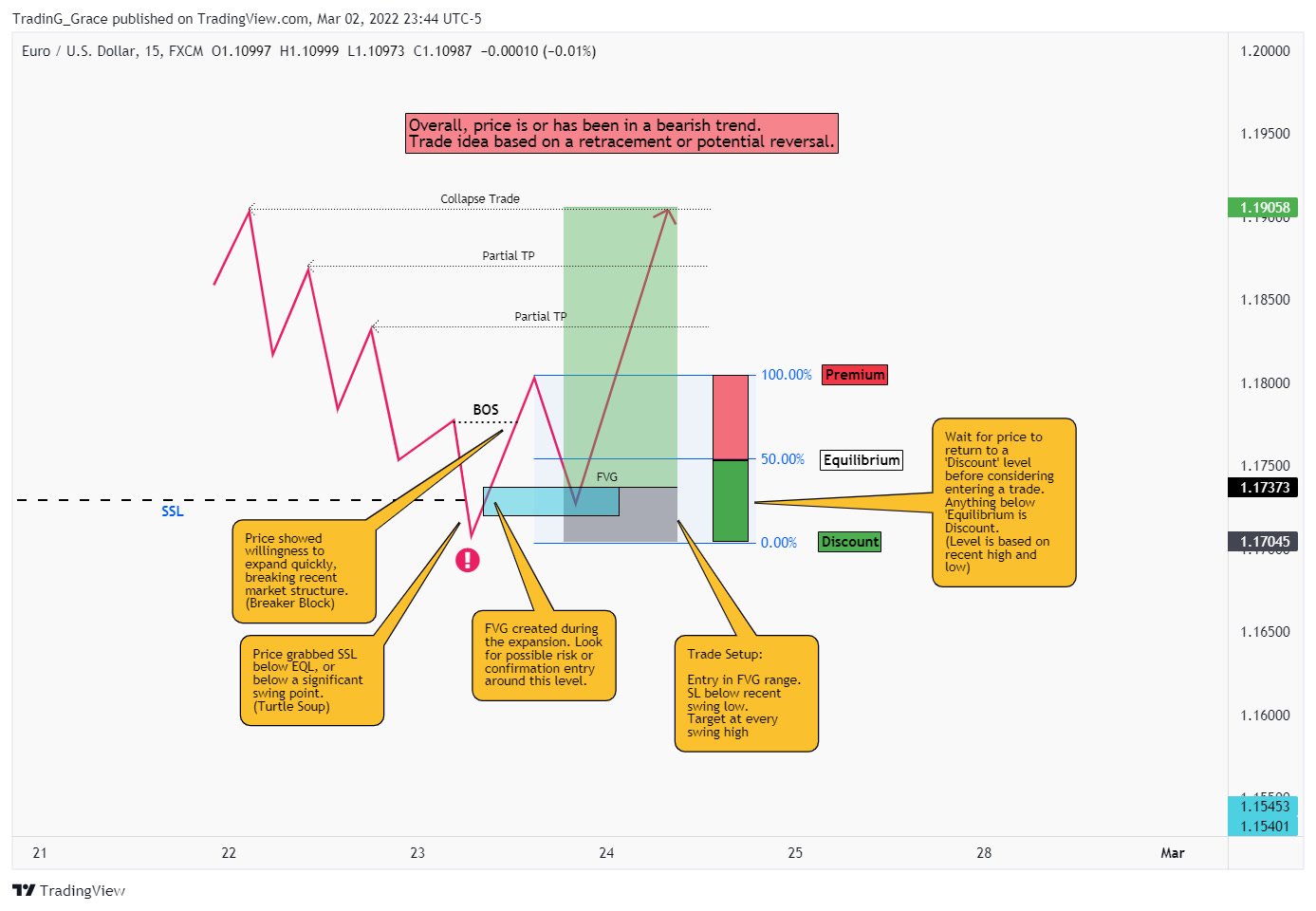
Here's the kind of sequence I mean, as an illustration rather than a trade log.
Picture GBPUSD on the 15-minute during London. There's a bearish setup off a 4H distribution range: a displacement candle leaves an untouched fair value gap, equal highs above have already been swept, and the higher timeframe bias is down. The short goes in inside the FVG with the stop just above the gap and the swing high, because if price takes that level the bearish read is wrong. The target is the sell-side liquidity below. Textbook.
Then price pokes up, stalls, and spikes straight through the stop, through the FVG and the order block above it. Looking back, it's a clean inducement: there was buy-side liquidity resting above an earlier swing high that got underweighted. The first push down wasn't continuation yet. The real move needed that liquidity first.
The stop closes. Normal loss. Except price then reverses almost immediately and sells off exactly as planned, without the trader on board.
That's where the reframe happens. The story shifts from "I got the direction right but misread the manipulation" to "the market ran my stop to steal from me." The me in that sentence is the tell. Once it becomes about you, you've already lost the next trade.
A few minutes later they're back in, short again, lower down. No FVG. No structure behind it. Just in, with bigger size because they "need to make it back." The position goes against them, they hold it longer than they should because closing it means admitting it was a revenge trade, and it closes as a second, bigger loss. Two losses on the same idea, the second one manufactured by psychology.
That second trade isn't analysis. It's litigation.
The Archetype I See Everywhere
There's a specific type of trader I see making this mistake repeatedly, and it's almost never the beginner. It's the intermediate-to-advanced ICT trader who genuinely understands the concepts, who can read a chart, who knows what a breaker block is, who understands premium versus discount, but whose sophistication has outpaced their psychological infrastructure.
They get stopped out on what was, objectively, a solid setup. Then they immediately find another setup on the same pair that "confirms" their original bias. The second entry is presented to themselves as a "re-entry with better positioning," but when you look at the actual criteria, timeframe of entry, confluence checklist, session timing, risk sizing, it fails on at least three counts that the original setup passed. The knowledge is being used selectively, in service of a conclusion already reached emotionally. That's not ICT trading. That's confirmation bias in an OB costume.
If you've been in this game long enough, you'll recognise that pattern in your own journal somewhere. I certainly did. [Related: if you want to see how this specific mistake compounds inside a funded account challenge, the breakdown in our post on 7 fatal mistakes that kill your funded account challenge success is worth reading carefully.]
The 3-Step Interruption Protocol
This is what actually works. Not as a theory, as a practised, pre-built response that runs automatically when specific conditions are met. The key word is pre-built. You cannot design this protocol in the emotional state you're trying to overcome. Build it before you need it.
Step 1: Trigger Recognition, Name the Reframe Out Loud
Literally out loud. When a trade closes as a loss, your immediate post-trade task is to say, speaking the words, one of two sentences: "That was a valid loss in my distribution" or "The market owes me nothing."
This sounds almost embarrassingly simple. It works because the debt reframe is a subvocal process, it happens in the narrative layer of your mind without being examined. Speaking an explicit counter-narrative forces the reframe into conscious scrutiny. It's not a magic phrase; it's a pattern interrupt that buys you the ten seconds you need to run Step 2.
In my experience, putting a name on an emotional state takes some of its power away. You're doing the same thing with a specific cognitive distortion.
Step 2: The 3-Question Criteria Check (Before ANY Re-entry)
Before your next trade, on any pair, any timeframe, within the next 90 minutes of a loss, you answer these three questions with documented answers, not mental answers:
-
Would I have taken this exact entry if the previous trade had never happened? Not "is there a reason to take it", would it have been on my watchlist before the loss? If the honest answer is no, the trade is disqualified.
-
Is my risk sizing the same as my last three planned entries? If it's larger, even by a fraction, the trade is disqualified. Use the risk calculator to force the number rather than estimating.
-
Which session window and which timeframe confluence am I operating from? If you can't answer in under fifteen seconds with specifics, not "it looks bearish" but "15m FVG formed after NY open displacement, higher timeframe is in discount, targeting equal lows at X", the trade is disqualified.
Two disqualifications means you close the platform for that session. Not as punishment. As operational procedure.
Step 3: Journal the Reframe, Not Just the Trade
Most trade journals log entries and exits. What you need to log specifically after a stopped-out trade is the sentence your brain tried to tell you immediately afterward. "The spread widened on purpose." "That FVG shouldn't have been violated." "I was right, just early." Write the actual thought. Then write what the data says instead.
Over time, and it takes a while of consistent logging to see clearly, you'll notice your reframe narratives are nearly identical every time. The specific justifications repeat. Once you can see the pattern in your own handwriting across twenty journal entries, it loses a significant portion of its grip. You recognise it as a script your brain runs, not a genuine assessment of market conditions.
For a deeper look at how structure failures compound with psychological issues, our Q2 2026 market structure analysis shows exactly how this plays out in current conditions, and why this year's ranging environments are particularly prone to manufacturing these "debt" narratives in traders who keep expecting trending follow-through.
The Harder Truth
Here's the contrarian point I'll leave you with, because I think most commentary on revenge trading misses it entirely.
Revenge trading isn't a discipline failure. It's a belief failure. Specifically, it's evidence that somewhere underneath your ICT knowledge, you still believe that reading the market correctly entitles you to a winning trade. It doesn't. The relationship between a correct analysis and a profitable outcome is probabilistic, not contractual. Smart money concepts give you an edge. They do not give you a guarantee, and the moment you start trading like they do, sizing up after a "perfect" setup fails, demanding the market confirm your read, you've stepped outside the methodology entirely.
The traders who go deepest into revenge trading spirals are often the ones who've invested the most in their education. Because the more you've studied, the more it feels like a well-structured setup should work. And when it doesn't, the cognitive dissonance is sharper. The debt narrative is more convincing.
Ten years of this has taught me that the market doesn't grade your analysis. It just moves.
If you want to work on the full psychological and technical infrastructure, not just the mindset piece, but the actual ICT framework that reduces the number of "should have worked" setups you're taking in the first place, take a look at our coaching plans. Building the protocol above is one thing. Having someone review whether your setups are actually as high-probability as they feel in the moment is something else. Book a free discovery call if you want to understand what that looks like in practice.
And if you're currently inside a funded challenge and recognising this pattern in your recent trading, read the truth about funded trading before your next session. The emotional stakes of prop firm trading make the debt reframe exponentially more powerful. You need to know that going in.
Harvest Wright
ICT Trading Coach · 10+ Years Experience
Harvest specializes in ICT methodology and has helped traders pass prop firm challenges, develop consistent strategies, and build the psychology needed for long-term profitability.
Book a Free Discovery Call →Ready to Get Funded?
1-on-1 ICT coaching built around prop firm rules, from a trader who has passed an FTMO Challenge.
Book a Free Discovery CallFree ICT Funded-Trader Playbook
The setups, the pre-trade checklist, and the risk rules I use. Get it free.