
The Quiet Bias Killing Your ICT Trades
There's a specific moment I've seen play out hundreds of times across trading communities, Discord servers, and my own chart history. A trader builds a clean, well-reasoned daily bias in pre-market. They mark their levels. They wait. Then price does something unexpected, and instead of reading what's actually happening, they bend the narrative. The FVG they're now calling "valid" is sitting in premium. The order block they're defending was already swept. But their bias says bullish, so bullish it stays. That's not sloppy analysis. That's directional attachment, and it's the most destructive force in ICT trading psychology that almost nobody talks about directly.
Key Takeaway: The ICT practice of building a daily bias, while structurally sound, creates a psychological anchor that causes traders to unconsciously filter confluences in real time to match their pre-market narrative. This isn't generic confirmation bias; it's a methodology-specific trap that backtesting will never reveal, because in backtesting, price has already moved.
Why ICT's Greatest Strength Becomes Its Hidden Weakness
Let me say clearly: the daily bias framework is legitimate. Understanding where price is likely to draw, whether it's seeking buy-side or sell-side liquidity, whether we're in a premium or discount range, that's a skill that separates purposeful trading from randomness. I've built entire weeks of profitable trading on a solid morning bias read.
But here's what a decade in these markets teaches you that a year doesn't: the bias is a hypothesis, not a contract.
The problem isn't the daily bias itself. It's what happens neurologically when you've spent 45 minutes on a Sunday building a weekly narrative and another 20 minutes on Monday morning confirming it. By the time London opens, that bias isn't just a trade idea, it's an identity. You've written it in your journal. You've drawn the levels. You've told yourself the story. Now price has to cooperate, or you have to admit the story was wrong. And human brains are extraordinarily bad at admitting stories are wrong.
This is where ICT trading psychology breaks down for the majority of traders. The methodology teaches you to have a bias. It doesn't teach you how to hold it loosely.
A Trade That Made This Real For Me
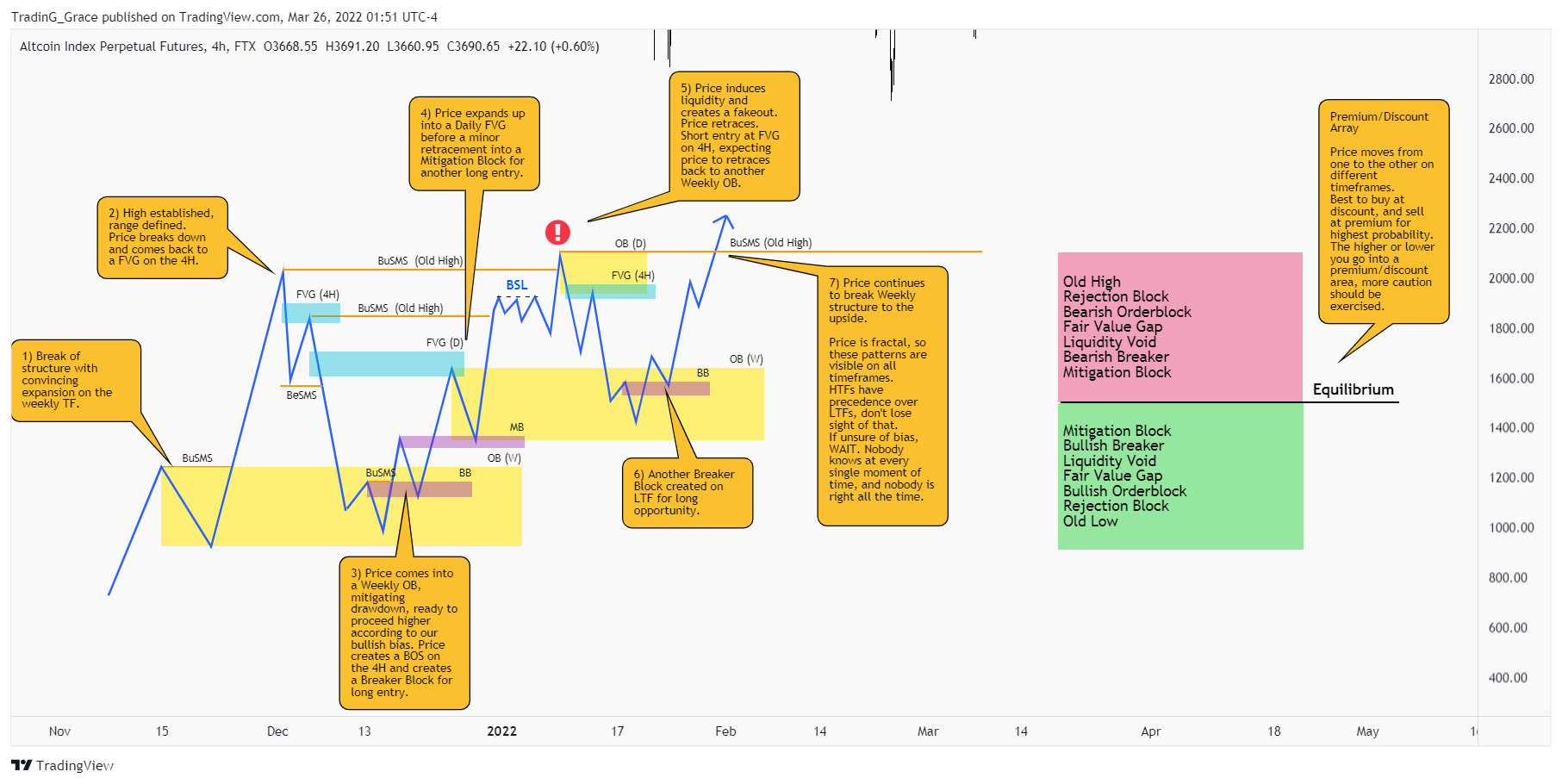
Early in Q1 this year, I was watching GBPUSD on the 15-minute chart. Pre-market, I had a clear bullish bias, price had swept sell-side liquidity below the Asian session low, London displacement had pushed higher, and I had a 4H order block sitting around 1.2634 that I was targeting for a long entry. The setup read textbook.
Price came back to 1.2641, tagged the upper edge of what I'd identified as the mitigation zone, and I entered long. Stop was at 1.2619, 22 pips, risking 0.75% of the account. Clean enough.
What I ignored: there was a fresh bearish FVG sitting directly above my entry at 1.2658, 1.2671 from the displacement move itself. I'd seen it. I'd noted it. And then I'd mentally filed it as "minor" because it contradicted my bullish target of 1.2710.
Price pushed to 1.2659, stalled in that FVG for 20 minutes, then rolled over and took my stop. Loss: 0.75%.
The setup didn't fail. My reading of the setup failed, because I had already decided where price was going, and I unconsciously weighted every confluence that agreed with that decision while rationalizing away the one that didn't. The FVG wasn't minor. It was the most recent institutional footprint on the chart. I just didn't want to see it.
Myth, Reality, and What I Actually See
Myth: When ICT trades fail, it's usually a setup quality problem, wrong order block, invalidated FVG, poor entry timing.
Reality: In my experience watching how traders actually operate in live markets versus backtesting, setup quality is rarely the primary failure point. Most people who study ICT seriously enough to understand displacement, liquidity sweeps, and PD arrays can identify valid setups on a clean chart. The breakdown happens in real time, when there's money on the line and a narrative already in place.
What I Actually See: The trader who consistently gets stopped out on order block entries is almost always not entering in the wrong OB, they're entering in the right OB at the wrong time, because their pre-market bias has made them need that OB to hold. The moment price reaches the level, confirmation bias kicks in and every minor bullish candlestick looks like a sign to enter. They don't wait for displacement confirmation. They don't check whether they're in premium or discount relative to the session range. They enter because the narrative demands it.
This pattern is particularly brutal during prop firm challenges, and I've written about the broader psychological minefield that funded challenges create in 7 fatal mistakes that kill your funded account challenge success. Directional attachment is responsible for at least two or three of those mistakes operating under the surface.
Why Backtesting Hides This Completely
This is the nuance that most ICT YouTube content misses entirely, and it matters.
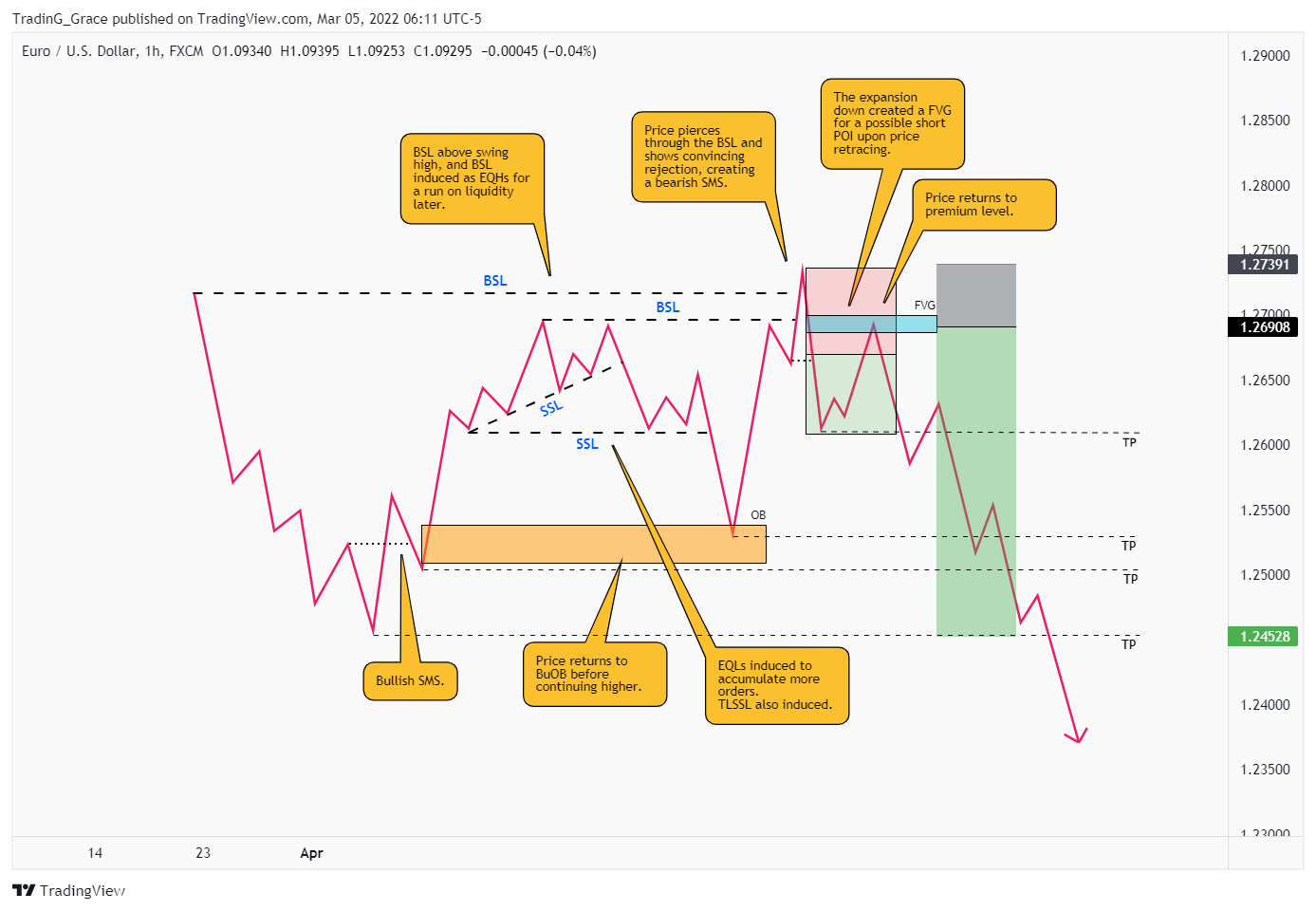
When you backtest, price has already moved. You scroll through a chart knowing where it went. You identify an order block, see that price reversed from it, and mark it as a valid entry. You're never tested on whether you would have ignored the bearish FVG above the entry, because you already know price didn't fill it. There's no psychological cost to being objective in hindsight.
Live trading removes that safety net completely. Now you have a bias, you have P&L anxiety, you have the memory of the last trade you missed by being too cautious, and you have 30 conflicting signals happening in real time. Your brain will solve that uncertainty by deferring to the narrative you built before the session, because that narrative took effort, and effort creates commitment.
Cognitive scientists call the underlying mechanism the sunk cost fallacy, but in trading it shows up specifically as an unwillingness to invalidate a bias you've already emotionally invested in. The more detailed your pre-market analysis, the stronger the anchor. Ironically, the traders who are most rigorous about their daily bias preparation are sometimes the ones most vulnerable to this.
For a deeper look at how Q2 2026 market structure has been specifically exposing this problem as ranges tighten and fakeouts multiply, see why Q2 2026 market structure shifts are breaking traditional ICT setups and how to adapt.
The Bias Audit Framework (Use This Before Every Entry)
This is the actual process I run now, not a concept, a checklist with teeth.
Step 1, State your bias and its specific invalidation condition before the session opens. Not just "I'm bullish on Cable today." Write: "Bullish bias on GBPUSD. Invalidated if price closes a 15-minute candle below 1.2598 (the sweep low) with no immediate reclaim." The invalidation condition is the most important part. If you can't articulate what would make you wrong, you don't have a bias, you have a belief.
Step 2, At every potential entry, run the opposing scenario first. Before you confirm the long, spend 60 seconds building the bear case from the current candle structure. What would price need to do to suggest distribution rather than accumulation? Are there unfilled bearish FVGs above? Is the OB you're targeting sitting in the premium of the current range? Force yourself to articulate the short thesis before committing to the long.
Step 3, Check your timeframe alignment from the top down, not from your bias down. This is subtle but critical. Most traders with a bullish bias look at the 15-minute, see something they want to call an order block, then glance at the 1-hour to "confirm" it. That's bias-first analysis. Instead, read the 1-hour structure cold, pretend you have no position and no bias. Does the 1-hour structure agree with a long from this level? If you have to stretch the interpretation, it's telling you something.
Step 4, Size down when your bias has already been tested once. If price moved against your bias, swept a level you thought was protected, and you still believe the bias is valid, cut your risk in half for the re-entry. This isn't a confidence vote. It's a mechanical response to the fact that the market has already shown you uncertainty. Use a risk calculator if you need to think through the position sizing, there's no award for oversizing a trade you're already second-guessing.
Step 5, Log the specific confluences you rejected on every losing trade. Not the confluences that supported your entry, the ones you overrode. After a month of this log, a pattern will appear. You'll see that you almost always dismissed bearish FVGs when you were bullish, or you consistently ignored sell-side liquidity resting above your target when you needed a clean run. That's your specific version of directional attachment made visible.
This is also why I think the ICT fair value gap trading checklist is worth internalizing, pre-trade confirmations function as a structural counterweight to the bias anchor, provided you run them honestly.
One More Thing Most People Won't Say Out Loud
I used to frame my daily bias write-ups as narratives. Full paragraphs about what "the market wants to do" and why the smart money was "clearly positioning" for a specific move. It felt professional. It felt analytical.
What it actually was: storytelling that made me emotionally attached to an outcome before the session even started.
Now my bias notes are sparse and conditional. "Above 1.0830, looking for longs into 1.0871. Below 1.0798, reassess." Two lines. No story. The bias exists to orient me, not to commit me.
That shift took years to make, not because I didn't understand it intellectually, but because detailed analysis feels like edge. Stripping it back feels like laziness. It isn't. The ability to hold a bias lightly while reading price honestly in real time is one of the hardest skills in ICT trading psychology to develop, and it's the one that separates traders who pass funded challenges from traders who keep re-buying them.
If you want to go deeper on the funded trading landscape and how psychology fits into that picture specifically, the truth about funded trading covers the structural side of what makes or breaks most prop traders.
Where To Go From Here
Start with the bias audit framework above on your next three trading sessions. Don't change your setup. Don't change your pairs. Just run Step 2, the opposing scenario, before every entry. That single habit will surface your directional attachment faster than anything else I can suggest.
If you're at the point where you want structured accountability around this and the rest of your live trading process, the coaching plans range from Lite at $150/week through to Full Mentorship at $1,000 for four months. Or if you want to get a feel for fit first, book a free discovery call, no sales pitch, just an honest conversation about where you are and whether working together makes sense.
The setup isn't what's failing you. It's the story you tell yourself about the setup before price has a chance to speak.
Harvest Wright
ICT Trading Coach · 10+ Years Experience
Harvest specializes in ICT methodology and has helped traders pass prop firm challenges, develop consistent strategies, and build the psychology needed for long-term profitability.
Book a Free Discovery Call →Ready to Get Funded?
Our students pass prop firm challenges in under 60 days with personalized ICT coaching.
Book a Free Discovery CallFree ICT Funded-Trader Playbook
The setups, the pre-trade checklist, and the risk rules I use. Get it free.