
The Silent Killer of ICT Traders: Pattern Addiction
After more than a decade of trading, including passing an FTMO Challenge and a top 1% finish in a TradingView trading competition, the failure pattern I see most often isn't what anyone expects. It's not traders who don't understand the concepts. It's traders who understand them too well.
Key Takeaway: Advanced ICT pattern recognition, order blocks, FVGs, liquidity sweeps, rewires your brain to find setups everywhere, manufacturing conviction in low-quality trades. This 'confirmation hallucination' bias blows a lot of accounts, and no one in the ICT space is incentivized to warn you about it.
The Problem No ICT YouTube Channel Will Ever Make a Video About
Every ICT trading educator, myself included, at times, is structurally incentivized to teach you more. More patterns. More confluence. More concepts. Breaker blocks, mitigation blocks, propulsion blocks. Inversion FVGs. ICT macros. Killzone setups. Quarterly shifts. The more you learn, the more content you consume, the more you share, the more the algorithm rewards the creator.
Here's what nobody says out loud: every new concept you learn is also a new lens your brain will force onto future charts, whether the setup is actually there or not.
This isn't a character flaw. It's how brains work. The human brain is a pattern-completion machine. You learn to see order blocks everywhere because that's literally what deep repetition does, it makes recognition automatic. And automatic recognition feels exactly like certainty. That feeling of "yes, this is it" becomes indistinguishable from actual edge.
I used to get this wrong badly. Around years three and four, I was fluent enough in ICT concepts to see setups on any chart, any timeframe, any session. And I genuinely believed fluency equaled edge. It doesn't. Fluency is just the entry fee. What comes after fluency is the real test, and most traders never even realize they're failing it.
Myth, Reality, and What I Actually See
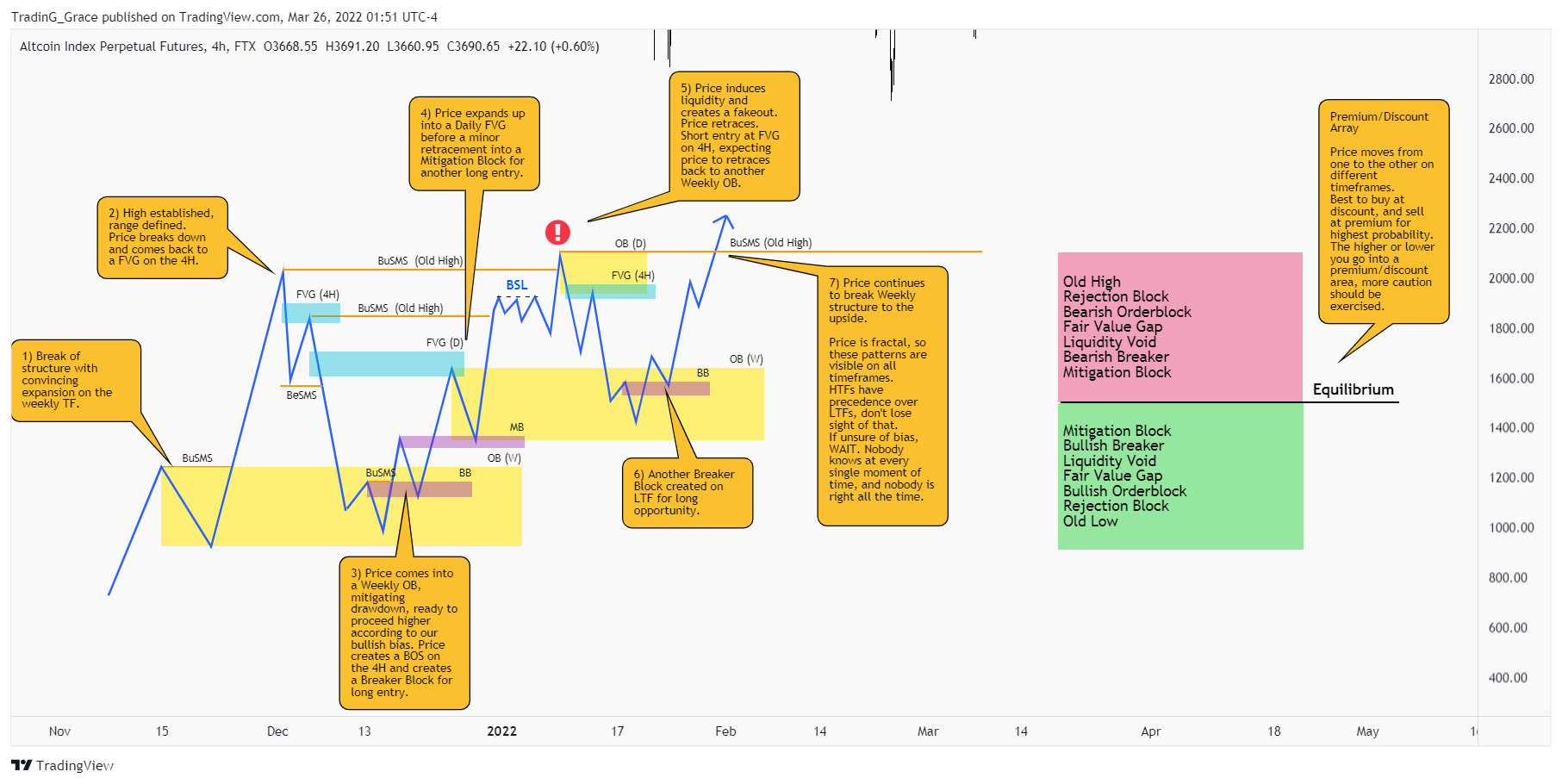
Myth: The more ICT concepts you can identify on a chart, the higher quality your trades will be.
Reality: Confluence is only valuable when each confirmatory signal is independently valid, not when your brain selectively perceives confirmation because it already wants to be in the trade.
What I Actually See: Traders who can fluently identify a bullish order block, align it with a premium/discount array, note a market structure shift, and call out a killzone window, and still enter a trade that should have never been touched. Because the structure was consolidating, not trending. Because the displacement was weak, not impulsive. Because they were in the middle of a range, not at a clean institutional level. All the boxes looked checked. None of the actual conditions were met.
This is confirmation hallucination. And the more ICT vocabulary you have, the more sophisticated your rationalizations become.
A Worked Example
Let me be specific, because vague warnings mean nothing.
Picture GBPUSD on the 15-minute chart during the London session. Price has been compressing for hours, classic pre-London range behavior. Then price pushes below the Asian session low and takes out the stops sitting there. The trained brain immediately says: liquidity sweep, look for longs.
The trader spots what looks like a bullish order block, goes long with the stop below the sweep low, and targets the previous day's high because that's the obvious buy-side liquidity. On paper, it's a clean plan.
Here's the problem, and it usually only shows up in the post-session review: the "displacement" wasn't displacement. It was a slow grind lower, no velocity, no impulsive single-candle move, no real break in structure on the lower timeframe. The "order block" was actually the last bearish candle before a choppy consolidation, not before a true delivery leg. The brain saw the ingredients and assembled a dish that wasn't actually on the menu. A real version of this setup needs a fast, impulsive move away from the sweep and a clear shift in structure before the order block means anything.
What makes it worse? The trader had five reasons to be in the trade. Five ICT concepts all pointing long. That's the trap. Five weak signals don't add up to one strong one, they add up to one very convincing hallucination.
The Trader Archetype I See Everywhere Right Now
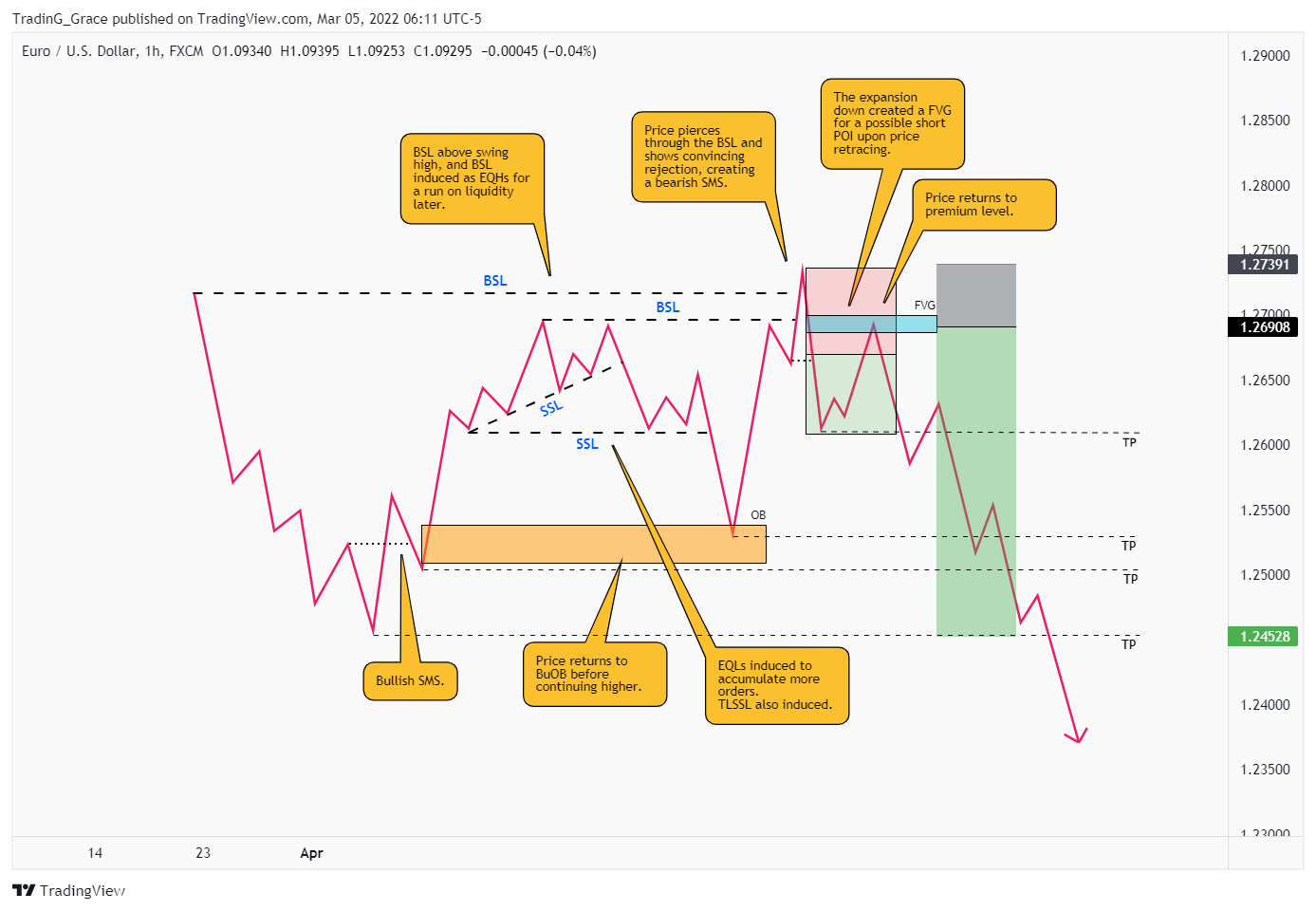
There's a specific type of trader who shows up repeatedly in trading forums and Discord servers in 2026. They post chart screenshots covered in drawings, multiple order blocks highlighted across three timeframes, FVGs stacked on top of each other, liquidity levels drawn at what seems like every recent swing high and low. They ask: "Does this look like a valid setup?"
The answer is almost always: it doesn't matter, because the question reveals the problem. When a trade requires that many drawings to justify, it isn't a high-probability setup. It's a decision that's already been made emotionally, dressed up in technical clothing.
This trader typically has 12, 18 months of serious ICT study behind them. They're not a beginner. They can explain market maker models fluently. But their win rate is collapsing, not improving, because their pattern recognition has outpaced their ability to reject setups. And nobody told them that rejecting setups, saying "this doesn't qualify", is actually the harder skill to develop, and the more valuable one.
If this resonates with what's been happening in your own trading, it might be worth reading through why Q2 2026 market structure shifts are breaking traditional ICT setups, because pattern addiction gets worse when markets stop behaving predictably.
The Anti-Pattern Framework: How to Actually Filter This
Here's what I now use, and what I'd apply before any ICT trading entry:
Step 1, The Cold Chart Test. Before annotating anything, look at the raw chart for 30 seconds. Is there an obvious directional narrative? If you have to search for it, it probably isn't there.
Step 2, Single Disqualification Rule. Identify the one thing that would make this trade invalid. Not the five things that confirm it, the one thing that kills it. If price hasn't swept a significant liquidity pool, the trade is off. If displacement isn't impulsive and single-candle on the entry timeframe, the trade is off. Full stop. One disqualifier ends the analysis.
Step 3, The Explanation Limit. If explaining your entry rationale takes more than three sentences, the trade is too complicated. Real institutional-level setups are obvious in hindsight because they were obvious in real time. If you need a paragraph to justify it, you're compensating.
Step 4, Risk sizing before entry, not after. Before you calculate a target, run your position size through a fixed framework. I keep mine at a hard 0.5% max on any trade where I have even slight hesitation about quality. If I'm fully convicted and the setup is clean by steps 1, 3, I'll size up to 1%. The sizing itself becomes a forcing function for honesty, if you're not confident enough to put 1% on it, why are you in it at all? Use a risk calculator and let the numbers reflect what you actually believe about the trade.
Step 5, Post-session audit, not just post-trade. Once a week, review every trade you considered but didn't take. Not just the ones you took. The skipped setups often reveal more about your pattern addiction than the ones you entered, especially if you find yourself relieved you skipped them because they would have lost.
For a more granular version of this filtering process applied specifically to FVGs, this ICT fair value gap checklist runs through nine pre-trade confirmations that separate quality FVG entries from the ones that just look like quality.
The Deeper Issue: Who's Teaching Subtraction?
Every piece of ICT content online teaches addition. New concept, new confluence, new model. The education economy runs on complexity because complexity creates dependency, you need the next video, the next framework, the next update to the model.
What the market actually rewards is subtraction. Fewer trades. Fewer patterns needed to justify an entry. Fewer reasons to be in a trade that isn't clean.
In my experience, the traders who do well in funded accounts aren't the ones who know the most ICT concepts. They're the ones who've narrowed down to two or three setups they understand with absolute clarity, and who can walk away from a session having done nothing because nothing qualified. That restraint isn't passive. It's the hardest active decision in trading.
If you want to understand how this pattern addiction compounds specifically in funded challenges, where the emotional stakes amplify every confirmation bias ten times over, this breakdown of fatal funded account mistakes covers it in detail.
And if you're at the point where you suspect your technical knowledge has gotten ahead of your psychological framework, where you can identify every structure on a chart but still can't stop overtrading, that's exactly the gap that coaching addresses. The Lite and Pro plans are built around exactly this kind of work: not teaching you more ICT, but helping you figure out where your own pattern addiction is costing you.
One Honest Question Before You Close This Tab
Think about your last five losing trades. Were they setups you couldn't explain? Or setups you could explain too well, with five reasons to enter and not a single hard disqualifier?
For a lot of experienced ICT traders, it's the second one.
The market doesn't reward knowing more. It rewards knowing when to do nothing. If that shift hasn't happened yet in your trading, that's where the work actually starts. Book a free discovery call and let's figure out exactly where your pattern recognition is working against you, because finding that answer is worth more than any new setup you could learn.
Harvest Wright
ICT Trading Coach · 10+ Years Experience
Harvest specializes in ICT methodology and has helped traders pass prop firm challenges, develop consistent strategies, and build the psychology needed for long-term profitability.
Book a Free Discovery Call →Master Your Trading Psychology
Psychology is a huge part of trading. Our coaching includes dedicated psychology sessions.
See Coaching PlansFree ICT Funded-Trader Playbook
The setups, the pre-trade checklist, and the risk rules I use. Get it free.