
Why Smart Traders Feel Nothing After Big Wins
There's a moment after a clean 3R trade, the kind where price swept liquidity perfectly, respected your order block to the pip, and hit your take profit like it was scripted, where you'd expect to feel something. Excitement. Satisfaction. Some kind of high. And when you don't feel much at all? Most trading psychology content would tell you that's a red flag. That you're disconnected. That you need to celebrate your wins to reinforce positive behaviour. That's wrong. And understanding why it's wrong might be the most important thing you read about smart money concepts this year.
Key Takeaway: Emotional flatness after a winning trade isn't psychological damage, it's the sign of a trader who has successfully decoupled self-worth from trade outcomes. The traders who chase the feel-good response after big wins are the same ones blowing up on losing days.
The Celebration Trap (And Why ICT Traders Fall Into It)
Here's what conventional trading psychology gets catastrophically wrong: it treats trading like sports psychology. Celebrate the win. Reinforce the behaviour. Build positive associations with good execution. On paper, this sounds reasonable. In practice, it creates a neurochemical problem that smart money concepts traders are uniquely vulnerable to.
When you celebrate a win, genuinely feel the dopamine hit, post the screenshot, do the mental fist-pump, you're not just acknowledging good execution. You're training your brain to need that response. And your brain doesn't care whether the next trade is Monday morning with a clean London session setup or Wednesday afternoon in a choppy, low-volume range. It just knows it wants that feeling again.
That's the hidden wiring behind revenge trading. Most people think revenge trading is about anger after a loss. Sometimes it is. But the subtler, more dangerous version is trading chasing the high from the last win. The trader doesn't even realise they're doing it. They think they're confident. They feel sharp. They see something that kind of looks like the setup that printed yesterday, and their brain, hungry for the next dopamine cycle, manufactures reasons to enter.
I've watched this pattern play out repeatedly in trading communities. Somebody posts a textbook order block entry on GBPUSD. Beautiful trade. Clean displacement, proper mitigation, a solid winner. People congratulate them. They feel great. Two hours later, they're in a second trade on the same pair, same session, no new narrative, entry mid-range, and they've just handed back a big chunk of what they made.
The win didn't teach them discipline. The celebration made them hungry.
A Worked Example
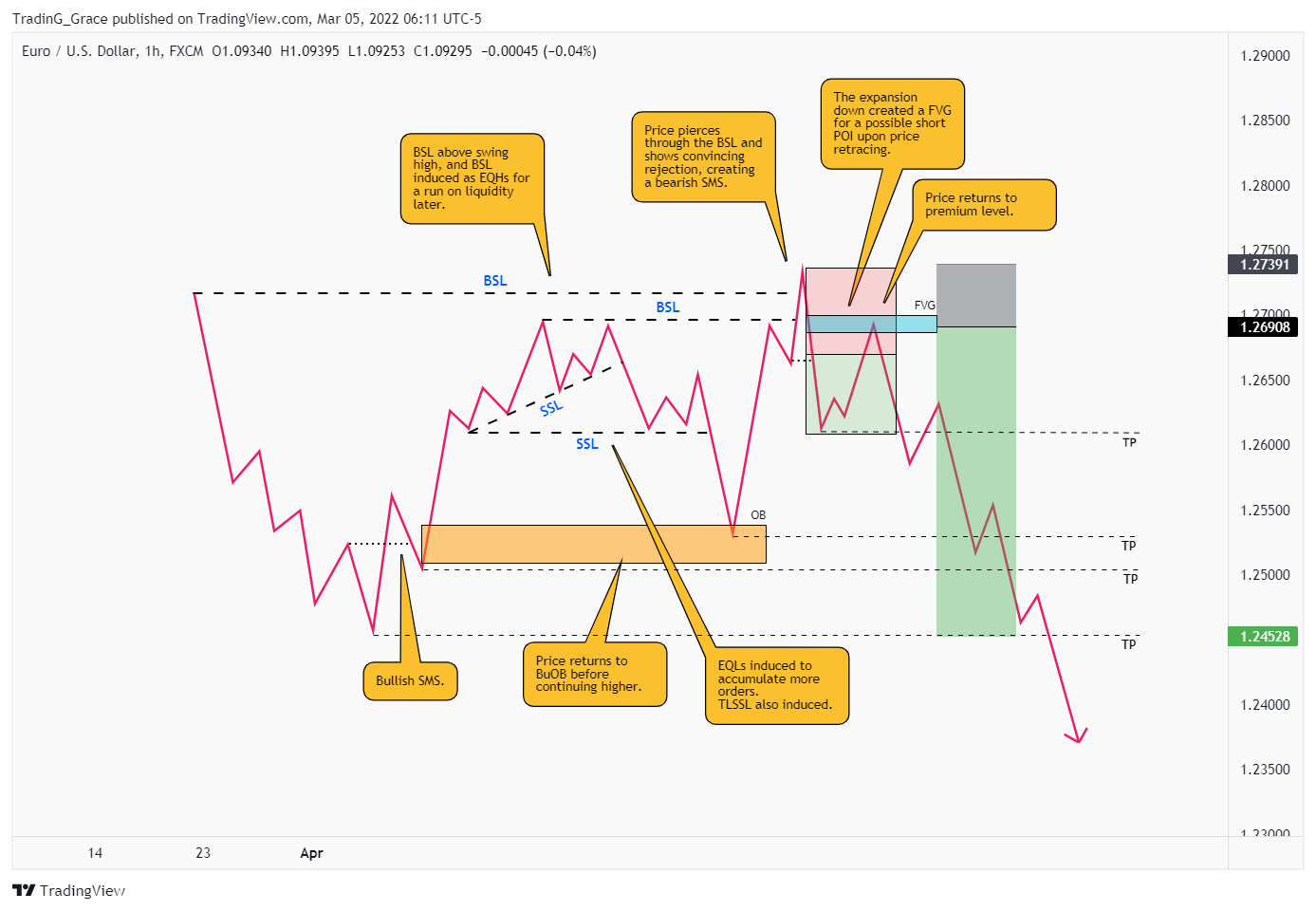
Let me make it concrete. Picture GBPUSD on the 15-minute chart during the London open. Price sweeps the Asian session high, a clean liquidity grab above a visible equal highs formation. After the sweep, a sharp displacement candle drops back below the range and leaves a well-defined fair value gap.
The plan is to wait for price to retrace into that FVG, then short it with the stop above the displacement candle high, because a move back above that high means the sweep failed. The target is a 4-hour demand zone below, where the sell-side liquidity sits. Partials at the first obvious low, runner to the target.
Say it works. What should happen when it closes? A note in the journal. A check of the entry against the pre-trade checklist. Lunch.
That's it. No fist pump. No screenshot for Twitter. No internal monologue about how sharp the read was. Because here's what ten years of trading has taught me: that trade was just execution. It either matched the criteria or it didn't. It either hit the target or it didn't. My opinion of my own performance is irrelevant to what price will do tomorrow, and the moment I start attaching identity to a win, I've introduced a variable that has nothing to do with smart money concepts and everything to do with ego.
If you're wondering how to actually size that trade and know your exact pip risk before you enter, the risk calculator on this site does the heavy lifting.
Myth, Reality, and What I Actually See
Myth: Celebrating wins reinforces good trading behaviour and builds confidence.
Reality: Emotional responses, positive or negative, after individual trades reinforce outcome-dependence, not process-dependence. A trade that followed your rules perfectly but lost 1R was a good trade. A trade that violated your rules but happened to win 2R was a bad trade. Celebrating the win trains your brain to chase outcomes. Neutrality trains it to chase execution quality.
What I Actually See: The trader archetype that struggles most with this isn't the angry revenge trader everyone talks about. It's the overconfident post-win trader, the person who had a great Monday using smart money concepts principles, correctly identified the weekly dealing range, nailed a perfect mitigation entry on a bullish order block, and then spent Tuesday and Wednesday taking sub-standard setups because they felt invincible. They don't look like they're revenge trading. They look like they're trading well. But the emotional residue from Monday's win is quietly distorting their risk filter. By Thursday, they've given back the week. They blame the market. The real culprit was the dopamine cycle they started on Monday afternoon.
This connects directly to something I wrote about in the context of 7 fatal mistakes that kill your funded account challenge success, the mistakes that blow funded accounts aren't usually dramatic. They're incremental. And they almost always start with a good day.
The Case for Emotional Flatness
I'm not a neuroscientist, but here's how I understand it: the buzz comes less from good decisions and more from unexpected good outcomes. That's a critical distinction.
When a trade that should work does work, it's less of a thrill than when a random, low-probability trade accidentally wins. It's part of why slot machines are so addictive. Unpredictability cranks up the reward. In smart money concepts trading, where you're executing high-probability setups with defined criteria, the wins should feel somewhat predictable. If you've done your analysis correctly, you expected that trade to work. There's less novelty, and therefore less emotional intensity.
The traders who chase big emotional highs after wins are often, paradoxically, the ones who aren't genuinely confident in their process. Deep confidence is quiet. It doesn't need validation from the outcome because it was already validated by the quality of the setup.
I used to get this wrong. In my first three or four years, a good trade would put me in a state where I felt like I understood the market. Like I'd cracked something. That feeling was dangerous. It made me louder in my analysis and quieter in my risk management. My most confident days were often the ones right before my sloppiest trading.
A Practical Framework: The Post-Trade Flatline Protocol
Here's what emotional neutrality looks like in practice, not as a vague mindset goal, but as a repeatable process you can run after every closed trade.
Step 1, The Five-Minute Rule. After a trade closes (win or loss), do nothing for five minutes. No analysis, no new chart scanning, no journaling. Just let the outcome exist without attaching to it. This isn't meditation, it's a pattern interrupt.
Step 2, Process Audit, Not Outcome Audit. When you journal the trade, the only question that matters is: did this trade match my entry criteria? Score it against your checklist. Was there a proper displacement? Was the entry in the discount of the range? Did you identify the correct dealing range on the higher timeframe first? For smart money concepts traders specifically, this means running through the institutional order flow logic, not just whether price moved in your direction. The ICT Fair Value Gap checklist is a solid reference point for what this kind of pre and post-trade audit looks like in practice.
Step 3, Session Closure. After a winning trade, physically close the platform for at least 90 minutes if you're in a session that's winding down. This is non-negotiable. The post-win re-entry is one of the most reliably destructive patterns in funded account trading. You're not missing anything, and if you are, the next session exists.
Step 4, Weekly, Not Daily, Emotional Accounting. Evaluate your emotional state on a weekly basis, not trade by trade. Did you feel desperate at any point? Did a win make you feel superior? Did a loss make you feel stupid? These are the signals that matter. Single trade emotions are noise. Weekly emotional patterns are data.
This framework won't feel natural at first. Flatness feels like indifference, and indifference can feel like you don't care about your performance. But there's a difference between not caring and being detached from outcomes while caring deeply about process. That distinction is where funded accounts are built.
If you want to understand how this psychology integrates with the actual technical framework, how to build the kind of systematic approach where emotional neutrality becomes structurally supported rather than a willpower exercise, the coaching plans on this site are built around exactly that integration, from Lite at $150/week up to Full Mentorship at $5,000 over four months.
The Quiet Edge
Elite smart money concepts traders aren't emotionless. They're not robots. They care deeply about their craft. But their emotional energy is invested in preparation and process, not in the outcome of any individual trade.
The market doesn't reward excitement. It doesn't punish flatness. It moves based on institutional order flow, liquidity engineering, and the kind of structural logic that shifting markets can be very unforgiving about for traders who let emotion override structure.
Feeling nothing after a 3R win isn't a problem to solve. It's evidence that something is working.
If you want to explore how the psychological and technical sides of this framework connect, book a free discovery call and we can look at where the gaps actually are in your current approach.
Harvest Wright
ICT Trading Coach · 10+ Years Experience
Harvest specializes in ICT methodology and has helped traders pass prop firm challenges, develop consistent strategies, and build the psychology needed for long-term profitability.
Book a Free Discovery Call →Ready to Get Funded?
Our students pass prop firm challenges in under 60 days with personalized ICT coaching.
Book a Free Discovery CallFree ICT Funded-Trader Playbook
The setups, the pre-trade checklist, and the risk rules I use. Get it free.