CPI Trading: Smart Money Positions Before Data
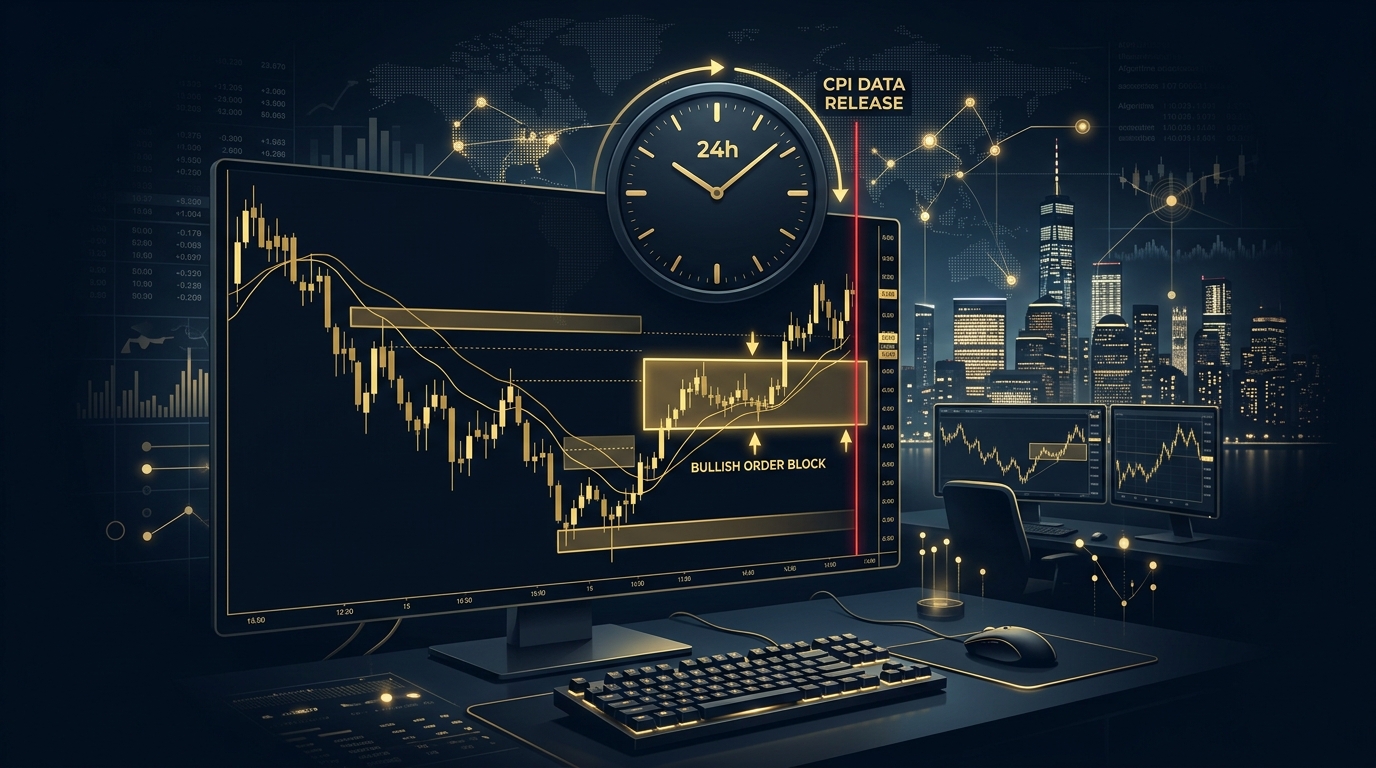
With CPI data dropping this week, it's a good time to talk about how positioning builds up before inflation data. After 10+ years of trading, with ICT concepts for a good part of that, and passing an FTMO Challenge, I've learned that the real money isn't made during the CPI release, it's made in the 24 hours before, when smart money uses order blocks to position for the inevitable liquidity grab that follows high-impact economic data.
Most retail traders wait for the news to hit, then try to chase momentum. Meanwhile, institutional players are already positioned, having identified key order blocks days in advance. Today, I'll break down exactly how they do it and how you can too.
Key Takeaway: Smart money positions before CPI releases by identifying order blocks in the 24-hour window preceding the data, targeting the liquidity grabs that predictably follow high-impact inflation events rather than reacting to the news itself.
Understanding Order Blocks in Pre-CPI Market Structure
Before diving into the strategy, let's establish what we're looking for. Order blocks represent areas where large institutions placed significant orders, creating imbalances that price often returns to. In the context of CPI trading, these zones become magnets for price action as smart money accumulates positions before the volatility spike.
The key insight most traders miss is that institutions don't wait for CPI to be released, they position based on anticipated market reactions. They identify order blocks formed during previous high-impact sessions and use them as reference points for their pre-CPI accumulation.
It's a theme I come back to across my trading insights, because it keeps you out of the worst of the news chaos.
The 24-Hour Pre-CPI Positioning Framework
Step 1: Identify Premium and Discount Order Blocks (48-72 Hours Before)
Three days before CPI, I start mapping institutional order blocks on the daily and 4-hour timeframes. I'm specifically looking for:
- Bearish order blocks in premium zones (above current price)
- Bullish order blocks in discount zones (below current price)
- Blocks that align with weekly/monthly support and resistance
These aren't random support and resistance levels, they're specific zones where I can identify the last down candle before an impulsive move up (bullish OB) or the last up candle before an impulsive move down (bearish OB).
Volatility usually jumps sharply when CPI hits, which is why I want these zones marked well before the release.
Step 2: Monitor London Session Liquidity Patterns (24 Hours Before)
Here's where it gets interesting. CPI is usually released at 8:30 AM EST, and in the day before the release I watch the London session like a hawk. Institutional traders use this session to:
- Test order block boundaries without full commitment
- Create false breakouts above/below key levels
- Build positions at optimal prices before retail traders wake up
My read is that the expectation matters. If the market expects a softer number, watch whether bullish order blocks get defended in London. If it expects a hotter number, watch the bearish ones.
The approach in my breakdown of NFP week liquidity patterns and ICT entries applies here too: positioning builds up in the sessions before a major data release.
Step 3: The New York Pre-Market Setup (2-4 Hours Before CPI)
This is where the magic happens. Between 4:30-6:30 AM EST on CPI day, I'm looking for specific order block reactions that signal institutional positioning:
Bullish Setup:
- Price sweeps below a discount order block
- Quick rejection with momentum back into the block
- Volume confirmation on the bounce
- No lower timeframe break of structure
Bearish Setup:
- Price pushes above a premium order block
- Failed auction with sellers stepping in
- Lower timeframe change of character
- Volume dries up on the push higher
The key is patience: wait for institutional confirmation instead of gambling on direction.
Reading Smart Money Accumulation Signals
Volume Analysis at Order Blocks
Institutional accumulation leaves footprints. When smart money is positioning at an order block, I see:
- Higher volume on touches without significant price movement
- Absorption patterns where selling/buying pressure gets "eaten up"
- Multiple time frame alignment showing respect for the zone
This is completely different from retail behavior, where you typically see panic buying/selling with high volume and large price swings.
Time-Based Positioning Patterns
Here's how I break down the time windows around a CPI release:
- 72 hours before: Initial order block identification
- 24 hours before: Position sizing and risk management
- 4 hours before: Final adjustments and hedging
- 30 minutes before: Retail stop hunting (liquidity grab)
Understanding these time frames is crucial for avoiding the common mistakes I outlined in my post about 7 fatal mistakes that kill your funded account challenge success, particularly the mistake of positioning too early or too late.
Post-CPI Order Block Validation Strategy
The First 15 Minutes: Chaos or Confirmation?
Once CPI hits, I'm not trading the initial spike. Instead, I'm watching how price reacts to my pre-identified order blocks. If institutional positioning was correct, I should see:
- Quick return to order block levels after initial volatility
- Sustained momentum in the anticipated direction
- Lower timeframe structure supporting the move
The 30-60 Minute Window: Where Real Money is Made
This is when institutional positions start showing their true strength. I'm looking for:
- Order block holds leading to extended moves
- Failed order blocks signaling position unwinding
- New order block formation at extremes
A lot of CPI days set much of their range within that first hour, so this window matters for trade management.
Risk Management for CPI Order Block Trading
Position Sizing During High-Impact Events
I never risk more than 0.5% per trade during CPI week. The volatility can trigger stops that wouldn't normally be hit, and slippage can make a loss bigger than you planned.
Stop Loss Placement
For order block trades around CPI, I place stops:
- Below the order block low for bullish setups (not just below the entry candle)
- Above the order block high for bearish setups
- With 20-30 pip buffer to account for increased volatility
Size the position from that wider stop so your dollar risk stays fixed. That way a losing trade stays a normal loss.
Building Your Watchlist for CPI Week
If the market has been behaving differently lately, read my piece on how to adapt when market structure shifts break ICT setups before you build your plan.
For each pair you trade, write down:
- The nearest bullish order block in discount
- The nearest bearish order block in premium
- The obvious liquidity above and below, like the previous day's high and low
Then watch which of those levels show the volume and price action signatures I described above in the 48 hours before the release.
Taking Your CPI Trading to the Next Level
Mastering order block analysis for high-impact news events like CPI takes time and practice. The concepts I've shared today come from years of watching how price behaves around these releases.
If you're serious about developing this skillset, I recommend starting with paper trading these setups before risking real capital. The concepts are simple, but execution requires discipline and experience.
For traders ready to dive deeper into ICT concepts and smart money analysis, my coaching plans give you 1-on-1 sessions where we go through your own charts and get you personalized feedback on your order block identification.
The upcoming CPI release presents an excellent opportunity to observe these concepts in real-time. Whether you're trading live or just studying price action, pay attention to how institutions position around order blocks in the 24 hours before the data hits.
Remember: forget predicting the CPI number. The goal is to align with smart money positioning and ride their coattails.
Ready to start implementing these strategies in your own trading? Book a free discovery call and let's discuss how these concepts can fit into your current trading plan and funding goals.
Harvest Wright
ICT Trading Coach · 10+ Years Experience
Harvest specializes in ICT methodology and has helped traders pass prop firm challenges, develop consistent strategies, and build the psychology needed for long-term profitability.
Book a Free Discovery Call →Take Your Trading to the Next Level
Get personalized 1-on-1 ICT coaching with Harvest Wright. Free discovery call, no commitment.
Book a Free Discovery CallFree ICT Funded-Trader Playbook
The setups, the pre-trade checklist, and the risk rules I use. Get it free.