
GDP Day Trading: What Smart Money Does First
Every GDP release, the same thing happens. Traders glue themselves to their screens at 8:30 AM Eastern, finger hovering over the buy or sell button, waiting for the number. The candle explodes. They chase. They get stopped out. And somewhere on the other side of that trade, someone who positioned hours earlier is taking profit.
It's a pattern I've seen a lot over more than a decade of trading, and understanding why it happens comes down to one thing: smart money concepts don't pause for economic data. They weaponize it.
Key Takeaway: GDP is not a 'trade the spike' event. In my view, a lot of the positioning happens in the hours before the release, while retail traders are primed by narrative bias to misread the move. The number is the exit, not the entry.
Myth: GDP Is a Fundamental Catalyst. Reality: It's a Liquidity Event.
Myth: The GDP print moves the market because it tells institutions something they didn't know.
Reality: By the time the Bureau of Economic Analysis releases the advance estimate, big desks have usually built their positions using leading data: ISM manufacturing, retail sales, jobless claims, the Atlanta Fed GDPNow tracker. They're rarely surprised. They're distributing.
What I Actually See: Retail traders treat GDP like an oracle. They wait for the number, form an opinion in 0.3 seconds, then execute with maximum emotional urgency. That urgency is the product, not the participant. The spike retail chases is the exit liquidity smart money needed to close positions they built before sunrise.
This isn't cynicism. This is mechanics. Large institutional orders can't be filled in one candle on a news spike, they need a sustained order flow environment. The pre-release accumulation phase is where that happens quietly, in the hours when retail volume is thin and most traders haven't had their coffee yet.
If you want to understand how this dynamic plays out across different macro events, my breakdown of April NfP week liquidity patterns covers the structural fingerprints in granular detail.
The Pre-Release Window Nobody Talks About
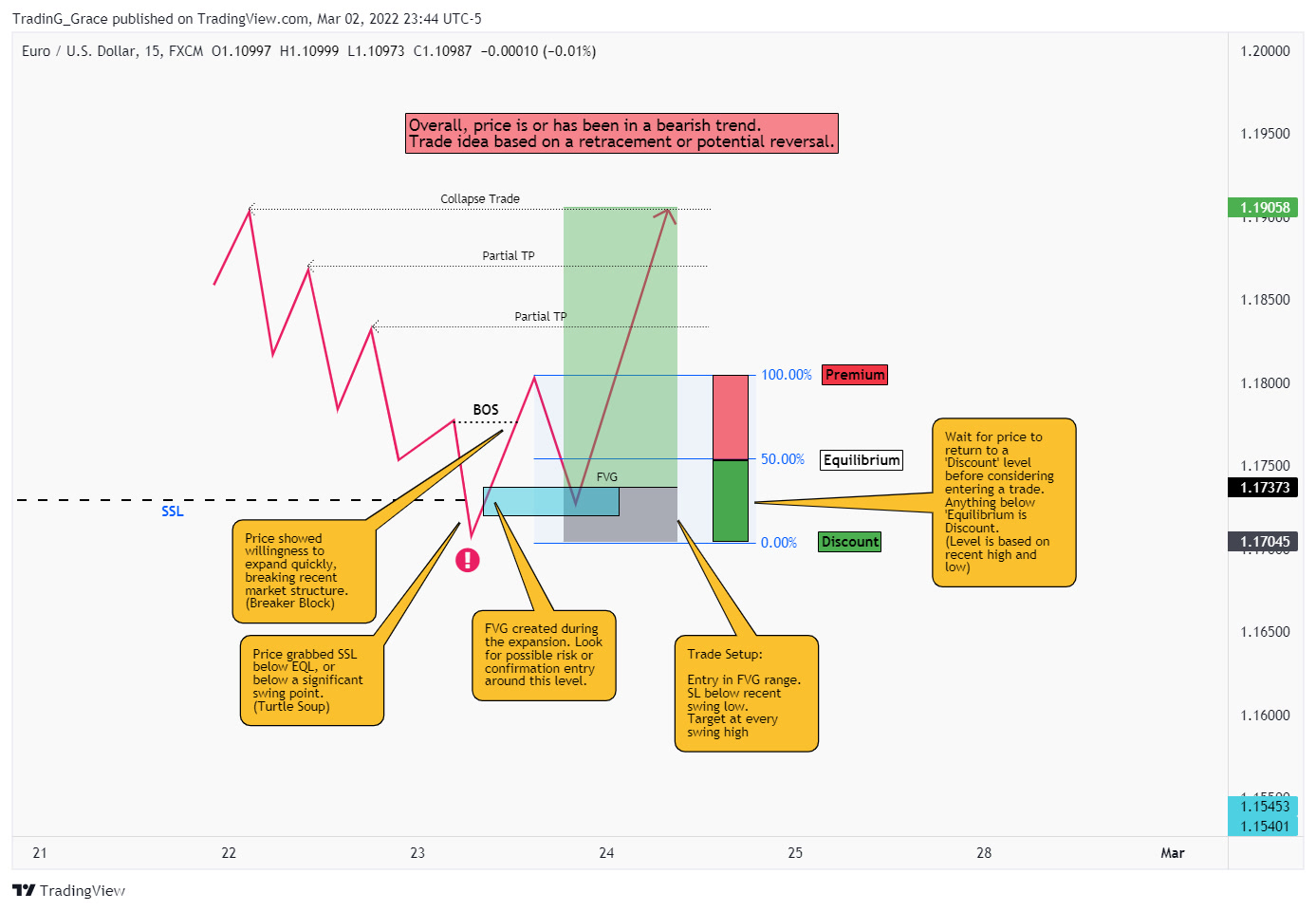
Here's what actually matters on GDP day, and almost nobody in the YouTube ICT community covers it: the pre-release window, roughly 2:30 AM to 8:30 AM Eastern.
During this window, three things often happen:
1. Asian session creates a range. This range isn't random consolidation. It's accumulation. Look at your 15-minute chart, you'll often see a classic turtle soup setup, where price sweeps above or below the Asian high/low, generates a false breakout, then reverses sharply back into the range. That sweep collects retail stops and fills institutional orders in one movement.
2. London session displaces. Between 3:00 AM and 6:00 AM Eastern, price often makes an aggressive displacement away from the Asian range. Most retail traders who are awake interpret this as "the market is moving, I should get in." Wrong. That displacement is positioning, not direction. London often reverses to fill the Fair Value Gap it created before New York opens.
3. The FVG sits there like a loaded spring. When New York opens at 8:00 AM and price pulls back toward that London displacement FVG, that is your institutional fingerprint. That's where smart money defended its position before the data dropped.
I used to get this wrong too, badly. Early in my career I'd see the London displacement and think I missed the move. I'd wait for GDP, then chase the initial reaction like everyone else. It took me years to understand that the FVG left by London displacement on GDP morning is one of the better entries on the macro calendar.
A Worked Example: EURUSD on GDP Morning
Let me make this concrete because abstract explanations don't help you in the moment.
Picture EURUSD on the 15-minute chart on GDP morning. The Asian session builds a clean range. Around the London open, price drops sharply below the Asian low, sweeping the sell stops resting under it and under a prior swing low, then displaces back up and leaves a clean bullish FVG on the 15-minute chart.
Before GDP drops, price retraces into that FVG and prints a bullish displacement candle off it. No news. No catalyst. Just price defending a level before the data.
The entry is in the FVG. The stop goes below the London sweep low, because if price takes that low out again, the whole idea of a stop run before a move higher is wrong. The target is the buy-side liquidity above the Asian high, with a 4-hour inefficiency above that as the extended target.
If the trade is already in profit when the number hits, a "bad" print that dips price briefly doesn't have to matter. The position was built on structure, so the spike is something to manage, not something to guess.
Use a proper risk calculator before sizing into macro events, the volatility expansion post-release can turn a properly sized trade into a margin event if you're not precise going in.
The 'Sell in May' Trap: How Narrative Bias Poisons ICT Traders
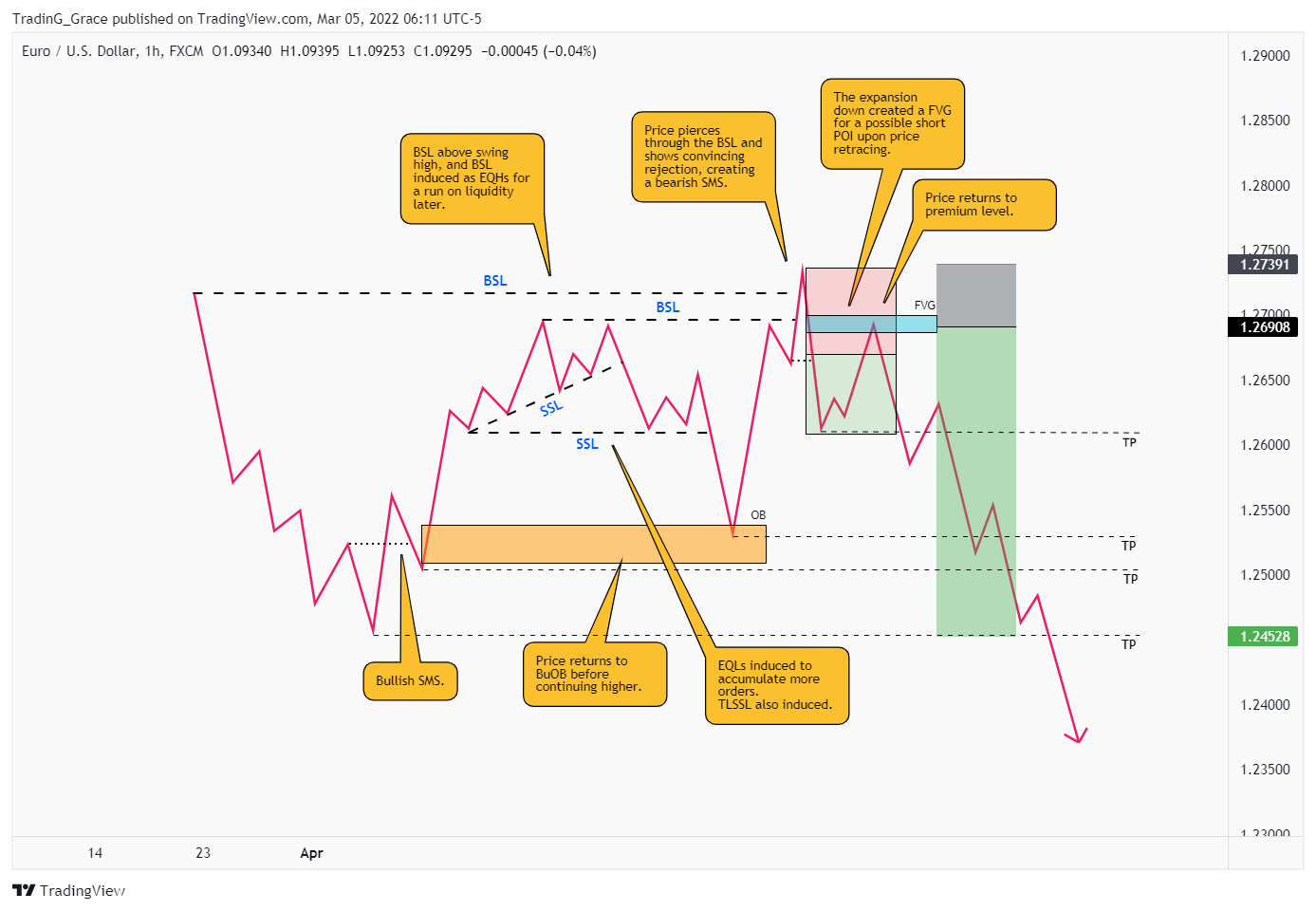
Here's the psychological layer that makes a May GDP release especially dangerous.
Around May, the "Sell in May and go away" narrative is everywhere, financial media, trading forums, social posts. It's a seasonal bias that primes retail traders to interpret any bearish data as confirmation of a trend they've already emotionally committed to.
When GDP comes in below expectations during May, traders who've absorbed the seasonal narrative experience something closer to relief than analysis. See? I knew it was going to drop. The data confirms the trend. That cognitive shortcut bypasses everything the ICT framework actually teaches about premium/discount, institutional order flow, and displacement.
The archetype I see constantly: the trader who has genuinely studied smart money concepts, can draw order blocks correctly, understands FVGs, has read the model inside and out, and then completely abandons all of it the moment a macro number drops that aligns with their existing bias. They chase a 40-pip move that's already 80% complete. They enter in premium because "the momentum is strong." They get stopped out on the retracement that was always likely, and they blame the GDP release instead of the decision to override their own framework.
The framework didn't fail. The narrative hijacked the execution.
This is worth understanding in the broader context of why Q2 2026 market structure shifts are breaking traditional ICT setups, seasonal narratives and macro volatility interact in ways that make psychological discipline more important than ever right now.
The Pre-GDP Framework: Exactly How I Approach It
Here's the step-by-step process, not the theory:
Step 1, Map the Asian range the night before. I literally draw horizontal lines on my 15M chart at the Asian high and low before I go to sleep. GDP days are known in advance. Prepare the chart, not the reaction.
Step 2, Watch London displacement (3:00, 6:00 AM Eastern). Is London sweeping the Asian high or low? Which direction? That displacement against the seasonal/macro narrative is more significant than one that confirms it. Note the displacement, find the FVG it creates.
Step 3, Mark the FVG levels. Specifically the 50% equilibrium of the FVG. This is where institutional defense tends to appear on the retracement.
Step 4, Wait for price to return to FVG before 8:00 AM. If price never returns and runs away from the displacement, there's no trade. Missing a trade is not a loss. Forcing an entry because you prepped is.
Step 5, Entry confirmation. A bullish or bearish displacement candle off the FVG, with a clear break of structure on the 5-minute chart. Not a slow grind, an actual displacement.
Step 6, Size conservatively. GDP releases carry expansion risk. I reduce my standard risk by 25-30% on these days, not because I'm afraid, but because the range expansion post-release can briefly spike through logical stop zones before reversing. That's a different conversation than the trade being wrong.
Step 7, Take partials before the release. If the trade is already 1.5R+ at 8:25 AM, I take at least 50% off. Let the remainder ride the post-release expansion if it aligns. Never let a winner become a full-risk trade into a news event.
For a deeper look at how FVG entries are confirmed in volatile conditions, the ICT Fair Value Gap Trading Checklist is worth going through before your next macro day, 9 specific pre-trade checks that catch the traps most traders miss.
What This Actually Means for Your Trading
GDP day is more readable than it looks. In my view, the post-release spike isn't where consistent traders make their money. The edge is in recognizing that economic data releases are mechanical events within a framework that was already operating hours before the number dropped.
Smart money concepts exist precisely to help retail traders stop playing the game at the table where the deck is stacked, and start reading the fingerprints of where real positioning happened. The pre-release window often leaves those fingerprints. The FVG from London displacement. The Asian range sweep. The quiet defense of an order block at 7:50 AM that nobody on financial TV mentions.
If you want to go deeper on building a complete framework around this, not just GDP but the full macro calendar within an ICT context, the coaching plans at R2F Trading are built specifically for traders who already understand the concepts but keep losing consistency in execution. Lite starts at $150/week, Pro at $250/week, and the Full Mentorship runs $5,000 for 4 months.
Or if you're not sure where you are in the process yet, book a free discovery call and we'll figure it out together.
The number is never the trade. The positioning before the number, that's where the actual story is written.
Harvest Wright
ICT Trading Coach · 10+ Years Experience
Harvest specializes in ICT methodology and has helped traders pass prop firm challenges, develop consistent strategies, and build the psychology needed for long-term profitability.
Book a Free Discovery Call →Master Your Trading Psychology
Psychology is a huge part of trading. Our coaching includes dedicated psychology sessions.
See Coaching PlansFree ICT Funded-Trader Playbook
The setups, the pre-trade checklist, and the risk rules I use. Get it free.