
Why You Can't Trust Your Own Trade Reviews
Most ICT traders I encounter are reviewers. They journal everything, screenshot every trade, colour-code their wins and losses, and spend hours on weekends going back through the week. They are, by any definition, doing the work. And yet the reviews are making things worse.
This is the core problem with an unstructured ICT trading review: it feels productive, looks productive, and produces exactly zero improvement in the decisions that matter.
Key Takeaway: A self-led trade review almost always audits the outcome rather than the decision. That means traders spend months correcting losses that were correct process, and repeating wins that were pure luck. Without a structured framework, the review itself becomes the source of the bias.
Myth, Reality, What I Actually See
Myth: Reviewing every trade builds self-awareness and gradually improves your process.
Reality: Without a structured framework, reviewing every trade builds a selective memory of your process. Outcome bias steps in immediately. A losing trade becomes evidence of patience failure, overtrading, or poor entry timing, regardless of whether any of those things are actually true. A winning trade becomes confirmation that the system works, regardless of whether it should have worked or just got lucky.
What I Actually See: Traders who review obsessively, without structure, entrench bad habits faster than traders who barely review at all. The reason is simple. Every review session that attributes a loss to a fixable personal flaw, when the trade was actually a correctly executed setup that hit stop in a low-probability market condition, trains the brain to second-guess the next correct entry. The trader doesn't exit the review session knowing more. They exit it more fearful, more tinkering-prone, and more convinced that some minor adjustment will fix a problem that didn't exist.
The Outcome Audit Problem in ICT Specifically
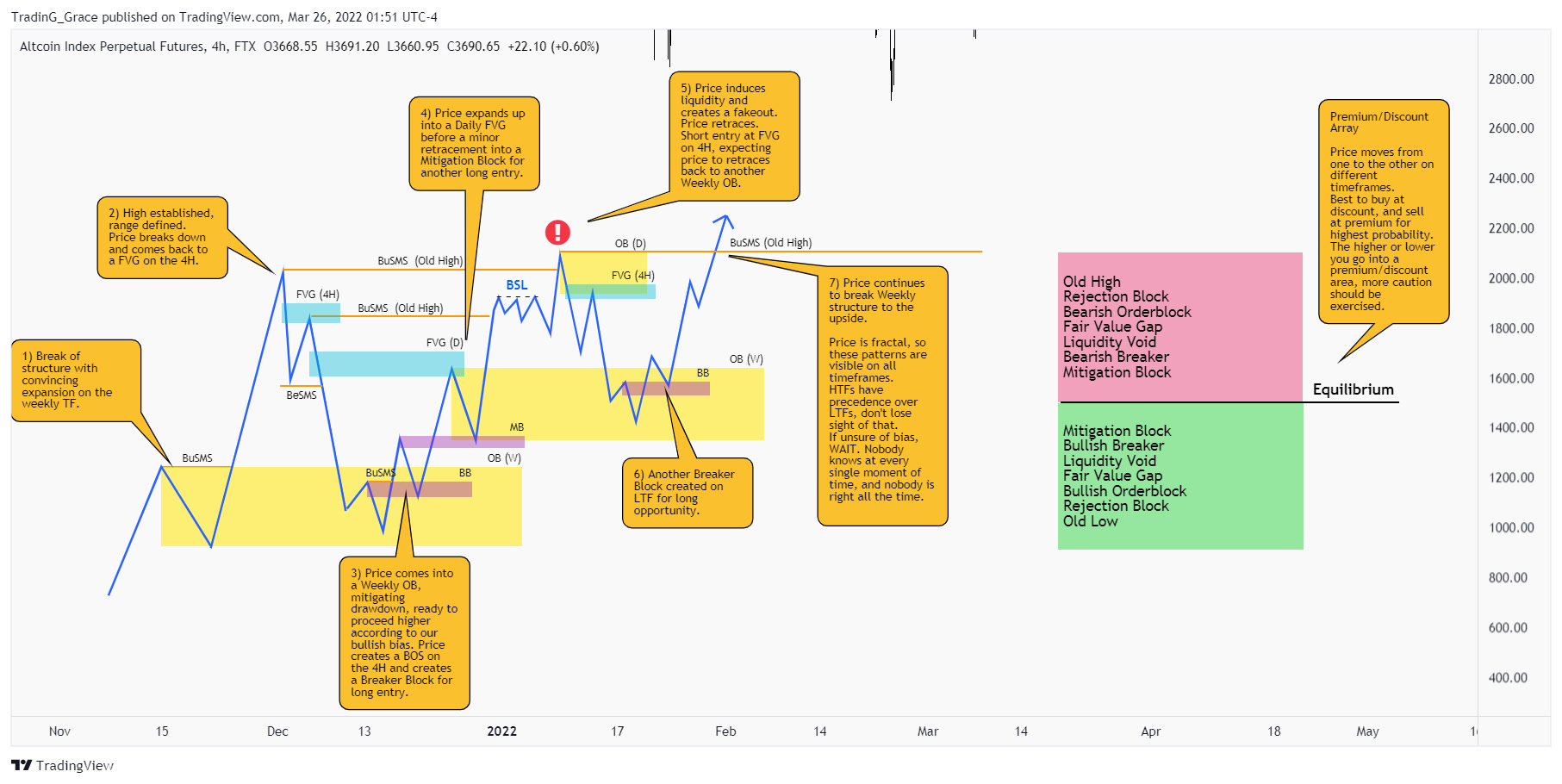
Here's where ICT methodology makes this worse, not better. The concepts are highly specific: order blocks, fair value gaps, market structure shifts, premium and discount arrays, kill zone timing. That specificity creates an illusion of analytical precision during the review. You can always find a reason, in hindsight, why the trade failed. There was an unmitigated FVG two levels up. The order block you entered on was technically a breaker. The liquidity pool above the entry hadn't been swept before price moved.
Hindsight does not make those observations wrong. It makes them useless. Because the question you need to answer after a losing trade is not "what did the chart eventually show me?" It is "at the moment I entered, did I follow my own criteria?"
That distinction sounds simple. It is extraordinarily difficult to apply when you're looking at a completed candle that closed a hundred pips against you.
I used to get this wrong for longer than I'd like to admit. The trade review felt rigorous because I was using legitimate ICT vocabulary to describe what I saw. But I was describing what I saw after the fact, not evaluating what I knew at the time of execution. Those are two completely different cognitive tasks.
The Archetype: The Patient Trader Who Isn't
There's a specific type of trader I see repeatedly in ICT communities. They take a loss on a bearish order block entry during New York open. Price runs to their stop, then reverses exactly where they expected. They sit down to review and conclude: "I was impatient. I should have waited for the retest."
So the following week, they wait for the retest. Price doesn't retest. It runs without them. The next session, they conclude: "I need to be more aggressive on the first touch."
This cycle continues for months. The actual issue, in most cases, isn't patience at all. It's that they're entering in premium on a bullish macro structure, so the "bearish OB" they're trading has a structural reason to fail. But because they never audit the decision ("Was my bias aligned with the higher timeframe structure when I entered?"), they spend all their time auditing the execution timing, which is the wrong variable entirely.
The review process becomes a treadmill. Lots of effort, no distance traveled.
For more on why the mechanics of knowing a setup don't translate to executing it correctly, this piece on why you know the setup but still take the bad trade goes deeper into that gap.
A Worked Example: EURUSD, London Open
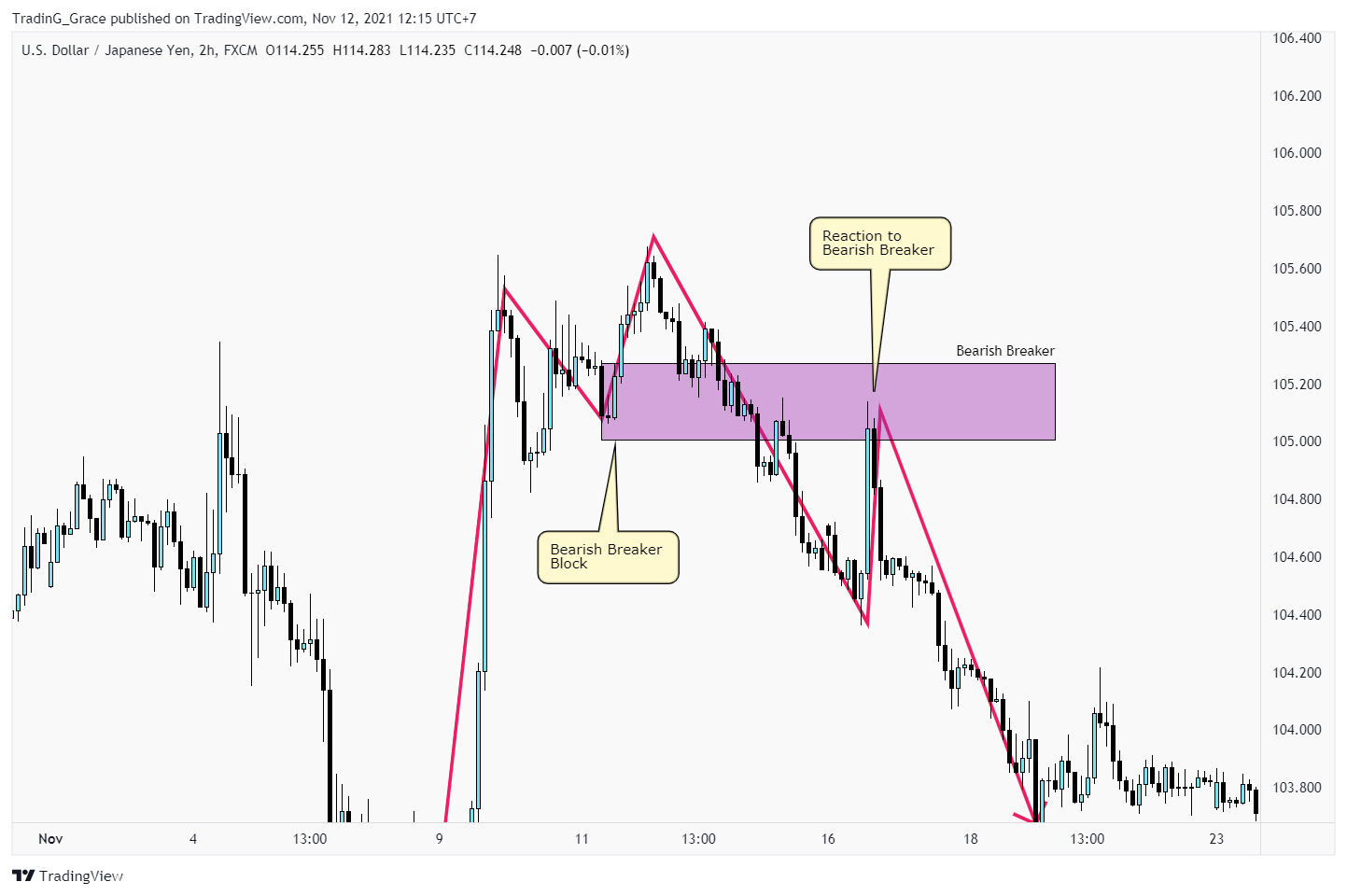
Picture EURUSD on a Tuesday London open. The daily structure is bearish, the previous week's high has been swept, and the 4-hour chart shows a clear internal market structure shift to the downside. On the 15-minute chart, price has retraced into a bearish fair value gap sitting right at the 0.705 Fibonacci level, putting it squarely in premium relative to the most recent 15-minute swing.
The entry reason is the confluence: bearish daily bias, confirmed 4H MSS, 15M FVG in premium, kill zone timing. Stop goes above the FVG and above the most recent 15-minute swing high, because that level, if broken, invalidates the premise that the internal structure is bearish. The target is the sellside liquidity sitting at the previous day's low, which is the logical draw on liquidity given the overall structure.
Now suppose price stops you out by twelve pips before reversing and hitting the target.
A standard self-review produces: "I placed my stop too tight" or "I should have waited for the FVG to be fully mitigated." Both sound reasonable. Both might be wrong.
A structured review asks a different set of questions. Was the daily bias genuinely bearish at entry, or were you forcing bearish confluences on a retracement day? Was the 4H MSS confirmed or just a lower low without a confirmed break of structure? Was the 15M FVG a true inefficiency or a minor imbalance in a choppy range? Was the stop placement above the correct structural level, or did you compress it to hit a round-number position size?
If all four answers check out, the trade was correct process. The outcome was a loss. Those two facts can both be true simultaneously, and a trader who can hold that without adjusting their criteria is a trader whose process will actually improve over time.
This is also why I've written separately about why backtesting never quite transfers to live trading: the gap between knowing your criteria and auditing them honestly under pressure is where most of the real work lives.
The Framework: Decision Audit vs. Outcome Audit
Here is the exact structure I use when reviewing any trade, whether it wins or loses. Four questions, in this order, before you look at anything else.
1. What was the bias, and what confirmed it? Write down, before you look at where price went, what the higher timeframe bias was at the time of entry and what specific price action confirmed it. Not what you believed. What the chart showed. If you can't reconstruct this from memory or your pre-trade notes, that's the finding.
2. Did the entry meet your stated criteria at the moment of execution? Not the criteria you wish you'd used. The criteria written in your playbook. Tick them off one by one. OB or FVG: present or not? Kill zone: active or not? Structure alignment: confirmed or assumed? Premium/discount: checked or ignored?
3. Was the stop at the correct structural invalidation level? This is separate from whether the stop was hit. The question is whether the stop was placed where the trade idea would be structurally wrong, or whether it was placed where your risk tolerance happened to sit that day. These are not the same level. If your stop was dictated by a dollar amount rather than structure, flag it.
4. What was the realistic draw on liquidity for the target? Not "where did I think price could go" but "where was the identifiable pool of resting orders that price had a structural reason to seek?" If you can't name a specific liquidity level at the time of entry, the target was a guess.
Only after answering all four do you look at how the trade resolved and whether the outcome matched the process quality. A high-quality process that lost is a different category from a poor-quality process that won. Treating them the same is how traders stay stuck.
For position sizing within this framework, the risk calculator on this site makes it straightforward to separate the stop placement decision from the sizing decision, which is worth doing explicitly.
The Contrarian Take: Winning Trades Are the Real Threat
Everyone knows losing trades need reviewing. The insight most traders miss is that winning trades with poor process are far more dangerous than losing trades with good process.
A correctly-processed loss teaches you nothing needs to change. A lucky win teaches your subconscious that the shortcut works. Over time, the lucky wins accumulate into a mental model that is subtly wrong but emotionally validated, and it holds together until market conditions shift and the shortcut stops working at exactly the moment the trader has the most confidence in it.
This is the pattern behind what looks like sudden account blowups in traders who were "doing well." The doing well was built partly on process and partly on correlation with a trending market, and the review process never separated the two because winning trades didn't get scrutinised the same way losing ones did.
For a related angle, the piece on FVGs working in backtests but not live covers how this selective confirmation plays out specifically with ICT setups across different market conditions.
Fixing the Review Before the Next Trade
If you want your ICT trading review process to actually build skill rather than entrench bias, the change is structural, not motivational. You don't need to review more. You need to review differently.
Keep a pre-trade note, even a brief one, that records your bias, your entry criteria checklist, your stop level and the structural reason for it, and the liquidity draw for your target. This note is written before you enter. The review, when you do it, measures the executed trade against that note, not against the outcome.
If you didn't write a pre-trade note, the trade is unreviable. That's the finding. Log it as "unstructured entry" and don't try to learn process lessons from it.
This shift, from outcome audit to decision audit, is what separates traders who improve over years from traders who review obsessively and stay at the same level. If you want a structured framework built around your specific ICT approach, the coaching plans on this site offer different levels of support depending on where you are in that process. If you're not sure which fits, a free discovery call is the logical first step.
The review is not the problem. Reviewing the wrong thing is.
Harvest Wright
ICT Trading Coach · 10+ Years Experience
Harvest specializes in ICT methodology and has helped traders pass prop firm challenges, develop consistent strategies, and build the psychology needed for long-term profitability.
Book a Free Discovery Call →Master Your Trading Psychology
Psychology is a huge part of trading. Our coaching includes dedicated psychology sessions.
See Coaching PlansFree ICT Funded-Trader Playbook
The setups, the pre-trade checklist, and the risk rules I use. Get it free.