
Can a Trading Coach Make You Profitable?
People type "can a trading coach make you profitable" into Google because they want permission. Permission to spend the money. Permission to believe someone out there has the shortcut. After more than a decade of trading, earning a TradingView Editors' Pick, and passing an FTMO Challenge, here is my honest answer: no. A coach cannot make you profitable. But that framing misses what coaching actually does, and why the distinction matters enormously for your account.
Key Takeaway: No coach can make you profitable. Profitability requires screen time and discipline that only you can provide. What a good coach does is compress your feedback loop, identify the specific errors bleeding your account, and stop you from repeating the same expensive mistakes for another 18 months.
Can a Trading Coach Make You Profitable? The Honest Disqualifier
Any coach who answers "yes" to this question has just told you everything you need to know about them. Walk away.
Profitability in trading requires two things that are completely non-transferable: repetition and discipline. You cannot outsource the hundreds of hours of screen time it takes to build genuine pattern recognition. You cannot pay someone else to sit on their hands when your setup isn't there. A coach who implies otherwise is either deluded or selling something, and neither version deserves your money.
Here is the contrarian take that most ICT content creators miss, though: the traders who are convinced they just need the "right system" are not wrong because they believe in systems. They are wrong because they assume the system is the hard part. It isn't. Execution under pressure, against your own psychology, in live market conditions with real money on the line, that is the hard part. A coach accelerates your reckoning with that reality. They do not replace it.
I used to get this wrong too. Early in my trading, I thought buying a course, getting access to a mentor's private group, or landing a review call would flip a switch. It did not. What it did do, eventually, was force me to confront the specific, repeatable mistakes I kept making, faster than I would have found them alone.
What Coaching Actually Compresses
Think of your trading development as a feedback loop. You place a trade, something happens, you try to extract a lesson, you adjust, you place another trade. Without coaching, that loop takes weeks per iteration, because most traders journal poorly, analyze selectively, and have no one to challenge their rationalizations.
A competent coach tightens that loop dramatically. Here is specifically what changes:
1. Pattern identification across your trades, not just individual ones. You see your last trade. A coach sees your last 60 trades and spots that you keep entering GBPUSD shorts at equilibrium instead of discount, which is why your OBs keep failing. That perspective gap is worth months of solo trial and error.
2. Real-time framework correction before bad habits calcify. Bad execution habits at 6 months are fixable. The same habits at 3 years are nearly structural. Catching them early is where coaching delivers disproportionate value.
3. Emotional accountability that journaling alone cannot provide. Telling yourself you overtrade during news is different from explaining it to someone who will ask you the same question next week.
For a deeper look at how execution mistakes compound over time, my article on 7 fatal mistakes that kill your funded account challenge success breaks down the patterns that recur most often.
A Worked Example: What a Coaching Lens Changes
Let me make this concrete instead of theoretical.
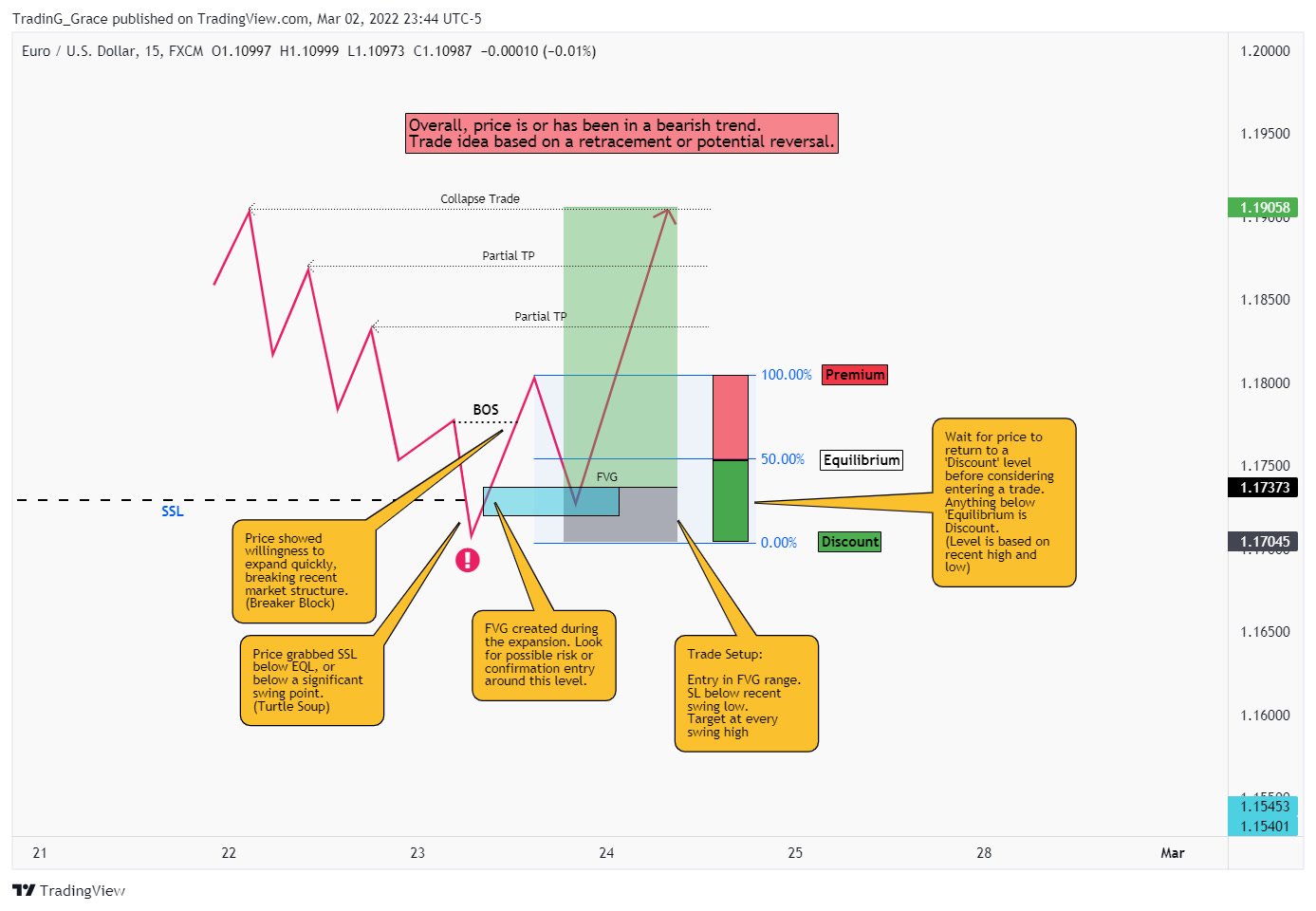
Picture GBPUSD on the 15-minute chart. The London open prints a clean displacement candle to the upside. Price returns into the Fair Value Gap left by that displacement, with the FVG sitting squarely in discount relative to the overnight range. The last bearish candle before the displacement marks a bullish order block, adding confluence.
Entry: inside the FVG. Stop: just below the OB low and the FVG, because if price trades through the order block, the bullish idea is invalid. Target: the buy-side liquidity resting above the Asian high. Take a partial on the way, move the stop to breakeven, and let the rest run toward the target.
Now here is what the coaching lens changes. A common mistake is entering that same setup a full session earlier, when price first touches the OB on the 1-hour chart, without waiting for the 15-minute displacement to confirm direction. That entry sits higher, in premium, with a stop that is structurally too tight, and it can get stopped out before the actual move happens.
The lesson: displacement is the permission slip, not the order block. A lot of traders using ICT concepts are marking up OBs and FVGs correctly but entering before market structure confirms the intent. They draw the right levels and then trade them like price action support and resistance instead of liquidity delivery mechanisms.
The Trader Archetype That Wastes the Most Coaching Money
There is a specific trader profile I see consistently in trading communities, on forums, in comment sections: the trader who buys coaching before they have a base model to refine.
This person has watched 40 hours of ICT content, understands the vocabulary, can identify FVGs and OBs on a chart in hindsight, but has no defined model. No specific session they trade. No specific pair. No written rules for what constitutes a valid entry versus an invalid one. They want coaching to hand them that model.
Coaching cannot do that efficiently. A coach can help you refine a flawed model. Refining something that does not exist yet is not coaching, it is just building the model for you, which means you have not internalized it, which means you cannot execute it under pressure.
If you do not yet have a model you can write down in under 10 bullet points, start with structured education before you spend money on live coaching. The crash course on this site exists specifically for that stage of development.
For context on how shifting market structure can break setups that used to work, this piece on why Q2 2026 market structure shifts are breaking traditional ICT setups is worth reading before you decide what you need refined.
The 4 Questions to Ask Any Coach Before Paying
If you are evaluating coaching programs, including ours, run every candidate through these:
1. Can you show me a verified track record, not a curated screenshot gallery? Prop firm payouts with timestamps, live account statements, competition results. Anyone can screenshot winning trades. Context matters.
2. What is your process for identifying what specifically is wrong with my trading? If the answer is vague ("we'll review your trades together"), push harder. A systematic coach has a diagnostic framework.
3. What does a trader who is not ready for your coaching look like? A coach with standards will describe this clearly. One without standards will say everyone is welcome.
4. What does success look like at the end of this engagement, and how will we measure it? Not "you'll be profitable." Something specific: a defined edge with positive expectancy over 50 trades, a funded account passed, a drawdown ceiling maintained for 90 days.
If you're weighing ours, the coaching plans at R2F are Lite at $150/week, Pro at $250/week, and Full Mentorship at $5,000 for four months, depending on where you are in your development and how much direct access and accountability you need.
What Stays On You, Always
Screen time is not negotiable. There is no coaching program, at any price point, that substitutes for sitting in front of charts during London open, logging trades, reviewing recordings, and building genuine pattern recognition through repetition.
Discipline is not a trait some traders have and others lack. It is a system. A coach can help you build the system: defined risk parameters, a position sizing framework you actually use, rules for when you are not allowed to trade. But following the system when your account is down 3% on a Tuesday and you are convinced the next setup will fix everything, that is entirely yours to manage.
For a realistic view of what funded trading actually demands before you factor any coaching costs in, the truth about funded trading covers the parts most educators gloss over.
You can also read what past clients say about working with me.
The Honest Summary
Can a trading coach make you profitable? No. Profitability is a product of your screen time, your discipline, your risk management, and your psychological responses under pressure. None of those are transferable.
What a coach can do: compress your feedback loop, so long stretches of expensive guessing turn into shorter stretches of targeted refinement. Identify the specific, repeatable errors that are bleeding your account. Create accountability structures that make it harder to break your own rules. And give you a perspective on your trading that you structurally cannot have on your own, because you are too close to it.
That is worth paying for. Just not from someone who promises the outcome instead of the process.
If you want to find out whether coaching makes sense for your current stage of development, book a free discovery call and we will give you a straight answer, even if that answer is "not yet."
Harvest Wright
ICT Trading Coach · 10+ Years Experience
Harvest specializes in ICT methodology and has helped traders pass prop firm challenges, develop consistent strategies, and build the psychology needed for long-term profitability.
Book a Free Discovery Call →Ready to Get Funded?
1-on-1 ICT coaching built around prop firm rules, from a trader who has passed an FTMO Challenge.
Book a Free Discovery CallFree ICT Funded-Trader Playbook
The setups, the pre-trade checklist, and the risk rules I use. Get it free.