
Why Knowing ICT Concepts Isn't Making You Money
You can define a bearish order block, explain the mechanics of a fair value gap, and walk someone through a liquidity sweep on a Tuesday morning YouTube comment, and still blow a $50,000 funded account by Friday afternoon. It's a sequence I see a lot. Not because the methodology is flawed. Not because ICT trading doesn't work. But because there is a dangerous, largely unacknowledged gap between knowing a concept and being able to execute it under real pressure, with real money, in real time.
Key Takeaway: Most ICT traders aren't stuck because they lack knowledge, they're stuck because their brain has convinced them that fluent explanation equals readiness to execute. It doesn't. Conceptual fluency and execution-level competence are two completely different skills, and the only way across that gap is deliberate, accountable screen repetition on a single setup, not more content consumption.
The Brain Lie That's Keeping You Broke
Here's the cognitive trap nobody in the ICT trading space talks about honestly: your brain treats smooth explanation of a concept as evidence of mastery.
Psychologists call this the "fluency illusion", the feeling that because something is easy to recall or articulate, you must be good at applying it. When you can replay an ICT concept fluently in your head, it feels like competence. It feels like you're ready. But recalling something and applying it are different things. One is memory. The other is skill.
Trading exposes the difference brutally.
In a YouTube comment, you're not managing a 0.75% position sizing decision while price sweeps your stop by 3 pips before reversing. You're not staring at a 15-minute candle at 3:47 AM London open wondering if this displacement is genuine or a trap. There's no adrenaline. No self-doubt. No second-guessing whether the HTF bias you marked on Sunday is still valid after Wednesday's CPI data.
Explaining ICT trading is easy. Executing it is a completely separate discipline.
Myth, Reality, and What I Actually See
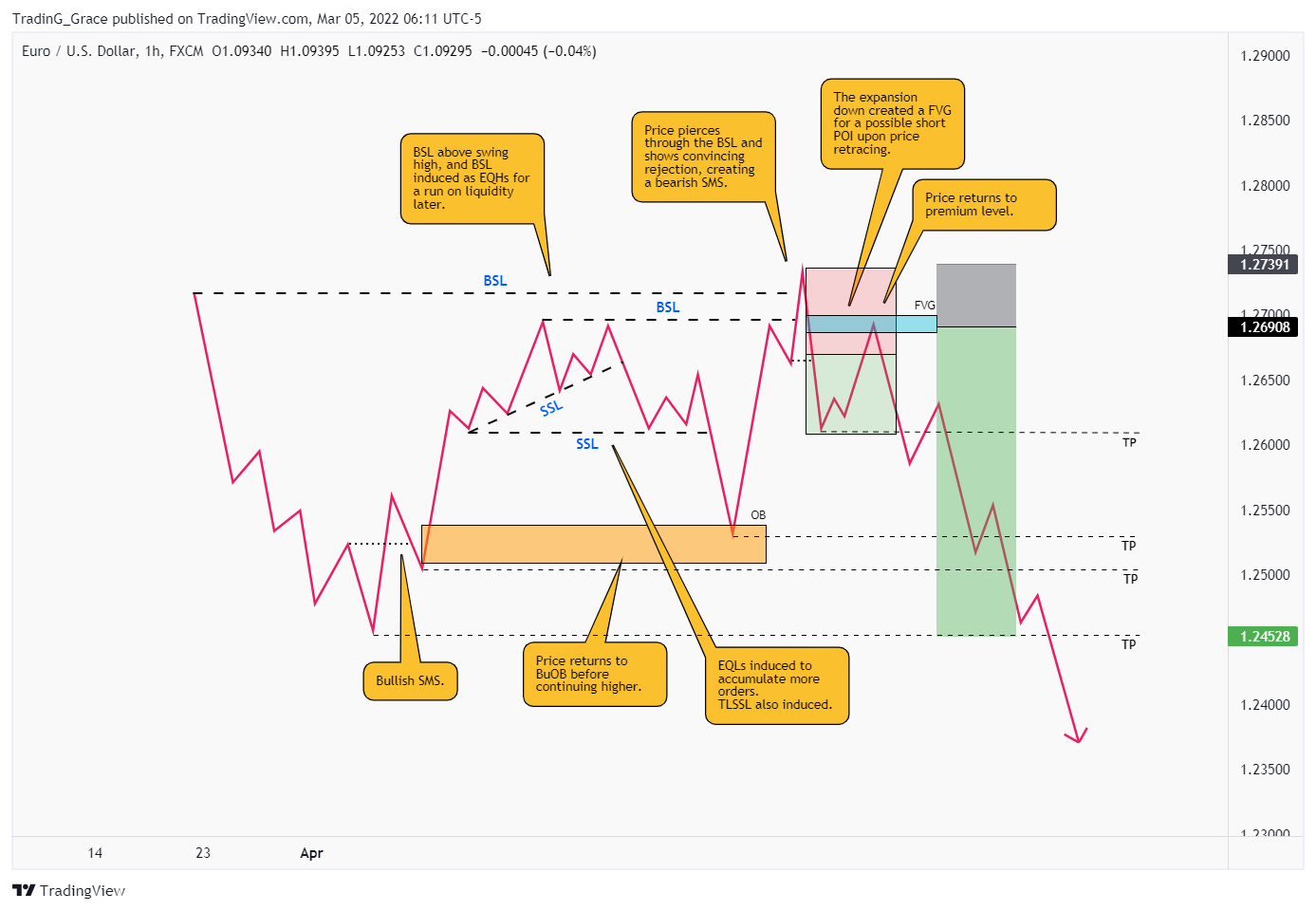
Myth: "I just need to study more setups and watch more market replays before I'm ready to go live."
Reality: More studying, without structured, accountable execution practice, only deepens the fluency illusion. Every hour spent watching someone else's analysis reinforces the feeling of competence without testing it. At a certain point, additional conceptual input has a negative return. You stop learning. You just get more confident in knowledge you haven't actually earned the right to use.
What I Actually See: Traders who've been studying ICT for 18 to 24 months, who can name and draw every PD array from memory, who have notebooks full of annotated setups, and who are more paralyzed in live markets than someone who started three months ago. Why? Because they've accumulated so much conceptual knowledge that now every setup has a competing interpretation. They've studied themselves into analysis paralysis. The person who started three months ago doesn't have that problem yet. They're just executing what little they know. Sometimes badly. But they're executing.
Knowledge without repetition builds doubt, not confidence.
The Archetype I Keep Seeing in 2026
There's a specific trader pattern I've watched repeat throughout this year, someone I'd call the Permanent Researcher.
They follow every major ICT account. They've watched the original ICT content archives multiple times. They can tell you which session produces the cleanest order flow, which pairs behave most consistently with displacement-based FVG entries, and why the Asian range matters for London targeting. They've built a beautiful multi-timeframe top-down analysis template in TradingView.
And they haven't had a green week in four months.
When you look at their trade log, assuming they even keep one, the entries are scattered across six different pairs, three different timeframes, and at least four variations of ICT setups. Every week there's a new "I'm focusing on this" declaration. Every blowup is followed by more research, not more disciplined practice.
The studying isn't a preparation strategy. It's an avoidance strategy. Subconscious, mostly. Studying feels like progress. Every new video watched, every new concept understood, every new annotation on a chart, it feels like a small reward. Progress-feeling without the pain of being held accountable to actual results.
Live trading doesn't give you that. Live trading just shows you who you are.
A Worked Example of the Gap
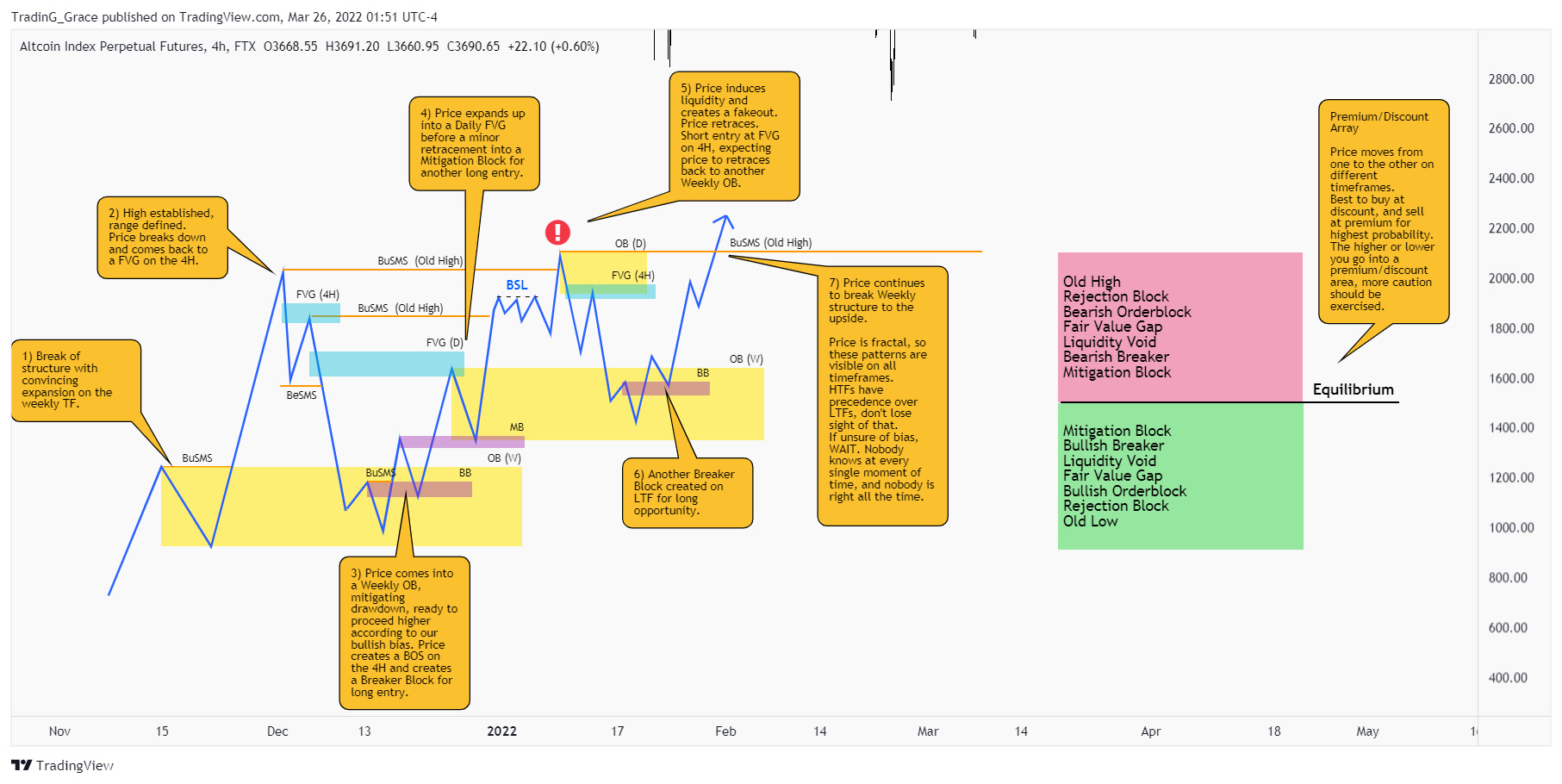
Here's the kind of setup I mean. Picture GBPUSD on the 15-minute chart. The London open displaces aggressively to the upside off the Asian range low, leaving a clean three-candle FVG. The HTF bias is bullish: the daily swept equal lows the previous week and closed strong. The entry is a retracement into that FVG, within a discount of the daily range. Textbook.
The stop goes below the Asian range low, because that's the low the move launched from. If price takes it out, the displacement has failed. The target is the next obvious buy-side liquidity above, such as the prior daily swing high. (If you want to size your own positions precisely for a setup like this, the risk calculator on this site makes it quick.)
Now, could you explain that entire entry rationale before taking the trade? Probably, perfectly. But here's what the explanation doesn't capture: the confidence to hold through a small wiggle against you comes from reps with that exact setup. When the pattern recognition is baked in deep enough, a wiggle stops feeling like the trade failing. It just feels normal.
Someone who knows that setup but has only taken it five times? That wiggle feels like death. They close early for a fraction of the move and then watch it run to target. Sound familiar?
The Framework That Actually Fixes This
Stop adding concepts. Start drilling execution on one setup until it's automatic.
Here's exactly how I'd structure this:
Week 1 to 2: Setup selection. Pick one ICT trading setup. One. I'd suggest London open FVG entry on a major pair like GBPUSD or EURUSD on the 15-minute chart, it has clear session timing, measurable displacement criteria, and defined invalidation. Write out your checklist: HTF bias confirmed? Displacement present? FVG formed within discount of the HTF range? No competing OB directly above the entry?
Week 3 to 6: 20-trade demo block. Take exactly 20 trades on that single setup. Not 20 trades total across all setups, 20 qualifying instances of this specific setup. Log each one. Not just the outcome, log your emotional state during, whether you followed the checklist 100%, and whether you closed early or moved your stop. This is where the real data lives. You can also check our ICT FVG trading checklist for a solid nine-point pre-trade confirmation framework to build from.
Week 7 to 10: Micro-live execution. Move to live with the smallest possible position size, we're talking $1 to $2 risk per trade. Not because the money matters, but because live markets feel different. That micro-stress is real. Your hands move differently. Your breathing changes. You need to normalize that physiological response on tiny risk before it becomes meaningful risk.
Week 11+: Scale once the behavior is consistent, not once the P&L looks good. This distinction matters enormously. P&L in 20 trades is mostly noise. Behavior, did you follow your checklist every single time, did you honor your stop every single time, that's signal.
If you try to shortcut any stage of this, you're back in the fluency illusion. You're studying again.
The Uncomfortable Truth About "Watching More Charts"
I used to fall into this trap myself. Early on, I genuinely believed that if I just watched enough price action, enough replays, enough live sessions, the pattern recognition would transfer automatically into execution skill. It didn't. I was accumulating observation experience, which is completely different from decision-making experience.
Observation is passive. You're watching. The stakes are zero. There's no cost to being wrong about what you would have done.
Decision-making under uncertainty, with real consequences, is what actually builds the skill. That's not a motivational statement, it's just how the brain forms procedural competence. The same way you can watch a thousand hours of someone riding a bike and still wobble the first time you actually sit on one.
The ICT trading concepts are not the problem. They're genuinely powerful when applied correctly, and if you want to see how they hold up during real market conditions in 2026, including the structural shifts we've been navigating this quarter, this breakdown on Q2 market structure is worth your time.
The problem is the gap between knowing them and being able to access them under pressure, consistently, with discipline, and that gap only closes one way.
What Separates Traders Who Break Through
In my view, traders who go from chronic losing to consistent results tend to share one behavioral shift: they stopped adding information and started logging behavior.
Not just trades. Behavior. The emotional state before entry, the impulse to move the stop, the urge to revenge trade after a loss, the moment they closed a 0.9R winner early because it "felt like it was going to reverse."
That behavioral log is more valuable than any additional concept you could learn. Because your problem isn't your knowledge base. It's often one of three specific execution failures: entering before confirmation, closing early due to discomfort, or abandoning the setup the moment it doesn't work within the first five tries.
None of those problems are solved by watching another breakdown video. They're solved by reps, accountability, and honest self-examination.
If you're genuinely ready to close that gap rather than study your way around it, the coaching plans here are built specifically for that transition, not to teach you more ICT theory, but to create the structured execution environment that actually forces the skill to develop. You can also book a free discovery call if you want to figure out which level makes sense for where you are right now.
But first, close the YouTube tab. Open a chart. Pick one setup. Take it 20 times. That's the work.
Harvest Wright
ICT Trading Coach · 10+ Years Experience
Harvest specializes in ICT methodology and has helped traders pass prop firm challenges, develop consistent strategies, and build the psychology needed for long-term profitability.
Book a Free Discovery Call →Master Your Trading Psychology
Psychology is a huge part of trading. Our coaching includes dedicated psychology sessions.
See Coaching PlansFree ICT Funded-Trader Playbook
The setups, the pre-trade checklist, and the risk rules I use. Get it free.