
Why Knowing ICT Perfectly Won't Make You Profitable
Here's a story I hear a lot, and it almost never changes. A trader is frustrated, sometimes angry. They've watched hundreds of hours of ICT content. They can define a Fair Value Gap, map premium and discount arrays, identify the killzone, talk about liquidity pools with confidence. And they're still losing. Still blowing challenges. Still watching their funded account drain toward the breach line. The gap, they assume, must be in their ICT trading knowledge. So they go back to studying.
That's the trap.
Key Takeaway: Deep ICT knowledge and profitable ICT execution are not the same skill, and the psychological mechanism that separates them, what I call the competence-confidence mismatch, is something more study will never fix. Understanding this distinction is the actual edge most struggling traders are missing.
The Myth That's Costing You Funded Accounts
Myth: If I just understand ICT trading well enough, I'll execute it correctly.
Reality: Conceptual mastery and real-time execution under risk are different skills. One is declarative memory, the part that lets you recall and recite. The other is procedural memory under stress, the part that has to work when real money is on the line, your heart rate spikes, and you have seconds to make a decision. Studying sharpens the first. It does almost nothing for the second.
What I Actually See: Traders who can pass any ICT quiz you put in front of them, and then override their stop loss on a live trade because "the displacement looks real, the draw on liquidity is clear, price just needs a bit more room." They're not ignorant. They're dangerously fluent. That fluency is exactly why they keep overriding the plan.
This is the part nobody talks about.
The Competence-Confidence Mismatch
I used to think this was a discipline problem. I'd see traders who clearly understood the methodology make decisions that defied everything they could explain about it. Override stops. Revenge trade after a loss. Size up on a setup they "really believed in." And I'd chalk it up to emotional weakness or lack of discipline.
I was wrong. It's more specific than that, and it's more structural.
When you develop deep competence in something, genuine, hard-earned understanding, your brain starts generating very confident internal signals. I see what price is doing. I know where the liquidity is. I understand this. And that confidence feels like permission. Permission to trust your real-time read over your pre-planned rules. Permission to stay in a trade because your analysis says it should work. Permission to take revenge on a loss because you know you were right about the setup, just early.
The cruel irony: the more you study ICT trading, the more sophisticated your justifications become when you break your rules. A trader with six months of screen time says, "I don't know, it didn't look right." A trader with two years of deep ICT study says, "Price swept the SSL at 1.0821, there was a clear displacement candle leaving a FVG, the OB at 1.0847 is sitting at the 62% of the range which aligns with a premium array, and I have confluence with the 4H MSB, this trade has to work." Both traders are about to blow their stop. The second one has a better story.
More knowledge. More convincing self-deception. Worse outcome.
A Worked Example
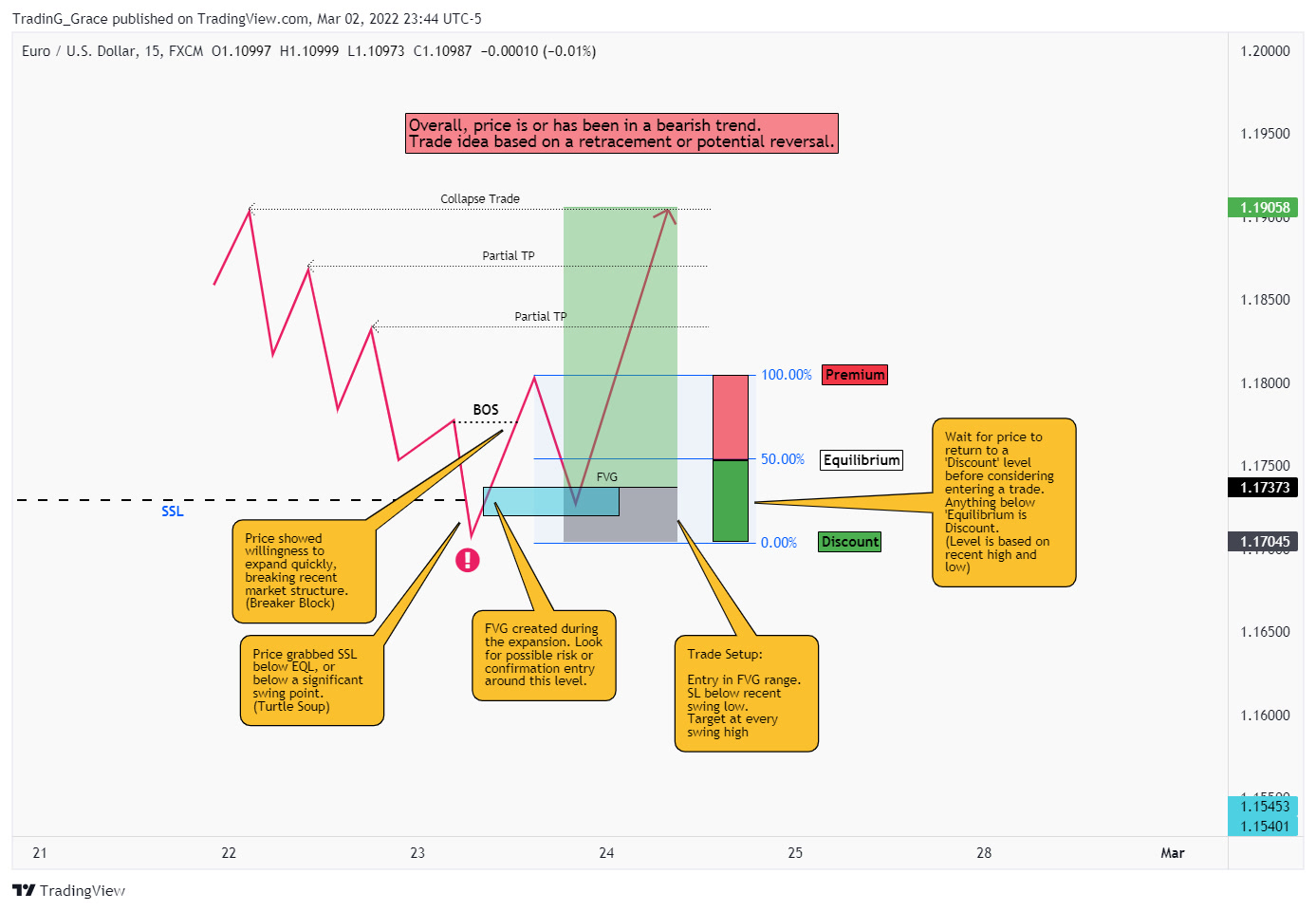
Here's the kind of setup I mean. Picture GBPUSD on the 15-minute chart around the London open.
Price sweeps the Asian session low and prints a clean displacement candle with a textbook FVG. The 4-hour structure is bullish. Everything aligns. You mark the entry zone, set an alert, and plan the trade: entry on the return to the FVG, stop below the swept low (if price takes that low again, the sweep has failed), target the next obvious buy-side liquidity above.
Price returns to the zone and you enter.
Then price pushes a few pips lower, below the FVG but still above your stop. This is where it gets real. A wick below a FVG doesn't automatically invalidate it, and the stop is below the swept low for a reason. Your analysis says hold. You mapped this correctly. This is just a stop hunt before the run.
The outcome of the trade isn't the lesson. The lesson is those few minutes between the wick and whatever comes next. Every second feels like the trade is failing. Your knowledge starts giving you reasons to override your stop and "give it more room", which means sizing incorrectly and breaking the risk structure entirely. The plan says the stop stays where it is. Let the plan win. Trust the plan over your knowledge.
That distinction is everything.
The Archetype I See Breaking Funded Accounts
There's a specific trader pattern that shows up constantly in the ICT community. Call them the fluent over-analyser. This trader has absorbed more ICT content than most people will ever consume. They post clean charts. Their markup is precise. In a Discord breakdown, they're impressive.
But in live trading, they can't stop thinking. Every tick is a new data point feeding a new micro-analysis. Price moves against them two pips and they're already building a case for why their original bias was wrong, or equally, why it's definitely right and they should add. They're not impulsive in the traditional sense. They're over-analytically impulsive, which looks totally different but produces identical account damage.
The root cause: they're treating live trading like a study session. More information in, better decision out. That's how learning works. That's not how execution works.
If you recognise yourself in this, and plenty of people will, I'd also recommend reading why your ICT order blocks keep failing in ranging markets, because over-analysis gets amplified catastrophically in choppy, low-momentum conditions.
The Framework: Separating Understanding from Execution
Here's what actually bridges the gap. Not more study. Not more backtesting in isolation. A deliberate practice structure that builds procedural memory, the kind that holds under pressure.
Step 1: Pre-session rules, written, non-negotiable. Before you open a chart for the live session, write your rules for that day. Not concepts, rules. Specific. Operational. "I will only take setups in the first 30 minutes of London or New York killzone. Entry only on return to a confirmed FVG after displacement. Stop is always below the swept low. No adjustments in-trade. Maximum two trades." This is your plan. Your analysis is done. The live session is execution only.
Step 2: Treat in-trade analysis as a red flag, not a signal. If you find yourself building a new case for why price should do something while you're in a trade, that's your cue to do nothing. The time for analysis was before entry. In-trade thinking is almost always rationalization in disguise, your emotional state generating intellectual-sounding reasons to act.
Step 3: Use a risk calculator before every trade, every time. This sounds mechanical because it is. Doing the math manually, position size, pip value, percentage risked, forces a brief pause between intention and action. That pause is where impulsive entries die. Make it a physical ritual.
Step 4: Journal the decision, not just the trade. After each trade, write one sentence: "I followed my plan" or "I deviated from my plan." That's the only metric that matters for the first 90 days of this process. Win rate, R-multiple, accuracy, those come later. Right now, you're building a different skill entirely.
For anyone wanting a deeper look at how Q2 2026 market structure specifically affects ICT execution, this piece on Q2 2026 market structure shifts is worth your time, because the environments where this execution breakdown shows up most destructively are exactly the ones we've been navigating lately.
What the 10-Year View Actually Looks Like
After 10+ years of trading, the pattern looks consistent to me. The traders who last are rarely the most knowledgeable. They're the ones who made peace with a simpler truth: your job in a live trade is not to be smart. Your job is to execute a plan that a smarter, calmer version of you built before the session started.
The knowledge was never the edge. The plan is the edge. Your discipline in following it is the edge.
Study to build your plan. Then trust your plan over your knowledge. That's the entire game.
If this resonates and you want to understand specifically where your execution is breaking down, not generically, but in your actual charts and trade history, the coaching plans on this site are built around exactly this problem. The Full Mentorship is the deepest level of that work, but even the Lite tier is structured around execution habits, not more concept delivery. If you're not sure where to start, book a free discovery call and we'll figure out what's actually costing you.
And if you're in the middle of a funded account challenge right now, read this before you trade tomorrow: 7 fatal mistakes that kill your funded account challenge success. Several of the mistakes on that list are direct consequences of exactly the competence-confidence mismatch we've been talking about here.
Harvest Wright
ICT Trading Coach · 10+ Years Experience
Harvest specializes in ICT methodology and has helped traders pass prop firm challenges, develop consistent strategies, and build the psychology needed for long-term profitability.
Book a Free Discovery Call →Ready to Get Funded?
Our students pass prop firm challenges in under 60 days with personalized ICT coaching.
Book a Free Discovery CallFree ICT Funded-Trader Playbook
The setups, the pre-trade checklist, and the risk rules I use. Get it free.