
Your Trading Journal Is Lying to You
After ten years of watching traders fail, and failing myself in ways I'm still honest about, I can tell you exactly what a losing trader's trading journal looks like.
It's detailed. It's colour-coded. It has screenshots. It has R-multiples calculated to two decimal places. And it is completely, systematically useless.
Key Takeaway: The standard trading journal captures what you traded but buries why you really entered, and that "why" almost always has nothing to do with the setup. Until your journal documents emotional state before the trade decision, it's just a highlight reel that makes you feel productive while your account bleeds.
The Myth Everyone Teaches (And Why It's Backwards)
Myth: A good trading journal documents your entry, your stop, your target, the setup type, and the outcome. Review it weekly, find patterns, fix the pattern.
Reality: That process only works if bad trades come from bad technical decisions. In my experience they often don't. The losing trade that blows a weekly drawdown limit is often not a technical error. The entry is at a valid Fair Value Gap. The stop is placed correctly below the Order Block. The session timing is right.
What was wrong happened 90 seconds before the click.
What I Actually See: A trader who had a winning week, gave back 60% of it on Friday, logged the Friday trade as "entered FVG, price reversed, stopped out, need to work on entry timing" and moved on. The actual cause, overconfidence from a big Thursday, a position sized at 2% instead of their usual 0.75%, entered during a dead zone with no London overlap, never touched the journal page. Because the journal template they downloaded from YouTube doesn't have a field for "I was trying to recapture the high from yesterday and I knew it when I clicked buy."
That's the lie. Not intentional. Just structural.
The Real Pattern Behind Blown Accounts
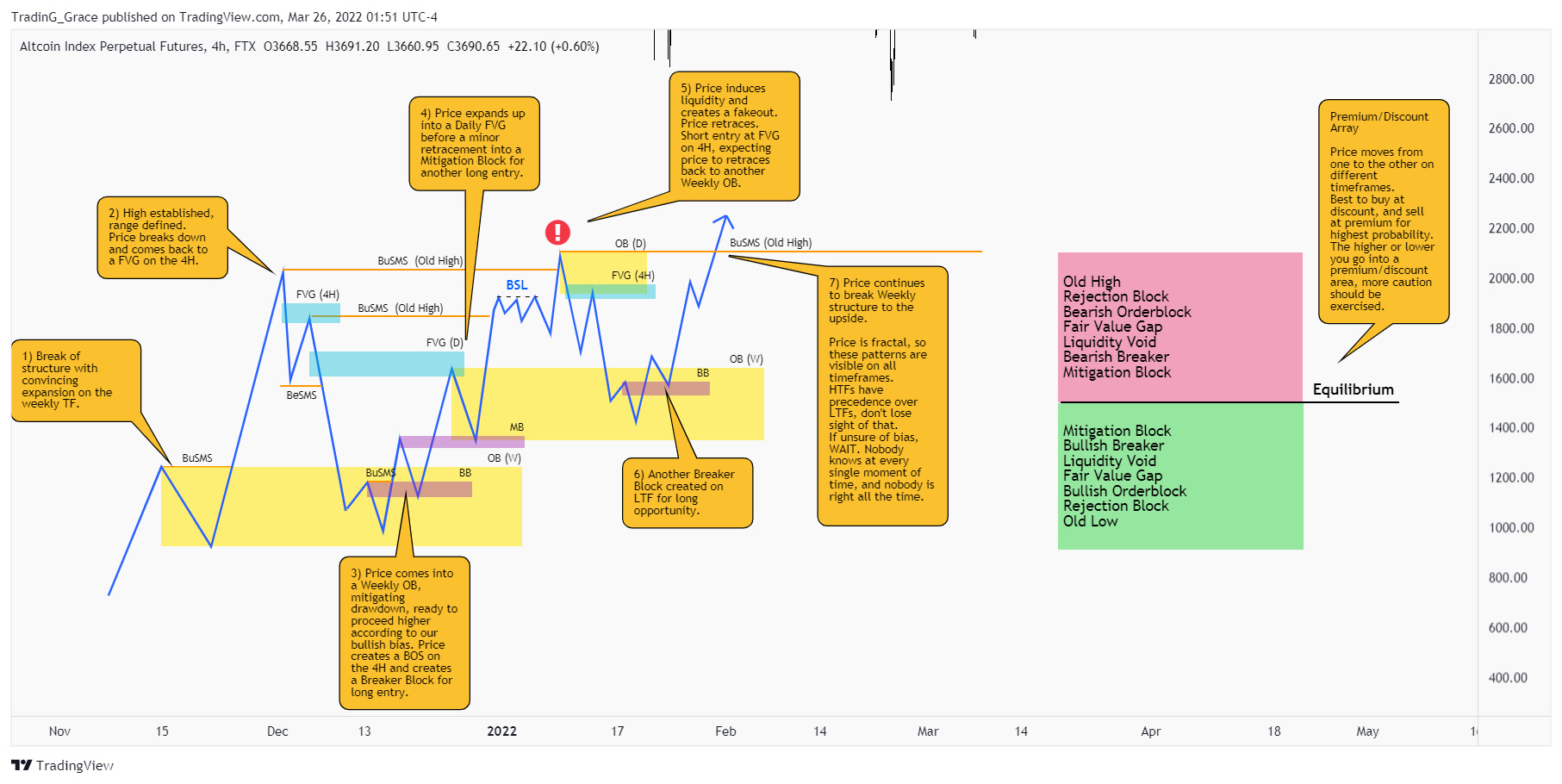
Here's a worked example of how this plays out.
Picture GBPUSD on the 15-minute chart. London opens with a clean displacement after a sweep, printing a textbook FVG. Higher timeframe context is bullish: price is in discount relative to the previous week's range, sitting just above a 4-hour bullish Order Block. The entry is in the FVG, the stop goes below the Order Block (if price trades through it, the bullish read is wrong), and the target is the previous high. Clean setup. Everything confirmed.
The trader takes it. Price pushes most of the way to target, and they close the full position early.
Here's what a standard trading journal would say: "GBPUSD 15m, FVG entry post-London displacement, closed before target. Note: consider holding longer next time."
Now say what actually happened is this: the night before, they took a small loss on EURUSD that annoyed them. It was a sloppy entry and they knew it. So on this GBPUSD trade, the moment it was in profit and approaching target, a voice said just take it, don't give this back too. They exited early because of how EURUSD made them feel the day before. Price action had nothing to do with it.
A journal that only captures technicals would say "hold trades longer." The real lesson is that unresolved frustration from a previous session was quietly managing the risk instead of the rules.
That's the difference between a journal that documents trades and one that documents trading.
Why Standard Journaling Advice Is Actively Harmful
Here's the contrarian take most people won't say out loud: logging trades without logging mental state doesn't just fail to fix the problem, it actively makes it worse.
Why? Because journaling creates a feeling of productivity. You spent 20 minutes reviewing your week, you identified "entry timing" as the issue, you have a plan to work on it. You feel like you did the work. That feeling reduces the psychological urgency to actually dig deeper. The journal becomes a pressure valve that vents just enough discomfort to keep you stuck.
This is the trader archetype I see constantly in trading communities: the perpetual "almost there" trader. They've been trading for 18 to 24 months. Their technical knowledge is genuinely solid, they understand displacement, they know how to identify institutional order flow, they can draw a proper premium/discount range. Their journal is meticulous. And they're still failing funded account challenges at the drawdown limit, again and again. Not because they don't know ICT concepts. Because their journal has never once asked them what was happening in their head at 9:32 AM when they entered that trade that started the drawdown spiral. If you're in this cycle, this piece on 7 fatal mistakes that kill your funded account challenge success is worth reading alongside this one, because a lot of those mistakes are downstream of exactly this journaling gap.
The technical knowledge is there. The self-knowledge isn't being captured.
The Pre-Trade Emotional State Framework (Use This Today)
This is the specific framework I use and the one I'd implement if I were rebuilding my journaling practice from scratch. It takes about 90 seconds per trade, less time than pasting a screenshot, and it captures the data that actually predicts outcomes.
Before you enter any trade, record these four things:
1. Physical state (10 seconds) Are you tired? Hungry? Have you been staring at screens for more than two hours straight? Your answer goes in one word: alert, fatigued, wired, distracted. That's it. No sentences needed. Just the honest one-word answer.
2. Emotional carry-in (20 seconds) What happened in the last 24 hours of trading? Not today, the recent window. Did you take a loss? A big win? Were you flat for three days and itching for action? Write one sentence, maximum. "Took 1.2R loss on EURUSD yesterday morning" or "Up 4R this week, entering the Friday session." This forces you to acknowledge what you're carrying into the decision.
3. Confidence rating (5 seconds) Rate your confidence in this specific setup on a 1 to 5 scale. Not your general confidence. This trade, right now. A 5 means you'd take this trade in a funded account evaluation without hesitation. A 3 means you're half-convinced. A 1 means you're hoping. If it's below a 4, the entry should require an extra confirmation, at minimum, you should check whether you're trading inside of premium with a risk calculator position size discipline.
4. Motivation check (15 seconds) Ask yourself, and answer honestly, why am I taking this trade right now? The answer you're looking for is: "Because the setup meets all my criteria and the session timing aligns." The answer that should stop you cold is anything that involves the words "make back," "bored," "should have run," or "feels like."
That's the entire pre-trade log. Four fields. 90 seconds.
Here's what you do with the data: every week, before you review your technical performance, sort your trades by their pre-trade emotional state. Look at your win rate and average R across trades taken when fatigued vs. alert. Look at what happened after high-carry-in trades, the ones where you noted a recent loss or a big win. The patterns will show up within a few weeks, and they'll be specific to you, not to a generic "psychology tips" article.
For a deeper look at how confirmation biases play into individual trade decisions, specifically around FVG entries, this ICT Fair Value Gap checklist pairs well with the emotional framework above. The nine pre-trade confirmations are technical; pair them with the four emotional fields and you have a complete pre-trade protocol.
I Used to Get This Wrong Too
For full transparency: my early journals were all screenshots and R-multiples. Beautifully useless. I thought pattern recognition in setups would solve the problem because that's what every journaling template on the internet told me to track.
What helped was tracking just the motivation check, that one field. Just "why am I taking this right now." It showed me how often my honest answer was some variation of "it looks like it should work" instead of "it meets criteria X, Y, and Z." And my trade management was different on those trades. When I knew I was in a conviction trade, I managed it according to my rules. When I was half-convinced, I was glued to the chart interfering with it.
The trading journal didn't fix anything on its own. Honest data did.
What a Real Journal Entry Looks Like
For comparison, here's the same example GBPUSD trade from earlier, logged the standard way versus the honest way.
Standard journal entry: GBPUSD 15m | FVG entry after London sweep | Stop below 4H OB | Target: previous high | Closed before target | Notes: exited early, hold longer next time.
Honest journal entry: GBPUSD 15m | FVG entry after London sweep | Stop below 4H OB | Target: previous high | Closed before target Pre-trade state: alert | Carry-in: annoyed from EURUSD loss yesterday, felt sloppy | Confidence: 4/5 | Motivation: valid setup, but also aware I want a win to "clean" yesterday | Outcome note: the early exit was a psychological signal. The market gave no reason to close. The "clean the slate" motivation contaminated trade management.
One of those entries teaches something real. The other teaches you to hold longer, which is advice you'll ignore the next time you're carrying emotional residue from the prior session, because it doesn't address the actual variable.
The Bigger Picture
If any of this resonates, if you have a detailed technical journal and you're still not seeing the results your setup quality should produce, the issue is probably the data you're not capturing. The fix is making self-awareness a deliberate data practice instead of something you vaguely acknowledge and then ignore.
Erratic sessions make this worse, because they amplify emotional decision-making (the breakdown of why market structure shifts are breaking traditional ICT setups covers the structure side). The traders who get through choppy stretches are the ones who know when they personally shouldn't be trading, and that knowledge comes from honest journaling data.
If you want direct feedback on your journaling process and trade reviews, that's something we can work on in the 1-on-1 sessions in the coaching plans, including the Lite option at $150/week. Or if you're not sure where you stand yet, book a free discovery call and we'll look at your actual data together before you commit to anything.
But honestly? Start with the four-field pre-trade protocol today. You don't need a coach to try it. You just need the willingness to ask yourself an uncomfortable question before every trade, and write down the real answer, not the one that sounds like a trader who has it together.
That discomfort is the data. Stop hiding it in a journal full of clean screenshots.
Harvest Wright
ICT Trading Coach · 10+ Years Experience
Harvest specializes in ICT methodology and has helped traders pass prop firm challenges, develop consistent strategies, and build the psychology needed for long-term profitability.
Book a Free Discovery Call →Ready to Get Funded?
1-on-1 ICT coaching built around prop firm rules, from a trader who has passed an FTMO Challenge.
Book a Free Discovery CallFree ICT Funded-Trader Playbook
The setups, the pre-trade checklist, and the risk rules I use. Get it free.