Why More Screen Time Is Making You Worse
Here's something nobody in the ICT trading space wants to say out loud: the traders grinding 8-hour chart sessions are often getting worse. After 10+ years of trading, I'm convinced excessive screen time is one of the most underdiagnosed reasons competent traders stay stuck.
Key Takeaway: After a few hours of focused chart work, fatigue wears down the pattern recognition that ICT trading demands, turning real setups into noise and noise into setups. The fix is cutting screen time hard and protecting your best hours.
The Myth That's Costing You Real Money
Myth: More hours on the charts equals more experience, faster growth, and sharper ICT trading instincts.
Reality: Experience without cognitive clarity is just repetition of errors. After a few hours of active chart analysis, fatigue sets in and your brain starts pattern-matching against a sloppier template. In ICT trading specifically, this is catastrophic. The entire framework depends on nuanced contextual reading: is price in premium or discount, is this displacement or chop, is this order block valid or just a random candle? These aren't binary questions. They require a clear head. Deep into a long session, that precision slips, and most traders have no idea it's happening because impaired judgment feels exactly like judgment.
What I Actually See: The trader grinding 6-8 hours a day isn't building a deeper library of ICT setups. They're building a corrupted one. By the end of a long session, they've forced three marginal trades, adjusted their bias twice mid-session without structural reason, and ended the day genuinely confused about what they believe about price. Then they wake up tomorrow and do it again.
I Used to Get This Wrong Too
When I first got serious about ICT concepts, I wore long screen time like a badge. I'd sit through London and New York, be exhausted by the close, and mistake that exhaustion for having "put in the work." The mistakes from those long days were predictable: overriding my own pre-session bias, chasing displacement I spotted too late, taking OB entries in clear premium zones because I'd lost my premium/discount reference points.
What helped was capping my analysis time and then stepping away. It showed me the problem had never been my understanding of ICT concepts. It had been the tired state I was trying to apply them from.
What Actually Happens to Your Brain After Hour Three
Decision fatigue is a well-known idea. The way I see it show up on the charts follows a rough sequence: first goes nuance, then goes risk calibration, then goes the ability to do nothing. That last one is the killer for ICT traders.
When you're fresh, "wait for the setup" is a real option. After five hours on the charts, doing nothing starts to feel like a punishment. You've watched price move all day and you feel urgency that the market didn't earn. Suddenly that fair value gap on the 5-minute chart that you'd have ignored at 9am looks compelling at 2pm. The setup didn't improve. You just need to trade, and your idea of "good enough" has quietly dropped.
For ICT trading specifically, this is where the real damage happens. You start seeing:
- FVGs that aren't actually imbalances, they're normal candle spread
- Order blocks on candles that never had any real buy or sell program behind them
- "Liquidity sweeps" on minor equal lows that are just consolidation
And here's the part that makes recovery so slow: you're now logging these manufactured setups in your journal. You're building a dataset of bad trades that you then try to extract lessons from. The lesson you extract, "I need to be more patient" or "I need better confirmation", is wrong. The actual lesson is: stop trading after three hours.
If you want to go deeper on how degraded pattern recognition affects specific setup types, the breakdown in why your ICT order blocks keep failing in ranging markets covers a lot of this from a pure structure angle.
A Worked Example: What Quality Looks Like
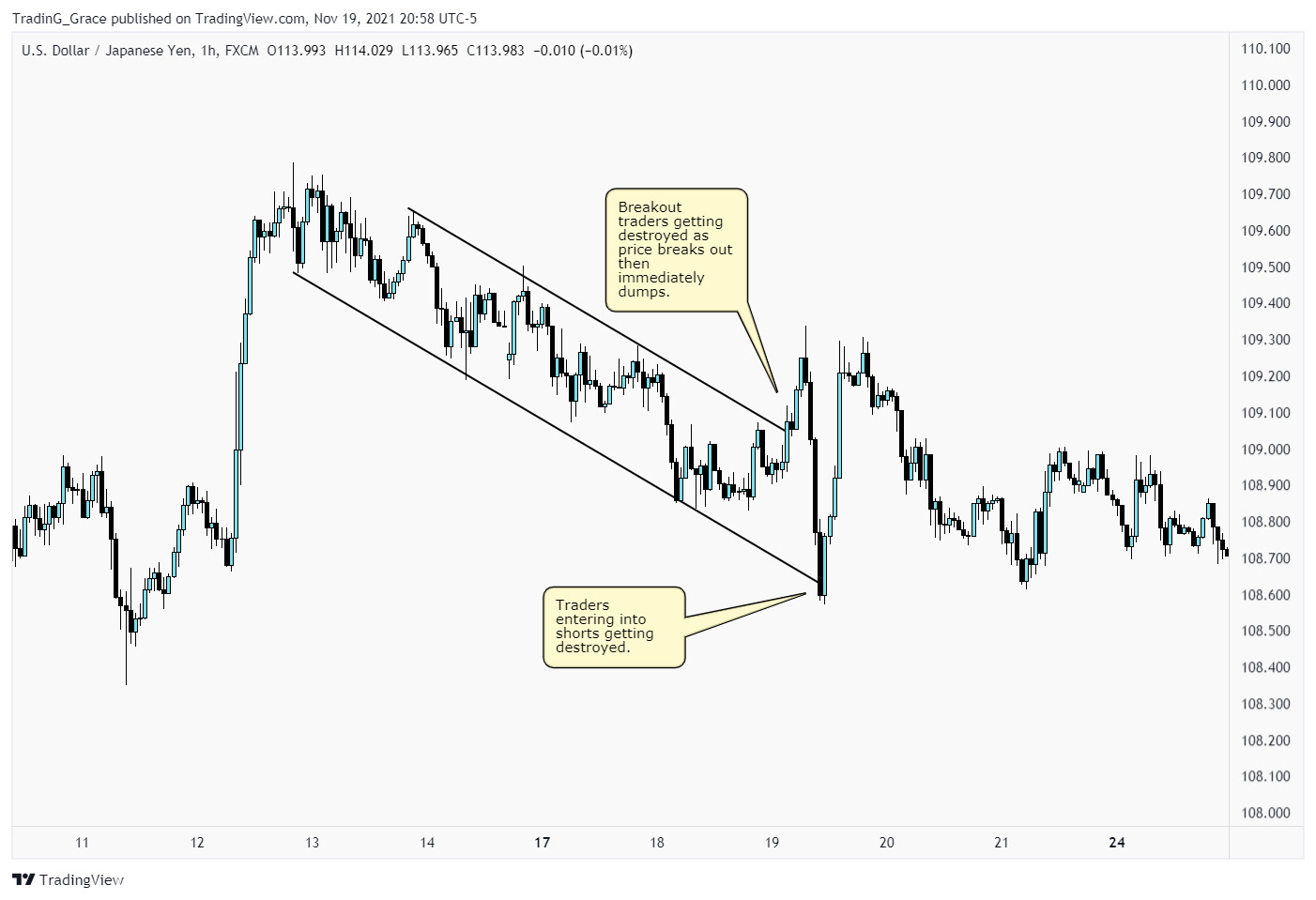
Here's the kind of setup I mean. Picture GBPUSD on the 15-minute chart. Pre-session analysis takes 45 minutes the night before: the Daily is bearish, and there's unmitigated sell-side liquidity below the prior week's low. The plan going into London open is simple: wait for a liquidity grab above the Asian range highs, displacement back down through an FVG, and a short from the first OB formed during that displacement move.
London open runs the Asian highs. A clean displacement candle drives back down and leaves an FVG, with a bearish OB just above it. The entry is on the return into that OB. The stop goes just above the high of the sweep, because if price takes that high again the idea is wrong. The target is the prior week's sell-side liquidity, since that's the pool the Daily bias is pointing at.
Once the order is in, there's very little to do. Check in once or twice, that's it. The work was already done the night before. A trade like this comes from pre-session analysis that is clean, rested, and built on a high-timeframe read. That kind of clarity comes from better hours, and more hours usually get in the way.
The Trader Archetype I See Constantly
There's a specific type of trader who appears in every forum, every Discord, every comments section of every ICT trading video. They're not beginners. They've been at this 1-3 years. They can name every concept, they can spot an FVG in a screenshot quiz, and they have a journal that's three notebooks deep. But they're still losing.
Here's the tell: when you ask them about a bad trade, they describe it in incredible detail. The exact sequence of candles. Every level they considered. Three different reasons they almost didn't take it. The analysis is thorough. The problem is the analysis happened at hour five of their session, in a zone where they'd already had two losing trades that day, after news had chewed through their initial bias.
They didn't fail because they lacked knowledge. They failed because they were operating in a worn-out state that was incapable of applying what they knew. More screen time didn't cause a lack of knowledge, it caused a failure of execution in real-time conditions. And because the knowledge feels solid, they conclude the solution is more repetition. More hours. More charts. More of the thing that's already breaking them.
You'll recognize this pattern more clearly after reading about the 7 fatal mistakes that kill funded account challenges, a lot of those mistakes happen not in the first hour of a session but the fourth.
The Practical Framework: The 90-Minute Protocol
Here's exactly how I'd structure it:
Step 1, Pre-session analysis (45-60 min, night before or 2hrs before session) Top-down from Daily → 4H → 1H. Mark premium/discount range. Identify the closest unmitigated PD array in the direction of the daily bias. Write one sentence: "Tomorrow I am looking for [long/short] from [level] if [condition] is met." That sentence is your session filter. If a setup doesn't fit that sentence, it's not your trade.
Step 2, Active watch window (60-90 min max) For London: 7-8:30am GMT. For New York: 9:30-11am EST. These are the only windows where ICT trading setups have the institutional backing to deliver proper displacement and follow-through. You are not missing setups outside these windows. The market is missing the conditions that make setups valid.
Step 3, Walk away Completely. No checking the chart "just to see where it went." That behavior is how you learn to second-guess closed trades and re-enter bad positions. Close the platform. The trade either worked or it didn't. Your cognitive state for tomorrow depends on what you do in the next six hours.
Step 4, Review (20-30 min, end of day) Only one question: Did I follow the plan I wrote in Step 1? Not "was the trade profitable." Not "was the analysis right." Did your behavior match your process? This is the only variable you actually control, and it's the one that compounds.
For position sizing during the active watch window, use the R2F risk calculator to set your parameters before the session opens, not in the moment when you're watching price move.
Cutting Screen Time Is the Advanced Move
Every beginner believes the answer is more. More content, more hours, more screen time. That belief is almost never challenged in the ICT trading space because the content machine runs on engagement, and engagement requires keeping you watching. More hours on TradingView doesn't equal more edge.
Traders who make real, lasting progress tend to share one counter-intuitive trait: they treat their attention as a scarce, depletable resource. They protect their best cognitive hours aggressively. They don't grind charts. They hunt specifically, briefly, and then disappear.
That discipline isn't a personality trait. It's an understanding of what ICT trading actually demands. The concepts aren't complicated. The execution window is narrow. The cognitive requirement is precision, not endurance.
If you're still trying to figure out why a sound understanding of ICT concepts isn't translating into consistent results, the Q2 2026 market structure breakdown is worth reviewing, some of what looks like a screen time problem is actually a context problem.
And if you want structured accountability around building this kind of disciplined framework from scratch, take a look at the coaching plans available here. The Lite tier at $150/week exists specifically for traders who already understand the concepts and need someone in their corner holding the process accountable. That's often the only thing standing between where you are and where you're trying to get.
The next session you trade? Cap yourself at 90 minutes of active watching. Walk away. See what happens to your clarity the following day. You already know more than enough to trade well. The question is whether you'll protect the mental state required to apply it.
Harvest Wright
ICT Trading Coach · 10+ Years Experience
Harvest specializes in ICT methodology and has helped traders pass prop firm challenges, develop consistent strategies, and build the psychology needed for long-term profitability.
Book a Free Discovery Call →Master Your Trading Psychology
Psychology is a huge part of trading. Our coaching includes dedicated psychology sessions.
See Coaching PlansFree ICT Funded-Trader Playbook
The setups, the pre-trade checklist, and the risk rules I use. Get it free.