
GDP Week Trading: Control Your Emotions, Not the Chart
There's a specific kind of overconfidence that hits traders in the 48 hours before a major GDP release. It doesn't feel like overconfidence. It feels like preparation. You're reading macro reports, watching Fed commentary, cross-referencing previous quarters, building a thesis. The trading psychology trap isn't laziness here, it's the opposite. You're doing too much intellectual work in the wrong direction, and by the time price actually moves, you've already committed emotionally to a side.
Key Takeaway: The biggest threat during GDP week isn't volatility, it's pre-narrative bias, the cognitive distortion where macro storytelling disguises emotional speculation as analysis. The fix isn't ignoring the data; it's deliberately withholding directional commitment until Smart Money confirms through structure, not headlines.
Why GDP Week Breaks Traders Differently Than Other High-Impact Events
NFP weeks, CPI drops, FOMC statements, all of these carry psychological weight. But GDP releases have a particular flavor of danger because the data feels explainable. A surprise unemployment number is jarring. GDP, though? Traders have entire narratives pre-loaded. "If GDP comes in hot, dollar strengthens, risk-off, short equities, long DXY", this kind of chain logic feels analytical. It reads like a trade plan. It has economic language in it. But here's what a decade of watching price actually react has taught me: GDP narratives are almost never wrong about the direction of the story and almost always wrong about the direction of the trade.
GDP is one of the big scheduled releases of any quarter. In my experience, the price displacement after the release often contradicts the consensus narrative. Markets aren't random here: Smart Money has already positioned, already hunted liquidity, and the retail herd is the exit ramp.
This is the structural reason your narrative gets punished. Not bad luck. Mechanism.
The Trader Who Already Knows What's Going to Happen
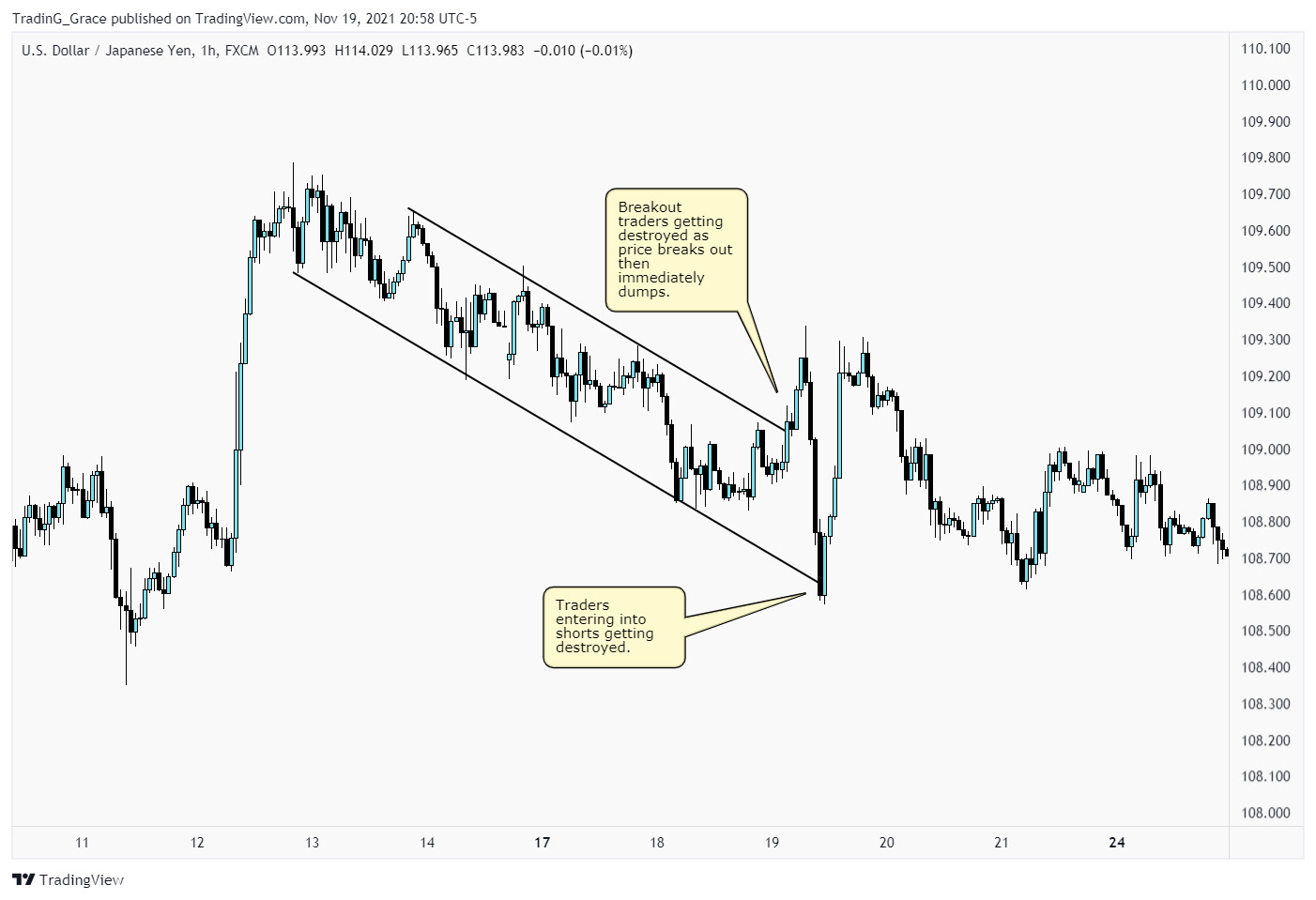
Let me describe a pattern I see constantly, I'll call this archetype the Macro Analyst Cosplay Trader. This person has done genuine homework. They've read the Fed minutes, they know what Q1 GDP was, they've watched three YouTube breakdowns of what "below-forecast" means for equities. By Wednesday afternoon before Thursday's GDP release, they have a full thesis. Short GBPUSD, target the previous week's low, the UK economy is contracting.
Here's what actually happens to this trader: They enter Tuesday. Not Wednesday after London open. Not Thursday after the release. Tuesday. Because the thesis is already complete in their head, and waiting feels like leaving money on the table. They size up slightly because the conviction is high, maybe 1.5% risk instead of their usual 0.75%. The stop is placed below a level that "should hold if the thesis is right."
By Thursday morning, price has swept above the previous week's high, taking their stop, and then sold off exactly as they predicted. They got the direction right. They lost money anyway. And then, critically, they don't re-enter because they feel robbed, and watching the original thesis play out without them is psychologically unbearable.
This isn't a bad trader. This is a trader who let macro storytelling replace price confirmation. The thesis became the entry trigger instead of the market structure.
What I Used to Do Wrong (And Still Catch Myself Doing)
I'll be honest about something. Early on, I thought my edge in high-impact macro weeks was in understanding the data better than other traders. I'd spend hours on economic analysis, building conviction. The occasional win reinforced the habit, which is the dangerous kind of wrong, because intermittent reinforcement is how behavioral loops calcify.
The problem was simple once I saw it. You can be right about the economy and still lose, because you're trading the story instead of the liquidity.
ICT concepts reframed this completely for me. The question stopped being "what does GDP mean for price?" and became "where has Smart Money engineered liquidity, and which direction does the narrative serve as a trap?" That's a fundamentally different question. And it requires emotional neutrality to ask honestly.
The Pre-GDP Mental Protocol: 5 Steps to Stay Structurally Neutral
Here's the exact framework I run through starting 48 hours before any GDP release. This is process-based, not motivation-based. You don't need discipline to follow it, you need a checklist that interrupts the narrative construction before it completes.
Step 1: Identify the prevailing HTF narrative in the market, then consciously flag it as a liquidity trap candidate.
Whatever story everyone is telling about GDP, write it down explicitly. "Weak GDP = dollar sells off." Now mark the most obvious retail entry level for that scenario. That's probably where Smart Money will engineer a stop hunt before the actual move occurs. You're not inverting the thesis yet, you're just tagging it as suspect.
Step 2: Map your key liquidity levels on the Daily and 4H, without a directional bias attached.
Mark previous highs and lows, equal highs, equal lows, and any FVGs left open from the prior week. Do this as a neutral exercise. No arrows, no bias labels. Just the engineering on the chart. If you catch yourself thinking "price will come here to run stops and then go up", pause. That's a narrative forming. Just mark the level. Direction gets assigned by price, not you.
Step 3: Set a hard rule, no new entries in the hours right before the GDP release.
Pick your cutoff and stick to it. The pre-release window is when institutional players are completing their positioning, which means price will often drift in the direction that maximizes retail pain before the candle even prints. Entering in this window is paying a premium for the privilege of being stopped out.
Step 4: Post-release, wait for the first 15-minute candle close after the displacement.
After GDP drops and price makes its initial move, the instinct is to chase. Don't. What I'm looking for is a retracement into the displacement origin, an FVG or OB formed on that first impulse candle, on the 5-minute or 15-minute chart. That's where the ICT confirmation structure lives. If there's no retracement and clean structure, there's no trade. The move already happened without you, and that's fine.
Step 5: Size down by 25-30% on GDP week regardless of conviction.
High conviction during high-impact weeks is a psychological artifact, not genuine edge. Use the risk calculator to set your position size before you even look at the chart that morning. Lock it in. Don't let "but this setup is perfect" talk you into overriding the predetermined size. The accounts that survive GDP weeks are almost never the ones that "went big on the right call", they're the ones that survived being wrong and came back Thursday afternoon with capital intact.
A Worked Example: EURUSD Into GDP
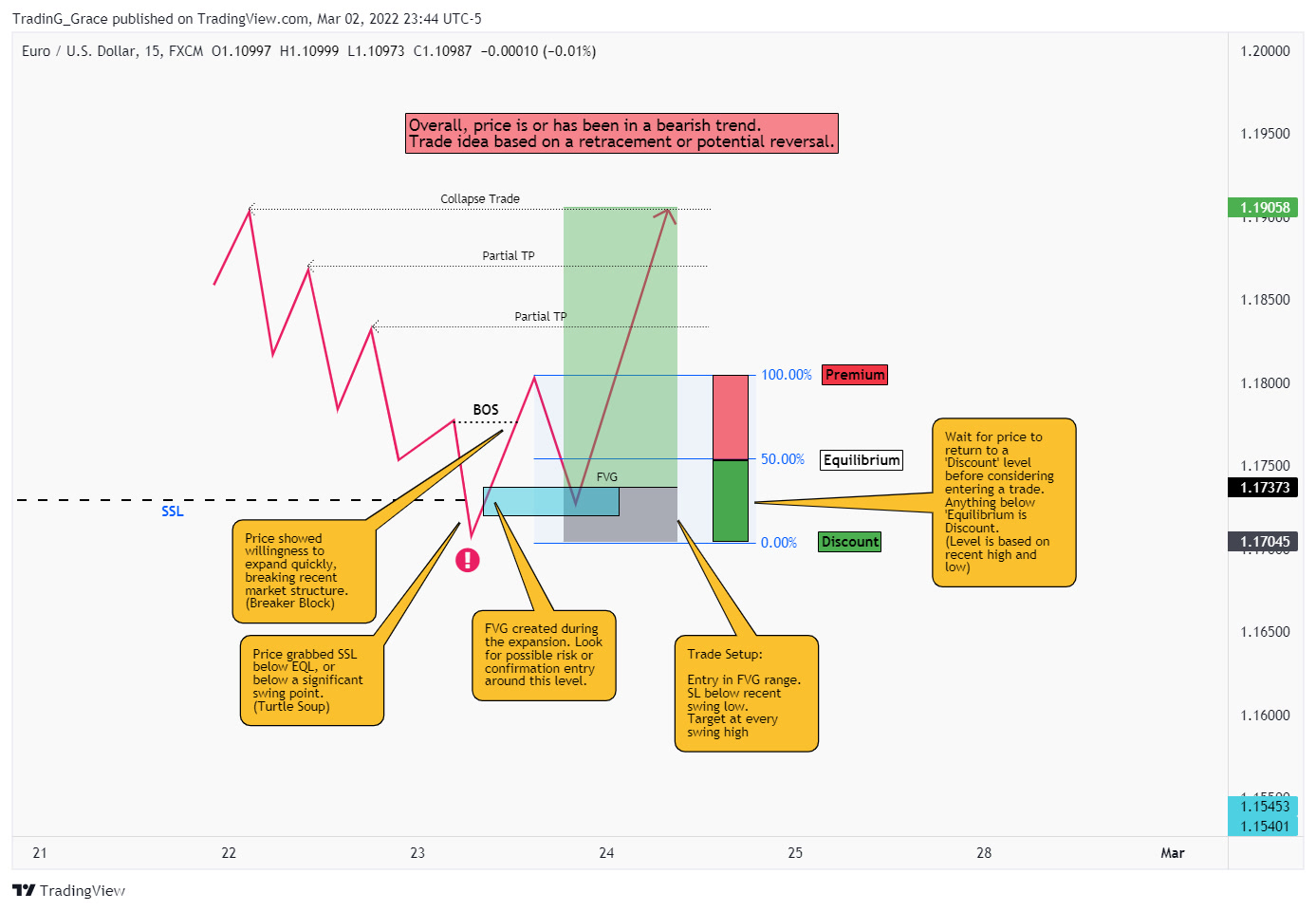
Here's the kind of setup I mean. Picture EURUSD in a GDP week where the popular narrative is Euro weakness. Everyone and their TikTok feed is short EUR.
On Tuesday, price sweeps the equal lows from the prior Friday, a classic liquidity grab below the retail short entries. Instead of confirming the bearish thesis, price holds above that swept level. Then in the London session, a displacement to the upside leaves a clean 15M FVG. No narrative, just structure.
Entry: on the 15M, once a candle closes inside the FVG with momentum confirmation. Stop: below the swing low that formed after the displacement. If price trades back through it, the bullish read is wrong. Target: the previous week's high, where the clean liquidity sits.
In a picture like this, the Euro weakness story can still play out later. It just plays out after the stop hunt that would have gutted anyone who went short on Tuesday based on the macro story alone.
The setup wasn't about GDP. It was about what price did in response to the anticipation of GDP. That's the distinction that separates ICT-structured trading from macro speculation dressed up as analysis. For more on how liquidity grabs set up these kinds of plays, this breakdown of ICT liquidity concepts covers the mechanics in depth.
The Contrarian Truth About "Waiting for the Data"
Here's the take most people miss, and I say this knowing it runs against a lot of content you'll see from ICT traders on YouTube: waiting for the GDP release is not the same as being patient. A lot of traders think they're being disciplined by waiting for 8:30 AM and then immediately entering on the spike. That's not patience. That's just a different version of narrative trading, now operating in real-time panic.
Real patience in trading psychology means waiting for structure to form after the spike, not reacting to the spike itself. The number drops, price explodes, and your job in that moment is to do nothing for approximately 15-30 minutes while the dust settles and an actual ICT entry model appears. For a broader look at how Q2 2026 market structure is shifting and what that means for these setups, this analysis covers the current landscape in a way that'll reframe how you're reading price context right now.
Also worth noting: avoiding the classic funded account mistakes during GDP week is directly tied to this. In my experience, a lot of funded account blowups during macro releases trace back to pre-narrative positioning more than trade management.
Your Specific Next Step Before the Next GDP Release
Before next quarter's GDP week hits, run through this exercise once: Pull up the chart from the last GDP release on your primary pair. Mark where the retail narrative entry was. Mark where the actual Smart Money displacement went first. In most cases, you'll see a liquidity grab in the direction of consensus narrative before the actual move. That pattern, repeated across pairs and time, is the empirical antidote to pre-narrative bias.
You can't unfeel the anticipation. But you can build a process that doesn't let the feeling become a trade.
If you want to work on exactly this kind of trade structure, the psychology layer and the ICT mechanics together, the coaching options here range from $150/week for Lite support up to the Full Mentorship at $5,000 for four months. Or if you want to get a feel for the approach first, book a free discovery call and we can talk through where your trading actually breaks down during high-impact weeks.
Harvest Wright
ICT Trading Coach · 10+ Years Experience
Harvest specializes in ICT methodology and has helped traders pass prop firm challenges, develop consistent strategies, and build the psychology needed for long-term profitability.
Book a Free Discovery Call →Ready to Get Funded?
Our students pass prop firm challenges in under 60 days with personalized ICT coaching.
Book a Free Discovery CallFree ICT Funded-Trader Playbook
The setups, the pre-trade checklist, and the risk rules I use. Get it free.