
The Sunday Night Lie Every ICT Trader Tells Himself
There's a ritual that happens every Sunday night in thousands of trading setups around the world. The lights are low. TradingView is open. A trader sits there drawing boxes on EURUSD, marking order blocks on the daily, dropping Fibonacci levels on the weekly, setting alerts on HTF fair value gaps. Two hours later, they close the laptop feeling ready.
That feeling is the lie. And I know it intimately, because I told it to myself for years before I understood what was actually happening inside my head. This is a conversation about ICT trading psychology that most people don't want to have, because it requires looking at your Sunday ritual and asking an uncomfortable question: Is this preparation, or is this self-medication?
Key Takeaway: Over-preparation on Sunday isn't a sign of discipline, it's often an anxiety response to past losing weeks, creating false certainty that makes you more likely to deviate from a plan by Tuesday, not less. Real ICT readiness is measured by what you're willing to leave unmarked, not by how many levels you've drawn.
The Chart That Looked Like Confidence
Picture a trader coming off a rough week: two GBPUSD trades that hit full stop, both valid setups by every checklist metric they use. Their confidence is shaken. So that Sunday, they go deep. The weekly order block, the daily breaker, three separate FVGs on the 4H, a HTF liquidity pool above the previous week's high, two entry models on the 1H, and alerts at seven different price levels.
Monday's London session opens. Price sweeps a low they almost marked but didn't, because by then they were drowning in levels, and then runs hard to the upside. The textbook trade was right there: long after the sweep and displacement, stop below the swept low, target the liquidity pool above last week's high. They have no position. The setup was there. The chart was just too cluttered to see the actual narrative. The Sunday session didn't prepare them. It buried them.
That's the paradox nobody talks about in ICT trading psychology circles. The more you mark, the less you see.
Why Sunday Night Feels So Good (And Why That's the Problem)
Here's what I think is happening when you sit down Sunday night after a red week. Your brain is in threat-response mode. Last week hurt. Maybe you blew through a drawdown limit, maybe you got chopped up on Tuesday during a manipulation move you should have identified. Whatever it was, your nervous system logged it as danger.
So Sunday prep becomes a control behavior. Marking levels gives you the sensation of command over something that felt completely out of your hands five days ago. Every order block you draw is a small dopamine hit. Every alert you set is a promise to yourself: this time I'm ready. The ritual feels productive. It looks like preparation. But functionally, it's closer to checking the locks on your door three times before bed, not because there's actually more danger, but because your anxiety needs somewhere to go.
The traders I see fall into this pattern hardest are the ones who experienced a significant loss event, a challenge failure, a large drawdown, a week where multiple A+ setups just stopped working. It's not a skill upgrade. It's a coping mechanism wearing a skill's clothing.
The Archetype I Keep Seeing
There's a specific trader pattern that shows up constantly in ICT communities. Call him the Over-Prepared Under-Executor. His charts are immaculate. His Sunday screenshots get fifty likes on X. Every level is labeled, color-coded, annotated. His prep thread is a thing of beauty.
By Wednesday, he's taken three trades that weren't on any of his marked levels. Why? Because when price actually moved, when the real, messy, live market came in with its manipulation wicks and liquidity raids, it didn't look like his clean Sunday chart. The gap between his prepared narrative and the live reality created cognitive dissonance. And instead of sitting on his hands, he improvised. Twice at a loss. Once at a small win that didn't offset the damage.
The over-marking on Sunday didn't make him disciplined. It made him brittle. He had so much confirmation bias baked into his chart by Sunday night that any deviation from that exact scenario felt like the market was broken, not that his read was incomplete.
This connects directly to what I think is the most underrated failure point in funded account challenges: traders don't blow challenges on random impulse trades. They blow them on trades that felt justified by a preparation ritual that had quietly become emotional scaffolding rather than genuine analysis.
What Real Readiness Actually Looks Like

I used to get this wrong too, badly. One exercise that helps: track not what you mark on Sunday, but how many of your Sunday marks you actually use by Friday close. For a lot of traders, it's an embarrassingly small share. The rest is noise that exists to make you feel ready.
Now my Sunday prep has a hard rule: if I can't explain in one sentence why a specific level matters to the current weekly narrative, it doesn't go on the chart. Not because I'm lazy. Because vague levels create vague decisions, and vague decisions at 8:35 AM during London open cost real money.
Here's the framework I actually use now:
The Sunday Subtraction Method
Step one: Do your analysis normally. Mark everything you see. Don't filter yet.
Step two: Write one sentence about the dominant weekly narrative. Not multiple scenarios, one. Where is price in the macro range? Is it in premium or discount on the monthly? What's the path of least resistance for institutional flow this week?
Step three: Now go back to your chart and remove every level that doesn't directly support that one sentence. If you wrote "price is in monthly premium targeting sell-side liquidity below last week's low," then that bullish order block you marked on the 4H from three weeks ago? Gone. It's not relevant to this week's narrative. Leave it for another week.
Step four: Whatever remains, that's your chart for the week. If you have more than four to five key levels on any single pair, you've over-marked. Start cutting again.
This process hurts the first few times you do it. Removing levels feels like throwing away preparation. It's actually the opposite, it's where the preparation becomes real.
What a Clean Chart Looks Like
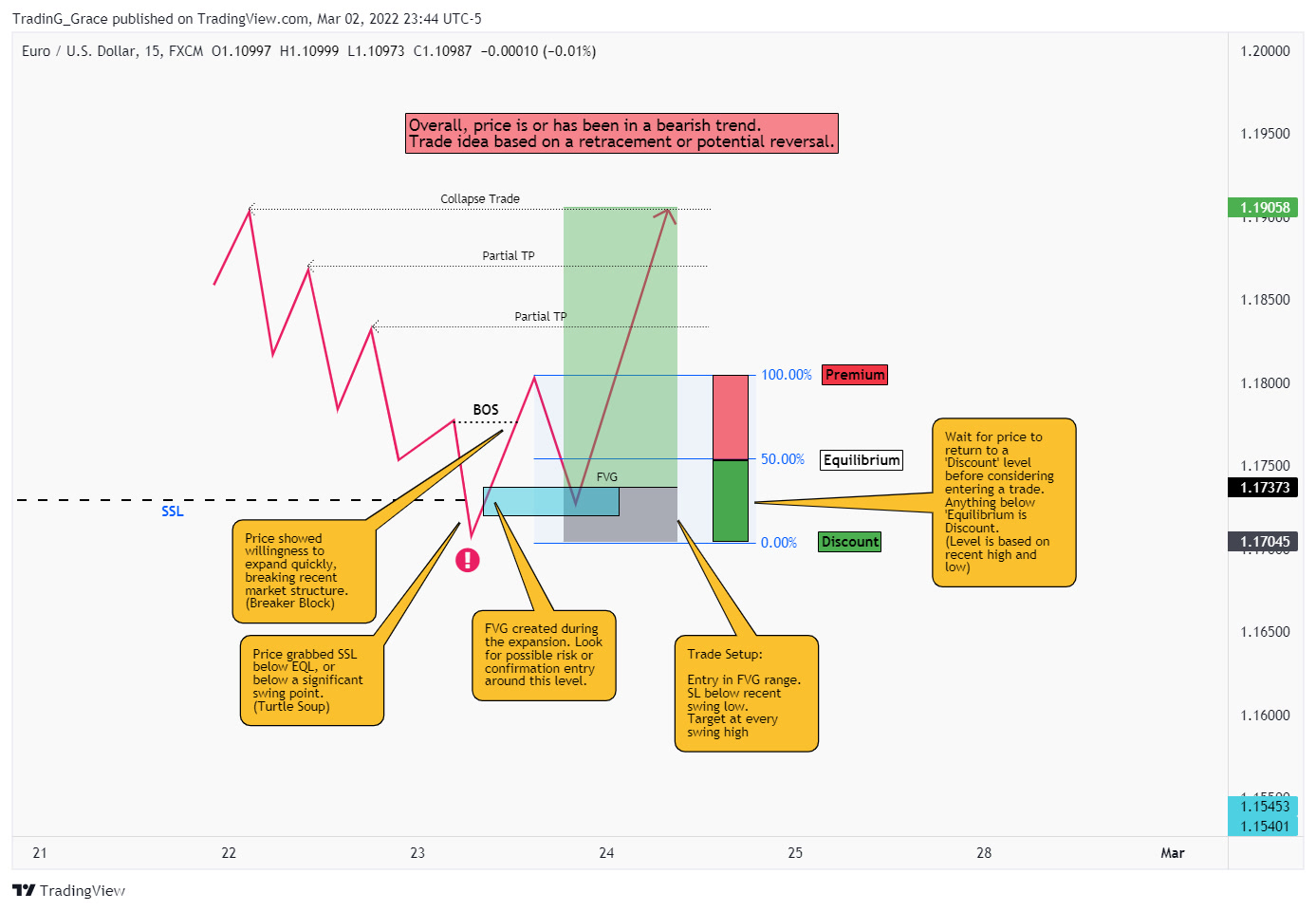
Here's the kind of week I mean. Picture EURUSD with a simple Sunday narrative: price swept buy-side liquidity above the prior week's high, left a significant bearish FVG on the 4H, and the plan is to look for sells toward the sell-side liquidity resting below a recent swing low.
London opens with price pushing up into that 4H FVG. On the 15-minute, a clear bearish order block forms at the top of the push, the last up-close candle before the move down. The entry is a short from that order block, the stop goes just above the OB high because a break above it means the FVG failed, and the target is the 4H demand zone where that sell-side liquidity sits. Partials at the first minor low, stop to breakeven on the rest.
That entry is only obvious because the chart is clean. With six other levels screaming competing narratives, it gets lost. The subtraction work on Sunday is what makes the 4H FVG the only significant sell-side reference in that range.
For position sizing on setups like this, I run everything through a risk calculator before I touch the order ticket, discipline at entry, not just at prep.
The Question That Changes the Practice
Stop asking yourself "what did I mark this week?" on Sunday night. Start asking "what am I not marking, and why am I confident enough to leave it off?"
That second question is where ICT trading psychology actually lives. It requires genuine conviction about a narrative, not the busy-work security blanket of exhaustive chart annotation. It means you have to commit to a read rather than hedging every possible scenario with a level.
If you can't answer that second question with confidence, you're not ready yet, and no amount of additional marking will fix that. More boxes won't make the narrative clearer. They'll just give you more places to hide from the uncertainty you haven't resolved.
Shifting market structure is brutal for over-prepared traders, especially when ranges get tighter and the manipulation sweeps more aggressive. When price doesn't reach your neatly drawn levels and instead raids something two pips outside your marked zone, a cluttered chart gives you nowhere to anchor. A clean chart with one strong narrative gives you context to identify the real move.
In my experience, too many reference points make decisions worse, not better. ICT methodology gives you tools. But tools aren't a strategy. You still have to decide.
Before You Open TradingView Tonight
If it's Sunday and you're reading this before your prep session, here's the only thing I'll ask you to do differently: before you draw a single level, write down this week's narrative in one sentence. Not a paragraph. One sentence. If you can't write it, you're not ready to mark anything yet. Go back to your higher timeframes until that sentence becomes clear.
When it does become clear, and it will, your chart will almost mark itself. The relevant levels become obvious when the narrative is honest. And honest narratives come from a settled mind, not a busy one.
If the Sunday ritual has been feeling more like anxiety management than actual prep for you, that's worth sitting with. It doesn't mean you're broken or undisciplined. It usually means you haven't dealt with what last week actually taught you yet.
That's the real preparation. Not the marking. The reckoning.
If you're at a point where you want a structured framework for building this kind of narrative-first approach into your weekly process, the coaching plans on this site are built around exactly that, not giving you more levels to draw, but fewer, better ones. Or if you just want to explore where you are first, book a free discovery call and we'll figure out what's actually getting in the way.
Harvest Wright
ICT Trading Coach · 10+ Years Experience
Harvest specializes in ICT methodology and has helped traders pass prop firm challenges, develop consistent strategies, and build the psychology needed for long-term profitability.
Book a Free Discovery Call →Ready to Get Funded?
Our students pass prop firm challenges in under 60 days with personalized ICT coaching.
Book a Free Discovery CallFree ICT Funded-Trader Playbook
The setups, the pre-trade checklist, and the risk rules I use. Get it free.