
The Sunday Fear That Ruins Monday Trades
There's a specific feeling I've learned to recognize over ten years of trading. It tends to show up on Sunday evening, while you're sitting at your desk reviewing the weekly chart. It feels like preparation. It feels like focus. What it actually is, most of the time, is the beginning of a loss.
This isn't about overtrading on Monday. That advice is everywhere. This is about something quieter and more destructive: the moment you finish your Sunday analysis, close your charts, and already know what the market is going to do tomorrow. That feeling of certainty? That's where the damage begins. And if you're trading smart money concepts, the ICT framework specifically, you're more exposed to this trap than almost any other methodology out there.
Key Takeaway: Sunday bias-setting becomes psychologically dangerous when thorough ICT preparation creates premature conviction, transforming a planning tool into an emotional anchor that causes traders to force trades that should work rather than respond to what the market is actually offering on Monday.
A Worked Example
Let me make this concrete.
Picture a Sunday where everything is done by the book. The weekly chart on GBPUSD shows a clean inducement sweep above the prior week's high, followed by a displacement candle closing well below the swing high on the daily. You mark the premium zone, a mitigation block inside it, and an unmitigated fair value gap beneath it. The weekly narrative is bearish. The daily structure has shifted. The bias is short, and it feels good. Unusually good.
Monday's London session opens. Price pushes up into that mitigation block, and the trader is already mentally in the trade. They short it with the stop above the block's high, because a clean break of that high means the bearish idea is wrong. The target is the FVG below and a prior equal low, where the sell-side liquidity sits.
Price stalls. Then slowly, agonizingly slowly, it pushes higher. The stop hasn't been hit yet. Here's what happens in the trader's head: they don't reassess. They defend the trade internally. It hasn't tapped the liquidity above yet. Price is just grabbing stops before the move. Every tick higher becomes evidence they're about to be right, instead of evidence they might be wrong. Then the stop goes.
And here's the painful part: the short idea can still work later in the week. Price rotates back down on Tuesday and hits that FVG. But the trader has no position, because they anchored so hard to Monday being the entry that they miss the actual opportunity when it comes. The better entry was after the sweep of the liquidity above the block, once price displaced back down.
The loss didn't come from a bad setup. The setup was fine. The loss came from Sunday.
Why ICT Traders Are Uniquely Vulnerable
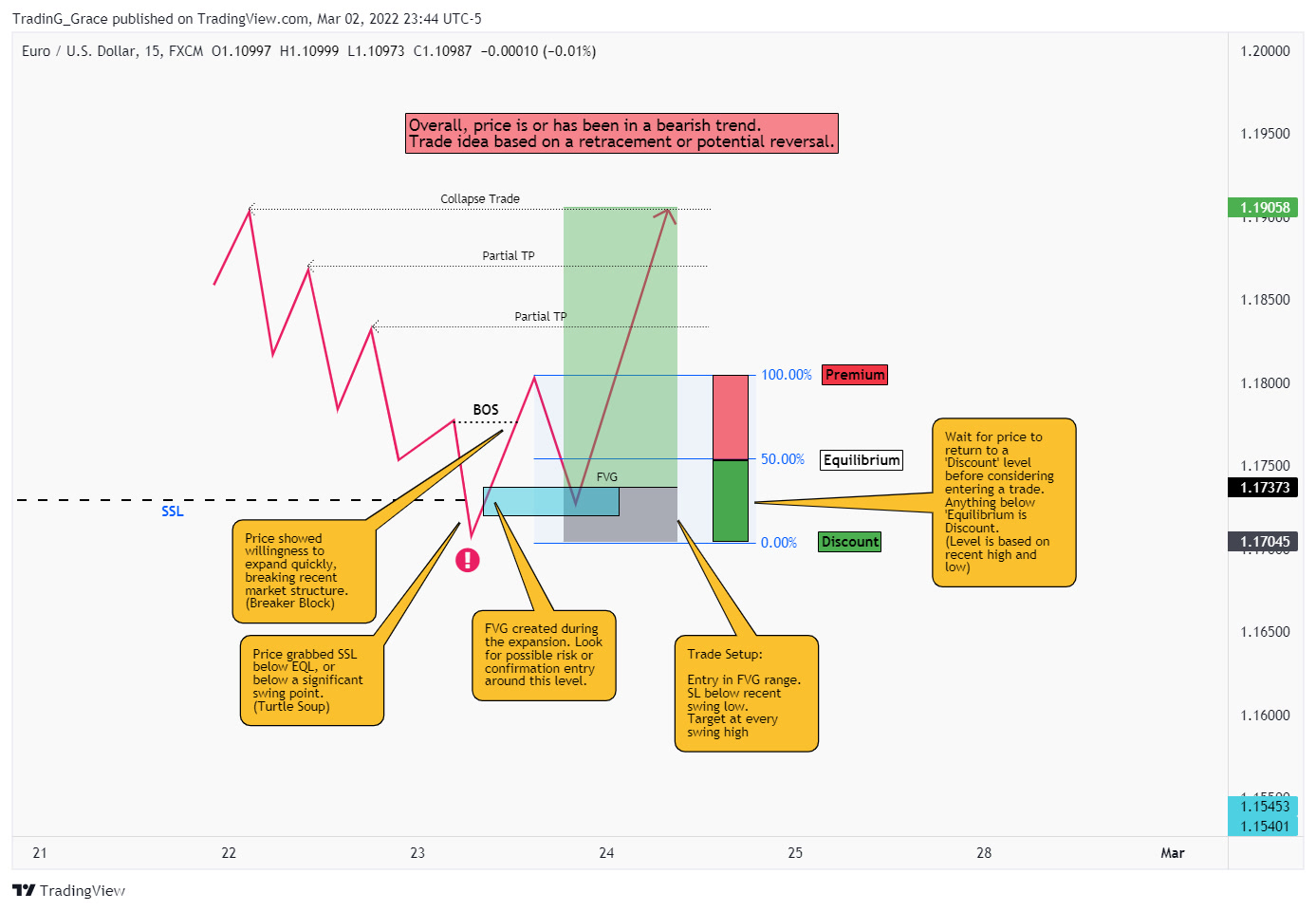
Most trading psychology content talks about generic discipline problems, revenge trading, FOMO, moving stops. But there's a specific cognitive trap baked into how smart money concepts work, and I don't see enough people talking about it honestly.
The ICT framework is deep. Order blocks, fair value gaps, breaker blocks, mitigation blocks, inducement, liquidity raids, optimal trade entry, the model gives you an extraordinarily detailed language for reading price. And that depth is its greatest strength and its most subtle danger. Because when you spend Sunday evening building a layered, multi-timeframe narrative, weekly draw on liquidity, daily structure, 4H entry model, 15M confirmation, what you've actually built is a story. A compelling, internally consistent story backed by years of learned concepts.
And humans do not abandon compelling stories easily. We elaborate them. We find ways to make contradictory evidence fit the story rather than revising it. Psychologists call this narrative bias, the tendency to interpret new information through the lens of an existing narrative rather than evaluating it independently.
The ritual of Sunday Asian session bias-setting, which is a legitimate cornerstone of ICT methodology, becomes psychologically dangerous at the exact moment you stop thinking of it as a hypothesis to test and start treating it as a verdict already delivered. Preparation becomes presumption. A planning tool becomes an emotional anchor.
A pattern I see repeatedly in online trading communities: traders post their Sunday analysis, perfectly structured, well-reasoned, genuinely good ICT work, and then on Tuesday they post a frustrated follow-up saying price didn't respect their levels. Often, looking at their Monday chart, price did give them an entry. Just not at exactly the time or price they expected. They missed it because they were waiting for their specific vision to materialize, not watching what the market was actually doing. The analysis was right. The narrative attachment ruined the execution.
What Preparation Is Actually For
Here's the contrarian take, and after a decade of this, I believe it completely: your Sunday analysis should make you more flexible on Monday, not less.
Most traders treat bias-setting as narrowing down, eliminating scenarios until you're left with the one trade you're going to take. But that's backwards. The point of thorough preparation is to map the entire decision tree in advance, so that when Monday arrives, you're not making decisions under pressure. You already know: if price does X, I'm interested in Y. If price does Z instead, here's what I'm watching. You're not locked into one outcome. You're prepared for multiple.
This is the difference between a scenario plan and a directional conviction. One keeps you adaptive. The other makes Monday's market feel like a personal challenge to your Sunday work.
I've written about some of these structural traps in more detail when looking at why Q2 2026 market structure shifts are breaking traditional ICT setups, the same underlying issue applies here. When conditions change, attachment to a pre-formed view is what separates traders who adapt from those who blow accounts defending their analysis.
A Sunday Process That Actually Works
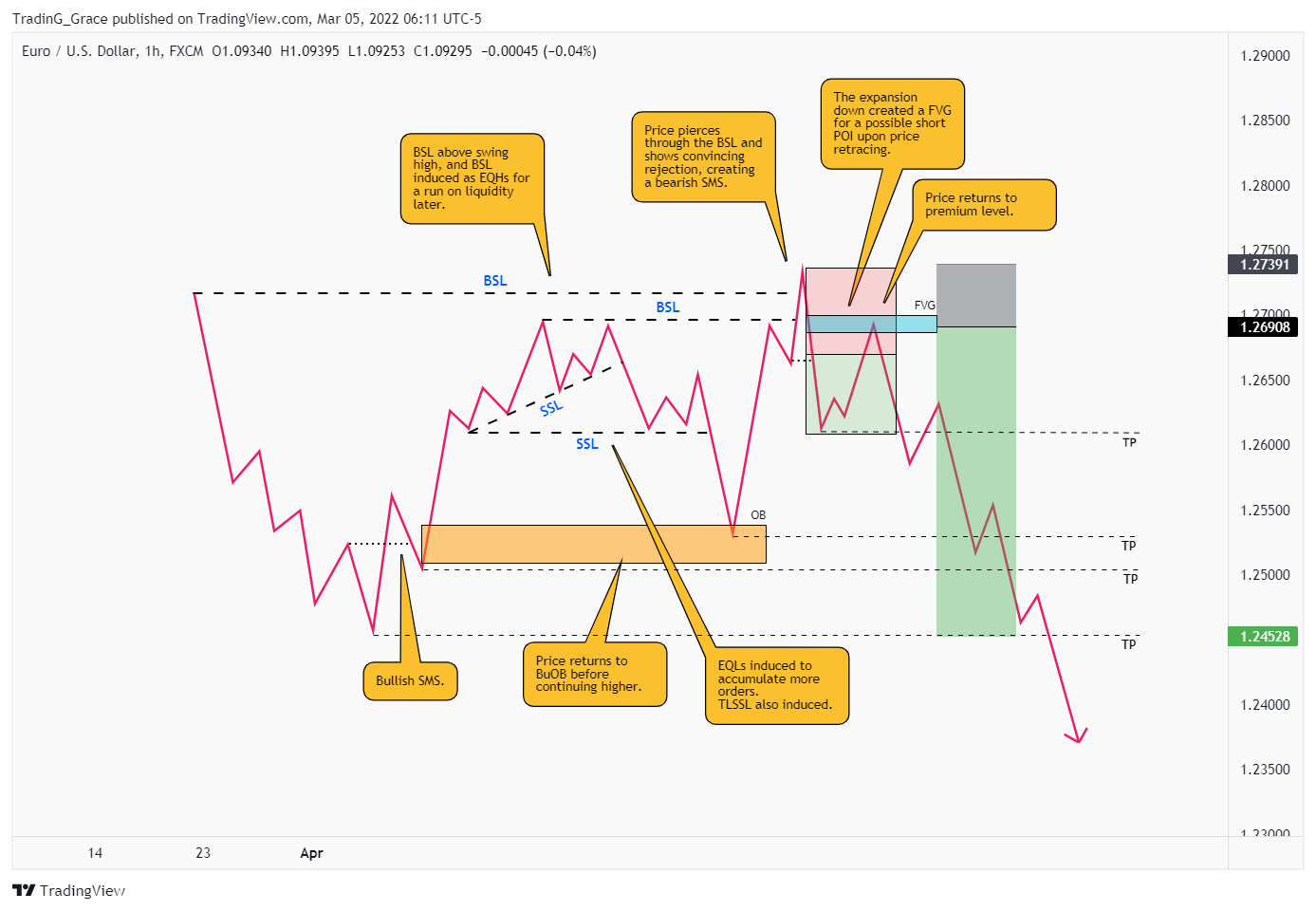
This is exactly how I've restructured my Sunday bias work, and it's the difference between arriving at Monday with a weapon or a blindfold.
Step 1: Mark the Weekly and Daily in scenarios, not verdicts. Instead of writing "Bias: Bearish," write "IF price reaches X and rejects, I'll be looking for shorts toward Y. IF price instead breaks above Z and consolidates, I'll reassess for longs toward W." You're encoding conditions, not conclusions.
Step 2: Set your invalidation before you set your bias. What would have to happen for your read to be completely wrong? Write that down explicitly before you write anything else. Most traders do this backwards, they build the bullish case, then reluctantly add "unless..." as an afterthought. Put the invalidation first. It forces intellectual honesty before narrative momentum builds.
Step 3: Mark two competing FVGs or order blocks, not one. If you only mark the levels that fit your bias, you've already filtered out disconfirming information from your chart. Mark the key structure on both sides. The market doesn't owe you your preferred direction.
Step 4: Sunday ends with a question, not an answer. Literally end your session by writing a question: "What does price need to show me Monday to confirm institutional intent?" Not "Price should do X." What does it need to show you? This reframes your role from predictor to responder.
Step 5: Monday morning, before the London open, give yourself two minutes to re-read your Sunday notes as if someone else wrote them. Ask: "Am I still looking for conditions, or am I just looking for confirmation?" If the answer is the latter, you know what to do, step back, watch the first 30 minutes without touching anything, and let price show you its hand first.
For position sizing on the actual entries that come from this process, I use a risk calculator to ensure I'm not over-leveraging on any single idea regardless of how strong the narrative feels. Strong conviction and large position size is one of the most expensive combinations in this business.
The Deeper Honesty
I used to get this wrong constantly. Not occasionally, constantly. My Sunday analysis was meticulous and my Monday trading was emotional. I thought the solution was better analysis. It wasn't. The analysis was already good enough. The problem was I had confused the map for the territory, the preparation for the outcome.
The ICT liquidity grab vs. stop hunt question I explored in another piece is directly related to this, one of the reasons those two things are so hard to distinguish in the moment is that narrative attachment makes us decide which one it is based on our existing bias rather than letting the structure tell us.
This is also relevant if you're trading a funded account. The psychological pressure of a challenge compounds narrative attachment severely, you need the trade to work, which makes you more attached to your Sunday read, not less. That's a recipe for exactly the kind of forced entry that fails evaluation accounts. If you want to see how these psychological traps connect to funded trading mistakes specifically, the breakdown in 7 fatal mistakes that kill your funded account challenge success covers this overlap in detail.
Smart money concepts are a genuinely powerful framework. After years with them, I still believe that. But the power comes from using them to read what's happening, not to predict what must happen. The moment your framework becomes a prediction engine, you've stopped trading the market and started trading your own certainty about it.
Next Sunday evening, when you close your charts and that settled, confident feeling comes over you, that sense that you know what Monday holds, treat that feeling as a warning signal. Not because your analysis is wrong. But because that feeling, comfortable and convincing as it is, might be the most expensive thing on your desk.
If this is resonating and you want to work through how your specific bias-setting process might be affecting your execution, the coaching plans on this site break down exactly what that kind of structured work looks like. Or if you want to talk through where you are first, book a free discovery call and we'll figure out together whether it's the right fit.
Harvest Wright
ICT Trading Coach · 10+ Years Experience
Harvest specializes in ICT methodology and has helped traders pass prop firm challenges, develop consistent strategies, and build the psychology needed for long-term profitability.
Book a Free Discovery Call →Master Your Trading Psychology
Psychology is a huge part of trading. Our coaching includes dedicated psychology sessions.
See Coaching PlansFree ICT Funded-Trader Playbook
The setups, the pre-trade checklist, and the risk rules I use. Get it free.