
The Quiet Saboteur: Trading Boredom
Every trading psychology article you've ever read warns you about the same two villains, fear and greed. Fear freezes you out of good setups. Greed keeps you in trades too long. Both are real, both matter, and both have been written about to death. But after more than a decade of sitting in front of these charts through every kind of market condition imaginable, I can tell you with complete confidence: the thing that quietly bleeds accounts dry, especially during periods like right now in Q2 2026, isn't fear, and it isn't greed.
It's boredom.
Key Takeaway: Boredom is a distinct psychological trigger in trading that uniquely spikes during slow, ranging markets like May's typical drift conditions, and it manufactures trades disguised as analysis. Running a 3-question self-audit before any ICT entry when no clear premium/discount array exists is the most practical way to stop it before it costs you real money.
The Disguise Is What Makes It Dangerous
Here's what separates boredom from greed in the context of trading psychology: greed at least knows it wants more. It's loud. You can feel it pulling at you when a trade is running and you're thinking about moving your target further out. Boredom is quieter, more insidious, and it's a brilliant impersonator.
When you're bored at the charts, you don't think to yourself, "I'm bored, so I'm going to take a bad trade." What actually happens is your brain starts constructing a narrative. You zoom in. You find a structure you weren't looking at ten minutes ago. You start drawing a Fair Value Gap on the 1-minute chart when your higher timeframe context has given you absolutely nothing to work with. You convince yourself there's an OB forming. The internal monologue sounds exactly like analysis, it uses the right vocabulary, references the right concepts, but the origin of it isn't a genuine setup. It's your brain manufacturing stimulation because it can't tolerate stillness.
That's the disguise. And it's sophisticated enough to fool traders who genuinely know what they're doing.
I used to get this wrong badly. Years four and five of my trading career, I'd sit through dead London sessions, killzone open, no displacement, no break of structure, price just floating, and by 9:30 AM GMT I'd already talked myself into two entries that had no business being taken. The real tell was always how complicated my justification had become. Any time I needed more than one sentence to explain why I was in a trade, I was almost certainly bored, not strategic.
A Real Example From This Month
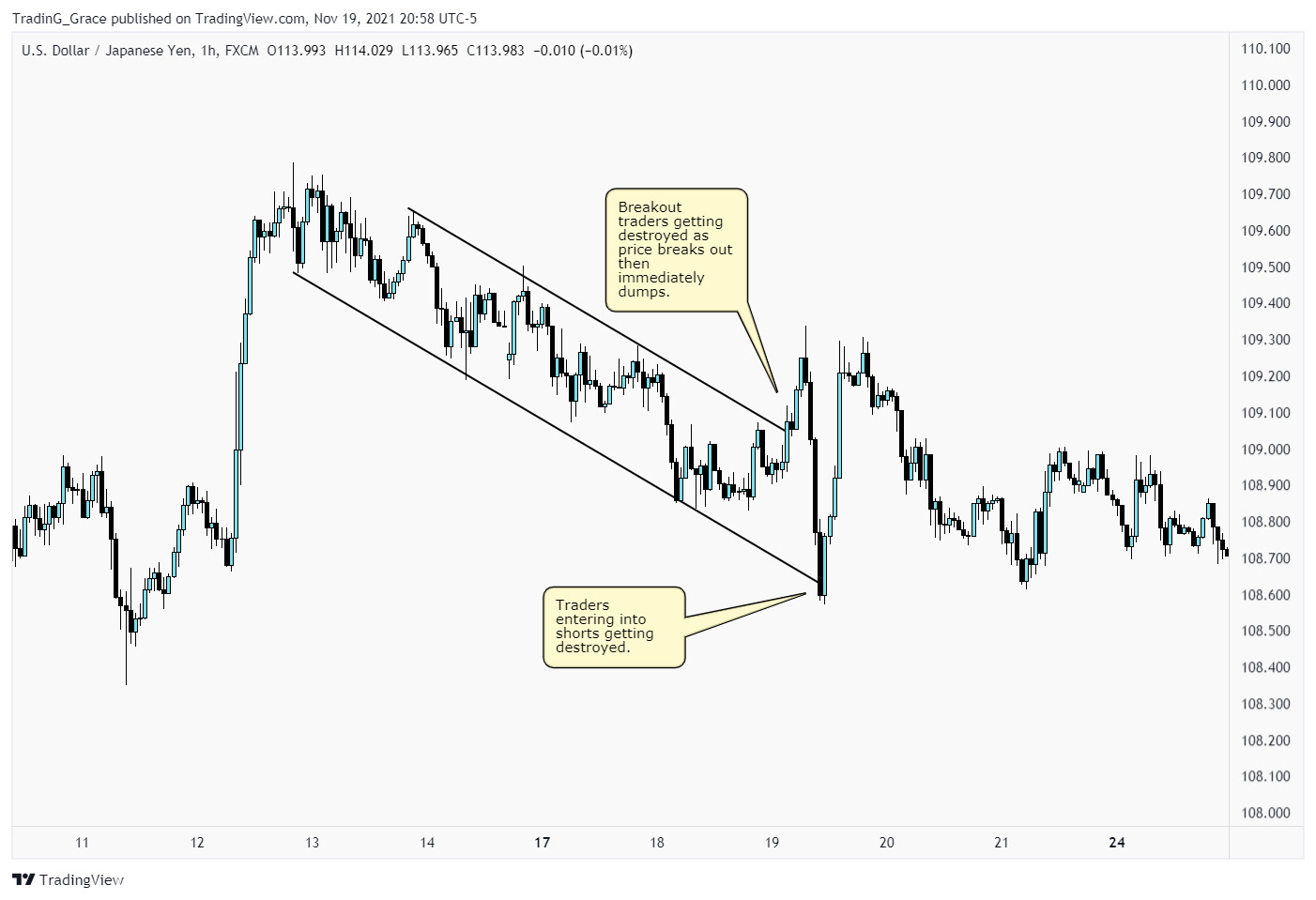
Let me give you something concrete. On April 28th this year, classic pre-May drift territory, I was watching GBPUSD on the 15-minute chart during the New York AM session. Price had been coiling since the London open, no real displacement, no clean BOS. The daily showed we were sitting dead in the middle of a premium/discount range, no POI above or below within reasonable reach.
And yet. There it was, a 15M FVG that had formed around 1.2734 from about 72 hours earlier, sitting untouched. Price began gravitating toward it around 10:15 AM EST. I felt the pull. This is a retest. This is confluent with a minor inversion FVG above it. I can enter at 1.2738, stop at 1.2718, that's 20 pips, risk 0.5% of the account.
The math worked. The label fit. But I ran my boredom audit (more on that in a moment), and question two stopped me cold: Is there a clear narrative from the higher timeframe that points price in this direction, or am I building the narrative to justify this specific level? Honest answer? I was building the narrative. The 4-hour had no directional bias. The daily was in equilibrium. I was looking at a valid-looking FVG in isolation because it was there, not because the market was actually offering me anything.
I didn't take the trade. Price wicked into that FVG, briefly tapped 1.2737, then continued drifting sideways for another two hours before fading 40 pips lower by end of day. Had I entered, my stop would have initially survived, which is almost worse, because it reinforces the behavior. Sometimes the most important thing to see isn't a winning trade. It's a trade you correctly didn't take.
The 'Sell in May' Effect on Your Psychology
This isn't a coincidence that I'm writing about this right now in early May 2026. Seasonal low volatility, the kind you typically see creep in as institutional desks wind down activity ahead of summer, creates a specific, chronic boredom pressure on active traders. The Q2 2026 market structure shifts we've been navigating have already compressed ranges and reduced the frequency of clean killzone displacement. When displacement is rare, your ICT setups are rare by definition, because the entire framework depends on purposeful institutional movement creating the inefficiencies you're hunting.
Rarer setups mean longer wait times. Longer wait times mean more boredom. More boredom means more manufactured trades. It's a direct chain, and recognising it as seasonal and structural, not a reflection of your skill, changes how you manage it psychologically.
The trader archetype I see most often during these conditions is what I'd call the Retroactive Analyst. This trader doesn't enter impulsively in an obviously reckless way. They're too educated for that. Instead, they spend twenty minutes studying the chart, build a technically coherent case, enter the trade, and only after it moves against them do they realise the whole analysis was constructed backwards from a conclusion they'd already reached. The conclusion being: I want to be in a trade right now. The analysis came second. It always does with boredom-driven entries, because the emotional decision precedes the technical justification.
If this sounds familiar, you're not alone. It's arguably more common among traders who have significant ICT knowledge, because they have a bigger vocabulary available to construct those retroactive justifications. Knowing what a Breaker Block is doesn't protect you, it gives you another label to misapply when you're bored.
The 3-Question Boredom Audit

This is what I actually use during dead killzone sessions when I notice myself getting drawn to a level that has no clear premium/discount array behind it on the higher timeframe. Three questions, in order, and you have to answer them before touching your entry.
Question 1: What is the higher timeframe narrative, and does this level align with it, or does the level exist independently of it?
Not 'is there a narrative I can construct.' Is there a narrative that already existed before you spotted this specific level? The daily and 4-hour bias should be established before you ever drop to the 15M. If you're constructing the HTF narrative after identifying the entry, the entry came first. That's boredom.
Question 2: Would I have this trade marked on my chart if I'd done my pre-session prep at 7 AM, before the killzone opened?
This one is ruthless. Pre-session prep is done with a clear head, no real-time price movement pulling at you, no opportunity cost feeling. If the level you're looking at now wasn't in your notes or marked before the session started, you need a very specific reason why it's appeared as a valid candidate mid-session. Sometimes there is one, a fresh displacement creates a new FVG that genuinely matters. But most of the time, the honest answer is no. And 'no' means you're manufacturing.
Question 3: How long have I been at the charts without a valid entry?
Keep a session log. If it's been two hours of watching without a clean setup presenting itself, your boredom threshold is almost certainly affecting your perception. This doesn't mean the next thing you see is automatically invalid, but flag it. Make the question conscious rather than unconscious. The simple act of writing '2h 15m since last valid opportunity' in your trade journal creates a pattern interrupt that often dissolves the manufactured-trade impulse on its own.
For more on what actually separates profitable FVG entries from ones that look valid but aren't, this pre-trade checklist covers the mechanical side in depth, pair it with the boredom audit and you've got both the psychological and structural filters running simultaneously.
What Ten Years Teaches You That One Year Can't
Here's the nuanced take that most ICT content misses entirely: boredom management isn't about having more discipline. Newer traders hear 'sit on your hands' and interpret it as a willpower problem, something to push through by gritting their teeth harder. That framing is wrong, and it produces worse outcomes because it creates performance anxiety around inactivity.
The reframe that actually works, the one I arrived at somewhere around year seven, is treating no-trade days as data collection days, not as failed trading days. During slow, ranging sessions like the ones we're seeing now in May, your job isn't to force participation. Your job is to watch price interact with the levels you've identified and update your model. Is the OB you marked last week holding? Is sell-side liquidity being respected or swept through? What does the 4-hour look like going into the next session?
This isn't passive or philosophical. It's active preparation that pays dividends when volatility returns. And more practically, it gives your brain something to do that isn't manufacturing entries, which is the entire point.
The risk of blowing a funded account is highest not during volatile news events where you're alert and engaged, but during exactly these slow drift periods where boredom creeps in under the radar. Understanding that is half the battle. Auditing it in real time is the other half.
For position sizing on the entries you do take, use the R2F risk calculator, because boredom-driven trades almost always involve unconsciously oversizing as a way of making a marginal setup feel 'worth it.' Keep your risk consistent whether the trade feels exciting or not. That consistency in itself is a diagnostic tool: if you're tempted to size up on a setup you can't cleanly explain in one sentence, that's your signal.
One Concrete Habit to Start This Week
At the end of every session this week, add one line to your trade journal: "What was my boredom level at the point of entry, on a scale of 1-10?" Don't change anything else. Just track it for five sessions. What most traders find when they do this is a clear correlation between higher boredom scores and lower-quality entries, entries that lose, or that technically win but feel uncomfortable during execution. That correlation, once you see it in your own data, does more for your trading psychology than any amount of content consumption.
If you want a structured environment to work through this, one that includes regular review of your decision-making process alongside the technical framework, the coaching options here are built specifically around ICT methodology and the psychological patterns that come with it. And if you're not sure where to start, booking a free discovery call takes ten minutes and gives you a clear sense of whether it's the right fit.
Boredom will be back next week. And the week after. The market doesn't owe you a setup just because you showed up. But showing up prepared for boredom, with a protocol, not just patience, is what separates the traders still in the game at year ten from the ones who washed out at year two.
Harvest Wright
ICT Trading Coach · 10+ Years Experience
Harvest specializes in ICT methodology and has helped traders pass prop firm challenges, develop consistent strategies, and build the psychology needed for long-term profitability.
Book a Free Discovery Call →Ready to Get Funded?
Our students pass prop firm challenges in under 60 days with personalized ICT coaching.
Book a Free Discovery CallFree ICT Funded-Trader Playbook
The setups, the pre-trade checklist, and the risk rules I use. Get it free.