
Why Winning Trades Feel Wrong at First
There's a specific moment in every high-quality ICT setup where most traders bail. Not after a stop-out. Not after a loss. They bail during a winner, right before price delivers, and the reason has little to do with discipline or screen time. It's psychological. And once you understand what's actually happening in that moment, the way you approach ICT trading psychology changes permanently.
Key Takeaway: The discomfort you feel between entry confirmation and price delivery isn't necessarily a signal that you're wrong. In ICT terms, that pullback is often the part of the move that shakes retail traders out of winning positions. Learning to sit inside that discomfort is the actual edge, not the entry itself.
A Worked Example
Here's the kind of setup I mean. Picture GBPUSD on the 15-minute chart, just after the London open.
Price sweeps the Asian session low with a clean wick, a proper liquidity raid. On the displacement candle back up, a Fair Value Gap prints. On the 5-minute chart, price retraces into the 50% level of that FVG. There's a 4-hour bullish Order Block just below. The daily draw is clear: unfilled buy-side liquidity from the previous week's range.
The long goes in at the FVG. The stop sits below the 4-hour Order Block and the sweep low, because if price closes under there the bullish idea is wrong. The target is that buy-side liquidity above. Clean. Textbook. Everything aligned.
And then price dips.
Not through the stop. Not enough to invalidate the setup. Just... heat. Staring at a position that looks wrong, sitting inside the FVG with the 4-hour OB holding underneath. The brain starts running the script: What if this is a trap? What if the daily is actually bearish? Maybe that sweep wasn't real liquidity.
Price consolidates for what feels like forever, and then either expands toward the target or it doesn't. Either way, nothing about that dip changed the setup. The stop is where the idea is wrong. The dip is just discomfort.
A lot of the time, that discomfort is part of how a good setup plays out.
What's Actually Happening in Your Brain
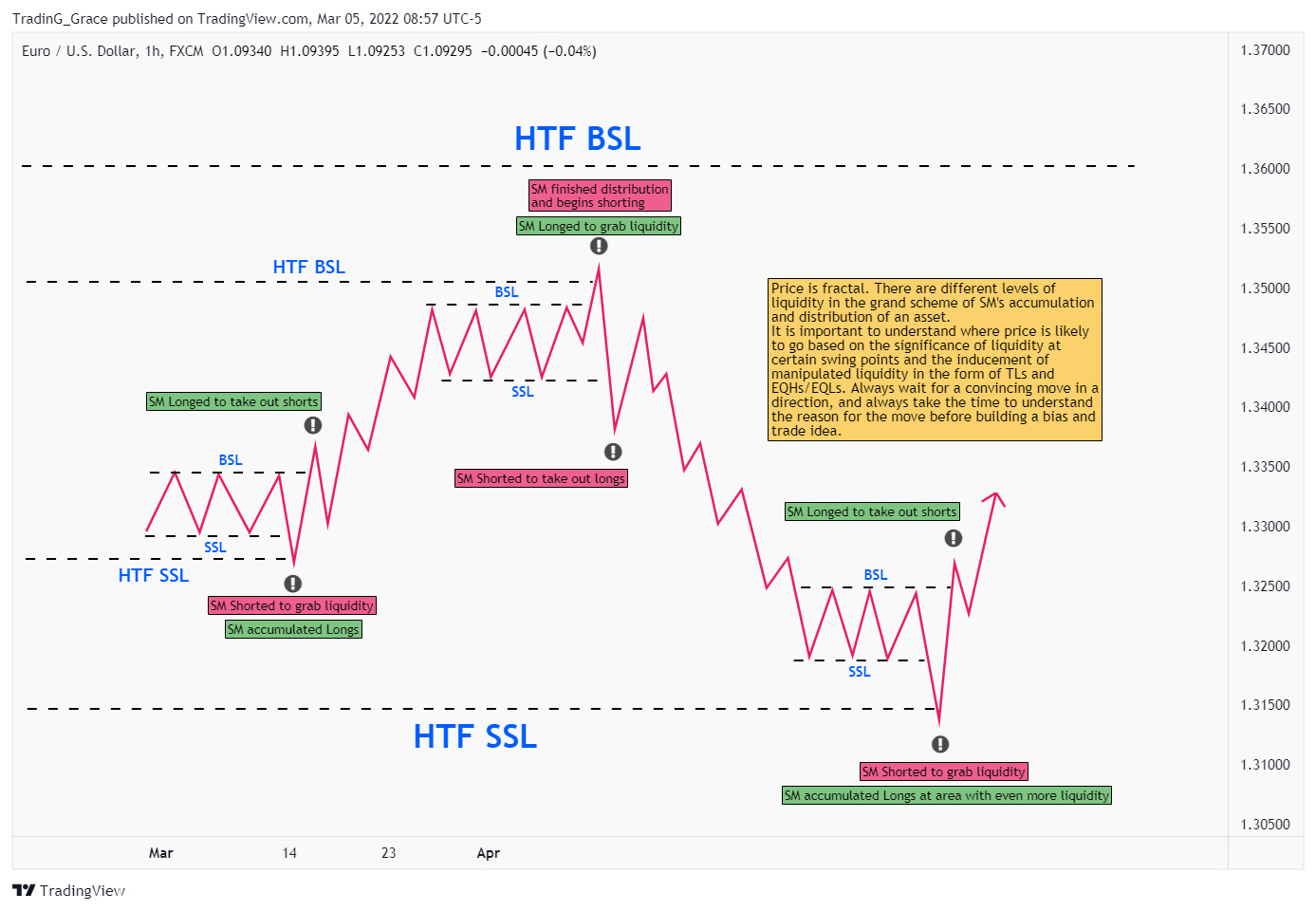
Here's what nobody in the ICT YouTube space talks about clearly enough: your nervous system is pattern-matched to the wrong outcomes.
If you've been trading for any length of time, especially if you came up through retail strategies, support/resistance, trendlines, indicators, your brain has logged thousands of reps where "feeling uncertain during a trade" correlated with a loss. That association sticks. Your gut doesn't distinguish between a bad trade and an uncomfortable winning trade. It just fires the same alarm: get out.
Behavioral economists call a related idea loss aversion, the asymmetric emotional weight we assign to potential losses versus gains. But in an ICT context, there's something more specific at play. Smart money structure is designed to trigger that alarm at the worst possible moment.
When price raids liquidity below a key level, displaces, then retraces into an FVG before delivery, that retracement is what shakes people out. It looks like weakness. It looks like the setup failed. Retail conditioning says: "price went the wrong way, cut the loss." But you're not in a loss. You're in a position that's consolidating before expansion, sitting inside a confirmed institutional footprint. The discomfort is the smart money tax. And most traders pay it without realizing it.
The Archetype I See Most Often
There's a particular type of trader who shows up in forums, in communities, everywhere, posting about how ICT concepts "don't work" or how they keep getting "chopped up" on Order Block entries. You dig into their trades and the pattern is often the same: they're entering correctly, getting legitimate heat during the consolidation phase, and exiting at breakeven or a small loss just before the move delivers.
They're not losing on bad trades. They're losing confidence on good ones.
What makes this brutal is that it creates a feedback loop. You exit a winner early because it felt wrong. Price runs without you. So now you add another data point to your subconscious: "this setup made me feel bad." The next time a similar structure forms, the alarm fires even faster. Within a few months, you've essentially trained yourself to avoid your best setups.
The fix isn't discipline. The fix isn't "trust your system." Those phrases mean nothing without understanding why the discomfort exists and what it's telling you within the specific language of ICT market structure.
Why This Moment Is Engineered
Let me be specific about the mechanics, because this is where most explanations fall short.
After smart money raids buy-side or sell-side liquidity, there's a rebalancing phase. Price doesn't just shoot from the liquidity grab to the target in a straight line, if it did, nobody would exit early. The rebalancing phase is where price revisits the inefficiency (the FVG), often dipping slightly into it, sometimes sweeping a minor internal level before committing to the directional move.
This phase looks like failure. It looks like the setup is invalidating. And it tends to last just long enough to test how long a retail trader can psychologically sit through it.
I've written about this mechanical behavior in more depth in my breakdown of Q2 2026 market structure shifts, but the psychological dimension is what this article is about. The structure creates the doubt on purpose. Understanding that flips the signal: instead of discomfort meaning get out, it starts meaning this is working.
A rule I see a lot: "if a trade goes more than halfway to my stop, I close it." Seems logical. But on setups like the one above, it means exiting at exactly the point where smart money is running the final retail purge before expansion. You pay the tax and book nothing.
A Framework for Sitting in Discomfort
This is the practical part. Not theory, a process you can apply to the next trade you take.
Step 1: Define your invalidation before entry, not during it. Write down, literally write it, the exact price level that would make your thesis wrong. For an OB entry, it's a close below the OB's low on the entry timeframe. Not heat. Not red candles. A close. Anything above that level means your thesis is intact, regardless of how it looks.
Step 2: Separate "uncomfortable" from "invalid." Once you're in the trade, ask one question: has price closed below (or above, for shorts) my invalidation level? If the answer is no, the discomfort is noise. Label it out loud if you have to, "this is the rebalancing phase". Naming what's happening makes it easier to stay rational.
Step 3: Use the ICT FVG checklist framework before entry to build pre-trade conviction. The more confirmed your entry before you're in, the more conviction you have to draw on when the heat comes. Traders who rush entries don't just have worse R:R, they have less psychological buffer for the rebalancing phase.
Step 4: Track the discomfort, not just the outcome. For every trade you take this week, score the discomfort level from 1-5 at two points: entry and during the rebalancing phase. After a month, compare those scores against your results. If some of your most uncomfortable trades turn out to be good winners, that data will change the association faster than any mindset content.
Step 5: Reduce position size to reduce noise. This is the one nobody wants to hear. If you're sizing at 1-2% and the heat is making you close winning trades, the problem might be size, not psychology. Drop to 0.25-0.5% on setups where you historically exit early. Use the risk calculator to model what that actually looks like in dollar terms. Small enough to hold. Large enough to care.
The Longer You Trade ICT, The Quieter It Gets
Ten years of watching price move through ICT structure does something specific to your perception of heat. The discomfort doesn't disappear, I still feel it. But it shifts from an alarm to information. "Price is in the FVG. It's holding above the OB. The draw is intact. This is the rebalancing phase." That internal script can replace the old one, but it takes a lot of reps.
If you're newer to this and the discomfort is genuinely derailing your execution, that's worth addressing before scaling up. The ICT liquidity grab vs stop hunt breakdown covers some of the structural mechanics that will help you identify which discomfort is signal versus noise. And if you're looking at funded account environments specifically, this piece on the 7 mistakes that kill funded challenges goes into how this psychology dynamic plays out when there's evaluation pressure on top of normal trade management stress.
The gut feeling that says "this trade is wrong" is real. It's just been calibrated by years of retail conditioning to fire at exactly the wrong moment. Rewiring it isn't a mindset shift. It's repetition, structure, and data, running the same confirmations until the pattern recognition updates.
Your discomfort is telling you something. After long enough, you'll know exactly what it means.
If you want to work through this systematically, building the pre-trade conviction and post-trade review process that actually accelerates the rewiring, the coaching options on this site cover everything from weekly accountability to full mentorship. The place to start is figuring out which level fits where you are right now.
Harvest Wright
ICT Trading Coach · 10+ Years Experience
Harvest specializes in ICT methodology and has helped traders pass prop firm challenges, develop consistent strategies, and build the psychology needed for long-term profitability.
Book a Free Discovery Call →Ready to Get Funded?
1-on-1 ICT coaching built around prop firm rules, from a trader who has passed an FTMO Challenge.
Book a Free Discovery CallFree ICT Funded-Trader Playbook
The setups, the pre-trade checklist, and the risk rules I use. Get it free.