
Why Revenge Trading Feels Like Discipline
Every trader knows revenge trading is a problem. You take a loss, you feel that heat in your chest, you jump back in with double size trying to claw it back, classic story, right? Except the version of revenge trading that actually destroys accounts doesn't look anything like that. It doesn't announce itself. It doesn't feel reckless. It feels like composure. It feels, almost exactly, like discipline.
Key Takeaway: The most destructive form of revenge trading is indistinguishable from a legitimate ICT setup, same order block, same FVG, same checklist ticked. The only difference is what's actually driving the entry: edge, or emotional recovery. And the chart can't tell you which one it is.
The Version Nobody Warns You About
Most revenge trading content describes the obvious case. You lose a trade, you get angry, you throw 5% at the next setup because the market "owes you" something. That version is bad, but it's visible. You can feel the heat, you know you're off-script, and most experienced traders have enough self-awareness to step back.
The version that actually costs money over the long run? It's calm. It's methodical. The trader looks at the chart after the loss, takes a breath, and says: "Okay. Let's be disciplined. Let's find the next setup."
And then they find one. An order block forms. There's a fair value gap above it. Price swept a short-term low. The 15-minute structure aligns with the hourly narrative. The checklist is ticked. They enter.
From the outside, from the chart, from the trade log, it looks clean. But from the inside, the actual question driving that entry wasn't "Does this setup have edge?" It was "Can I get back to breakeven before I close the platform today?"
That's the trap. And I've watched traders with two, three years of ICT experience fall into it repeatedly because they never learned to audit the why behind an entry, only the what.
A Worked Example

Let me make it concrete. Picture GBPUSD during a London session. A trader shorts off a 15-minute bearish order block, stop above the OB high because a close above it means sellers have lost control, targeting the sell-side liquidity below the session low. The trade reverses and stops out cleanly. No chase, no emotional response. They log it, note the execution was correct, and move on.
Then, half an hour or so later, they spot what looks like a secondary entry. A 5-minute FVG has printed just below the original order block zone. Structure on the 15-minute is still nominally bearish. There's a minor liquidity sweep to the upside. On paper, it's a valid setup.
They enter short again, this time with a much tighter stop. And it stops out again.
Here's what honest self-review of that second trade sounds like: "Second entry was technically justifiable but I know why I took it. I wanted the loss back. The FVG was real but the timeframe compression was a red flag I ignored because I needed a winner. That's revenge trading wearing a good suit."
The setup had structure. The model was there. But the trader was trading the P&L, not the setup. That distinction is everything.
Myth, Reality, What I Actually See
Myth: Revenge trading is easy to identify because it involves emotional, oversized, impulsive entries that any disciplined trader can recognize and stop.
Reality: The version that persists into experienced trading is subtle, composed, and structurally justified. The checklist is ticked not because the setup is high-probability, but because the trader needs the checklist to be ticked. The ICT framework, ironically, becomes the perfect costume for emotional entries, because it provides so many legitimate-sounding reasons to be in a trade.
What I Actually See: A pattern I notice in the trading community again and again, the trader who is meticulous about their model, who can articulate every confluence, who trades the right pairs and the right sessions, but who consistently underperforms their backtested results. When you look at the trade history, there's a recurring signature: clusters of two, three, sometimes four entries within 60-90 minutes of each other, usually following an initial stop-out. The first trade? Often solid. The ones after it? Tighter stops, more compressed timeframes, more marginal confluences. That's not bad strategy. That's emotional recovery disguised as strategy.
The archetype here is what I'd call the Structured Avenger, the trader who has done enough work to know they can't rage-trade, so instead they channel the same emotional energy into technically-framed entries. They're not blowing 5% at once. They're bleeding 0.5% at a time, three entries in a row, and telling themselves they were disciplined because the order blocks were real.
Why ICT Traders Are Especially Vulnerable
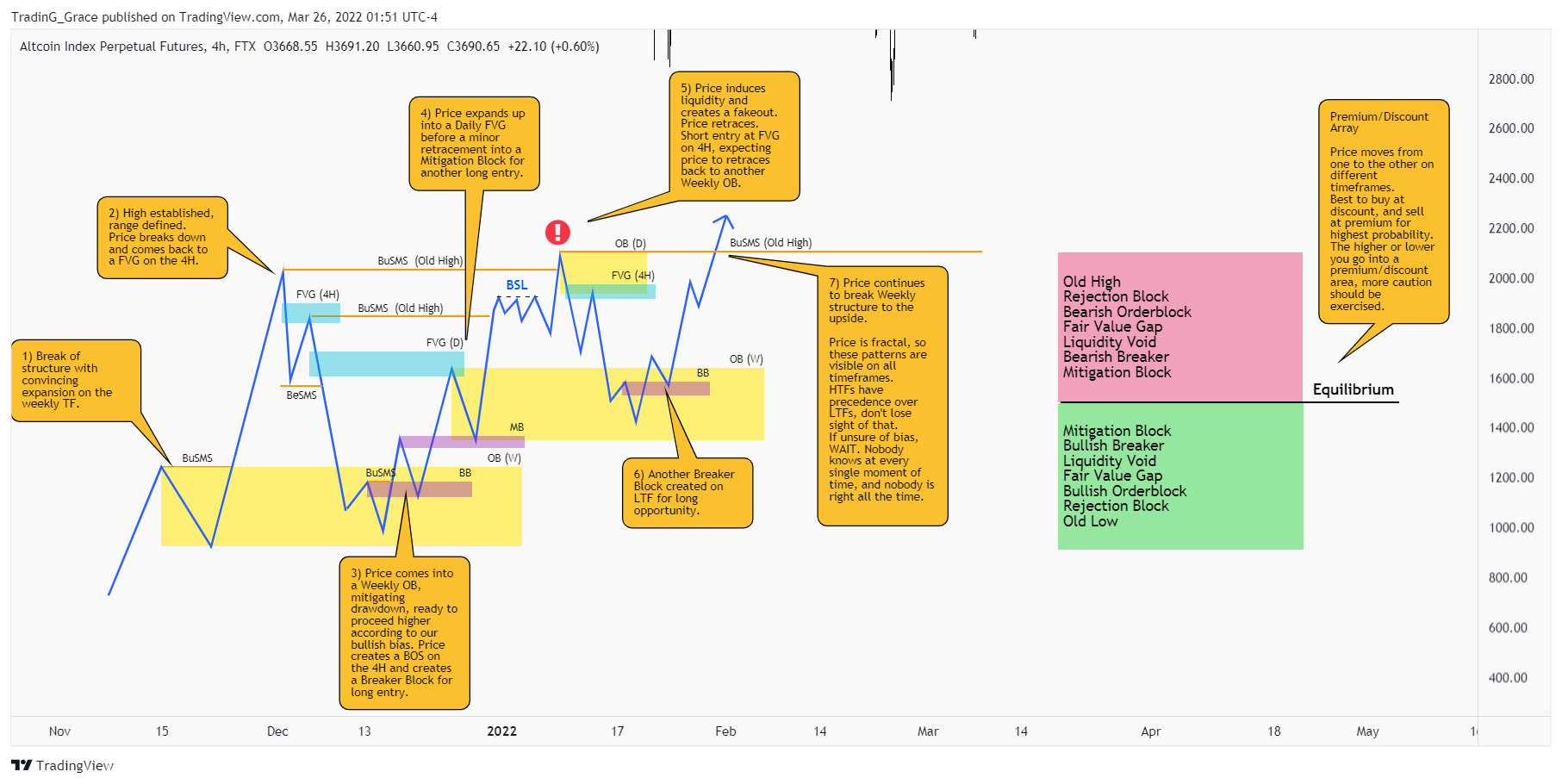
This is the nuanced take that I don't see enough people discuss: the richer your framework, the easier it is to justify any entry.
A price action trader with only support/resistance has fewer confluence factors to cherry-pick from. An ICT trader has order blocks, fair value gaps, breakers, mitigation blocks, optimal trade entries, session liquidity, PD arrays, market structure shifts, NWOG, NDOG, the list goes on. Every one of those concepts is legitimate. But having 15 legitimate tools means you can always find three or four that align with where you want to trade.
This is something a one-year trader doesn't fully grasp. More confluence can actually make emotional entries easier to commit to, not harder. The model becomes a justification engine. I've seen traders take a setup that had two real confluences and three forced ones, enter, lose, and then genuinely believe the trade was correct execution, because they found the OB, found the FVG, found the sweep. They weren't wrong about the structure. They were wrong about why they were looking for it.
If you want a deeper look at how the ICT framework can create false confidence in marginal setups, the breakdown in why your ICT order blocks keep failing in ranging markets is worth reading alongside this one.
The Pre-Entry Emotional Audit: A Practical Framework
Here's how I actually catch this in real time. Before any entry, but especially within 90 minutes of a stopped trade, I run through what I call the three-question audit. It takes 60 seconds. It has saved me from bad trades more times than any chart confirmation ever has.
Question 1: What would I do if I hadn't just had a loss? Not rhetorically. Literally. If this were the first time I was opening the platform today, would this setup meet my threshold for entry? If the honest answer is "probably not, it's a bit thin," that's your answer. The loss changed your threshold, not the setup's quality.
Question 2: Am I compressing timeframes to find confluence that isn't on my primary timeframe? Dropping from 15-minute to 5-minute to 3-minute to find an FVG that "confirms" a marginal OB is a classic signature of emotional entry. My rule: if I need to go more than one timeframe below my execution frame to build the case, the case isn't there.
Question 3: What is the actual driver, edge or recovery? This one requires honesty that most traders aren't willing to bring to themselves. Say it out loud if you have to. "Am I entering because this setup has edge, or because I want to be back at breakeven?" The uncomfortable truth is that your nervous system knows the answer before your rational brain has finished constructing the justification.
If any of these questions produces an uncomfortable pause, that's your signal to stand down. Not forever, just for that entry, in that moment.
For the position sizing mechanics that sit alongside this, specifically how to structure your risk so a single stop-out doesn't create the emotional pressure that triggers this pattern in the first place, our risk calculator is a practical starting point.
The Hard Truth About "Staying in the Game"
One more thing needs to be said here, because I used to get this wrong myself.
There's a version of revenge trading that dresses up as professional resilience. The internal narrative sounds like: "A real trader doesn't let one loss shake them. I'm staying focused, staying engaged, staying in the game." It sounds like mental toughness. It sounds like what you're supposed to do.
But there's a difference between staying in the game (being psychologically available to trade the next genuinely high-quality setup) and staying active (needing to enter because inactivity feels like losing). The second one is revenge trading. It's just wearing a motivational poster instead of showing up as anger.
Real discipline, after a loss, often looks like doing nothing. It looks like closing the chart, logging the trade, and waiting, not for the next entry, but for the emotional charge to discharge completely. That can take 30 minutes. It can take the rest of the session. The market will have setups tomorrow. The setup you manufacture today from a place of emotional recovery will cost more than the original loss.
If this pattern is one you recognise in yourself, and most serious traders eventually do, the funded account context makes it significantly more costly. The pressure of drawdown limits creates a feedback loop where losing trades generate more urgency, which generates more marginal entries, which generates more losses. That cycle is exactly what breaks challenges that should have been passed. The breakdown in 7 fatal mistakes that kill your funded account challenge success gets into the structural side of that, and it's worth pairing with the psychological layer we've covered here.
In my experience, emotional decisions after losses do more damage to accounts than gaps in technical knowledge. A lot of traders who blow accounts aren't technically incompetent. They're emotionally unaudited.
Where This Leaves You
The framework is simple, even if applying it isn't: audit your emotional state before you audit your chart. The chart will always have something to offer if you look hard enough. Your emotional state is the variable that determines whether you're trading edge or trading recovery.
Run the three-question audit every single time you enter within 90 minutes of a loss. Make it non-negotiable. Write it on a sticky note if you have to.
And if you want a structured environment for working on this, not just the conceptual layer but the actual execution habits that make consistent ICT trading viable, take a look at the coaching plans we offer. The psychological infrastructure is built into the framework, not treated as an afterthought.
The trading insights archive also has more on how shifting market structure can create the conditions where this pattern shows up, including why Q2 2026 market structure shifts are breaking traditional ICT setups, which is directly relevant if you're finding your setups are working in backtesting but failing in live execution right now.
The setup was real. The order block was valid. The problem was never the chart.
Harvest Wright
ICT Trading Coach · 10+ Years Experience
Harvest specializes in ICT methodology and has helped traders pass prop firm challenges, develop consistent strategies, and build the psychology needed for long-term profitability.
Book a Free Discovery Call →Ready to Get Funded?
Our students pass prop firm challenges in under 60 days with personalized ICT coaching.
Book a Free Discovery CallFree ICT Funded-Trader Playbook
The setups, the pre-trade checklist, and the risk rules I use. Get it free.