
The Quiet Confidence Loop ICT Traders Miss
There's a specific kind of silence that happens right before a trader quits. Not dramatic. Not loud. It's the silence of someone who has seen a setup form perfectly, FVG, displacement, clean inducement run, and still can't pull the trigger. They know what they're looking at. They just don't trust themselves to act on it anymore. That silence is a broken feedback loop. And in over ten years of trading, it's one of the most common things I see wreck otherwise capable traders, more often than losses or bad setups. The ICT trading mindset collapse usually traces back to one specific mistake: they switched something at exactly the wrong moment.
Key Takeaway: Confidence in ICT trading isn't built by winning more, it's built by completing a specific 3-stage loop of rep stacking, live micro-wins, and identity anchoring. Most traders break this loop every time they tweak their model, and they don't realize the loop has to restart from scratch when they do.
The Real Confidence Killer Isn't What You Think
Every trading psychology article you've ever read tells you some version of the same thing: journal your trades, trust your system, manage your emotions. That advice isn't wrong. It's just incomplete in a way that's almost cruel, because it tells you what without telling you why the system stops working for you.
Here's what I've actually observed: the traders who spiral aren't the ones taking losses. Losses inside a model you understand are actually fine, they're data. The traders who spiral are the ones who took three losses in a row, watched a YouTube breakdown of a "better" OB entry technique, quietly incorporated it, took two more losses, then found a different liquidity model, tweaked their session bias rules, and three weeks later are sitting in front of a chart they technically know but emotionally don't recognize anymore.
That's model-hopping. And it doesn't just hurt your win rate. It destroys your confidence architecture, the invisible internal structure that lets you act without hesitating when you see price behave correctly.
The reason this matters specifically to ICT traders is that ICT methodology has so many individually coherent concepts that you can rationalize almost any change. Added a PD array filter? Sounds reasonable. Switched from the 15m to the 5m for entry refinements? Makes sense. Started using AMD on the 1-hour instead of the 4-hour? Sure, plenty of people do that. Each tweak feels like improvement. Collectively, they reset your reps to zero. If you want to understand exactly how this pattern plays out and why it's so hard to catch in yourself, the boredom problem every ICT trader ignores is worth reading alongside this.
What the Loop Actually Looks Like
I want to walk you through the three stages deliberately, because naming them matters. When you can see where you are in the loop, you stop panicking about being early in it.
Stage 1: Rep Stacking
This is pure backtesting volume, but with a specific constraint: one model, one session, one pair, 90 days minimum. Not multi-pair. Not "I'll test London and New York separately." One thing, studied until the pattern recognition becomes almost boring.
Boring is the signal. When you're bored by a setup because you've seen it 200 times, your brain has stopped treating it as a threat. That's not complacency, that's calibration. The ICT trading mindset work that actually matters happens here, in the repetition phase, before a single live dollar is at stake.
A common version of this: market structure shifts tempt a trader into adjusting their New York model mid-quarter. They start taking setups that don't match their original parameters and call them "adaptations." The fix is to stop trading for a couple of weeks and re-stack reps on the base model. Uncomfortable? Yes. Necessary? Completely.
Stage 2: Live Micro-Wins
This is where most frameworks skip a crucial step. They go from backtesting straight to "now trade your plan live." But there's a middle layer that matters enormously: structured low-risk live confirmation.
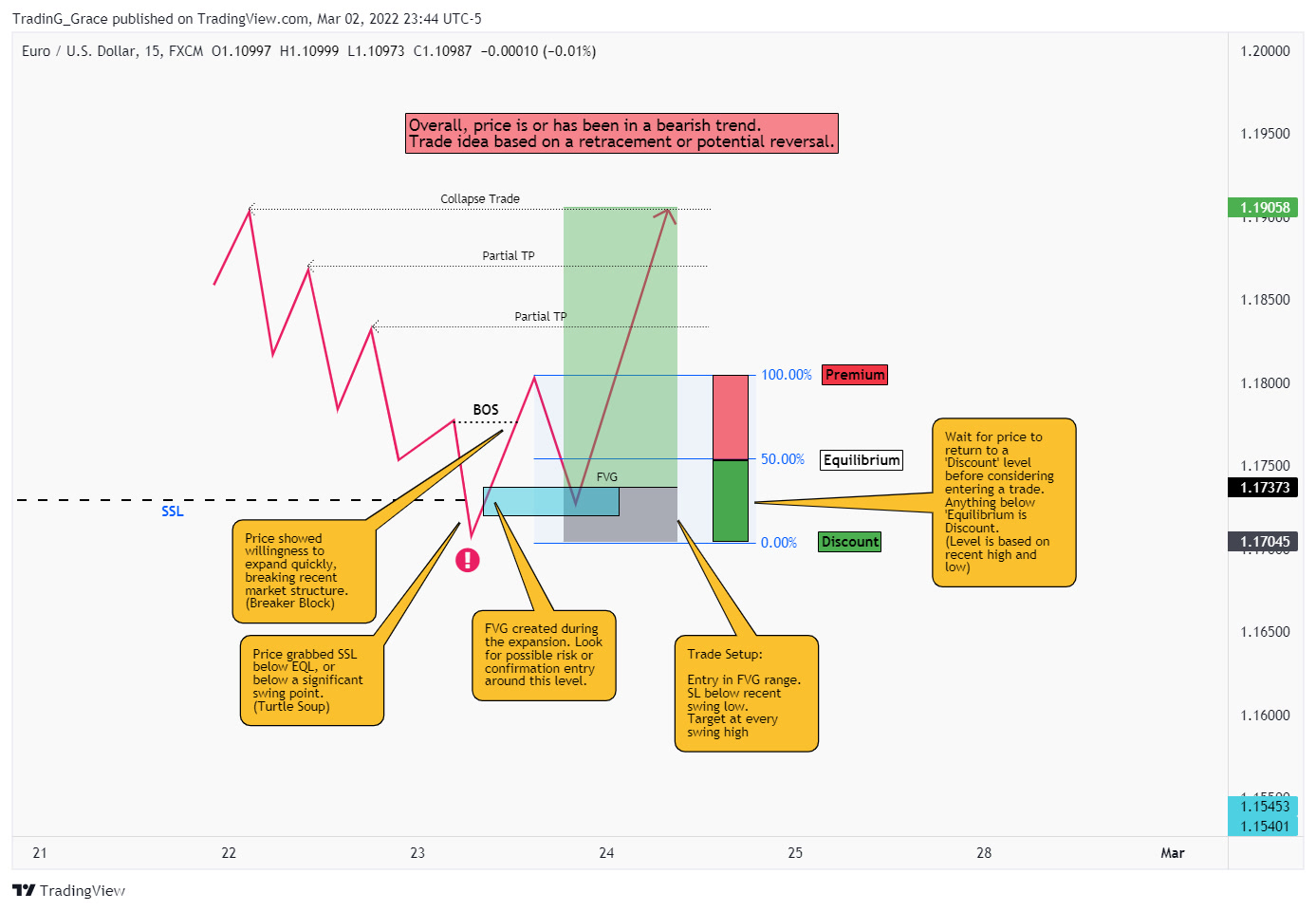
Here's what this looks like in practice. After re-establishing your model reps, run a short micro-risk phase, say 10 sessions on GBPUSD 15m during the London open, exclusively targeting Fair Value Gaps formed after clear displacement moves. Position size: something tiny, like 0.25% per trade. The goal isn't profit. The goal is live confirmation that your read of the model matches live price behavior.
Here's the kind of trade I mean. Around the London open, a three-candle displacement leg pushes through a prior 4-hour swing, creating a textbook FVG on the 15m chart. Price pulls back into the gap. Entry inside the gap, stop just beyond the displacement origin because that's where the move would be proven wrong, target the Asia session high because that's the nearest obvious liquidity. Whether that one trade wins or loses matters less than whether price behaves the same way live as it did in your backtest. That confirmation is Stage 2's entire purpose.
Without this micro-win phase, traders jump to full size with backtest confidence, which is theoretical, and get shaken by the emotional weight of real money before their nervous system has had a chance to connect "seeing the setup" to "this works in real time."
Stage 3: Identity Anchoring
This is the stage almost nobody talks about, and it's where the loop either closes or breaks permanently.
Identity anchoring is the internal moment where you shift from "I am trying to trade this model" to "I am a trader who trades this model." That distinction sounds soft. It isn't. Behaviorally, it changes everything, because your brain will protect and reinforce an identity in ways it simply won't do for a strategy you're testing.
For ICT traders specifically, this anchoring happens through evidence review, not affirmations. Take your last 30 live trades under the current model. Count the setups where price behaved as your model predicted, regardless of whether you took the trade or managed it well. That count is your evidence base. When you can look at 20 out of 30 setups where the model was structurally correct even in losses, where you were stopped out by normal volatility, not by being wrong about direction, your identity shifts. You stop saying "this doesn't work for me" and start recognizing that you interrupted the model.
The Archetype That Keeps Breaking the Loop
There's a specific trader pattern I see consistently across forums, Discord servers, and trading communities: the Perpetual Refiner. This trader has genuinely good technical knowledge. They can identify displacement, they understand the AMD cycle, they know the difference between a valid OB and a random candle. But every time they hit a two-week drawdown, they find something to optimize.
The Perpetual Refiner isn't undisciplined. That's what makes it hard to diagnose. They're applying discipline, just to the wrong thing. They're disciplined about improving the model when what actually needs attention is completing the loop. The model is fine. The identity hasn't anchored yet. And every refinement resets Stage 1.
If you recognize yourself here, the fix isn't to stop thinking critically about your model. It's to separate refinement windows from execution windows. Pick a quarterly review date. Everything you want to change gets written down and evaluated then, not during a losing stretch. During an active trading phase, the model is frozen. You're only in execution mode.
For more on how model stability interacts with funded account rules, where this pattern becomes especially costly, this breakdown on funded account mistakes is worth reading before you touch another prop challenge. And if you've read about why discipline breaks down after winning streaks, you'll recognize the same Perpetual Refiner pattern showing up in a different disguise.
Rebuilding the Loop Deliberately

If you've identified that your loop is broken, you switched timeframes, added three new filters, or moved from Forex to indices mid-model, here's the exact restart protocol I use:
Week 1, 2: Declare a model freeze. Write down the current version of your entry rules in one paragraph. That's the model. Nothing gets added or removed for 60 days.
Week 2, 4: Run 60, 90 backtest sessions on that frozen model. One pair, one session window, one entry type. Log whether the model was correct, separate from whether you executed well. You're building rep volume, not a track record.
Week 4, 6: Move to the micro-risk live phase. 0.25%, 0.5% per trade, targeting 10, 15 live executions. The only metric that matters: did price behave as the model predicted? Win rate is secondary here. You're looking for structural confirmation.
Week 6, 8: Do the identity audit. Review your last 30 model setups (backtest + live). Mark each one where the model's read of structure was correct. If that number is above 60%, you have an evidence base. Write a single sentence: "My model identifies [X setup] correctly in [Y context] the majority of the time." That's your anchor statement. Not an affirmation, a documented conclusion.
The ICT trading mindset most people are chasing isn't about being fearless. It's about having closed the loop enough times that hesitation shrinks on its own. You can read more on how these concepts intersect with live market conditions and FVG execution here.
For position sizing during the micro-risk phase, I recommend using a dedicated risk calculator so that percentage risk stays exact, removing one more variable from the emotional equation while the loop is rebuilding.
One Honest Admission
I used to think confidence was downstream of performance. Win more, feel better, trade better. That's the logic almost everyone operates on, and it's circular in a way that traps you. Because when you're in drawdown, which is inevitable, that logic means your confidence should be low, which means your execution suffers, which means the drawdown extends, which confirms the low confidence. Round and round.
The loop I've described here breaks that cycle because it generates confidence structurally, not from outcomes. You're not waiting to win. You're completing stages. And once you've run the full cycle two or three times, rep stacking, live confirmation, identity anchoring, you start to recognize exactly where you are when things feel uncertain. Usually it's Stage 1 again. And Stage 1 has a very specific fix: more reps, fewer changes, frozen model.
That recognition alone is worth more than any mindset mantra I've ever heard.
If you want to work through this loop with structured guidance, the coaching plans on this site are built around exactly this kind of systematic confidence-building, not just strategy review. And if you're not sure where you are in your own loop right now, the best first step is a free discovery call to map it out before the next trading week starts.
Harvest Wright
ICT Trading Coach · 10+ Years Experience
Harvest specializes in ICT methodology and has helped traders pass prop firm challenges, develop consistent strategies, and build the psychology needed for long-term profitability.
Book a Free Discovery Call →Ready to Get Funded?
Our students pass prop firm challenges in under 60 days with personalized ICT coaching.
Book a Free Discovery CallFree ICT Funded-Trader Playbook
The setups, the pre-trade checklist, and the risk rules I use. Get it free.