
The Trader Identity Trap Keeping You Stuck
There's a psychological trap sitting in the middle of most traders' accounts, and it has nothing to do with your entry timing, your stop placement, or whether you're using the correct Premium/Discount arrays. It's quieter than that. And it's doing far more damage to your trading psychology than any bad setup ever could.
The trap is this: you stopped being a trader who uses ICT concepts, and became 'an ICT trader', and that shift in language, as small as it sounds, rewired how your brain processes every single loss you take.
Key Takeaway: When traders fuse their self-worth with their methodology label, every losing trade becomes a personal attack rather than market feedback, causing them to over-trade setups, hold losers past invalidation, and ignore obvious signals that contradict their bias. The fix isn't more discipline. It's deliberately separating who you are from how you trade.
The Mechanism Nobody Talks About in Trading Psychology Content
Most trading psychology content hits the same notes. Emotional control. Discipline. Journaling. Following your plan. All valid. All incomplete.
What gets skipped, almost universally, is a specific mechanism I've started calling method-identity fusion. It's the point where a trader no longer evaluates a setup on its own merits, but instead filters every decision through the lens of proving their methodology correct.
Here's how it develops. You find ICT concepts. The liquidity theory makes sense. The Fair Value Gaps click. The Order Block logic explains market moves you couldn't understand before. You go deep. You watch hundreds of hours. You practice. You build conviction.
And slowly, without noticing it, you stop evaluating whether this specific setup is valid, and start defending whether ICT as a system is valid.
That's the trap. Because now every losing trade isn't just a losing trade, it's evidence against your identity. And your brain will do almost anything to avoid that conclusion.
What This Actually Looks Like in Real Trades
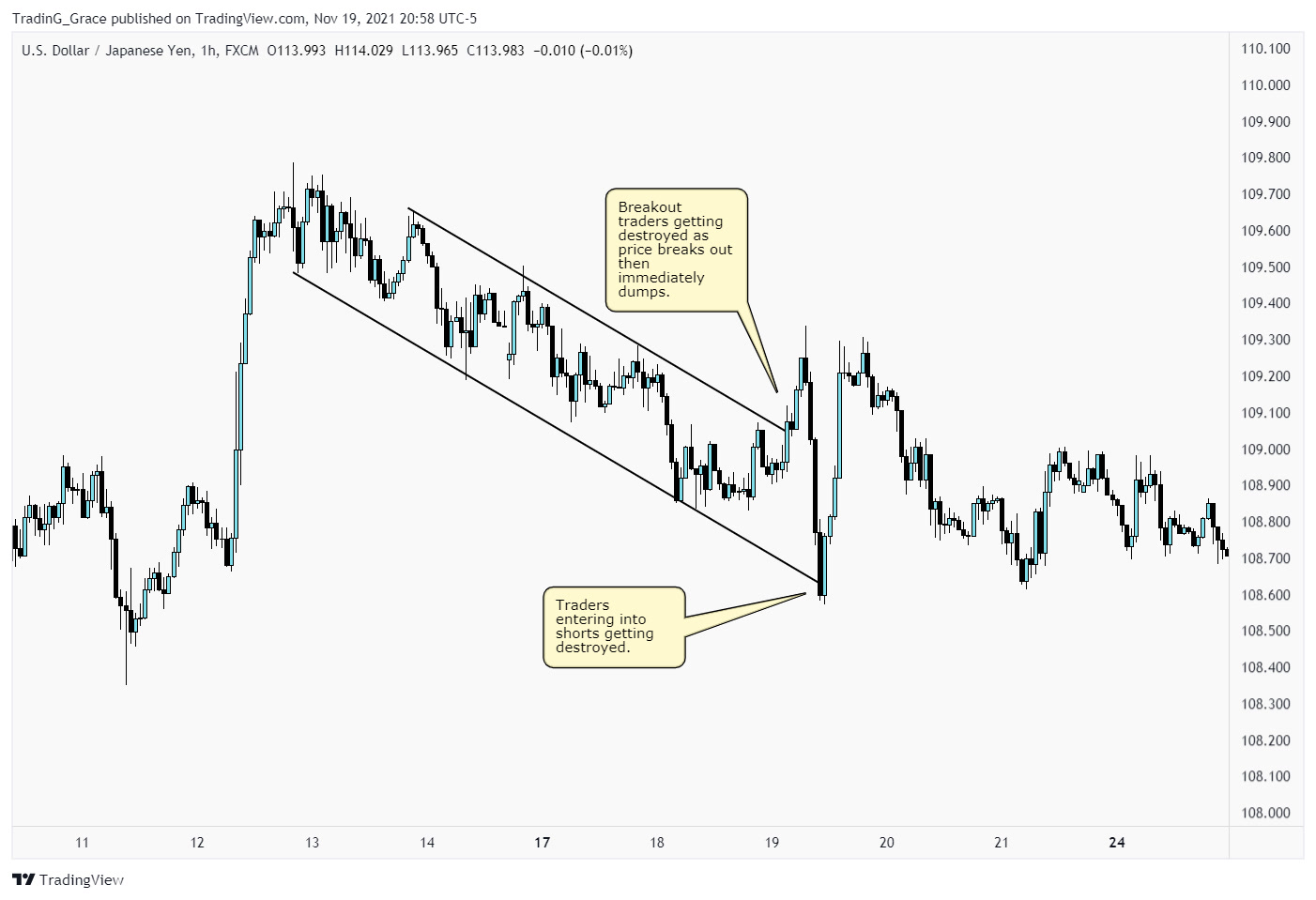
Let me give you a worked example, because this isn't abstract.
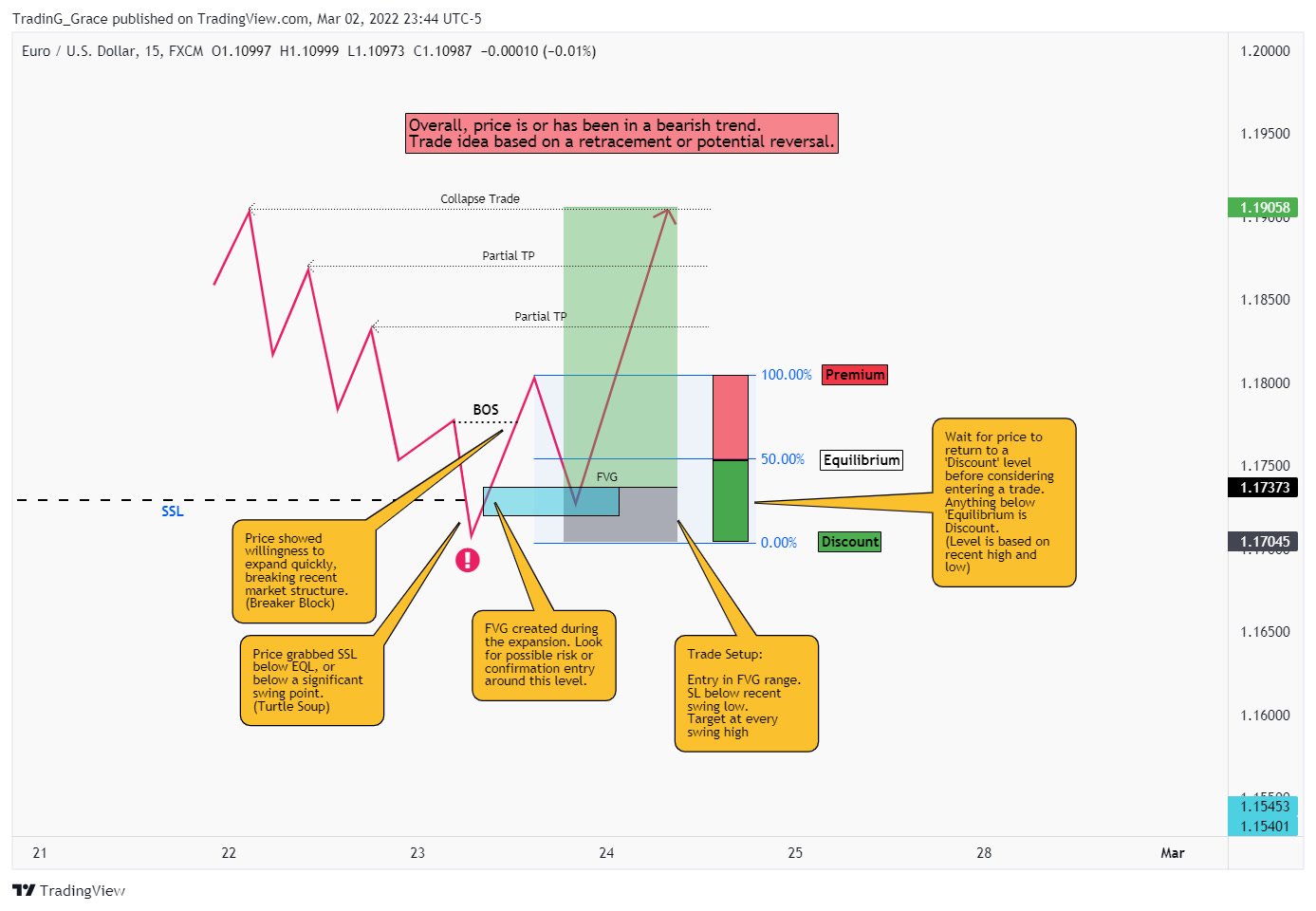
Picture GBPUSD on the 15-minute chart. London has already run the liquidity above the Asian high, a bearish displacement candle prints, and a Fair Value Gap forms. The short goes in at the gap, with the stop above the displacement high, because a move back above that high means the sell-off failed. The target is the 4H internal low below, the nearest obvious sell-side liquidity.
Then price retraces into the gap, stalls, and does something unexpected. Instead of delivering, it prints a strong bullish displacement candle back through the FVG. The gap is violated. In ICT terms, the setup is dead.
Here's what a lot of traders feel in that moment: resistance. Maybe not to cutting the trade, but to admitting the narrative was wrong. The brain immediately starts building a counter-case. Maybe it's just a liquidity sweep above the gap. Maybe it needs more time. The daily bias is still bearish.
None of those thoughts come from price action analysis. They come from identity protection.
I'll get to the framework, but sit with that for a second. That moment of internal resistance is the trap activating. Miss it, and you end up holding the trade deeper into the red looking for the 'real' move.
Myth / Reality / What I Actually See
Myth: Traders hold losers too long because they don't have a proper stop-loss rule.
Reality: Most traders holding losers past invalidation have a stop-loss rule. They're just not running it, because somewhere between the setup and the drawdown, protecting the trade became synonymous with protecting their identity.
What I Actually See: A very specific archetype I see over and over. The trader who takes a few technically valid ICT setups per week, journals them beautifully, talks about their bias with real sophistication, and still ends each month slightly red. When you look closely at their losers, there's a pattern: the losing trades are held a lot longer than they should be. Not because they don't know better. Because they need the trade to work to confirm they read the market correctly.
This trader will take a 4R loss on a setup that should have been a 1R loss, simply because exiting at the technical invalidation point feels like conceding the whole narrative was wrong. And they'd rather bleed another 80 pips than feel wrong about their ICT read.
This same mechanism also drives over-trading. If you subconsciously need your methodology to be validated, you will take setups that don't quite meet your criteria, because more trades means more chances for the method to prove itself. This pattern shows up constantly in funded account environments, where the pressure to perform accelerates the identity defense to a breaking point.
The Contrarian Take: Discipline Isn't What's Missing
Every piece of conventional trading psychology advice eventually lands on discipline as the answer. Build better habits. Create rules and follow them. Use checklists.
Here's what a decade of watching traders, and watching my own patterns, has taught me: discipline built on top of a fused identity still fails. Because discipline is a cognitive resource. And when you're in active identity-defense mode, you will rationalize your way around every rule you've set.
The checklist you built for FVG confirmations? You'll find a way to tick every box on a setup that doesn't deserve it, because you want it to work. I've seen traders with 9-point confirmation checklists still take bad trades, they just spend more time justifying why the setup qualifies before they do.
This is what most ICT YouTube content misses entirely. The conversation stays at the technical layer, better entries, tighter stops, more confluences, when the actual problem is operating one layer beneath all of that.
The traders who finally break through aren't the ones who got more disciplined. They're the ones who stopped needing to be right about ICT.
The Identity Separation Framework (Use This Today)
This is the practical piece. Not abstract mindset advice, a repeatable process.
Step 1: Audit your self-talk around losses. After your next losing trade, write down exactly what you thought in the 60 seconds after you closed it. Specifically, look for phrases like 'the setup should have worked,' 'the market was wrong,' or 'I just need more confluences next time.' Those phrases are identity signals, not analysis.
Step 2: Name the setup, not yourself. Change your internal language deliberately. Instead of 'I'm an ICT trader, I trade liquidity,' use 'I'm a trader who currently uses ICT concepts as a framework.' Sounds trivial. It's not. The 'currently' and 'framework' language keeps your identity separate from the method, it signals to your brain that the tool can be wrong without you being wrong.
Step 3: Pre-define invalidation before entry, in writing. Before you enter any trade, complete this sentence: 'This setup is invalidated if price does X.' Not 'my stop is at X.' Invalidated. Because 'stop' is mechanical; 'invalidated' is analytical. Writing it down means you've already processed the possibility of being wrong before the trade is live, so your brain doesn't have to do that processing in real-time under emotional pressure.
For the GBPUSD example above, it would read: 'This setup is invalidated if a bullish candle closes above the FVG high on the 15m.' When that happens, you already have permission, your own pre-given permission, to exit without it feeling like a personal failure.
Step 4: Track RR delivered vs. RR possible on losers. In your journal, add a column: 'Exit vs. Optimal Exit.' On losing trades, note where you actually exited versus where the technical invalidation point was. If your average losing trade exits 50 pips after invalidation, that number is the direct cost of your identity fusion. Watching that number shrink over time gives you something concrete to improve, not 'be more disciplined,' but an actual measurable gap.
For position sizing and loss calculation as part of this process, the R2F risk calculator will help you ground the numbers so the math is always clear before emotions get involved.
The Deeper Reckoning
Here's the honest part. When I've taken losses bigger than they needed to be, it usually wasn't a technical failure. I was defending my read of the market rather than responding to what the market was actually doing. When you label yourself thoroughly enough as someone who understands smart money concepts, every contradicting signal starts to feel like a threat instead of information.
Getting past that takes a specific kind of humility, not the generic 'stay humble' advice you'll hear everywhere, but the specific recognition that the concepts are a lens, not a truth. ICT framework is a way of modeling price delivery. It's useful. It's been more useful to me than anything else I've encountered in over a decade of trading insights. But it's a model. And models are wrong sometimes. And that has to be completely fine with you before you can trade it properly.
If it's not fine, if a losing FVG trade genuinely bothers you at the identity level, not just the financial level, you haven't separated who you are from what you trade. And until you do, every piece of technical refinement you add is being built on an unstable foundation.
If you're at a point where you want to work through both the technical and psychological layer together, take a look at the R2F coaching plans, from Lite at $150/week through to the Full Mentorship at $5,000 for four months. Or if you're not sure where you sit yet, book a free discovery call and we'll figure it out from there.
But honestly, start with Step 1 from the framework above. Right now, after your next trade. The audit doesn't cost anything, and it will show you exactly where you stand faster than anything else I could tell you.
Related reading: Why Q2 2026 market structure shifts are breaking traditional ICT setups, because identity fusion is especially dangerous in environments where the methodology needs to adapt.
Harvest Wright
ICT Trading Coach · 10+ Years Experience
Harvest specializes in ICT methodology and has helped traders pass prop firm challenges, develop consistent strategies, and build the psychology needed for long-term profitability.
Book a Free Discovery Call →Ready to Get Funded?
1-on-1 ICT coaching built around prop firm rules, from a trader who has passed an FTMO Challenge.
Book a Free Discovery CallFree ICT Funded-Trader Playbook
The setups, the pre-trade checklist, and the risk rules I use. Get it free.