
Why Patience Feels Like Losing (And How to Fix It)
There's a specific kind of suffering that happens at 10:47 AM EST on a Tuesday when the market is just... sitting there. No clean displacement. No clear liquidity sweep. Nothing that fits the model. And yet something inside you is screaming, do something. That feeling? That's not laziness or lack of discipline. That's your nervous system treating inaction like a threat in a modern trading environment. Understanding that changed how I approach trading psychology, and I wish someone had explained it to me much earlier.
Key Takeaway: The discomfort of waiting during dead market hours is less a discipline problem and more a very human one. Your brain tends to treat inaction as a threat, triggering manufactured busyness (redrawing levels, dropping to lower timeframes) that mimics preparation but is actually anxiety management. Recognizing this pattern is the turning point that makes ICT's low-frequency model finally work for you.
Your Brain Doesn't Know You're Trading, It Thinks You're Prey
Here's what most trading psychology content skips entirely: the human nervous system wasn't built for waiting. It was built for responding. Early survival depended on constant environmental scanning and rapid action when opportunities appeared. Standing still, doing nothing, carried a real cost in that context. Predators moved. Seasons changed. Resources disappeared.
Fast forward to 2026, and you're sitting at a desk watching a 15-minute EURUSD chart. Nothing is happening. But your limbic system doesn't know that. It's still running the same program: inaction = falling behind = threat. You get restless. Your attention narrows. You start scanning harder, not because there's more information to find, but because your nervous system needs the act of scanning to feel safe.
This is what produces the behaviors every ICT trader recognizes but rarely admits to: dropping from the 15-minute down to the 1-minute to 'confirm', redrawing the same order block three times with slightly different wicks, opening a second pair to 'see if there's more opportunity', refreshing the economic calendar even though you already checked it. None of this is analysis. It's anxiety with a productivity costume on.
How to Spot It in Your Journal
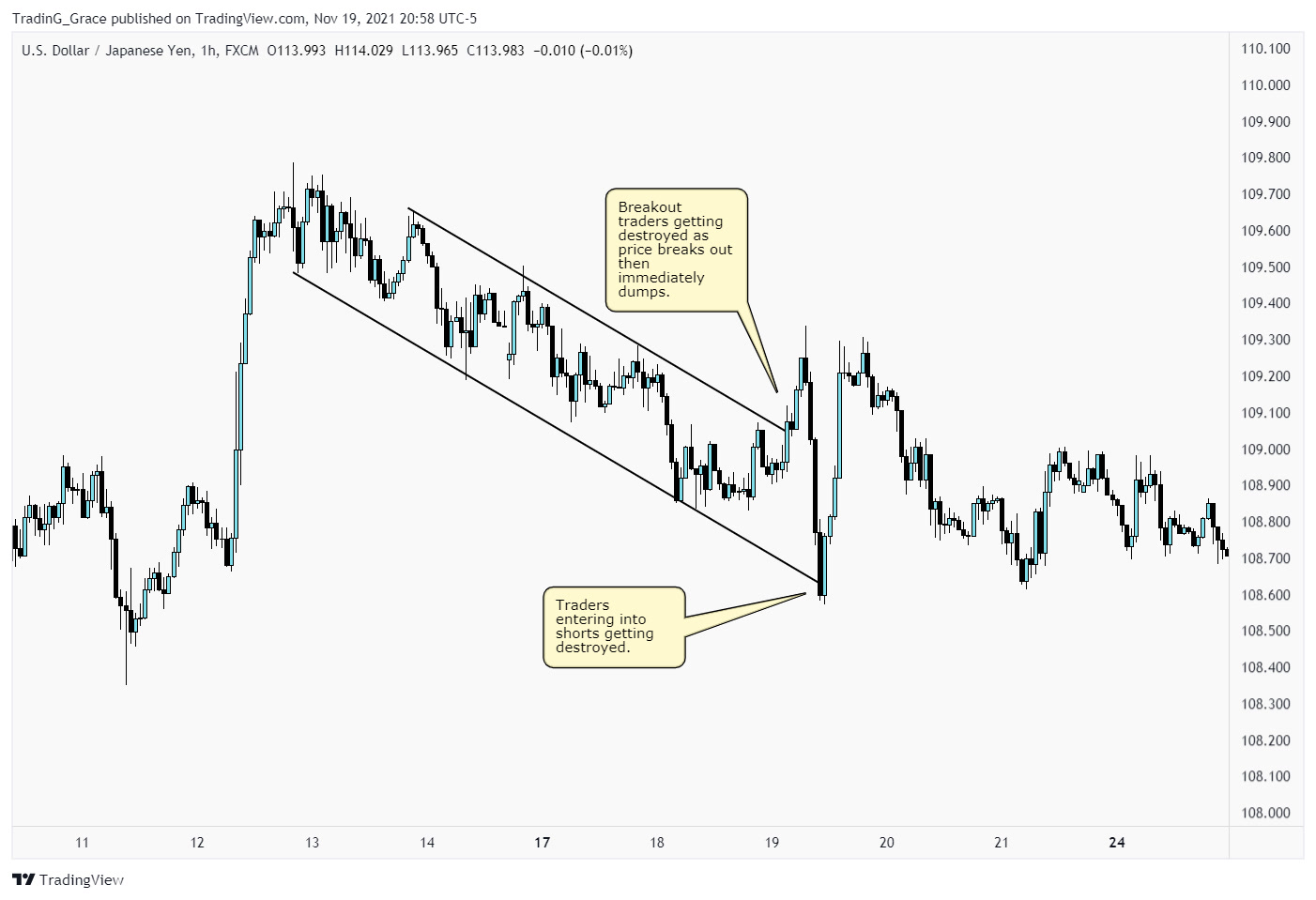
A common pattern I see: a trader's worst weeks aren't the volatile ones. They're the quiet weeks, where London open produces one clean setup and then nothing useful appears until the next day's New York session.
One way to catch this is to journal differently. Instead of just logging trades, log what you're doing when you're not in trades. Timestamped entries. Honest ones.
What often shows up is uncomfortable to read. Hours of so-called 'analysis' on slow days that, when you check the timestamps against your charts, turn out to be the same decision points revisited over and over. No new information. Just rechecking conclusions you'd already reached, looking for permission to act when the model is telling you to wait.
That kind of manufactured busyness is a coping mechanism dressed up as preparation.
And it's expensive. Because occasionally in that anxious scanning, you find something that looks like a setup. Not a real one. A plausible one. And plausible-in-a-restless-state is a dangerous filter.
A Worked Example
Here's what this looks like on a chart. Picture GBPUSD on the 15-minute. London opens with a solid displacement move to the upside, sweeps a clean equal high from the previous Friday, then stalls. No retracement into the imbalance. No mitigation of any significant order block. By mid-morning New York time, it's clear the day's setup either already happened or never presented itself in a way that matched the entry criteria.
The disciplined move is to close the charts. But say the trader stays at the desk. After an hour or so of watching, a small "demand zone" starts to look worth a shot as New York comes online. The narrative is coherent. The reasoning has all the right vocabulary. They go long with a tight stop and a bit more risk than usual because they feel "confident."
Price drifts sideways, then steps down through the stop. Not catastrophic. But looked at cold that evening, the setup is obviously substandard. The "demand zone" is three candles of consolidation: no displacement, no real imbalance, nothing they'd touch on someone else's chart. It was a manufactured reason to act because waiting had become intolerable.
That entry didn't come from the model. It came from a nervous system looking for relief.
The Reframe That Actually Worked
Here's the thing about telling yourself 'just be patient', it doesn't work, because it's fighting the nervous system directly. You can't out-willpower a biological threat response. What you can do is change what you're asking your brain to evaluate.
The shift I made was this: I stopped framing waiting as 'not trading' and started framing it as 'running the model at full fidelity.'
Instead of: I'm sitting here doing nothing while the market moves. I started asking: Is this moment a high-confluence, high-probability setup, yes or no?
The answer to that question is itself an action. It's a decision. It's the model working exactly as designed. And the critical insight is that outputting a 'no' is not nothing, it's the strategy executing correctly. ICT's framework is deliberately low-frequency. That's not a bug. The selectivity is the edge. Treating every 'no' as the model working means your nervous system gets to register activity and competence, not absence.
This is different from positive self-talk. It's a structural reframe about what constitutes 'doing your job.'
If You're Stuck in This Loop
Picture a trader who understands ICT concepts and can identify setups in hindsight with real accuracy, but whose live account keeps bleeding. Not from large losses. From lots of small ones. Entries that were 'close enough.' Setups that were 'basically there.'
Ask them to describe a typical slow-market morning and you hear the 1-minute chart rabbit hole, the redrawing, the second and third opinion setups. They frame all of it as diligence.
What helps is logging your attention in fifteen-minute blocks during market hours. What were you actually doing? For how long? Was it generating new information or revisiting old conclusions?
Once you can see the pattern, you can catch it in the moment: close the 1-minute chart, step away, and come back for the next session window. The good setups show up regardless. The difference is you haven't bled through three bad entries before they arrive. In my view, the psychological shift has to come first.
A Practical Framework for the Dead Hours
Here's exactly what I do, and what I walk students through, to handle the market hours when the model says 'not yet':
1. Define your session window in advance. For ICT-based trading, this typically means London open (2-5 AM EST) and New York open (7-10 AM EST) as primary windows. Outside of those windows, you're in observation mode by default, not evaluation mode. The decision is already made before you sit down.
2. Use the 'cold chart test' before any entry. Before you execute, screenshot your setup, close the chart, open it again after three minutes. If you can't immediately articulate why it's a valid entry based on what's visible, displacement, imbalance, liquidity sweep, premium/discount positioning, it isn't one. You can cross-reference our ICT Fair Value Gap checklist for the specific confirmations I use.
3. Journal your attention, not just your trades. Fifteen-minute timestamped entries on slow days. What were you doing? Was it new information? This single habit surfaces the anxiety-management patterns faster than any amount of reflective journaling after the fact.
4. Cap your timeframe minimum. During evaluation periods, I don't go below the 5-minute chart for entry refinement, and even that only after confirmation on 15-minute or higher. If you find yourself on the 1-minute 'just to check,' that's a nervous system alert, not a trading decision.
5. Position size properly so waiting doesn't feel existential. A lot of the desperation to trade comes from accounts sized in a way that makes every missed move feel catastrophic. Our risk calculator is free, use it. When each session's potential outcome is proportionate to your account, the urgency drops dramatically.
For context on how forced patience applies specifically to prop firm environments, where the pressure to 'perform' compounds everything, I'd recommend reading about the truth about funded trading and the 7 fatal mistakes that kill funded account challenges. The psychology I'm describing here sits behind a lot of the patterns discussed in those pieces.
The Counterintuitive Truth About Low-Frequency Models
Here's the thing that took me years to fully internalize, and that most ICT content creators don't say clearly enough: the high-confluence, low-frequency model is harder on your psychology than a high-frequency approach, not easier. A scalper who takes fifteen trades a day has fifteen opportunities to feel like they're engaging. They're scratching the nervous system itch constantly.
When you commit to waiting for genuine displacement into a real imbalance with confluence from multiple timeframes and proper liquidity context, as the Q2 2026 market structure analysis discusses, you might take two or three trades in a week. That's two or three moments of engagement in forty-plus hours of market hours. Your nervous system is going to rebel against that. Not because you lack discipline, but because it's doing its job.
The fix isn't more willpower. It's understanding the mechanism well enough to work around it, which, as it turns out, requires the same kind of precise, structured thinking that good trading requires in the first place. In my experience, trying to 'discipline your way' through patience wears thin over time, which is why a structural fix works better than willpower.
If this is where you are right now, intellectually clear on the model, but emotionally fighting it every slow morning, the answer isn't more chart time. It's a different kind of support.
Our coaching plans are built around exactly this intersection of technical clarity and psychological execution. Lite coaching at $150/week is a strong starting point if you need structured accountability without full immersion. If you're ready to go deeper, book a free discovery call and we'll figure out together which level of support actually fits where you are. No pressure. Just an honest conversation about what's getting in the way.
The market will give you good setups. The only question is whether you'll still be standing, and patient, when they arrive.
Harvest Wright
ICT Trading Coach · 10+ Years Experience
Harvest specializes in ICT methodology and has helped traders pass prop firm challenges, develop consistent strategies, and build the psychology needed for long-term profitability.
Book a Free Discovery Call →Ready to Get Funded?
1-on-1 ICT coaching built around prop firm rules, from a trader who has passed an FTMO Challenge.
Book a Free Discovery CallFree ICT Funded-Trader Playbook
The setups, the pre-trade checklist, and the risk rules I use. Get it free.